

You read the concept in a bestseller. You hear it parroted on productivity podcasts and see it baked into corporate training seminars. The premise sounds universally fair: log 10,000 hours of practice, and you will become an elite expert in any field, regardless of your starting point. But if you have spent years practicing a language, playing a sport, or writing code without hitting that world-class level, you already suspect something is missing. The rule is highly motivating, but it completely ignores the complex biological and psychological realities of how humans actually acquire skills.

Getting to the truth requires looking past the motivational speakers and examining the raw data.
Where the Myth Originated (And Where the Math Failed)
The 10,000-hour concept exploded into mainstream culture through Malcolm Gladwell’s 2008 book Outliers. To support his thesis, Gladwell cited a 1993 study by psychologist K. Anders Ericsson, which examined violin students at a Berlin music academy. Gladwell noted that by age 20, the elite performers had accumulated an average of 10,000 hours of practice. He then applied this average to everyone from the Beatles performing in Hamburg to Bill Gates programming in his teenage years.
Gladwell's powerful storytelling about these iconic figures is a key reason the idea became so popular. For a closer look at these and other compelling narratives from his book, explore some of its most famous examples.
When critical thinkers ask, is outliers accurate, the scientific community points directly to how this specific data was manipulated to fit a narrative.
First, 10,000 hours was merely an average. In Ericsson’s actual study, half of the elite violinists had not accumulated 10,000 hours by the time they reached the top tier. Some achieved mastery in a fraction of that time. Second, the violinists did not stop at 10,000 hours; it was simply the amount of time they had practiced by the arbitrary age of 20.

By stripping away these statistical nuances, the media created an illusion. The outliers criticism from the scientific community focuses heavily on this exact point: you cannot take an average from a highly specific, restricted sample size in classical music and market it as a universal law for business, sports, and art.
To truly understand where the 10,000-hour rule originated and how it captured the American imagination, it is worth reading the source material itself. While scientists have challenged its primary thesis, Malcolm Gladwell's bestseller remains a masterclass in storytelling and sociological observation. If you want to explore the fascinating anecdotes about tech billionaires, star athletes, and iconic bands that popularized this concept in the first place, picking up a copy will give you the full context behind the controversy.

Outliers
Malcolm Gladwell
 43 Duration
 8 Key Points
 4.5 Rate
The Core Conflict: Anders Ericsson vs Gladwell
The most damning evidence against the rule came from the original researcher himself. The gladwell outliers controversy is unique because it features the primary scientist openly refuting the journalist who made his work famous.
In the debate of anders ericsson vs gladwell, Ericsson argued that Gladwell entirely missed the mechanism of skill acquisition. Ericsson eventually co-authored the book Peak: Secrets from the New Science of Expertise specifically to correct the public record.
Ericsson pointed out two massive flaws in Gladwell's interpretation:
- Performance is not practice: Gladwell claimed the Beatles achieved their 10,000 hours by playing marathon shows in Hamburg clubs. Ericsson countered that playing a gig is performance, not practice. You are entertaining a crowd, playing songs you already know. You are not stopping to hyper-analyze a single chord transition for an hour under the watchful eye of a master teacher.
- Problem-solving is not practice: Gladwell pointed to Bill Gates programming for thousands of hours. Ericsson clarified that Gates was engaged in creative problem-solving and exploring new technical frontiers, not following a structured, historical curriculum of deliberate practice.
Gladwell sold a comforting story that effort equals success. Ericsson reported the harsh scientific reality: simply logging hours on an activity rarely makes you world-class.
If you want to dive deeper into Anders Ericsson’s actual research on what truly drives elite performance, his definitive book is a must-read. Co-authored to set the record straight after the media frenzy, this work breaks down the exact mechanisms of deliberate practice that create world-class experts. It is a fantastic resource for anyone looking to understand the hard science of skill acquisition, offering actionable frameworks to improve your own abilities without blindly logging thousands of hours.

Peak
Anders Ericsson and Robert Pool
48 Duration10 Key Points4.5 RateUnderstanding the nuances between Gladwell's storytelling and Ericsson's science is key. If you're short on time but want to grasp the core arguments from both Outliers and Peak, a book summary app can be a huge help.


LeapAhead

Get the main ideas from influential books like Outliers and Peak in 15-minute summaries, so you can quickly understand both sides of the 10,000-hour rule debate.
The Reality of Deliberate Practice
If just showing up and putting in the time worked, every person who has driven a car for twenty years would be ready for Formula 1. Instead, most people hit a plateau. They reach a level of "acceptable competence" where the skill becomes automatic, and their performance stops improving entirely.

To bypass this plateau, you need deliberate practice. This is a highly specific, exhausting framework that involves:
- A well-defined field: The field must have objective standards of performance (like chess, gymnastics, or classical piano).
- A qualified coach: You need someone who has already reached mastery to design your training and provide instant, corrective feedback.
- Targeted micro-goals: You do not just "practice piano for an hour." You spend 45 minutes fixing the fingering on a single, specific three-second measure that you are currently failing at.
- Constant discomfort: Deliberate practice requires operating just outside your current comfort zone.
Because of the intense cognitive load, humans can generally only sustain true deliberate practice for about one to three hours a day. Grinding for eight hours a day, as the 10,000-hour myth implies you can do, leads to mental fatigue, physical injury, and deeply ingrained bad habits.
Wondering how deliberate practice actually changes your brain chemistry? When you push through that uncomfortable cognitive strain, you are actively building myelin—the neural insulator that increases signal speed and strength. If you are looking for a deep dive into how targeted training creates undeniable biological advantages, this captivating read explores the exact neurological mechanics behind world-class talent hubs across the globe. It will completely reframe the way you view your daily practice sessions and help you maximize your time.
The Talent Code
Daniel Coyle
19 Duration8 Key Points4.6 RateThe 12% Reality: Why Deliberate Practice Isn't Enough
With the 10000 hour rule debunked, the natural next question is: if you do engage in perfect deliberate practice, will you become a master?
A landmark 2014 meta-analysis conducted by psychologist Brooke Macnamara and her colleagues shattered even Ericsson’s optimistic views on practice. By reviewing 88 previous studies on deliberate practice across various fields, Macnamara’s team found that deliberate practice accounted for a surprisingly low percentage of the variance in performance:
- Games (like chess): 26%
- Music: 21%
- Sports: 18%
- Education: 4%
- Professions: Less than 1%
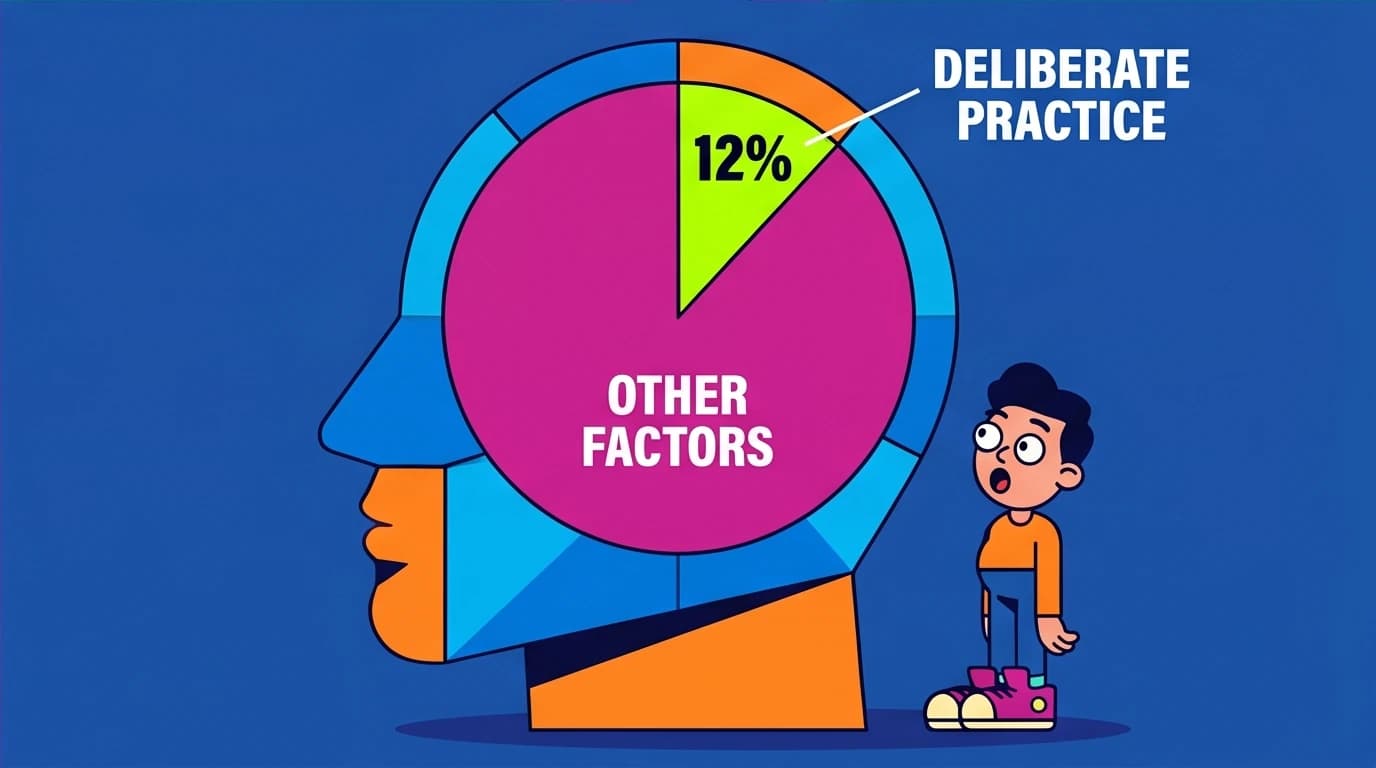
Across all domains, deliberate practice explained only about 12% of the difference between an elite performer and an average one. The remaining 88% is dictated by other factors.
This data completely re-writes the rulebook. It proves that while practice is absolutely necessary to reach your personal ceiling, it is not the sole variable that dictates where that ceiling is placed.
The Elephant in the Room: Genetics and Early Advantage
If practice only accounts for a fraction of elite performance, what makes up the rest?
The strongest critics of the 10,000-hour narrative point to biological realities. Innate talent and genetic predispositions are highly unpopular in self-help circles, but they are undeniable in science.
Physical Traits
No amount of deliberate practice will give you the baseline height required to be a competitive center in the NBA. You cannot practice your way into a higher percentage of fast-twitch muscle fibers required for Olympic sprinting.
Cognitive Traits
In intellectually demanding fields, working memory capacity plays a massive role. Working memory is the brain’s ability to hold and manipulate information in real-time. Studies show that individuals with higher baseline working memory capacity acquire complex skills, like sight-reading music or calculating chess variables, significantly faster than those with average capacity. A player with exceptional working memory might master a tactic in 50 hours; a player with average working memory might need 500 hours to reach the same proficiency.
Age of Acquisition
Neuroplasticity peaks in early childhood. Starting a complex skill—like a tonal language or the violin—at age four provides a structural advantage in brain development that a person starting at age twenty-five simply cannot replicate, regardless of how many hours the adult logs.
These factors—from innate talent to the year you were born—are exactly the kinds of hidden advantages that Gladwell explored in Outliers, even if his 10,000-hour conclusion was flawed. For a deeper dive into the fascinating combination of luck, timing, and hard work, our related article offers more insight.
Domain Dependency: Why "Business" Doesn't Follow the Rules
One of the most dangerous applications of the 10,000-hour rule is its misapplication to modern professions. You will frequently see entrepreneurs on LinkedIn or authors on Amazon claiming they are grinding out their 10,000 hours in "startups" or "leadership."
Skill acquisition heavily depends on the structure of the domain. Psychologist Robin Hogarth categorizes learning environments into two types: Kind and Wicked.
Kind Environments have clear rules, immediate and accurate feedback, and patterns that repeat identically. Chess, golf, and classical music are kind environments. In these fields, deliberate practice yields highly predictable results.
Wicked Environments have obscure rules, delayed or inaccurate feedback, and rapidly changing conditions. Business, investing, emergency room medicine, and software development are wicked environments. You cannot reliably apply the concept of deliberate practice to a startup because the market conditions change every single day. Logging hours in a wicked environment often reinforces the wrong lessons, making experience a liability rather than an asset.
The critical difference between kind and wicked learning environments is one of the most eye-opening concepts for modern professionals. If you are navigating an unpredictable industry like software development, finance, or entrepreneurship, you need a different set of tools than a classical musician. David Epstein’s groundbreaking work explores exactly why generalists—people who sample multiple fields and adapt quickly—tend to triumph in these complex, wicked domains. It is an incredibly validating read for anyone who has ever worried that they started a skill too late in life.

Range
David Epstein
16 Duration7 Key Points4.8 RateA Science-Based Framework for Skill Acquisition
Understanding that the 10,000-hour rule is a marketing fabrication frees you from the guilt of the stopwatch. Instead of blindly logging time, apply these evidence-based strategies to optimize how you learn:
- Audit the Environment First: Before committing time to a skill, determine if you are in a kind or wicked learning environment. If you want to learn Python, rely on structured practice. If you want to become a startup founder, prioritize rapid experimentation and adaptability over repetitive study.
- Optimize for Feedback, Not Time: A single hour of practice with a mentor who actively points out your flaws is worth fifty hours of practicing alone. Shorten your feedback loops.
- Align with Your Baseline: Stop fighting your biology. Lean into fields where your natural cognitive or physical traits provide a tailwind. Practice acts as a multiplier; you want to multiply your highest baseline numbers.
- Target the Edges: When you practice, you should feel a high degree of cognitive strain. If you are comfortable, you are performing, not practicing. You must continuously adjust the difficulty of your tasks so you are failing about 15% to 20% of the time.
Putting these principles into practice means continuously learning from the experts. For those who want to absorb the wisdom from books like Range and The Talent Code but can't fit dense reading into a busy schedule, an app designed for micro-learning can be a game-changer.
LeapAhead
Turn your commute or workout into a productive learning session by listening to the key insights from the best books on skill acquisition and deliberate practice.
True mastery is not a clock you punch. It is an exhausting, highly individualized intersection of genetic baseline, environmental timing, and intense, uncomfortable focus. Leave the 10,000-hour rule on the self-help shelf at Barnes & Noble, and start focusing on the quality of your repetitions instead of the quantity.
FAQ
Does practice still matter if the 10,000-hour rule is fake?
Absolutely. The debunking of the rule does not mean practice is useless. It simply means practice is a prerequisite, not a guarantee. You still need thousands of hours of highly focused work to reach your personal genetic and cognitive ceiling. The myth is the guarantee of world-class mastery, not the value of hard work itself.
Absolutely. The debunking of the rule does not mean practice is useless. It simply means practice is a prerequisite, not a guarantee. You still need thousands of hours of highly focused work to reach your personal genetic and cognitive ceiling. The myth is the guarantee of world-class mastery, not the value of hard work itself.
What did Malcolm Gladwell get wrong about the original violin study?
Gladwell took an average of the hours practiced by elite 20-year-old violinists (which happened to be roughly 10,000) and presented it as a mandatory threshold for success. He ignored that many reached elite status in far fewer hours, he ignored the critical role of innate talent, and he confused general "experience" (like playing in a rock band) with structured "deliberate practice."
Gladwell took an average of the hours practiced by elite 20-year-old violinists (which happened to be roughly 10,000) and presented it as a mandatory threshold for success. He ignored that many reached elite status in far fewer hours, he ignored the critical role of innate talent, and he confused general "experience" (like playing in a rock band) with structured "deliberate practice."
Can anyone become a master at anything with enough deliberate practice?
No. Scientific consensus shows that deliberate practice accounts for a relatively small percentage of the performance difference between individuals (often around 12% across all fields). Innate cognitive abilities (like working memory), physical genetics, starting age, and access to world-class coaching serve as hard limits on how far practice alone can take you.
No. Scientific consensus shows that deliberate practice accounts for a relatively small percentage of the performance difference between individuals (often around 12% across all fields). Innate cognitive abilities (like working memory), physical genetics, starting age, and access to world-class coaching serve as hard limits on how far practice alone can take you.
Why is it harder to apply deliberate practice to a career like business or marketing?
Fields like chess or music have stable, unchanging rules where feedback is immediate—if you hit the wrong key, you hear it instantly. Careers like business or investing exist in "wicked environments" where the rules constantly shift, human behavior is unpredictable, and feedback on a decision might take years to materialize. In these domains, adaptability and pattern recognition often outweigh repetitive mechanical practice.
Fields like chess or music have stable, unchanging rules where feedback is immediate—if you hit the wrong key, you hear it instantly. Careers like business or investing exist in "wicked environments" where the rules constantly shift, human behavior is unpredictable, and feedback on a decision might take years to materialize. In these domains, adaptability and pattern recognition often outweigh repetitive mechanical practice.