


You know Stephen Hawking's masterpiece is a must-read, but finding hours to sit down with a dense theoretical physics book simply does not fit into a busy schedule. You are likely commuting down the freeway, hitting the gym, or folding laundry. You want to absorb brilliant ideas, but you need your hands and eyes free.
The problem with consuming theoretical physics via audio is the lack of visual aids. There are no diagrams of light cones or collapsing stars to look at while you drive. You need a strategy to process this information effectively. Whether you want to dive into the unabridged narration or prefer a streamlined breakdown, here is exactly how to conquer this classic through your headphones.
The Unabridged Experience: Should You Listen to the Full Book?
When you decide to listen to a brief history of time, your first stop is usually a major retailer like Amazon’s Audible, Apple Books, or Google Play Books. You can also borrow it for free using your local library card through the Libby app.
The unabridged audiobook typically runs just under 10 hours. Narrated by professionals like John Sackville (on the most popular Audible edition), the delivery is clear, measured, and highly engaging.
The Pros of the Full Audiobook
- Hawking's True Voice: You get the author’s exact phrasing, dry wit, and philosophical musings intact. Hawking had a unique talent for explaining complex ideas with surprising humor.
- Deep Immersion: Spending 10 hours with the material allows your brain to slowly marinate in concepts like relativity and quantum mechanics.
The Cons and Challenges
The biggest hurdle is the "diagram deficit." Hawking wrote for a general audience, but he relied on occasional charts to explain concepts like the curvature of spacetime. When you listen while driving 65 miles per hour, your brain has to work overtime to visualize a four-dimensional universe. If your attention drifts for just two minutes to navigate traffic, you might miss a crucial step in the evolution of black holes.

This brings up a common question for new readers and listeners alike. For a more detailed look at the challenges and rewards of tackling this classic, explore our full review.
If you decide to dive into the complete, unabridged experience, you are in for a profound intellectual journey. Getting the actual audiobook is the best way to hear Stephen Hawking’s signature humor and groundbreaking theories exactly as he wrote them. It challenges you to stretch your imagination and visualize the cosmos in entirely new ways. Whether you are battling rush hour traffic or knocking out household chores, having this definitive classic in your audio library is a fantastic way to turn idle time into a masterclass on the universe.

A Brief History of Time
Stephen Hawking, PhD
 20 Duration
 8 Key Points
 4.6 Rate
The Alternative: Why an Audio Summary Might Be Better
If 10 hours of physics sounds like a recipe for a headache during your morning commute, you are not alone. Many auditory learners opt for a more compressed format.
A well-crafted a brief history of time audio summary distills the 250-page book into actionable, easy-to-understand bites. Platforms like Blinkist, Audible Originals, or even high-quality YouTube channels offer 15-to-30-minute audio digests.
When to Choose a Summary
- The 30-Minute Commuter: If your drive is short, picking up where you left off in a dense physics chapter can be disorienting. A summary provides a complete thought loop in one trip.
- The Prerequisite Listener: Many people listen to a summary before tackling the full audiobook. Understanding the broad strokes first makes the unabridged version significantly easier to follow.
- The Casual Enthusiast: If you just want to know what a black hole is and why time only moves forward, a summary delivers exactly what you need without the complex historical backstory of Newtonian physics.
LeapAhead: Microlearning for Complex Topics
Another excellent tool in this category is LeapAhead, a microlearning app designed specifically for this purpose. It offers 15-minute audio and text summaries of over 30,000 bestselling non-fiction books, including A Brief History of Time. What makes it particularly useful for a topic like theoretical physics is its multi-format approach. You can listen to the audio summary during your commute and later pull up visual infographics and mind maps within the app to help solidify abstract concepts like spacetime and black holes, directly addressing the "diagram deficit" of a purely auditory experience.
Of course, like any summary, it won't replace the depth and nuance of Hawking's full prose. It's designed for efficiency and retention of core ideas, not for academic study. For the busy professional who wants to understand the foundational concepts that changed our view of the universe without getting bogged down in complex proofs, LeapAhead presents a highly structured and accessible path.


Grasp the core ideas of Stephen Hawking's work and thousands of other non-fiction books in just 15 minutes. Perfect for the busy learner.
 LeapAhead
Finding a High-Quality Podcast Breakdown
If you do not want to pay for a premium subscription, search your favorite podcast app (Spotify, Apple Podcasts) for a stephen hawking podcast summary. Many science communicators and literature podcasters dedicate entire episodes to breaking down Hawking's book. These podcasts often feature conversational formats, making the dense subject matter feel like a fascinating chat with a smart friend. Look for episodes that explicitly promise chapter-by-chapter breakdowns or core takeaways.
If you love the idea of exploring the cosmos on your commute but want something specifically designed for short listening sessions, there are other fantastic options that do not require an audio summary. Some books are written perfectly for the busy commuter. Neil deGrasse Tyson crafted a brilliant guide to the universe that is broken down into bite-sized chapters. It is the perfect alternative if you want to understand the nature of space and time without feeling overwhelmed, giving you a complete cosmological education in the time it takes to drive to work and back.

Astrophysics for People in a Hurry
Neil deGrasse Tyson
17 Duration7 Key Points4.4 RateCore Concepts Translated for Your Ears
If you are looking for immediate a brief history of time takeaways audio, here is a cheat sheet of the massive concepts you will encounter. Keep these in mind, and the audiobook will make much more sense.
1. The Expanding Universe
Hawking spends a lot of time on Edwin Hubble’s discovery that galaxies are moving away from us. Imagine blowing up a balloon with dots drawn on it; as the balloon expands, every dot moves away from every other dot. That is our universe. In audio format, whenever Hawking mentions "redshift" or the "Doppler effect," just picture that expanding balloon.

2. General Relativity vs. Quantum Mechanics
This is the central conflict of the book. General relativity explains massive things (planets, stars, gravity). Quantum mechanics explains incredibly tiny things (atoms, subatomic particles). The problem? The two theories do not work together.

Hawking’s life mission was to find a "Theory of Everything" that unites them. Keep this grand conflict in mind; it is the backbone of the entire audiobook.
Hawking’s life mission was to find a "Theory of Everything" that unites them. Keep this grand conflict in mind; it is the backbone of the entire audiobook.
3. Black Holes Are Not Completely Black
This is Hawking’s most famous discovery. Due to complex quantum effects near the edge of a black hole (the event horizon), they actually emit a tiny amount of radiation. This is known as "Hawking Radiation." Eventually, over trillions of years, black holes evaporate and disappear.
4. The Arrow of Time
Why do we remember the past and not the future? Why does a shattered coffee cup never magically reassemble itself? Hawking explains this through the Second Law of Thermodynamics, which states that entropy (disorder) in an isolated system always increases. The universe moves from order to chaos, and that dictates the direction of time.
These foundational ideas are just the beginning. To truly appreciate how Hawking connects these theories, it's helpful to see them laid out in more detail.
Once you grasp these massive concepts, you might find yourself hungering for even more accessible science to fill your playlist. If Stephen Hawking’s deep dive into quantum mechanics leaves you curious about how the rest of our world came to be, you should expand your audio library. Bill Bryson offers an incredibly entertaining, narrative-driven exploration of science, from the Big Bang to the rise of civilization. It is a fantastic follow-up listen that keeps the complex science light, humorous, and incredibly engaging for those long stretches on the highway.
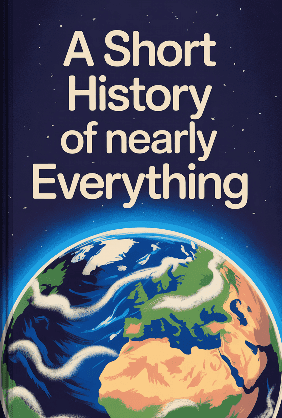
A Short History of Nearly Everything
Bill Bryson
24 Duration10 Key Points4.6 RateHow to Optimize Your Listening Experience
If you commit to the audio format, you need to set up your environment and your app for success. Listening to physics requires a different approach than listening to a true crime thriller.
Adjust the Playback Speed
Audiobook narrators usually read at a deliberate, conversational pace. While you might listen to business books at 1.5x speed, do not do this with Hawking. Keep it at 1.0x or even drop it to 0.9x if you find yourself struggling to process the concepts. Give your brain the extra fraction of a second to build mental models.
Audiobook narrators usually read at a deliberate, conversational pace. While you might listen to business books at 1.5x speed, do not do this with Hawking. Keep it at 1.0x or even drop it to 0.9x if you find yourself struggling to process the concepts. Give your brain the extra fraction of a second to build mental models.
Use the Bookmark/Clip Feature
Most audio apps like Audible have a clip or bookmark feature. When you hear a profound insight about the nature of time, tap that button. Reviewing your saved audio clips at the end of the week is a powerful way to lock the information into your long-term memory.
Most audio apps like Audible have a clip or bookmark feature. When you hear a profound insight about the nature of time, tap that button. Reviewing your saved audio clips at the end of the week is a powerful way to lock the information into your long-term memory.
Speaking of profound insights, bookmarking is a great way to capture the book's most memorable and thought-provoking statements. Many of Hawking's observations on the universe and our place in it are as powerful as they are educational.
Supplement with Visuals Later
Do not try to look up diagrams on your phone while listening on the go. Instead, let the audio wash over you and grasp the conceptual framework. Later, when you are sitting on your couch, spend five minutes Googling "light cones A Brief History of Time" or "Hawking radiation diagram." The visual will instantly snap the audio concepts into sharp focus.
Do not try to look up diagrams on your phone while listening on the go. Instead, let the audio wash over you and grasp the conceptual framework. Later, when you are sitting on your couch, spend five minutes Googling "light cones A Brief History of Time" or "Hawking radiation diagram." The visual will instantly snap the audio concepts into sharp focus.
Do Not Stress Over the Math
Hawking famously noted that every equation included in the book would halve its sales, so he only included one: Einstein's E=mc². Even so, the conceptual math can feel heavy. If a specific explanation about string theory or the uncertainty principle goes over your head, let it go. Keep listening. The broad philosophical takeaways are much more important than the granular physics details.
Hawking famously noted that every equation included in the book would halve its sales, so he only included one: Einstein's E=mc². Even so, the conceptual math can feel heavy. If a specific explanation about string theory or the uncertainty principle goes over your head, let it go. Keep listening. The broad philosophical takeaways are much more important than the granular physics details.
Building a routine where you actively listen to dense, educational content instead of just zoning out to music is a massive shift in your daily routine. If you want to permanently transform your commute into a mobile university, you need to cement this behavior. James Clear’s groundbreaking work on habit formation is the perfect resource to help you seamlessly integrate audiobook listening into your busy United States lifestyle. By applying small, incremental changes, you can effortlessly turn a simple morning drive into a powerful engine for lifelong learning and personal growth.

Atomic Habits
James Clear
26 Duration8 Key Points4.7 RateMaking the Final Decision
Choosing between the full a brief history of time audiobook and a streamlined audio summary comes down to your bandwidth. If you want a deep, challenging, and rewarding intellectual journey over the next couple of weeks, download the unabridged version from Audible or Apple Books.
Turn your commute into a learning opportunity. Listen to summaries of complex books like *A Brief History of Time* with LeapAhead.
LeapAheadIf you want the brilliance without the heavy lifting, seek out an audio summary or a dedicated podcast episode. Either way, you are taking a massive step toward understanding the fundamental nature of our universe, all while simply driving to work or walking the dog.
FAQ
Is the audiobook hard to follow without the physical book's diagrams?
It requires focus, but it is not impossible. The narrator’s pacing helps, and Hawking’s use of everyday analogies (like balloons and trains) translates well to audio. If you get confused, simply let the difficult parts pass and focus on the broader philosophical concepts. You can always look up specific diagrams online later.
It requires focus, but it is not impossible. The narrator’s pacing helps, and Hawking’s use of everyday analogies (like balloons and trains) translates well to audio. If you get confused, simply let the difficult parts pass and focus on the broader philosophical concepts. You can always look up specific diagrams online later.
How long does the unabridged audiobook take to listen to?
The standard unabridged English version runs for about 9 hours and 22 minutes. At a standard pace, a commuter driving 30 minutes each way will finish the book in roughly two weeks.
The standard unabridged English version runs for about 9 hours and 22 minutes. At a standard pace, a commuter driving 30 minutes each way will finish the book in roughly two weeks.
Can I get the audio version for free?
Yes. If you have a local library card in the US, you can download the Libby or Hoopla apps and borrow the audiobook digitally for free. Alternatively, new users on platforms like Audible often receive their first credit for free, which can be used to permanently acquire the book.
Yes. If you have a local library card in the US, you can download the Libby or Hoopla apps and borrow the audiobook digitally for free. Alternatively, new users on platforms like Audible often receive their first credit for free, which can be used to permanently acquire the book.
Does the audio format include updates from newer editions?
Most major audiobook retailers carry the updated editions (often labeled as the "Updated and Expanded Tenth Anniversary Edition"), which include a newer introduction by Hawking and a chapter on wormholes and time travel that was not in the original 1988 release. Always check the publication details before hitting download.
Most major audiobook retailers carry the updated editions (often labeled as the "Updated and Expanded Tenth Anniversary Edition"), which include a newer introduction by Hawking and a chapter on wormholes and time travel that was not in the original 1988 release. Always check the publication details before hitting download.