


You have probably heard the running joke. Stephen Hawking's groundbreaking book holds the unofficial title of the "most widely bought, least read book in history." It sits on countless bookshelves across the United States, acting more like an intellectual trophy than a well-worn paperback. You might be staring at a copy right now, browsing Amazon or standing in a Barnes & Noble aisle, wondering if you actually have the background to get through it without feeling completely lost.
The fear is justified. When astrophysics and quantum mechanics collide, the human brain naturally struggles. But letting its infamous reputation keep you from opening the cover means missing out on one of the greatest scientific translations of the 20th century.
Let's break down exactly what makes this book intimidating, what you can expect, and how to actually finish it without needing a PhD.
Understanding the A Brief History of Time Reading Level
If we look strictly at the vocabulary and sentence structure, the a brief history of time reading level hovers around a typical high school grade. Hawking was remarkably disciplined about keeping academic jargon to a bare minimum.
He famously wrote in the acknowledgments that his publisher warned him every equation included in the book would halve the sales. Taking that advice to heart, Hawking included exactly one equation in the entire text: Einstein's famous E = mc².
The difficulty of the book does not lie in the words themselves. It lies in the conceptual leaps. Hawking is asking you to visualize things that make no logical sense to our everyday human experience. He asks you to imagine space curving around a bowling ball, time moving slower the closer you get to the speed of light, and particles that exist in multiple places at once until you look at them.
Here is how the reading difficulty actually maps out as you progress through the book:
Chapters 1 to 3: The Smooth Sailing
The book starts incredibly well for the casual reader. Hawking walks you through the history of human understanding of the universe. You go from Aristotle to Galileo, then to Newton and Einstein. He uses brilliant, simple analogies. By the time he explains the expanding universe using the metaphor of drawing dots on a balloon and inflating it, you will feel like an astrophysics genius.
The book starts incredibly well for the casual reader. Hawking walks you through the history of human understanding of the universe. You go from Aristotle to Galileo, then to Newton and Einstein. He uses brilliant, simple analogies. By the time he explains the expanding universe using the metaphor of drawing dots on a balloon and inflating it, you will feel like an astrophysics genius.
Chapters 4 to 6: The Speed Bump
This is where the infamous "unread bestseller" reputation is born. Hawking introduces quantum mechanics, the uncertainty principle, and the behavior of subatomic particles (quarks, gluons). The human brain is not wired to easily understand things that behave differently depending on whether they are being observed. Many readers put the book down here.
This is where the infamous "unread bestseller" reputation is born. Hawking introduces quantum mechanics, the uncertainty principle, and the behavior of subatomic particles (quarks, gluons). The human brain is not wired to easily understand things that behave differently depending on whether they are being observed. Many readers put the book down here.
If the thought of hitting that quantum mechanics wall is what's stopping you, there's a way to grasp Hawking's brilliant ideas without getting bogged down in the complex physics.


This app breaks down the core concepts of dense books like A Brief History of Time into short, easy-to-understand summaries you can read or listen to in minutes.
 LeapAhead
Chapters 7 to 11: The Deep Water
Here, we enter Hawking's specialty: black holes, the Big Bang, string theory, and the nature of time itself (the "arrow of time"). The concepts here are incredibly dense. You will read a paragraph, understand the individual words, but might need to stare at the wall for ten minutes to comprehend the actual meaning.
Here, we enter Hawking's specialty: black holes, the Big Bang, string theory, and the nature of time itself (the "arrow of time"). The concepts here are incredibly dense. You will read a paragraph, understand the individual words, but might need to stare at the wall for ten minutes to comprehend the actual meaning.
To help navigate these mind-bending topics, it's useful to have a clear understanding of the core principles before you dive in.

Before you dive into the deep end of quantum mechanics, you need the actual book in your hands. If reading about Hawking's genius has inspired you to finally tackle this legendary bestseller, there is no better time to start. Whether you choose to read a few pages before bed or study it like a college course, owning a copy of this foundational text is a must for anyone curious about how the universe actually works.

A Brief History of Time
Stephen Hawking, PhD
 20 Duration
 8 Key Points
 4.6 Rate
Is A Brief History of Time Outdated Today?
Before committing your time, you likely have a very practical question: is a brief history of time outdated? The book was published in 1988. Since then, the Hubble Space Telescope was launched, the James Webb Space Telescope revolutionized our view of deep space, the Higgs boson was discovered, and we finally detected gravitational waves.
Has modern science left Hawking's masterpiece behind?
The short answer is no. The long answer is that it serves as an impeccable foundation, but lacks the latest updates in the scientific patch notes.
Here is what still holds up perfectly today:
- General Relativity and Gravity: Einstein's theories are still the gold standard for understanding large-scale cosmic mechanics. Hawking's explanation of these concepts remains one of the best ever put to paper.
- The Big Bang Theory: The fundamental mechanics of how the universe began and continues to expand are still the accepted consensus.
- Black Hole Thermodynamics: Hawking radiation—the theory that black holes actually emit energy and slowly evaporate—is still a cornerstone of theoretical physics.
Here is what is missing or slightly behind the times:
- The Higgs Boson: Hawking famously bet $100 that the Higgs boson (the "God particle" that gives other particles mass) would never be found. He lost that bet in 2012 when CERN discovered it.
- Gravitational Waves: While predicted by Einstein, these ripples in spacetime weren't actually detected until 2015 by the LIGO observatory.
- Dark Energy: In 1998, a decade after the book was published, scientists discovered that the universe's expansion is actually accelerating due to a mysterious force called dark energy. Hawking touches on the expansion, but the dark energy revelation fundamentally changed modern cosmology.
Reading this book today is like reading the original U.S. Constitution. The core rules of the game are perfectly intact, even if a few new amendments have been added since it was written.

Because Hawking’s original work was published before major modern discoveries like the Higgs boson and the confirmation of gravitational waves, you might find yourself hungry for a more current perspective on theoretical physics. If you want to explore the modern quest to tie all these cosmic rules together into a single "theory of everything," acclaimed physicist Michio Kaku picks up exactly where Einstein and Hawking left off, making complex string theory surprisingly accessible for everyday readers.

The God Equation
Michio Kaku
44 Duration8 Key Points4.3 RateAn Honest A Brief History of Time Review for Beginners
If we were to write an objective a brief history of time review strictly for the non-scientist, it requires separating the brilliance of the author from the reality of the reading experience.
The Brilliance:
Hawking's greatest gift wasn't just his mathematical mind; it was his dry, distinctly British sense of humor. He approaches the most terrifying concepts in the universe—like falling into a black hole—with a lightheartedness that instantly puts you at ease. He uses relatable examples, like playing ping-pong on a moving train, to explain relative motion. He strips away the elitism of theoretical physics and hands it to the masses.
Hawking's greatest gift wasn't just his mathematical mind; it was his dry, distinctly British sense of humor. He approaches the most terrifying concepts in the universe—like falling into a black hole—with a lightheartedness that instantly puts you at ease. He uses relatable examples, like playing ping-pong on a moving train, to explain relative motion. He strips away the elitism of theoretical physics and hands it to the masses.
The Frustration:
Hawking suffered from the "curse of knowledge." When you are one of the smartest human beings to ever live, things that seem obvious to you are mind-bending to everyone else. Occasionally, he will write sentences like, "It then naturally follows that..." and present a conclusion that leaves the average reader completely baffled as to how he got from Point A to Point B.
Hawking suffered from the "curse of knowledge." When you are one of the smartest human beings to ever live, things that seem obvious to you are mind-bending to everyone else. Occasionally, he will write sentences like, "It then naturally follows that..." and present a conclusion that leaves the average reader completely baffled as to how he got from Point A to Point B.
He tries his best to hold your hand, but around Chapter 5, he starts walking faster, and you have to sprint to keep up.
Beyond the challenging science, the book is filled with Hawking's unique personality and wisdom, much of which has become legendary in its own right.
Should I Read A Brief History of Time?
If you are currently asking yourself, should I read a brief history of time, base your decision on your goals and your patience level.
You should definitely read it if:
- You want a historical baseline of how humanity figured out the mechanics of the universe.
- You enjoy having your mind bent by abstract concepts like time travel, wormholes, and multiple dimensions.
- You are okay with not understanding 100% of the material on the first pass.
You should skip it or look elsewhere if:
- You are looking for a highly visual, modern, and rapid-fire summary of space. (If this is you, pick up Neil deGrasse Tyson's Astrophysics for People in a Hurry instead).
- You get easily frustrated when you have to re-read a paragraph multiple times to grasp its meaning.
- You want the absolute most current data on string theory and quantum computing from the 2020s.
As noted earlier, Stephen Hawking’s deep dive isn't the only way to explore the stars. If you are looking for that highly visual, rapid-fire summary of space, Neil deGrasse Tyson has you covered. His approach strips away the dense academic layers and delivers mind-blowing cosmic truths in quick, digestible chapters. It is the perfect read for your morning commute or your lunch break, offering a spectacular view of the universe without the headache of theoretical physics.

Astrophysics for People in a Hurry
Neil deGrasse Tyson
17 Duration7 Key Points4.4 RateThe Survival Guide: How to Actually Finish the Book

If you decide to take the plunge, do not just open to page one and try to power through. You will hit the Chapter 4 wall and give up. Use these specific strategies to make it to the end.
1. Leverage Audiobooks
This is a game-changer for dense material. Getting the book on Audible and listening to it while commuting, driving, or doing household chores bypasses the intimidation factor of the printed page. When you just let the concepts wash over you through audio, the complex quantum mechanics feel more like a fascinating podcast than a homework assignment.
This is a game-changer for dense material. Getting the book on Audible and listening to it while commuting, driving, or doing household chores bypasses the intimidation factor of the printed page. When you just let the concepts wash over you through audio, the complex quantum mechanics feel more like a fascinating podcast than a homework assignment.
If the audio format sounds like the right approach for you, it's worth exploring the specific benefits and what to expect from the narration.
2. Give Yourself Permission to Skip the Weeds
When Hawking starts diving deep into the exact differences between up-quarks, down-quarks, and strange-quarks, just let it go. You do not need to memorize particle physics to understand the grand narrative of the book. Grasp the main point—that the universe is made of incredibly tiny, unpredictable building blocks—and move on to the next chapter.
When Hawking starts diving deep into the exact differences between up-quarks, down-quarks, and strange-quarks, just let it go. You do not need to memorize particle physics to understand the grand narrative of the book. Grasp the main point—that the universe is made of incredibly tiny, unpredictable building blocks—and move on to the next chapter.
3. Use Visual Aids
Hawking’s text is great, but human brains love pictures. Keep your phone handy. When he mentions the "light cone" of an event or the curvature of spacetime, pull up a 3-minute animated YouTube video explaining it. Seeing a visual animation of spacetime curving will instantly lock the concept into your brain far better than reading text alone.
Hawking’s text is great, but human brains love pictures. Keep your phone handy. When he mentions the "light cone" of an event or the curvature of spacetime, pull up a 3-minute animated YouTube video explaining it. Seeing a visual animation of spacetime curving will instantly lock the concept into your brain far better than reading text alone.
4. Read the Illustrated Edition
If you haven't bought the book yet, do not buy the standard paperback. Seek out The Illustrated A Brief History of Time. Released years later, this version contains hundreds of full-color diagrams, charts, and photographs that perfectly bridge the gap between Hawking's text and your visual imagination.
If you haven't bought the book yet, do not buy the standard paperback. Seek out The Illustrated A Brief History of Time. Released years later, this version contains hundreds of full-color diagrams, charts, and photographs that perfectly bridge the gap between Hawking's text and your visual imagination.
Even with audiobooks and YouTube videos, pure astrophysics isn't for everyone. If you love the idea of learning how our universe came to be but want an approach that feels less like a physics lecture and more like a witty conversation with a brilliant friend, you should consider broadening your scope. Bill Bryson takes the intimidating history of the cosmos, the Earth, and humanity itself, and spins it into one of the most entertaining, laugh-out-loud science books ever published.
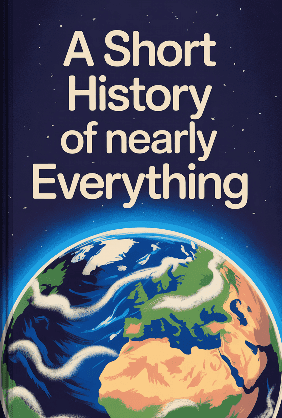
A Short History of Nearly Everything
Bill Bryson
24 Duration10 Key Points4.6 RateUltimately, if even these survival tips feel like a heavy lift for your busy schedule, you can still absorb the key takeaways from this and other classic non-fiction books.
Perfect for busy minds, this app delivers the essential insights from must-read books, helping you clear your 'to-read' list on your commute or during a workout.
LeapAheadFAQ
Do I need to be good at math to understand this book?
Not at all. There is only one equation (E = mc²) in the entire book. Hawking intentionally removed the math to focus entirely on concepts. You need a good imagination and basic logic, not calculus.
Not at all. There is only one equation (E = mc²) in the entire book. Hawking intentionally removed the math to focus entirely on concepts. You need a good imagination and basic logic, not calculus.
How long does it take the average person to read?
The book is relatively short—around 250 pages depending on the edition. An average reader could technically get through the word count in 6 to 8 hours. However, because the concepts are so dense, expect to spend 10 to 12 hours digesting it over a couple of weeks.
The book is relatively short—around 250 pages depending on the edition. An average reader could technically get through the word count in 6 to 8 hours. However, because the concepts are so dense, expect to spend 10 to 12 hours digesting it over a couple of weeks.
I tried reading it and got completely lost around Chapter 4. Is there an easier alternative?
Yes. Years later, Hawking recognized that the original book was still too tough for many readers. He co-authored A Briefer History of Time with Leonard Mlodinow in 2005. It updates some of the science, drops the most confusing technical details, and is significantly easier to digest.
Yes. Years later, Hawking recognized that the original book was still too tough for many readers. He co-authored A Briefer History of Time with Leonard Mlodinow in 2005. It updates some of the science, drops the most confusing technical details, and is significantly easier to digest.
Are the theories in the book proven facts?
Some are, some are not. Concepts like relativity and the expansion of the universe are proven and observable. Other concepts, like string theory, wormholes, and what exactly happens at the center of a black hole (the singularity), remain highly theoretical and are still debated by physicists today.
Some are, some are not. Concepts like relativity and the expansion of the universe are proven and observable. Other concepts, like string theory, wormholes, and what exactly happens at the center of a black hole (the singularity), remain highly theoretical and are still debated by physicists today.