


You wake up, brew your coffee, sit in traffic for ten miles, stare at a screen for eight hours, drive home, pay bills, sleep, and do it all over again. One day, the alarm goes off, and a single question pierces through the routine: "What is the point of all this?"
That exact moment of hesitation—when the stage sets of daily life collapse and you are left staring at the raw, unfiltered reality of existence—is where Albert Camus begins. He did not write for academics locked in ivory towers. He wrote for the everyday person standing on a train platform, wondering why they are going to work. If you are trying to figure out how to live in a world that refuses to offer easy answers, Camus provides one of the most resilient mental frameworks ever designed.
What is Absurdism? The Core Conflict
To understand the core of this worldview, we must define what is absurdism.
In everyday American English, we use the word "absurd" to describe something silly or ridiculous. In the philosophy of the absurd, it has a very specific, almost mathematical definition. The Absurd is not the universe itself, nor is it the human being. The Absurd is the friction between two unyielding forces:
- The Human Demand: Our desperate, biological need for order, meaning, and a clear reason for existing.
- The Unreasonable Silence of the World: The universe's complete indifference to that demand.
You shout into the void, asking for your life's purpose, and the void echoes nothing back. That silence is deafening. The realization that the universe does not care if you get a promotion, pay off your mortgage, or exist at all is terrifying.

For many thinkers, this realization leads to absolute despair or nihilism. Camus looked at this terrifying void and decided it was the perfect place to start living.
Albert Camus Beliefs: Three Responses to the Absurd
When a person realizes life has no inherent meaning, they are forced to make a choice. In his landmark essay The Myth of Sisyphus, Camus outlines three potential responses to the human predicament. The first two he fiercely rejects as forms of escape; the third is the foundation of Albert Camus beliefs.
1. Physical Suicide (The Coward's Way Out)
If life is meaningless and full of suffering, why not just end it? Camus addresses this head-on, famously stating that suicide is the only truly serious philosophical problem. However, he concludes that physical suicide is a failure. It is a surrender. By killing yourself, you do not solve the problem of the Absurd; you merely eliminate one side of the equation (yourself). It is a total concession to the meaningless of the world.
2. Philosophical Suicide (The Leap of Faith)
If physical suicide is abandoning the body, philosophical suicide is abandoning the mind. This occurs when someone takes a "leap of faith" to escape the anxiety of the unknown. They adopt a rigid religion, a dogmatic political ideology, or a spiritual belief system that promises a grand plan or an afterlife. Camus argued that relying on an invisible safety net forces you to ignore the reality in front of you. You stop living in this world and start waiting for the next one. He rejected this as intellectual cowardice.
3. Acceptance and Rebellion (The Absurd Hero)
The third option—and the only valid path for Camus—is to stare directly into the void, acknowledge the Absurd, and stay alive to rebel against it. You accept that there is no grand design, no divine script, and no afterlife waiting to reward you. You realize that this life is all you have. Rather than crushing you, this realization should act as an ultimate liberator. You rebel not by starting a war, but by choosing to live with exhausting intensity right here, right now.

The Myth of Sisyphus: Embracing the Boulder
To illustrate this rebellion, Camus turned to Greek mythology and the figure of Sisyphus. The gods condemned Sisyphus to a horrific punishment: he had to push a massive boulder to the top of a mountain, only to watch it roll back down to the bottom. He was forced to repeat this useless, agonizing task for all eternity.
Sisyphus is the ultimate representation of the human condition. We are all pushing our own boulders. Your boulder might be your commute, your overflowing email inbox, a chronic illness, or the endless cycle of paying taxes and buying groceries. The tasks often feel futile.
But Camus asks us to focus on Sisyphus during his walk back down the mountain. In that moment of pause, as he descends to retrieve his rock, Sisyphus is entirely aware of his wretched condition. He knows his labor is pointless. Yet, he decides to push the rock anyway. He owns his labor. He owns his fate.
Camus famously concludes, "The struggle itself toward the heights is enough to fill a man's heart. One must imagine Sisyphus happy."

He is happy because he has accepted his reality and refuses to let the gods break his spirit. His rebellion is his joy.
Camus's interpretation of this ancient myth is the very heart of his philosophy. For a more detailed exploration of his arguments in that seminal essay, we have a comprehensive summary.
If you're ready to dive deeper into the very foundation of absurdism, there is no better starting point than Camus's own defining essay on the subject. While reading philosophy can sometimes feel like a daunting homework assignment, Camus writes with a poetic, fiery passion that feels surprisingly modern. The Myth of Sisyphus completely unpacks why we struggle with finding our purpose and lays out his exact blueprint for rebelling against a silent universe. It’s a brilliant, thought-provoking read that might just change the way you view your daily grind.
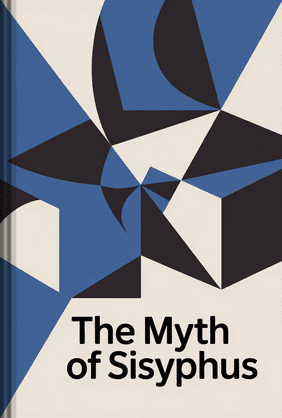
The Myth of Sisyphus
Albert Camus
 49 Duration
 8 Key Points
 4.5 Rate
If the idea of diving into complex philosophical texts feels a bit heavy, you're not alone. Sometimes, getting a clear overview of the core concepts first can make the full read much more rewarding.

Grasp the key ideas from profound philosophical works like The Myth of Sisyphus in just 15 minutes, making complex theories accessible for your daily life.

Download LeapAhead App now
Camus Existentialism: Why He Hated the Label
If you browse the philosophy section at a Barnes & Noble, you will almost certainly find Camus shelved next to Jean-Paul Sartre under the banner of Existentialism. The irony is that Camus vehemently rejected this label during his lifetime.
While they shared common ground—both were French intellectuals operating in Paris during and after World War II, and both rejected traditional religious meaning—the distinction between Camus existentialism and Sartre’s philosophy is critical to understanding the man.
Sartre believed that "existence precedes essence." This means humans are born as blank slates and must actively invent their own meaning and purpose through their choices. Sartre’s view is heavily intellectual, focusing on human freedom and the anxiety of creating your own identity.
Camus, on the other hand, did not believe we could construct a lasting, objective meaning. To him, trying to build a personal meaning to replace a divine one was just another form of philosophical suicide. You cannot invent a meaning that the universe will respect. The world remains absurd regardless of how you define yourself.
Instead of creating meaning, Camus advocated for living without it. He was a Mediterranean thinker—a man who grew up in the harsh sun and poverty of Algiers, who loved playing soccer, swimming in the sea, and breathing in the physical world. For Camus, philosophy was not about sitting in a smoky Parisian café debating abstract concepts; it was about feeling the sand between your toes, tasting a good meal, and cherishing the brief, fleeting moments of physical existence.
The subtle but crucial differences between Camus and his contemporaries like Sartre are a cornerstone of 20th-century philosophy. To explore these distinctions in greater detail, see our full comparison.
While Camus believed in living fiercely without inherent meaning, other existential thinkers took a slightly different path when faced with unimaginable suffering. If you are fascinated by the human drive to find purpose in the darkest of places, Viktor Frankl’s psychological masterpiece is absolute required reading. Written by a psychiatrist who survived the Holocaust, this profound book explores how identifying a personal purpose can help us endure almost any hardship. It offers a fascinating counter-perspective to Camus, showing how different minds wrestle with the exact same questions of human survival and meaning.
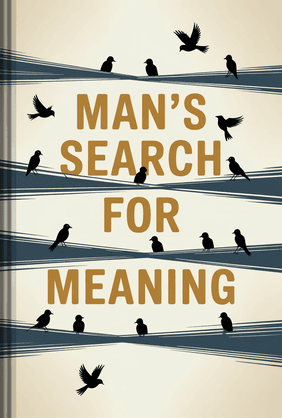
Man's Search for Meaning
Viktor E. Frankl
44 Duration8 Key Points4.6 RateApplying the Philosophy of the Absurd to Modern Life
Understanding the philosophy of the absurd is one thing; putting it into practice in a 21st-century American context is another. How do you live as an absurd hero when you are facing economic inflation, algorithmic social media doom-scrolling, and corporate burnout?
Camus outlined three consequences of accepting the Absurd: Revolt, Freedom, and Passion. Here is how they translate into everyday actions.
1. Revolt: Stop Waiting for Tomorrow
We spend most of our lives living in the future tense. We tell ourselves, "I will be happy when I graduate," "I will relax when I hit this salary," or "Things will make sense when I retire." Camus views this as a tragedy. Revolt means completely abandoning the illusion of tomorrow.
Revolt is recognizing that a perfectly ordered future will never arrive. The world will always be chaotic. True rebellion is choosing to find joy in the present mess. Drink your morning coffee with total awareness. Feel the heat of the mug. Notice the changing colors of the leaves on your street. Refuse to let the daily grind numb you to the sensory experience of being alive right now.
2. Freedom: Drop the Heavy Scripts
Because there is no inherent meaning to the universe, there is no predetermined destiny you are failing to achieve. You are not "falling behind" because there is no track to fall behind on.
This realization provides immense psychological freedom. If you have been carrying the weight of parental expectations, societal pressures, or your own rigid ideas of what your life "should" look like, you have permission to put that boulder down. You are free to change your mind, change your career, or simply exist without having to justify your presence with constant productivity.
Letting go of the relentless pressure to be perfectly productive is easier said than done, especially in our hyper-connected, hustle-obsessed culture. If you find yourself completely burned out by endless to-do lists and the anxiety of trying to optimize every single minute, Oliver Burkeman’s eye-opening book offers a much-needed reality check. He applies a very similar, almost absurdist philosophical lens to modern time management, reminding us that our time is short, we can't do it all, and that’s actually incredibly liberating. It’s the perfect modern companion to dropping those heavy scripts.
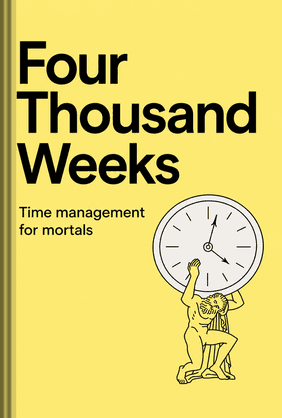
Four Thousand Weeks
Oliver Burkeman
36 Duration7 Key Points4.6 Rate3. Passion: Maximize the Experience
Since life is temporary and death is inevitable, the goal is not to live the "best" life according to some moral checklist, but to live the most life. Camus advocated for a life of passion, which means maximizing the quantity and intensity of your experiences.
This does not necessarily mean skydiving or traveling the globe. It means being fully engaged with whatever is in front of you. Whether you are reading a book, arguing with a friend, walking your dog in the freezing rain, or organizing your garage—do it fully. Do not sleepwalk through your routine. An absurd hero pays attention.
Finding Your Smile at the Bottom of the Mountain
Albert Camus does not offer comfortable lies. He does not promise that everything happens for a reason. He does not guarantee that your suffering will eventually make sense. He strips away every illusion we use to shield ourselves from the harshness of reality.
But in doing so, he offers something far more durable: resilience. By embracing the philosophy of the absurd, you become unbreakable. When life inevitably knocks you down, you do not waste time asking the sky, "Why me?" You already know the sky has no answers. Instead, you wipe the dust off, smile at the absurdity of it all, and put your hands back on your boulder.
Life is meaningless. That is precisely why it is worth living.
If this introduction to Camus's thought has sparked your interest, the next step is to dive into his literary works. From novels to essays, his writings offer a powerful and accessible entry into his worldview.
Embracing the absurd isn't about being apathetic; it’s about choosing what actually deserves your energy and letting go of the rest. If Camus’s philosophy resonates with you but you want a punchy, modern take on ditching societal expectations, Mark Manson’s breakout bestseller hits all the right notes. It strips away the toxic positivity that clutters up the self-help aisle and delivers a grounded, no-nonsense approach to living a better life. It will teach you how to stare down life's inevitable struggles, figure out what truly matters to you, and happily ignore the noise.

The Subtle Art of Not Giving a F*ck
Mark Manson
26 Duration9 Key Points4.6 RateFAQ
Was Albert Camus a nihilist?
No. This is a very common misconception. While nihilism concludes that because life has no meaning, nothing matters, Camus argued the exact opposite. He believed that the lack of inherent meaning is a starting point, not an end. Rather than sinking into nihilistic apathy, Camus urged us to rebel against the meaninglessness by living passionately, loving deeply, and fighting against injustice. He was a champion of human dignity and solidarity, which fundamentally separates him from nihilism.
Did Albert Camus believe in God?
Camus did not believe in God. He considered himself an atheist, but he was not hostile toward individuals who held religious beliefs. However, from a philosophical standpoint, he rejected religion because it relies on a "leap of faith" to resolve the problem of human suffering and meaning. He believed we must confront the reality of our finite existence here on Earth without holding out hope for a divine afterlife or cosmic justice.
What is the best Albert Camus book for beginners?
If you want to start exploring his work, the best starting point is The Stranger. It is a short, gripping novel that introduces his ideas through the story of Meursault, a man who refuses to conform to society's emotional expectations. You can easily find it at Barnes & Noble, order a physical copy on Amazon, or grab the audiobook on Audible. After reading The Stranger, move on to his essay The Myth of Sisyphus to get the direct, non-fiction breakdown of his philosophical framework.
How does absurdism help with burnout and anxiety?
Absurdism acts as a pressure release valve. Much of modern anxiety comes from the belief that you must find a singular "purpose" in life or achieve specific milestones to be valid. Absurdism tells you that the universe keeps no score. It lowers the stakes. When you realize that your career, your failures, and your societal status are ultimately absurd, it frees you to stop agonizing over perfection and simply start enjoying the everyday process of living.