

You just turned the last page of Yuval Noah Harari’s masterpiece, and now you have a massive reading hangover. Standard history texts suddenly feel narrow. You want another macro-level narrative that connects biology, money, religion, and human behavior. Figuring out what to read after Sapiens is tricky. You want that exact same thrill of seeing the world through a completely new lens, but you definitely do not want to slog through a dry academic textbook.
You need books that hit the sweet spot between deep science and brilliant storytelling. Here is a curated guide to the best reads that match Harari’s ambitious scope.
The Logical Next Step: Sapiens vs Homo Deus
Before branching out to other authors, you have an immediate decision to make regarding Harari’s sequel. Many readers debate the Sapiens vs Homo Deus progression and whether it makes sense to read them back-to-back.
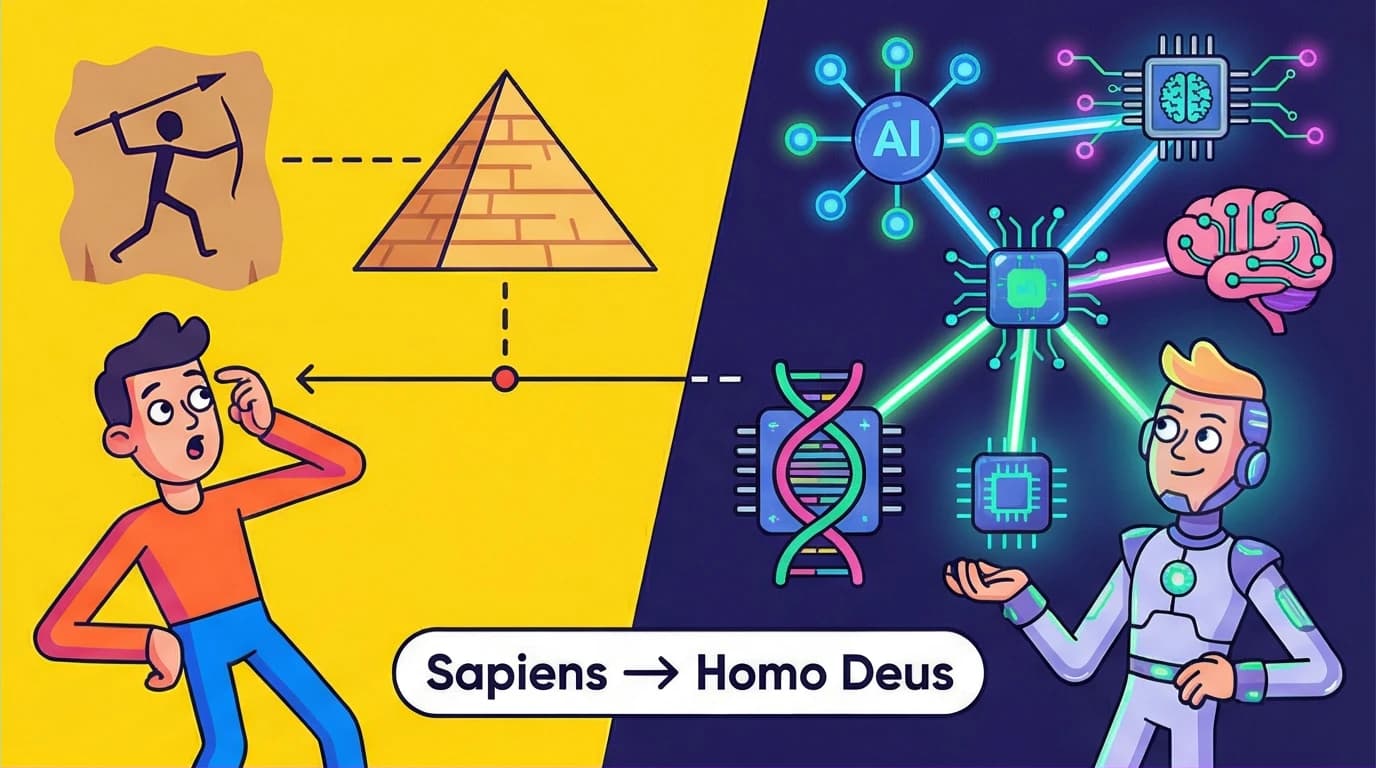
Sapiens looks backward. It explains how a totally average ape managed to dominate the planet through the cognitive revolution and our unique ability to believe in shared fictions (like money, borders, and corporations).
Homo Deus: A Brief History of Tomorrow looks forward. It asks a terrifying but necessary question: Now that we have largely conquered famine, plague, and war, what exactly are we going to do with ourselves? Harari argues that humans will strive to upgrade themselves into gods (Homo Deus) using biotechnology and artificial intelligence.
Should you read it immediately? Yes, if you are fascinated by the tech-driven future and the concept of "Dataism." However, Homo Deus is noticeably darker and more speculative than its predecessor. If you need a break from Harari’s distinct voice, add it to your Goodreads shelf for later and pick a different title from the lists below.
Before jumping into the future with Homo Deus, you might want to spend more time with the core ideas that made Sapiens so groundbreaking.
If you are absolutely hooked on Yuval Noah Harari's sweeping narrative style and want to dive straight into his predictions for the future of humanity, grabbing a copy of this sequel is your smartest next move. While Sapiens explains how we arrived at our current civilization, this follow-up will make you rethink where our algorithms and biotechnology are leading us next. It is a brilliant, provocative read that challenges what it means to be human in the twenty-first century.

Homo Deus
Prof. Yuval Noah Harari
 41 Duration
 8 Key Points
 4.5 Rate
The Best Books on Human History and Civilization
If the sweeping timeline of the Agricultural and Industrial Revolutions was your favorite part of Harari’s work, you need more "Big History." These are widely considered the best books on human history for readers who want massive geographic and temporal scope.
1. Guns, Germs, and Steel by Jared Diamond
The Core Premise: Why did Eurasians conquer the world instead of Native Americans or Africans? Diamond argues it had absolutely nothing to do with genetics or intellect, and everything to do with geography. The orientation of the continents, the availability of domesticable animals, and the types of native crops dictated the fate of human societies.
Why Sapiens Fans Will Love It: Harari cites Diamond as a major inspiration. This book provides the raw, physical mechanics behind the rise of empires that Sapiens touched upon. It is a Pulitzer Prize winner and an absolute essential for your bookshelf.
Why Sapiens Fans Will Love It: Harari cites Diamond as a major inspiration. This book provides the raw, physical mechanics behind the rise of empires that Sapiens touched upon. It is a Pulitzer Prize winner and an absolute essential for your bookshelf.
Ready to explore the geographic lottery that shaped the modern world? Jared Diamond's groundbreaking work is arguably the gold standard for macro-history. By stripping away biases and looking purely at environmental advantages—like east-west continental axes and domesticable livestock—he completely reframes how human societies evolved over thousands of years. Add this to your cart if you want a deeply researched, scientifically grounded explanation for why global inequality exists today.

Guns, Germs, and Steel
Jared Diamond, Ph.D.
16 Duration7 Key Points4.8 Rate2. The Dawn of Everything by David Graeber and David Wengrow
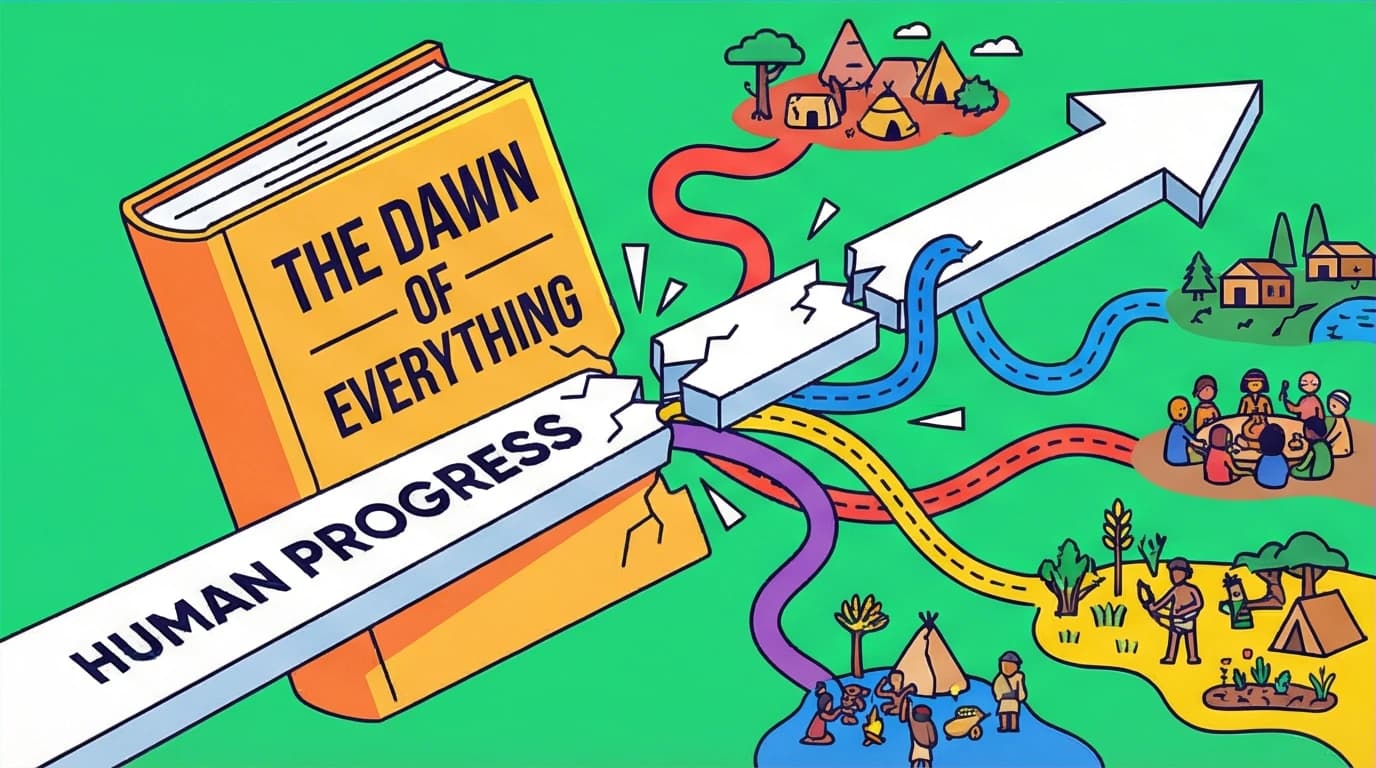
The Core Premise: This book actively challenges the standard narrative of human progress. Graeber and Wengrow argue that early humans were not just simple hunter-gatherers trapped in small bands. They actively experimented with complex social structures, built massive temporary cities, and consciously rejected agriculture for thousands of years.
Why Sapiens Fans Will Love It: Harari famously called the Agricultural Revolution "history’s biggest fraud." This book pushes back against that narrative. If you love deep intellectual debates and want to see where modern anthropology disagrees with Harari, pick up a copy at Barnes & Noble. It will completely rewire your understanding of our ancestors.
Why Sapiens Fans Will Love It: Harari famously called the Agricultural Revolution "history’s biggest fraud." This book pushes back against that narrative. If you love deep intellectual debates and want to see where modern anthropology disagrees with Harari, pick up a copy at Barnes & Noble. It will completely rewire your understanding of our ancestors.
This kind of critical engagement is crucial when reading grand historical narratives. While Sapiens is a masterpiece of storytelling, it has faced its own share of academic debate.
3. A Short History of Nearly Everything by Bill Bryson
The Core Premise: Bryson attempts to understand everything that happened from the Big Bang to the rise of civilization. He focuses on the physical sciences—geology, chemistry, paleontology, and astronomy.
Why Sapiens Fans Will Love It: It delivers the exact same macro-perspective but shifts the focus from sociology to natural science. Bryson is hilarious, making incredibly complex scientific discoveries accessible and entertaining.
Why Sapiens Fans Will Love It: It delivers the exact same macro-perspective but shifts the focus from sociology to natural science. Bryson is hilarious, making incredibly complex scientific discoveries accessible and entertaining.
Books Similar to Sapiens That Decode Human Behavior
Harari spent a lot of time explaining why we do what we do based on our evolutionary wiring. If you want books similar to Sapiens that dig deeper into the meat computer inside our skulls, look into behavioral psychology and biology.
4. Behave: The Biology of Humans at Our Best and Worst by Robert Sapolsky
The Core Premise: Sapolsky, a neurobiologist and primatologist, traces the origins of human behavior. He starts one second before a behavior occurs (neurology), moves to minutes before (endocrinology), and goes all the way back millions of years (evolutionary biology) to explain why we are capable of incredible violence and profound empathy.
Why Sapiens Fans Will Love It: It takes the biological concepts Harari introduced and puts them under a microscope. Sapolsky’s writing is dense but highly conversational. It is a hefty book, making it a fantastic choice for an Audible credit if you prefer to listen during a long commute.
Why Sapiens Fans Will Love It: It takes the biological concepts Harari introduced and puts them under a microscope. Sapolsky’s writing is dense but highly conversational. It is a hefty book, making it a fantastic choice for an Audible credit if you prefer to listen during a long commute.
5. Thinking, Fast and Slow by Daniel Kahneman
The Core Premise: Kahneman, a Nobel laureate, explains that our brains run on two systems. System 1 is fast, intuitive, and emotional. System 2 is slow, deliberate, and logical. He exposes the massive cognitive biases that control our daily decisions.
Why Sapiens Fans Will Love It: Harari explains that humans dominate because of our collective imagination. Kahneman explains how that imagination is actually processed by individual brains. It is the ultimate operator's manual for the human mind.
Why Sapiens Fans Will Love It: Harari explains that humans dominate because of our collective imagination. Kahneman explains how that imagination is actually processed by individual brains. It is the ultimate operator's manual for the human mind.
If you found yourself fascinated by the cognitive quirks that allow humans to collaborate and build societies, you owe it to yourself to study the internal wiring of your own mind. Daniel Kahneman's legendary research on behavioral economics lays bare the unconscious biases and mental shortcuts that dictate our daily choices. This profound book will fundamentally change how you process information, evaluate risks, and make decisions, whether you are managing your 401(k) or just shopping for groceries.
Thinking, Fast and Slow
Daniel Kahneman
53 Duration9 Key Points4.5 Rate6. The Righteous Mind by Jonathan Haidt
The Core Premise: Why are good people divided by politics and religion? Haidt argues that moral judgments arise not from reason, but from gut feelings. We make a snap emotional decision and then use our logic to justify it.
Why Sapiens Fans Will Love It: Harari’s concept of "shared fictions" (like human rights, laws, and religions) is brilliant. Haidt’s book explains the exact psychological mechanisms that make us believe in and fiercely defend those fictions.
Why Sapiens Fans Will Love It: Harari’s concept of "shared fictions" (like human rights, laws, and religions) is brilliant. Haidt’s book explains the exact psychological mechanisms that make us believe in and fiercely defend those fictions.
If you're intrigued by these deep dives into human behavior but don't have the time to tackle dense academic works right now, there's another way to absorb their powerful ideas.


Listen to the key insights from complex psychology and biology books in just 15 minutes, perfect for understanding the core concepts without the heavy time commitment.
 LeapAhead
Sweeping Perspectives on Biology and Economics
Sapiens is essentially an exercise in connecting totally different disciplines. If you want to see how a single subject shapes the entire world, check out these deep dives.
7. The Ascent of Money by Niall Ferguson
The Core Premise: Harari claimed that money is the most universal and most efficient system of mutual trust ever devised. Ferguson’s book is the definitive history of that trust. He tracks the evolution of finance from Mesopotamian clay tablets to modern Wall Street hedge funds.
Why Sapiens Fans Will Love It: It strips away the boring math of economics and frames money as a driving historical force that wins wars, topples empires, and funds the Renaissance.
Why Sapiens Fans Will Love It: It strips away the boring math of economics and frames money as a driving historical force that wins wars, topples empires, and funds the Renaissance.
Money is perhaps the ultimate "shared fiction" that holds our global society together. To fully grasp how credit, debt, and banking accelerated human progress, Niall Ferguson's financial history is an absolute must-read. He takes concepts that usually feel dry or intimidating and weaves them into a high-stakes global thriller. From the bond markets that funded military conquests to the real estate bubbles that crashed economies, this deep dive will completely transform the way you look at a dollar bill.
The Ascent of Money
Niall Ferguson
47 Duration8 Key Points4.6 Rate8. The Gene: An Intimate History by Siddhartha Mukherjee
The Core Premise: Mukherjee weaves a history of genetic research, tracing the quest to understand human heredity from Aristotle to modern CRISPR technology. He interlaces this massive scientific history with his own family’s struggle with mental illness.
Why Sapiens Fans Will Love It: It covers the biological reality of what makes us human. Just as Sapiens tracks our social evolution, The Gene tracks our biological source code. The writing is incredibly poetic and reads like a high-stakes thriller.
Why Sapiens Fans Will Love It: It covers the biological reality of what makes us human. Just as Sapiens tracks our social evolution, The Gene tracks our biological source code. The writing is incredibly poetic and reads like a high-stakes thriller.
9. Prisoners of Geography by Tim Marshall
The Core Premise: All leaders are constrained by geography. Mountains, rivers, and oceans dictate the geopolitical strategies of nations. Russia will always obsess over its flat western border; China will always secure its coastlines.
Why Sapiens Fans Will Love It: It gives you a highly pragmatic, map-based framework to understand world events. It removes the ideology from history and replaces it with cold, hard topographical facts.
Why Sapiens Fans Will Love It: It gives you a highly pragmatic, map-based framework to understand world events. It removes the ideology from history and replaces it with cold, hard topographical facts.
What to Read After Sapiens to Understand the Future
If your favorite parts of Harari’s work were his predictions about artificial intelligence, biotechnology, and the future of human labor, these books will keep you looking over the horizon.
10. Life 3.0: Being Human in the Age of Artificial Intelligence by Max Tegmark
The Core Premise: Tegmark, an MIT physicist, outlines the potential futures of humanity as we approach artificial general intelligence (AGI). He categorizes life into three stages: Life 1.0 (biological evolution), Life 2.0 (cultural evolution—where humans are now), and Life 3.0 (technological evolution, where life can design its own hardware).
Why Sapiens Fans Will Love It: It feels like the direct, highly technical successor to Homo Deus. Tegmark lays out actionable scenarios for what happens when we are no longer the smartest entities on the planet.
Why Sapiens Fans Will Love It: It feels like the direct, highly technical successor to Homo Deus. Tegmark lays out actionable scenarios for what happens when we are no longer the smartest entities on the planet.
11. The Age of Surveillance Capitalism by Shoshana Zuboff
The Core Premise: Zuboff argues that tech giants like Google and Facebook have created a new mutation of capitalism. Instead of extracting natural resources, they extract human experience, turning our private behaviors into data points to predict and control our future actions.
Why Sapiens Fans Will Love It: Harari warns about the danger of biometric tracking and data monopolies. Zuboff’s book proves that this dystopia is not a future threat; it is our current economic reality.
Why Sapiens Fans Will Love It: Harari warns about the danger of biometric tracking and data monopolies. Zuboff’s book proves that this dystopia is not a future threat; it is our current economic reality.

12. The Sixth Extinction by Elizabeth Kolbert
The Core Premise: Earth has seen five major mass extinction events driven by natural catastrophes. We are currently in the middle of the sixth, and humans are the asteroid. Kolbert travels the globe to document the flora and fauna that are disappearing right in front of us.
Why Sapiens Fans Will Love It: Early in Sapiens, Harari brutally describes how our ancestors wiped out megafauna in Australia and the Americas. Kolbert’s Pulitzer-winning reporting brings that exact ecological narrative into the modern day.
Why Sapiens Fans Will Love It: Early in Sapiens, Harari brutally describes how our ancestors wiped out megafauna in Australia and the Americas. Kolbert’s Pulitzer-winning reporting brings that exact ecological narrative into the modern day.
To truly comprehend the planetary impact of Homo sapiens, we have to look closely at the species we are leaving behind in our wake. Elizabeth Kolbert's exceptional journalism serves as a sobering wake-up call about the fragile biodiversity of our world. Her on-the-ground reporting—from the Andes to the Great Barrier Reef—makes the abstract concept of climate change feel urgent and intensely personal. This is a vital, eye-opening read for anyone who cares about the environmental legacy of our civilization.

The Sixth Extinction
Elizabeth Kolbert
25 Duration10 Key Points4.9 RateThis entire list represents a significant reading commitment. If you want to get the core wisdom from these titles and decide which ones to read in full, an app can help you start learning immediately.
Tackle your reading list by getting the main ideas from these world-changing books in minutes, making it easy to learn more while deciding on your next full read.
LeapAheadFAQ
Do I need to read Homo Deus right after finishing Sapiens?
No. While Homo Deus is the official follow-up, it focuses heavily on future technology, algorithms, and artificial intelligence rather than historical anthropology. If you want to stay in the realm of ancient history and human origins, pivot to Guns, Germs, and Steel or The Dawn of Everything first.
No. While Homo Deus is the official follow-up, it focuses heavily on future technology, algorithms, and artificial intelligence rather than historical anthropology. If you want to stay in the realm of ancient history and human origins, pivot to Guns, Germs, and Steel or The Dawn of Everything first.
Are there any books that actively disagree with Harari’s claims in Sapiens?
Yes. The Dawn of Everything by Graeber and Wengrow directly disputes Harari’s claim that the Agricultural Revolution was a trap that doomed humans to misery and hierarchy. It presents strong archaeological evidence that early human societies were much more politically flexible than Harari suggests.
Yes. The Dawn of Everything by Graeber and Wengrow directly disputes Harari’s claim that the Agricultural Revolution was a trap that doomed humans to misery and hierarchy. It presents strong archaeological evidence that early human societies were much more politically flexible than Harari suggests.
I prefer audiobooks. Which of these are best experienced on Audible?
A Short History of Nearly Everything is fantastic on audio due to Bryson’s witty, conversational tone. Behave by Robert Sapolsky is also highly recommended on audio; it is a massive, dense book, and a good narrator helps pull you through the heavier neurobiology chapters.
A Short History of Nearly Everything is fantastic on audio due to Bryson’s witty, conversational tone. Behave by Robert Sapolsky is also highly recommended on audio; it is a massive, dense book, and a good narrator helps pull you through the heavier neurobiology chapters.
Are these books too academic for a casual reader?
All the books listed here were written specifically for mainstream audiences. While they tackle complex subjects like genetics, macro-economics, and neuroscience, they rely heavily on storytelling and real-world examples. If you successfully navigated Sapiens, you possess the exact reading level required to enjoy every book on this list.
All the books listed here were written specifically for mainstream audiences. While they tackle complex subjects like genetics, macro-economics, and neuroscience, they rely heavily on storytelling and real-world examples. If you successfully navigated Sapiens, you possess the exact reading level required to enjoy every book on this list.