


You hit a wall. Your lungs burn on a run, or your brain feels like mush after a 14-hour workday. A voice in your head tells you to stop. It negotiates with you, assuring you that you have given everything you have. You listen, you quit, and later you realize you had more left in the tank.
That voice is a liar. It is the governor in your brain doing its job. It is designed to keep you comfortable and protect you from pain. It is also the exact reason you are stuck in a rut. If you want to decimate your current plateau, you have to stop listening to that voice and start understanding how to hack your own mind.
What is the 40 Rule?
If you are trying to figure out exactly what is the 40 rule, you need to look at evolutionary biology. Human beings are wired for survival and energy conservation. Like a car with a speed governor that prevents it from going over 85 miles per hour despite having a V8 engine, your brain caps your output.
When you feel like you are at absolute zero, your brain is just hitting the panic button early to keep a massive reserve of energy. The David Goggins 40 percent rule exposes this biological trick. When you think you are done, you have 60 percent of your potential left sitting dormant.
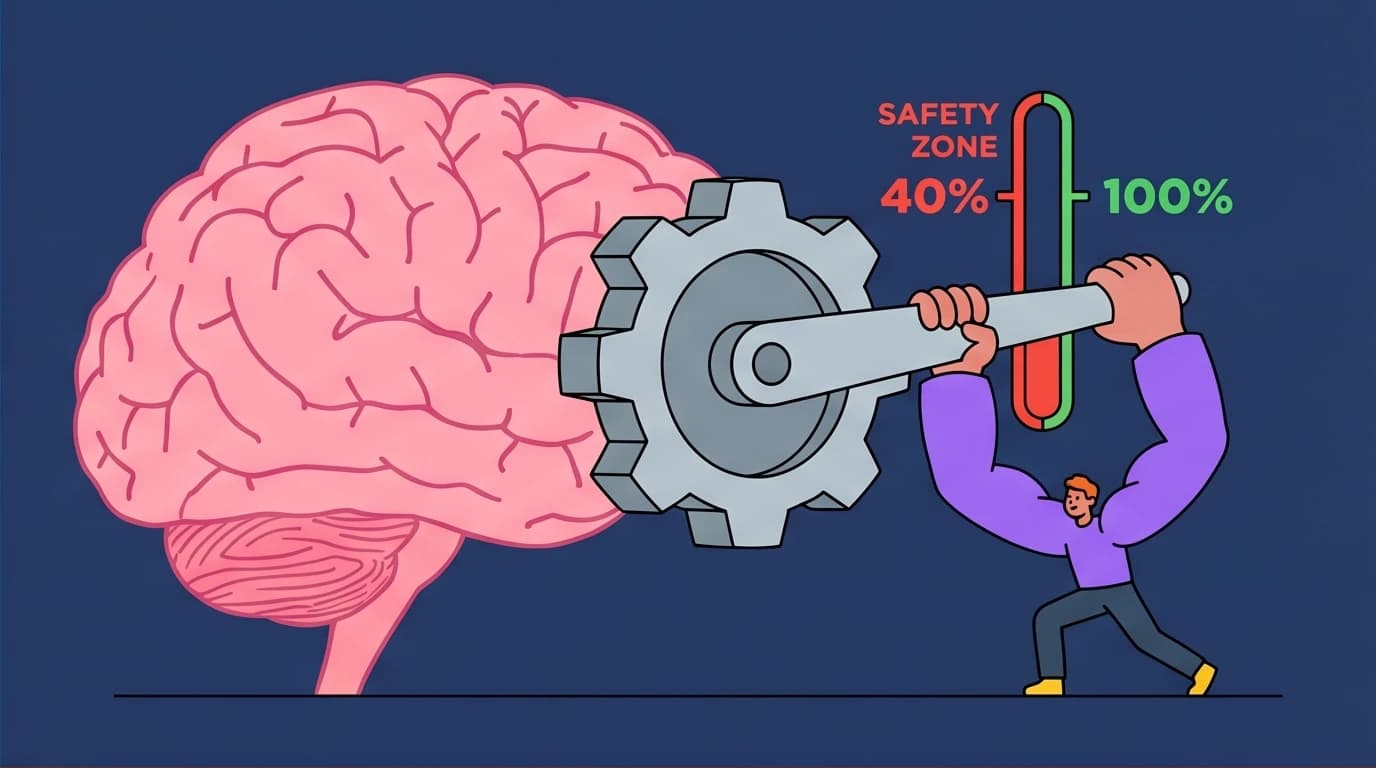
Tapping into that reserve is painful. It requires you to stay in the fight exactly when every fiber of your being is screaming at you to quit. The rule is not about physical fitness; it is a mental framework designed to expand your tolerance for suffering.
Since the entire 40 percent rule originates from David Goggins' own incredible life story, diving into his memoir is the logical next step if you want to truly grasp this concept. His journey from an overweight exterminator to a Navy SEAL and ultra-endurance athlete is nothing short of mind-bending. If you are ready to stop leaving 60 percent of your potential on the table and want the full, unfiltered blueprint of his mindset, this book is an absolute must-read.
For a deeper dive into the key lessons from his book without reading all 364 pages, exploring a summary of Can't Hurt Me can provide the core principles you need to get started.

Can't Hurt Me
David Goggins, Adam Skolnick, et al.
 26 Duration
 10 Key Points
 4.6 Rate
How to Build Mental Toughness
People assume mental resilience is a genetic lottery. It is not. It is a muscle that must be broken down and rebuilt repeatedly. If you want to know how to build mental toughness, you have to engineer friction in your daily life.
Motivation is garbage. It comes and goes with your mood, a good cup of coffee, or a motivational YouTube video. Mental toughness relies on discipline. You build it by callusing your mind.
Start doing things you hate every single day. Wake up at 4:30 AM. Run in 30-degree Fahrenheit weather. Take a freezing cold shower. Take the hardest project at work. When you voluntarily subject yourself to discomfort in controlled environments, you train your brain not to panic when involuntary adversity strikes. You teach your mind to endure.
To effectively push past the 40 percent barrier, Goggins developed specific, actionable tools. You cannot just rely on willpower; you need a system.
Embracing this level of discipline often starts with a structured daily plan. To see how Goggins organizes his day for maximum output, from his grueling workouts to his recovery methods, it's worth studying the David Goggins workout routine.
Speaking of relying on a system rather than fleeting motivation, building mental toughness requires a rock-solid foundation of daily habits. You cannot just wake up and decide to suffer; you have to engineer your environment to support that discipline. If you want to understand the mechanics of how to build those unshakable routines and break the bad habits that keep you comfortable, mastering the science of habit formation will give you the exact framework you need to stay on track.

Atomic Habits
James Clear
26 Duration8 Key Points4.7 RateWhile books like Atomic Habits provide the blueprint, consistently absorbing new ideas is a habit in itself. If you struggle to find the time for deep reading, you can still build a powerful learning routine.


LeapAhead lets you listen to the core principles of must-read books in just 15 minutes, making it easy to turn your commute or workout into a consistent learning habit.
 LeapAhead
The Accountability Mirror Method
You cannot access the remaining 60 percent of your potential if you are lying to yourself about who you are. This is where the accountability mirror method comes in.

Early in his life, Goggins was a 300-pound exterminator stuck in a dead-end job. He changed his trajectory by facing a mirror and getting brutally honest.
How to execute it:
- Face the reality: Stand in front of your mirror. Look at yourself. Stop blaming your boss, your genetics, or your lack of time. Own your failures. If you are out of shape, admit you are out of shape. If you are lazy, say it out loud.
- Write it down: Grab a stack of Post-it notes. Write your specific, immediate goals on them. "Run three miles today." "Finish the project proposal." "Stop eating junk food."
- Stick them on the mirror: Your mirror is no longer just for brushing your teeth. It is a daily scoreboard. You have to look at those notes every morning and every night. You hold yourself accountable to the person staring back at you.
Total ownership eliminates excuses. When the excuses are gone, you have no choice but to do the work.
Taking total accountability for your life is a tough pill to swallow, but it is the ultimate cheat code for personal and professional growth. If the Accountability Mirror method resonates with you, learning how elite military leaders handle responsibility will completely shift your perspective. By adopting a mindset where you own every outcome—good or bad—you strip away the victim mentality. For a deep dive into leading yourself and others with uncompromising accountability, this battle-tested guide is incredibly powerful.

Extreme Ownership
Jocko Willink, Leif Babin
45 Duration7 Key Points4.6 RateThe David Goggins Cookie Jar
When you override your brain's governor and push past 40 percent, you enter the pain cave. Your mind will frantically search for a reason to quit. It will demand to know why you are suffering. You need an answer ready.
You need the David Goggins cookie jar.
The cookie jar is a mental vault. Inside this vault, you store every victory you have ever achieved, every obstacle you have overcome, and every time you proved your own doubts wrong.

How to use it:
When you hit a wall—whether you are gasping for air on a long run or feeling overwhelmed by a seemingly impossible business deadline—reach into the mental cookie jar. Pull out a memory of a time you thought you were defeated but pushed through anyway.
When you hit a wall—whether you are gasping for air on a long run or feeling overwhelmed by a seemingly impossible business deadline—reach into the mental cookie jar. Pull out a memory of a time you thought you were defeated but pushed through anyway.
Remind yourself of the exams you passed when you were dead tired, the heavy weight you lifted when you thought you couldn't, or the time you survived a brutal personal tragedy. Use that past triumph as fuel for your current suffering. It proves to your panicking brain that you have survived worse and you can survive this.
Digging into your mental cookie jar is a brilliant way to manufacture perseverance in the heat of the moment. But if you want to understand why some people naturally possess that relentless drive while others quit at the first sign of friction, exploring the psychology of passion and endurance is eye-opening. Discovering how resilience can be cultivated over the long haul will help you keep that cookie jar fully stocked for whatever challenges life throws your way.

Grit
Angela Duckworth
18 Duration8 Key Points4.6 RateThe Reality of Pain vs. Injury
Applying the David Goggins 40 percent rule requires intense self-awareness. Pushing past mental fatigue is mandatory for growth. Destroying your physical body due to ego is pure stupidity.
You must learn to differentiate between pain and injury.
- Pain is lactic acid burning in your legs. It is shortness of breath. It is the overwhelming desire to sit on the couch. Pain is just information. You can push through it.
- Injury is a sharp, stabbing sensation in your knee joint. It is a torn muscle or a stress fracture.
The 40 percent rule is designed to break mental barriers, not bones. If you are experiencing genuine physiological damage, pushing through will only sideline you for months. Be aggressive, but do not be an idiot. Listen to your body, but interrogate your mind.
This distinction is crucial, and it's a topic of frequent debate among athletes and medical professionals. To better understand the potential risks and criticisms associated with his extreme methods, it's important to consider the question: is David Goggins' approach actually healthy in the long term?
Stop Negotiating
The moment you start negotiating with your inner voice, you have already lost. The mind wants comfort. Deny it. The next time you feel like you have absolutely nothing left to give, realize you are barely halfway there. Use the mirror to stay honest, dig into the cookie jar for fuel, and force yourself to find the other 60 percent.
Putting these powerful mindsets into practice means staying fueled with new knowledge. If your demanding schedule makes it tough to get through books by authors like Goggins and Willink, there’s a more efficient way to learn their key lessons.
Use LeapAhead to absorb the game-changing ideas from bestselling books on mental toughness in 15-minute audio or text summaries, arming you with the insights you need to push past the 40% wall.
LeapAheadFAQ
Does the 40 percent rule apply to everyone?
Yes. The 40 percent rule is based on universal human biology and psychology. The brain's survival mechanism functions the same way in everyone. While the exact percentage is a conceptual framework rather than a hard scientific measurement, the principle that your perceived limit is far lower than your actual limit applies universally.
Yes. The 40 percent rule is based on universal human biology and psychology. The brain's survival mechanism functions the same way in everyone. While the exact percentage is a conceptual framework rather than a hard scientific measurement, the principle that your perceived limit is far lower than your actual limit applies universally.
How do I know if I'm at 40 percent or actually at 100 percent?
If you have the cognitive ability to debate whether you should stop, you are not at 100 percent. True physical exhaustion (100 percent) usually results in involuntary muscle failure or passing out. If you are simply experiencing severe discomfort, heavy breathing, or a strong desire to quit, you are stuck at the 40 percent wall.
If you have the cognitive ability to debate whether you should stop, you are not at 100 percent. True physical exhaustion (100 percent) usually results in involuntary muscle failure or passing out. If you are simply experiencing severe discomfort, heavy breathing, or a strong desire to quit, you are stuck at the 40 percent wall.
Can I use the cookie jar method for career or business challenges?
Absolutely. The cookie jar is not just for fitness. If you are facing a massive project deadline, dealing with a major professional rejection, or experiencing extreme burnout, reach into the cookie jar. Remind yourself of past professional hurdles you cleared, impossible deadlines you met, or times you successfully learned a difficult skill. Fuel is fuel.
Absolutely. The cookie jar is not just for fitness. If you are facing a massive project deadline, dealing with a major professional rejection, or experiencing extreme burnout, reach into the cookie jar. Remind yourself of past professional hurdles you cleared, impossible deadlines you met, or times you successfully learned a difficult skill. Fuel is fuel.
Is it safe to practice the 40 percent rule every day?
Mental toughness should be practiced daily through small disciplines (waking up early, doing focused work). However, pushing your body to absolute physical exhaustion every single day will lead to overtraining and injury. Apply the 40 percent rule aggressively during your most challenging workouts or tasks, but program proper physical recovery so you can sustain the intensity long-term.
Mental toughness should be practiced daily through small disciplines (waking up early, doing focused work). However, pushing your body to absolute physical exhaustion every single day will lead to overtraining and injury. Apply the 40 percent rule aggressively during your most challenging workouts or tasks, but program proper physical recovery so you can sustain the intensity long-term.