


Your calendar is packed. Your email inbox never stops refreshing. You feel constantly busy, yet you end the day realizing you accomplished absolutely nothing of actual value. You are stretched too thin, saying yes to every request while your own goals sit untouched.
You do not need another time management hack or productivity app. You need a complete mindset shift.
Greg McKeown’s bestselling book Essentialism: The Disciplined Pursuit of Less is a wake-up call for the overworked and overwhelmed. It provides a framework for deciding what is truly important and ruthlessly cutting out everything else. Whether you need a powerful line for your next team presentation, a caption for social media, or a daily reminder on your office wall, these essentialism quotes will help you build boundaries and protect your time.
These quotes provide powerful snapshots of the core philosophy. For a more structured overview of how these ideas fit together, from exploration to execution, a detailed summary can be incredibly helpful.
Before diving into these life-changing quotes, you might realize that reading snippets just isn't enough. If this core philosophy strikes a chord with your current struggles, grabbing the complete source material is a game-changer. Greg McKeown’s original work is a must-read for anyone in the United States corporate world—or any busy parent—looking to regain their sanity. It lays out the exact blueprint for determining what is actually vital and how to gracefully eliminate the rest.
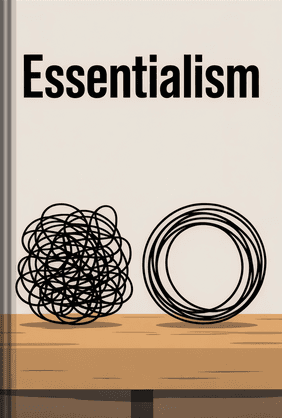
Essentialism
Greg McKeown
 32 Duration
 10 Key Points
 4.6 Rate
But what if you're so swamped that even starting one more book feels overwhelming? If you want to absorb the core lessons of Essentialism and other powerful non-fiction books without dedicating hours, a summary app can be a great first step.


LeapAhead

Get the key takeaways from bestsellers like *Essentialism* in just 15-minute audio or text summaries, perfect for learning on a packed schedule.
The Core Philosophy: The Disciplined Pursuit of Less
The foundation of Essentialism is not about getting more things done in less time. It is about getting only the right things done. If you are a manager looking to align your team, or a creator wanting to share deep insights on Goodreads, start with these the disciplined pursuit of less quotes.
"The way of the Essentialist is the relentless pursuit of less but better."
This is the ultimate summary of the entire book. Society conditions us to believe that more is always better: more clients, more features, more meetings, more money. Essentialism flips that script.
- Where to use it: Put this on the opening slide of your quarterly strategy deck. It tells your team that you are not adding new projects; you are optimizing the ones that matter.
"Essentialism is not about how to get more things done; it’s about how to get the right things done. It doesn't mean just doing less for the sake of less either. It is about making the wisest possible investment of your time and energy in order to operate at our highest point of contribution by doing only what is essential."
Productivity without direction is just motion. You can drive 100 miles an hour, but if you are heading in the wrong direction, speed does not matter.
- How to apply it: When reviewing your weekly to-do list, ask yourself which tasks actually move the needle. Cross off the busywork.
"If it isn’t a clear yes, then it’s a clear no."
Decision fatigue is real. We often waste hours agonizing over mediocre opportunities. McKeown argues that we need extreme criteria for our choices.
- Where to use it: Write this on a sticky note and attach it to your monitor. Look at it every time a new calendar invite pops up in your inbox.

Taking Back Control: If You Don't Prioritize Your Life...
Perhaps the most famous concept from the book deals with agency. We often surrender our time to bosses, colleagues, and acquaintances because we lack the courage to defend our own schedules. These essentialism book quotes tackle the hard truth of ownership.
"If you don't prioritize your life someone else will."
This is the hardest hitting truth in the entire book. Nature abhors a vacuum. If you leave white space on your calendar without assigning it a purpose, a coworker will book a meeting over it. If you do not decide what your career trajectory looks like, a manager will decide it for you.
- How to apply it: Block out "focus time" on your calendar before the week begins. Treat that blocked time with the exact same respect you would give a meeting with your CEO.

"The word priority came into the English language in the 1400s. It was singular. It meant the very first or prior thing. It stayed singular for the next five hundred years. Only in the 1900s did we pluralize the term and start talking about priorities."
You cannot have five top priorities. By definition, a priority is the single most important thing. When a company claims to have ten strategic priorities, they actually have zero.
- Where to use it: This is an incredible story to share in a leadership meeting when executives are trying to push too many initiatives at once. It forces a conversation about trade-offs.
That realization about the word "priority" originally being singular is a tough pill to swallow when you're staring at a daily list of twenty urgent tasks. If you're struggling to identify what that single most important thing should be, you need a system to filter out the distractions. There's an incredible follow-up read that dives deep into this exact concept, helping you figure out the one domino you can knock over that makes everything else easier or unnecessary.

The ONE Thing
Gary Keller, Jay Papasan
22 Duration10 Key Points4.5 Rate"We need to learn the slow 'yes' and the quick 'no'."
Our default response to requests is usually a reflexive "yes" out of a desire to please or a fear of missing out. The Essentialist flips this. They say "no" quickly to protect their time, and only say "yes" after careful, slow deliberation.
- How to apply it: Draft a polite, canned email response that says, "Let me check my commitments and get back to you by Friday." This buys you the time to make a slow, intentional decision.
Of course, knowing you need to say "no" and actually doing it are two entirely different things. Many of us are people-pleasers at heart, terrified of letting down our coworkers, friends, or family members. If you constantly find yourself agreeing to favors only to regret it the second the words leave your mouth, it's time to build your refusal muscles. Learning how to politely but firmly decline requests without feeling guilty is a superpower you can master.
The Art of Saying NO
Damon Zahariades
16 Duration9 Key Points4.6 RateSetting Boundaries and Accepting Trade-offs
You cannot say yes to a new project without saying no to something else. Time is a finite resource. These greg mckeown quotes focus on the reality of trade-offs and the power of boundaries.
"We can either make our choices deliberately or allow other people's agendas to control our lives."
Every time you check your email or open Slack first thing in the morning, you are letting other people dictate your workflow. You are reacting rather than acting.
- How to apply it: Spend the first hour of your workday doing deep work before you even open your inbox.
"To operate at your highest level of contribution requires that you deliberately tune in to what is important and tune out what is not."
Noise is everywhere. Social media, breaking news, constant notifications. The Essentialist builds systems to filter out the noise.
- Where to use it: Use this as a journal prompt. Ask yourself: What "noise" am I currently allowing into my life that is drowning out my actual goals?

"Only once you give yourself permission to stop trying to do it all, to stop saying yes to everyone, can you make your highest contribution towards the things that really matter."
There is a massive emotional release in letting go of the need to be the hero who does everything. You will inevitably disappoint some people when you start setting boundaries. Let them be disappointed. Your highest contribution requires that sacrifice.
Embracing the reality of trade-offs is a significant mental shift. Once you've accepted the philosophy, the next step is building the practical habits that support it, from learning to say "no" effectively to decluttering your calendar.
Letting go of the need to be everyone's hero is incredibly liberating, but it also requires setting firm boundaries—a skill that doesn't come naturally to most of us. Whether you're dealing with a boss who emails you at 10 PM on a Friday or a friend who constantly drains your energy, you have to clearly communicate your limits. If you're ready to stop bending over backward and start protecting your peace, learning the practical steps of boundary-setting is essential.
Set Boundaries, Find Peace
Nedra Glover Tawwab
29 Duration10 Key Points4.5 RateQuotes for Content Creators and Daily Inspiration
If you are a content creator, writer, or coach, you need bite-sized, impactful thoughts that resonate instantly with an audience scrolling on their phones. These quotes stop people in their tracks.
- "What if we stopped celebrating being busy as a measurement of importance?" (Perfect for a LinkedIn post challenging hustle culture.)
- "The life of an Essentialist is a life lived without regret. If you have correctly identified what really matters, if you invest your time and energy in it, then it is difficult to regret the choices you make." (Ideal for an Instagram caption about lifestyle design.)
- "Focusing on the essentials is a choice. It is your choice." (A sharp, direct closing line for a newsletter.)
How to Build a System Around These Quotes
Reading these quotes on a screen is one thing. Integrating them into your daily habits is another. If you want these words to change your behavior, you need to interact with them consistently.
1. Keep the book visible
If you bought the physical hardcover at Barnes & Noble or ordered it off Amazon, do not bury it on a bookshelf. Keep it on your desk. Its physical presence serves as a visual anchor reminding you to stay focused.
If you bought the physical hardcover at Barnes & Noble or ordered it off Amazon, do not bury it on a bookshelf. Keep it on your desk. Its physical presence serves as a visual anchor reminding you to stay focused.
2. Use digital highlights to your advantage
If you consume books digitally, leverage your ecosystem. If you read on Apple Books or a Kindle, export your highlights and review them weekly. If you listened to the audiobook on Audible, bookmark the timestamps of your favorite chapters. Re-listen to those specific segments during your morning commute when you know you are walking into a chaotic day.
If you consume books digitally, leverage your ecosystem. If you read on Apple Books or a Kindle, export your highlights and review them weekly. If you listened to the audiobook on Audible, bookmark the timestamps of your favorite chapters. Re-listen to those specific segments during your morning commute when you know you are walking into a chaotic day.
If you love the idea of re-listening to key concepts but find full audiobooks too long, you can integrate learning into even smaller pockets of time, like a commute or coffee break.
LeapAhead
Turn your commute into a productive learning session by listening to key book insights that help reinforce essentialist principles and other career-boosting ideas.
3. Build a "No" Committee
Share your favorite essentialism quotes with a trusted friend or colleague. When you are tempted to take on a massive project that you know you do not have time for, run it past them first. Let them use McKeown’s words to talk you out of it.
Share your favorite essentialism quotes with a trusted friend or colleague. When you are tempted to take on a massive project that you know you do not have time for, run it past them first. Let them use McKeown’s words to talk you out of it.
FAQ
What is the main message of Essentialism?
The main message is that you cannot do everything. Instead of making a millimeter of progress in a million different directions, you should focus your energy on making significant progress in the one direction that truly matters. It is about doing less, but better.
The main message is that you cannot do everything. Instead of making a millimeter of progress in a million different directions, you should focus your energy on making significant progress in the one direction that truly matters. It is about doing less, but better.
How do I say no at work without getting fired?
The trick is to frame your "no" around the success of your primary goals. Instead of a flat rejection, tell your boss: "I can absolutely take on this new project. However, to do it well, I will need to pause work on [current project]. Which of these is the higher priority for you right now?" This forces leadership to acknowledge the trade-off.
The trick is to frame your "no" around the success of your primary goals. Instead of a flat rejection, tell your boss: "I can absolutely take on this new project. However, to do it well, I will need to pause work on [current project]. Which of these is the higher priority for you right now?" This forces leadership to acknowledge the trade-off.
Are there practical steps in the book, or is it just philosophy?
While the quotes often sound philosophical, the book itself is highly practical. McKeown provides frameworks for editing your life, setting up routines, building buffer time for unexpected delays, and conducting a personal quarterly offsite to review your goals.
While the quotes often sound philosophical, the book itself is highly practical. McKeown provides frameworks for editing your life, setting up routines, building buffer time for unexpected delays, and conducting a personal quarterly offsite to review your goals.
Where is the best place to find more discussions on these quotes?
Goodreads is an excellent platform for community discussions around specific chapters and quotes. Alternatively, many professional groups on LinkedIn actively discuss how to apply McKeown’s principles to modern corporate environments, specifically focusing on remote work boundaries and meeting fatigue.
Goodreads is an excellent platform for community discussions around specific chapters and quotes. Alternatively, many professional groups on LinkedIn actively discuss how to apply McKeown’s principles to modern corporate environments, specifically focusing on remote work boundaries and meeting fatigue.