

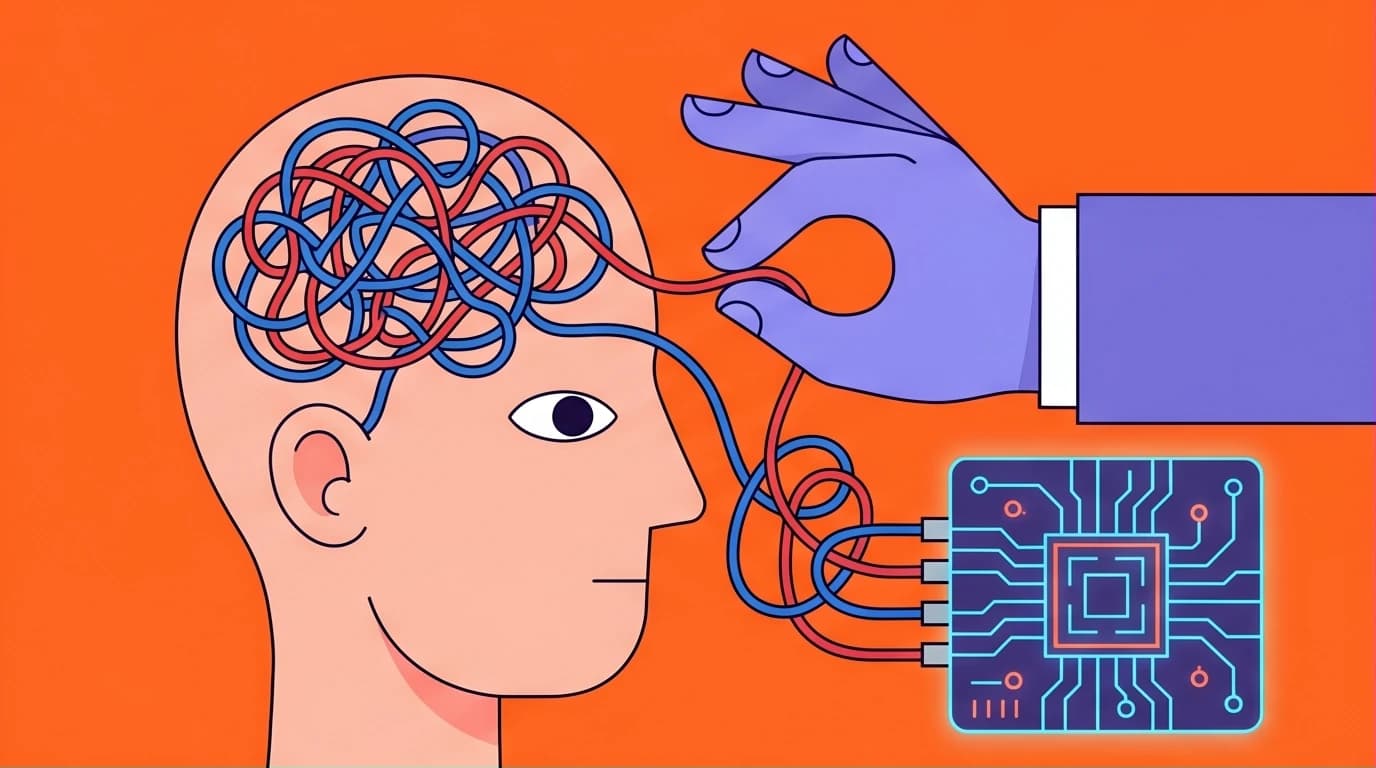
Your heart races, your chest tightens, and your mind rapidly spins through worst-case scenarios. A simple email from your boss or a drive on the interstate suddenly feels like a life-or-death crisis. You know your reaction is out of proportion, but your body is screaming that the danger is real.
If you have been looking for ways to stop this exhausting cycle, you have almost certainly come across the term CBT. Doctors recommend it. Friends swear by it. You see workbooks for it sitting on the shelves at Barnes & Noble.
But when you are already mentally drained from fighting your own nervous system, the last thing you want is complicated psychological jargon. You need to know exactly what this treatment is, if it actually gets results, and what you will be expected to do.
Here is exactly how CBT dismantles anxiety, step by step.
What is CBT Therapy?
At its core, CBT is a highly structured, goal-oriented form of talk therapy.
When most people picture therapy, they imagine lying on a leather couch, staring at the ceiling, and talking about their relationship with their parents while a therapist nods quietly. That is traditional psychoanalysis. CBT is entirely different.
CBT is essentially a training program for your mind. It focuses on the present moment and the specific problems you are facing right now. The therapist acts less like a silent observer and more like a personal trainer for your brain. You collaborate, you learn specific frameworks, and you are expected to do homework between sessions to build new mental muscles.
Cognitive Behavioral Therapy Basics: The Core Philosophy
To understand how this therapy stops anxiety, you need to grasp the fundamental premise of cognitive behavioral therapy basics: It is not the situation that causes your anxiety; it is your interpretation of the situation.
Imagine you are walking down the street, and you see a coworker walking toward you. You wave, but they walk right past you without making eye contact.
- Interpretation A: "They must be mad at me. Did I say something wrong in the meeting yesterday? They probably want to fire me."
- Resulting Emotion: Severe anxiety, panic, shame.
- Interpretation B: "Wow, they looked really distracted. They must be having a stressful day."
- Resulting Emotion: Neutrality, maybe a little empathy.
The event was exactly the same. The only difference was the thought. CBT teaches you that your thoughts, feelings, and behaviors are entirely interconnected. By changing one point of this triangle, you can change the entire system.
The Anxiety Triangle: How Your Brain Traps You
Anxiety survives by keeping you trapped in a self-reinforcing loop. Let's break down how this works in real life.
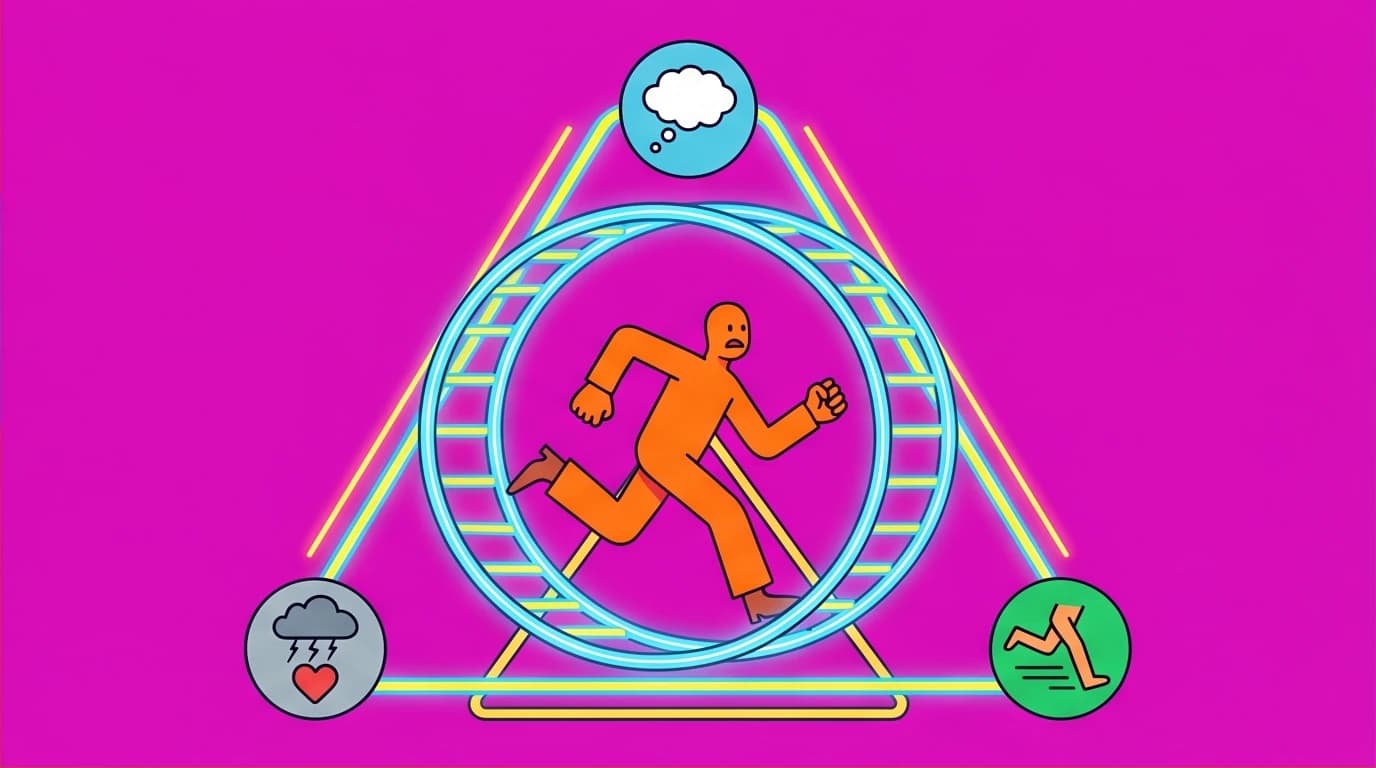
- The Thought: You receive a Slack message from your manager on a Friday afternoon that just says, "Can we chat on Monday?" Immediately, your brain fires off a thought: I am getting fired.
- The Feeling: Your body responds to this thought as if a bear just walked into your living room. Adrenaline pumps. Your stomach drops. You feel intense dread and anxiety.
- The Behavior: Because you feel terrible, you engage in "safety behaviors." You spend your entire weekend obsessively checking your emails, avoiding your family, or drinking half a bottle of wine to numb the panic.
Come Monday, you find out your manager just wanted to ask for your input on a new project. You spent 48 hours in agonizing panic over a threat that never existed.
How does CBT work for anxiety in this scenario? It teaches you to intercept the process at the "Thought" stage before it triggers the physiological panic and the destructive behaviors.
Understanding Cognitive Distortions: The Lies Anxiety Tells You
You cannot fix a problem if you cannot see it. The first major phase of CBT is learning to catch your brain in the act of lying to you.
When we are anxious, our brains process information through warped filters. Psychologists call these "cognitive distortions." Understanding cognitive distortions is like learning the playbook of your opposing team. Once you know their moves, they cannot surprise you.

Here are the most common cognitive distortions that fuel anxiety:
1. Catastrophizing
This is the bread and butter of an anxious brain. You take a minor negative event and instantly escalate it to the absolute worst-case scenario.
- Example: "I stumbled over my words during that presentation. My boss thinks I'm incompetent. I'm going to get passed over for the promotion, lose my job, and go bankrupt."
2. Mind Reading
You assume you know exactly what other people are thinking, and it is always negative about you, despite having no actual evidence.
- Example: "That person at the grocery store looked at my outfit and thinks I look like a mess."
3. Fortune Telling
You predict that things will turn out badly before they even happen, treating your prediction as an established fact.
- Example: "There is no point in going to this networking event. I know I am going to be awkward, and no one will want to talk to me anyway."
4. Emotional Reasoning
You assume that because you feel a certain way, it must be true.
- Example: "I feel terrified about getting on this airplane. Therefore, this airplane must be dangerous and is going to crash."
5. Black-and-White Thinking
You look at situations in absolute extremes. If a situation is not perfectly safe or entirely successful, it is a complete disaster.
- Example: "If I don't get an A on this exam, I am a total failure."
Anxiety relies on these distortions operating in the background, unchecked. CBT forces you to pull these thoughts out of the shadows and put them under a microscope. Recognizing these patterns is the first step, but the next is learning how to actively counter them, especially when they trap you in cycles of rumination and worry.
If you want to dive deeper into recognizing and dismantling these exact cognitive distortions, Dr. David Burns's groundbreaking work is an absolute must-read. Widely considered one of the most important resources in cognitive behavioral therapy, this book provides practical, everyday tools to help you put your thoughts under a microscope. It is like having a CBT therapist right on your nightstand, ready to guide you through identifying the mental traps that fuel your anxiety and giving you actionable steps to overcome them.

Feeling Good
David D. Burns, M.D.
 41 Duration
 9 Key Points
 4.6 Rate
When you're already feeling drained by anxiety, tackling a dense book can feel like a huge commitment. If you want to absorb these essential CBT concepts without the heavy lifting, an app can help you get the key takeaways quickly.

Get the core insights from best-selling psychology books like 'Feeling Good' in just 15-minute audio summaries, making it easier to learn new coping skills even when you're feeling overwhelmed.

Download LeapAhead App now
The Mechanics: How Does CBT Work for Anxiety Day-to-Day?
Once you recognize that your brain is serving you distorted thoughts, what do you actually do about it? CBT uses several core interventions to dismantle anxiety.

Strategy 1: Cognitive Restructuring (The Courtroom Method)
When an anxious thought enters your mind, CBT trains you to act like a defense attorney cross-examining a witness. You do not just accept the thought as truth; you demand evidence.
Therapists often use a tool called a "Thought Record." If you are feeling a spike in anxiety, you write down:
- The Trigger: What just happened? (e.g., My chest hurts).
- The Automatic Thought: What is my brain saying? (e.g., I am having a heart attack).
- The Evidence FOR the thought: (e.g., My chest feels tight, and my heart is beating fast).
- The Evidence AGAINST the thought: (e.g., I am 30 years old, I have been stressed all week, my doctor just gave me a clean bill of health last month, and I have had panic attacks that felt exactly like this before).
- The Balanced Thought: (e.g., I am experiencing a painful symptom of anxiety, but it is not medically dangerous. It will pass).
You are not forcing yourself to be happy. You are forcing yourself to be accurate. Anxiety thrives on fiction; CBT grounds you in facts.
Strategy 2: Behavioral Experiments
Anxiety tells you that if you do the thing you are afraid of, a disaster will happen. CBT asks you to test that hypothesis in the real world.
If your anxiety tells you, "If I don't double-check my front door lock five times, someone will break in," your behavioral experiment might involve checking the door only once, and then recording what actually happens. Over time, your brain collects undeniable data that the catastrophic predictions are false.
Strategy 3: Exposure and Response Prevention
Avoidance is the fuel that keeps anxiety burning. If you are afraid of driving on the highway, and you take backroads to avoid it, your anxiety instantly drops. Your brain learns, "Taking the backroads saved my life. The highway equals death." The fear grows stronger.
CBT uses gradual, systematic exposure to break this habit. You do not just jump into your car and drive 80 miles per hour into heavy traffic. You start small.
- Step 1: Sit in your car in the driveway with the engine running.
- Step 2: Drive one block down your street.
- Step 3: Drive on a busy local road.
- Step 4: Drive one exit on the highway during off-peak hours.
You stay in the uncomfortable situation until your nervous system realizes that the threat is not real, and the anxiety naturally subsides.
These structured approaches turn abstract concepts into tangible actions. To make these strategies a consistent part of your routine, using guided worksheets or journaling prompts can be incredibly effective.
Breaking the cycle of avoidance and leaning into exposure can feel incredibly daunting at first. If you are struggling with the urge to avoid things that trigger your panic, learning how to manage your brain's primal alarm system is crucial. This is where learning to quiet the constant noise in your head becomes incredibly valuable. By understanding how to untangle yourself from the exhausting cycle of fear and worry, you can start putting these behavioral experiments into practice and finally retrain your nervous system to feel safe again.

Don't Feed the Monkey Mind
Jennifer Shannon
21 Duration8 Key Points4.4 RateCBT for Generalized Anxiety Disorder (GAD)
While CBT is highly effective for specific phobias and panic attacks, it is also the gold standard for pervasive, free-floating worry.
CBT for generalized anxiety disorder specifically targets a psychological mechanism known as the "Intolerance of Uncertainty." People with GAD cannot stand not knowing how things will turn out. They worry endlessly about their health, their kids, their finances, and global events, believing that if they just worry enough, they can somehow prepare for or prevent bad things from happening.
CBT treats GAD by shifting the focus from the content of the worry to the act of worrying itself.
Therapists will teach you to categorize your worries into two buckets:
- Solvable problems: Things you have control over right now (e.g., "I need to pay the electric bill").
- Hypothetical worries: Things you cannot control right now (e.g., "What if the economy crashes next year and I lose my job?").
For solvable problems, CBT focuses on actionable problem-solving. For hypothetical worries, CBT employs techniques like "Worry Time." Instead of letting anxiety ruin your entire day, you schedule 15 minutes at 4:00 PM dedicated solely to worrying. If an anxious thought pops up at 10:00 AM, you write it down and tell your brain, "We will deal with this at 4:00 PM."
This boundary setting teaches your brain that you are in control of the worry, rather than the worry being in control of you.
Managing generalized anxiety and the constant barrage of "what-ifs" requires a proactive approach to quieting your mind. If you find that your brain is constantly running on an exhausting hamster wheel of hypothetical scenarios, taking steps to actively interrupt those thought loops is an essential next step. Mastering specific techniques to declutter your mind and set firm boundaries with your worry can dramatically lower your baseline anxiety, helping you stay grounded in the present instead of spiraling into tomorrow's unlikely disasters.
Stop Overthinking
Nick Trenton
50 Duration9 Key Points4.5 RateWhat to Expect If You Start CBT
If you decide to invest your time and money into CBT, knowing what the process actually looks like can drastically reduce the intimidation factor.
- It is usually short-term: Unlike traditional therapy that can last for years, CBT is typically designed to be completed in 12 to 20 weekly sessions. You are there to learn a specific skill set and graduate.
- You will get homework: Just like you cannot learn to play the piano by only touching the keys once a week during your lesson, you cannot rewire your brain just by talking to a therapist for 45 minutes. You will be asked to fill out thought records, read materials, or practice exposure exercises between sessions.
- It requires active effort: You cannot be a passive participant in CBT. Your therapist will challenge you, ask you difficult questions, and push you slightly out of your comfort zone. It can be exhausting, but it is highly effective.
Because CBT requires so much active effort and homework outside of your therapist's office, learning to manage your internal dialogue is key to your long-term success. The voice inside your head can either be your biggest critic or your most helpful coach as you navigate these new skills. Gaining a better understanding of how your inner monologue works will empower you to reframe negative self-talk into a supportive dialogue, giving you the mental endurance needed to put your CBT tools to work and conquer your anxiety once and for all.
Chatter
Ethan Kross, Ph.D.
23 Duration10 Key Points4.3 RateFAQ
Does CBT just mean I have to "think positive"?
Absolutely not. Toxic positivity—telling yourself "everything is great" when things are actually terrible—is deeply unhelpful. CBT is not about thinking positively; it is about thinking accurately. It is about stripping away the exaggerated catastrophic lies of anxiety and looking at your reality with logic and evidence.
Absolutely not. Toxic positivity—telling yourself "everything is great" when things are actually terrible—is deeply unhelpful. CBT is not about thinking positively; it is about thinking accurately. It is about stripping away the exaggerated catastrophic lies of anxiety and looking at your reality with logic and evidence.
How long does it take for CBT to work for anxiety?
Many people begin to notice a shift in their anxiety levels within the first 3 to 4 weeks, as they simply become aware of their cognitive distortions. Significant behavioral changes and symptom relief usually occur within the 12 to 20-week timeline of a standard CBT protocol. However, the speed of progress heavily depends on how consistently you do the homework outside of sessions.
Many people begin to notice a shift in their anxiety levels within the first 3 to 4 weeks, as they simply become aware of their cognitive distortions. Significant behavioral changes and symptom relief usually occur within the 12 to 20-week timeline of a standard CBT protocol. However, the speed of progress heavily depends on how consistently you do the homework outside of sessions.
Can I do CBT on my own, or do I need a therapist?
You can absolutely learn and apply CBT principles on your own. There are hundreds of excellent CBT workbooks available on Amazon or at local bookstores specifically designed for self-guided practice. However, if your anxiety is severe, paralyzing, or causing panic attacks, working with a licensed CBT therapist is highly recommended. A professional can spot blind spots in your thinking that you might miss on your own.
You can absolutely learn and apply CBT principles on your own. There are hundreds of excellent CBT workbooks available on Amazon or at local bookstores specifically designed for self-guided practice. However, if your anxiety is severe, paralyzing, or causing panic attacks, working with a licensed CBT therapist is highly recommended. A professional can spot blind spots in your thinking that you might miss on your own.
Is CBT better than medication for anxiety?
It is not necessarily about one being "better" than the other; they serve different purposes. Medication (like SSRIs) changes brain chemistry to lower the baseline volume of your anxiety, which can give you the breathing room you need to function. CBT provides you with lifelong coping skills to manage the thoughts that trigger the anxiety. For many people, a combination of both—using medication to calm the nervous system enough to actively participate in CBT—produces the best long-term results.
It is not necessarily about one being "better" than the other; they serve different purposes. Medication (like SSRIs) changes brain chemistry to lower the baseline volume of your anxiety, which can give you the breathing room you need to function. CBT provides you with lifelong coping skills to manage the thoughts that trigger the anxiety. For many people, a combination of both—using medication to calm the nervous system enough to actively participate in CBT—produces the best long-term results.