

You are staring at the ceiling at 2 AM. Your brain is replaying a casual conversation from Tuesday, dissecting every single word you said, and convincing you that you made a fool of yourself. Your alarm is set for 6 AM, but your mind is running a marathon you never signed up for. Or maybe you are sitting at your desk, paralyzed by a simple decision, weighing the pros and cons until you feel entirely drained of energy.

You want to take action, sleep, or simply enjoy the present moment, but your brain refuses to hit the brakes. The mental fatigue is real, and the traditional advice to "just relax" is completely useless. You need a tactical approach to disrupt the noise.
The Difference Between Problem-Solving and Overthinking
Before taking action, you need a clear benchmark to judge your own thoughts. Mental activity only falls into two categories: productive problem-solving and destructive overthinking.
Problem-solving has a clear destination. You identify an issue, gather the necessary facts, create a step-by-step plan, and execute it. It moves you forward.
Overthinking, on the other hand, is a hamster wheel. You are generating questions without seeking actual answers. You are obsessing over the "what ifs," trying to predict the future, or trying to change a past you have zero control over. When you constantly replay negative scenarios without finding a tangible solution, you need to learn how to stop ruminating. Rumination drains your mental energy and creates artificial stress in your nervous system.

Immediate Relief: How to Get Out of Your Head Right Now
When you are caught in a severe spiral of overthinking, rationalizing with yourself rarely works. Your brain is essentially locked in a mild fight-or-flight response. You cannot out-think an overthinking problem. You have to physicalize your way out of it. Here is how to get out of your head immediately.
Force a Physical Pattern Interrupt
Change your physical state to shock your nervous system into the present moment. Your brain cannot panic about a hypothetical situation five years from now if it is dealing with sudden physical stimuli right now.
- Change the temperature: Go to the bathroom and splash freezing cold water on your face for five seconds. If it is winter, step outside into the 30-degree Fahrenheit air for a minute in your t-shirt. The intense temperature shift forces your brain to register your immediate physical reality.
- Change your location: If you are overthinking in bed, get out of bed immediately. Your brain is starting to associate your mattress with anxiety. Move to the couch, read a physical book, and only return to bed when your eyelids are heavy.
- Move aggressively: Do twenty jumping jacks or push-ups. Push your body until your heart rate spikes from physical exertion rather than mental anxiety.
Execute the 5-4-3-2-1 Grounding Technique
This is a standard cognitive behavioral tool designed to anchor you firmly in reality when your thoughts drift into the worst-case scenario territory. Say these out loud:
- Name 5 things you can see around you (a coffee mug, a lamp, a spot on the wall).
- Name 4 things you can physically feel (the texture of your shirt, the chair against your back, your feet on the rug).
- Name 3 things you can hear (the hum of the refrigerator, traffic outside, a clock ticking).
- Name 2 things you can smell (coffee brewing, laundry detergent).
- Name 1 thing you can taste (mint toothpaste, the lingering taste of lunch).
This exercise demands enough mental bandwidth that it temporarily kicks your brain out of its rumination loop.
The Brain Dump Protocol
Overthinking happens when your working memory is overloaded. You are trying to juggle fifteen different anxieties at once. The solution is externalization.

Grab a pen and a piece of paper. Do not type this on your phone; the physical act of writing slows down your thoughts to the speed of your hand. Write down every single thing bothering you. Do not edit. Do not organize. Just dump the contents of your brain onto the paper.
Once it is out of your head and on the page, the perceived threat level drops drastically. You will realize that you do not have a massive, unmanageable life crisis—you just have a list of six very specific, solvable problems.
If you find that these physical interrupts and brain dump exercises provide temporary relief but you are still struggling to break the cycle long-term, it might be time to dig a little deeper into the mechanics of your mind. Learning how to identify your specific triggers can make these grounding techniques even more effective. For a highly practical guide that expands on these exact cognitive tools and helps you rewire your brain for lasting calmness, this is a fantastic resource to keep on your nightstand.
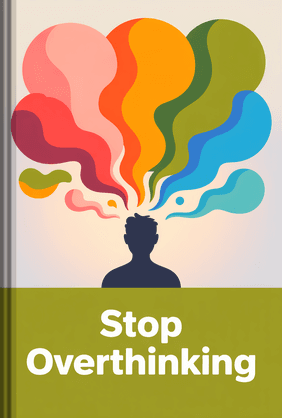
Stop Overthinking
Nick Trenton
 50 Duration
 9 Key Points
 4.5 Rate
Strategic Interventions: Ways to Stop Overthinking Daily
Emergency tactics handle the acute spirals, but you need structural changes to your daily routine to prevent the buildup of mental clutter. Here are practical ways to stop overthinking and build long-term cognitive resilience.
Impose Strict Deadlines on Decisions
Perfectionism fuels overthinking. You want to make the absolute best choice, so you analyze data until you are paralyzed. This happens everywhere, from major career moves to buying a $15 item on Amazon. You spend an hour reading reviews for a garlic press to ensure you get the absolute best one. That is a massive waste of mental energy.
Adopt the 2-Minute Rule for Micro-Decisions. If a decision has a minimal impact on your life one week from now (what to eat for dinner, which movie to watch, which household item to buy), give yourself exactly 120 seconds to decide. Set a timer on your phone. When it goes off, you pick.
For larger decisions, set a concrete deadline. "I will research car insurance options until 5 PM on Thursday. At 5:01 PM, I will purchase a policy." Constraint breeds action. Action kills overthinking.
This pattern of getting stuck on choices, big or small, is often called analysis paralysis. It can be a major roadblock at work and in your personal life, draining your time and energy.
Decision fatigue is a real productivity killer, and learning to set boundaries around your choices can dramatically reduce your daily anxiety. If you find yourself constantly agonizing over the small stuff—like debating which streaming show to watch or over-analyzing a simple email to a coworker—you aren't alone. Sometimes, seeing how other chronic overthinkers successfully implement boundaries can give you the push you need. If you're looking for an encouraging, relatable read on streamlining your daily choices, consider adding this to your reading list.

Don't Overthink It
Anne Bogel
41 Duration8 Key Points4.6 RateSchedule "Worry Time"
It sounds counterintuitive, but trying to suppress your worries often makes them rebound with twice the intensity. Instead of fighting the thoughts all day, give them a dedicated time slot.

Schedule 15 minutes every afternoon—say, 4:00 PM to 4:15 PM—as your official "Worry Time." When an anxious thought pops up at 10 AM, you acknowledge it and tell yourself, "I am not ignoring this, but I will deal with it at 4 PM."
When 4 PM rolls around, set a timer and worry as hard as you can. Write down all the worst-case scenarios. When the timer rings at 4:15 PM, you stop. You close the notebook and move on with your evening. This confines your anxiety to a small, manageable box rather than letting it bleed into your entire day.
Reframe "What If" to "Even If"
Overthinkers are masters of the negative "What If" game. What if I fail this presentation? What if my boss hates my proposal? What if I choose the wrong career path?
You can short-circuit this mental habit by replacing "What If" with "Even If."
- "What if I fail this presentation?" becomes "Even if I fail this presentation, I will learn where my gaps are, and I will survive the embarrassment."
- "What if I choose the wrong career path?" becomes "Even if I choose the wrong path, I will gain transferable skills and can pivot later."
"What if" induces panic by focusing on the threat. "Even if" induces calm by focusing on your resilience and ability to handle the outcome.
Audit Your Information Diet
Your brain processes what you feed it. If you spend three hours a day doomscrolling through negative news, Twitter arguments, and highly curated social media feeds, your brain will naturally stay in a hyper-vigilant, overactive state.
Cut the constant stream of fragmented information. If you want to consume content, choose long-form formats that require sustained, singular focus. Go to Barnes & Noble and buy a physical fiction book. Fire up Audible and listen to a biography while you go for a two-mile walk. Train your brain to focus on one narrative at a time rather than rapidly switching between hundreds of micro-stimuli.
But if even the idea of a full book feels overwhelming right now, you can still absorb these powerful ideas in a more focused way.

Listen to key insights from bestselling books on mindfulness and mental clarity in just 15 minutes, turning your commute into a productive escape from mental clutter.

Download LeapAhead App now
Practical Tips for Overthinkers
Building a life with less mental friction requires a few baseline rules. If you identify as an overthinker, keep these principles front and center.
1. Emphasize Action Over Perfection
Overthinkers believe they need to figure everything out before taking the first step. Flip this script. Action generates data. You will learn more from doing something poorly for ten minutes than you will from thinking about doing it perfectly for ten hours. Start writing the messy first draft. Send the imperfect email. Go to the gym and do a mediocre workout.
Overthinkers believe they need to figure everything out before taking the first step. Flip this script. Action generates data. You will learn more from doing something poorly for ten minutes than you will from thinking about doing it perfectly for ten hours. Start writing the messy first draft. Send the imperfect email. Go to the gym and do a mediocre workout.
2. Recognize the Illusion of Control
A massive percentage of overthinking is a futile attempt to control the uncontrollable. You cannot control what other people think of you. You cannot control the economy. You cannot control traffic.
A massive percentage of overthinking is a futile attempt to control the uncontrollable. You cannot control what other people think of you. You cannot control the economy. You cannot control traffic.
Draw a literal circle on a piece of paper. Inside the circle, write down everything you can control (your effort, your words, your boundaries, your bedtime). Outside the circle, write down everything you cannot control (other people's reactions, the past, the weather). When you catch yourself obsessing, check the paper. If the issue is outside the circle, force yourself to drop it.
The exercise of separating what you can and cannot control is actually rooted in ancient philosophy. Stoicism has been used for centuries by leaders, athletes, and top performers in the US and beyond to block out external noise and focus entirely on their own actions. If you want to make this mindset a permanent part of your daily routine, spending just five minutes a morning reading a short philosophical reflection can completely shift your perspective. This daily reader is an excellent way to train your brain to let go of the uncontrollable.

The Daily Stoic
Ryan Holiday & Stephen Hanselman
48 Duration9 Key Points4.6 Rate3. Optimize Your Sleep Environment
A tired brain lacks the prefrontal cortex function required to regulate emotion and stop intrusive thoughts. Protect your sleep ruthlessly. Keep your bedroom cool—around 65 degrees Fahrenheit is optimal for most people. Remove screens from the bedroom. A well-rested brain is naturally more decisive and less prone to looping thoughts.
A tired brain lacks the prefrontal cortex function required to regulate emotion and stop intrusive thoughts. Protect your sleep ruthlessly. Keep your bedroom cool—around 65 degrees Fahrenheit is optimal for most people. Remove screens from the bedroom. A well-rested brain is naturally more decisive and less prone to looping thoughts.
Protecting your sleep is non-negotiable if you want to keep your mind sharp and your anxiety low. However, when your brain is hardwired to race the second your head hits the pillow, simply lowering the thermostat to 65 degrees Fahrenheit might not be enough.
If you are consistently battling insomnia or waking up feeling mentally exhausted, it helps to understand the actual neurology of sleep. For a fascinating, science-backed look at how to permanently fix your sleep hygiene and quiet a restless mind at night, this book is highly recommended.
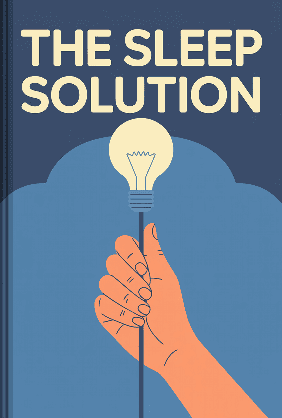
The Sleep Solution
W. Chris Winter, M.D.
41 Duration9 Key Points3.9 Rate4. Assume Positive Intent
Much of our social overthinking comes from analyzing other people's behavior. Why did they use a period at the end of that text? Why did they look at me funny in the hallway?
Much of our social overthinking comes from analyzing other people's behavior. Why did they use a period at the end of that text? Why did they look at me funny in the hallway?
Adopt a default policy of assuming positive intent. If someone is short with you, assume they are having a bad day, not that they secretly hate you. If a friend doesn't text back immediately, assume they are busy driving or working. Do not invent malicious narratives where mundane explanations fit perfectly.
This mindset is especially powerful in our closest connections, where misinterpreting a text message or a brief look can lead to days of unnecessary stress.
Putting these strategies into practice is a journey, and surrounding yourself with the right knowledge is key. But if your 'to-read' pile of self-help books is just adding to your anxiety, there's a more manageable way to get started.
Get the core lessons from books on Stoicism, anxiety, and focus without the pressure of a full read, making it easier to build a calmer mind on your busiest days.
Download LeapAhead App now
FAQ
Why do I overthink mostly at night?
During the day, your brain is occupied with work, conversations, and physical tasks. These distractions act as a buffer against your internal monologue. When you lie down at night in a dark, quiet room, all external stimuli disappear. Your brain suddenly has the silence and the bandwidth to process all the unresolved anxieties, tasks, and interactions you ignored during the day.
During the day, your brain is occupied with work, conversations, and physical tasks. These distractions act as a buffer against your internal monologue. When you lie down at night in a dark, quiet room, all external stimuli disappear. Your brain suddenly has the silence and the bandwidth to process all the unresolved anxieties, tasks, and interactions you ignored during the day.
Is overthinking a symptom of an anxiety disorder?
Overthinking itself is a common human experience and a behavioral habit, not an official clinical diagnosis. However, chronic rumination and the inability to control worrying can be prominent symptoms of Generalized Anxiety Disorder (GAD) or Obsessive-Compulsive Disorder (OCD). If your overthinking causes severe distress, triggers physical symptoms like a racing heart, or makes it impossible to function at work or maintain relationships, you should consult a licensed therapist or psychiatrist.
Overthinking itself is a common human experience and a behavioral habit, not an official clinical diagnosis. However, chronic rumination and the inability to control worrying can be prominent symptoms of Generalized Anxiety Disorder (GAD) or Obsessive-Compulsive Disorder (OCD). If your overthinking causes severe distress, triggers physical symptoms like a racing heart, or makes it impossible to function at work or maintain relationships, you should consult a licensed therapist or psychiatrist.
Can I completely cure my habit of overthinking?
You will never eliminate thoughts entirely—your brain is an organ designed to generate thoughts and assess risks. The goal is not a blank, empty mind. The goal is a shift in your relationship with your thoughts. You can train yourself to recognize an overthinking spiral within minutes, apply grounding techniques, and redirect your focus toward productive action. Over time, the intensity, frequency, and duration of your overthinking episodes will drastically decrease.
You will never eliminate thoughts entirely—your brain is an organ designed to generate thoughts and assess risks. The goal is not a blank, empty mind. The goal is a shift in your relationship with your thoughts. You can train yourself to recognize an overthinking spiral within minutes, apply grounding techniques, and redirect your focus toward productive action. Over time, the intensity, frequency, and duration of your overthinking episodes will drastically decrease.