


You are staring at an open laptop. The clock is ticking down, the guilt is compounding by the minute, yet you physically cannot force yourself to open the document or textbook. You switch tabs. You organize your desk. You check your phone. You are caught in a brutal cycle of wanting to work, feeling overwhelmed by the sheer volume of it, and doing absolutely nothing.
You are not lazy. You are experiencing severe task paralysis. When the pressure mounts, your brain interprets the looming workload as a literal threat, triggering a freeze response. To break this cycle, you have to stop relying on willpower and start manipulating your environment and expectations. Here is exactly what to do.

This feeling of being frozen is common, but for some, it can be linked to neurodivergent conditions. Differentiating between general procrastination and other forms of executive dysfunction is key to finding the right coping strategies.
The Root Cause of Task Paralysis
Before you can fix the problem, you have to understand what is actually happening in your head. Procrastination is deeply misunderstood. It is an emotional regulation problem. When you think about the 15-page research paper or the six chapters of organic chemistry you need to absorb, you experience a spike of negative emotion—boredom, frustration, self-doubt, or severe deadline anxiety.
To escape that negative emotion, your brain seeks immediate, cheap dopamine. You open a social media app or start organizing your digital files. The relief is instant, but it is temporary.
Academic Procrastination vs. Procrastinating at Work
Whether you are cramming for a final exam or pushing off a quarterly report, the mechanism is identical. Academic procrastination often stems from a lack of immediate consequences. A professor will not check your progress on a Tuesday if the paper is due on Friday. Similarly, procrastinating at work often happens when remote workers lack the physical oversight of a traditional office. Without a manager walking past your desk, the urgency disappears until the deadline is inches away.
If you are constantly battling the cycle of deadline anxiety and cheap dopamine distractions, understanding the psychology behind your avoidance is the best first step. When you realize that procrastination is about managing your emotions rather than your time, you can finally break the loop. For a deep dive into why your brain defaults to this freeze response and how to permanently rewire your approach to work, this classic guide offers incredibly practical, guilt-free strategies to get you moving again.
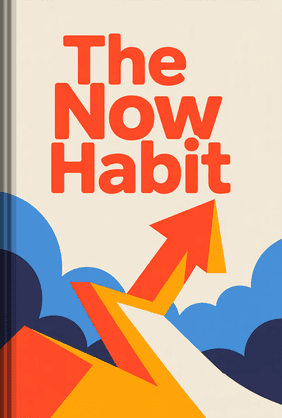
The Now Habit
Neil Fiore, Ph.D.
 48 Duration
 8 Key Points
 4.6 Rate
If the idea of starting another full book feels overwhelming, you can get the core concepts of titles like this one in a more manageable format.

Get key insights from bestselling books on psychology and productivity in 15-minute audio summaries, making it easier to learn new strategies even when you feel overwhelmed.

Download LeapAhead App now
Understanding that you're dealing with an emotional response rather than a character flaw is a crucial first step. If you want to delve deeper into the specific triggers and psychological patterns that fuel this behavior, it's worth exploring the common reasons we procrastinate.
Immediate Tactics: Break the Freeze Response Right Now
You do not need a new planner. You need to trick your brain into crossing the starting line.
The "Terrible First Draft" Rule
Perfectionism is the engine of deadline anxiety. You avoid the work because you expect the work to be good immediately. Lower your expectations to the floor. Give yourself permission to write the worst essay in the history of your university, or to read a chapter and comprehend almost nothing on the first pass.
Tell yourself: I am going to work for exactly five minutes, and it is going to be garbage.
Once you type a few disjointed sentences or highlight a few lines of text, the barrier to entry collapses. You realize the task is survivable. Often, those five minutes naturally stretch into fifty.
The Five-Minute Shrink
Your brain refuses to start because "study for finals" is too massive. It is an abstract concept, not an actionable step. You have to shrink the task until it looks ridiculous to avoid it.
- Wrong: "I need to study biology."
- Right: "I am going to open my biology textbook to page 42 and read the first paragraph."
Make the initial action so small that your brain registers zero resistance.

Shrinking your tasks down to microscopic, zero-resistance steps sounds almost too simple to work, but it is one of the most effective psychological hacks for productivity. When you set the bar so low that it feels impossible to fail, you bypass your brain's threat response entirely. If you want to master this approach and learn how to leverage ridiculously small daily actions to build massive long-term momentum, consider exploring how mini-habits can transform your academic and professional life without relying on sheer willpower.
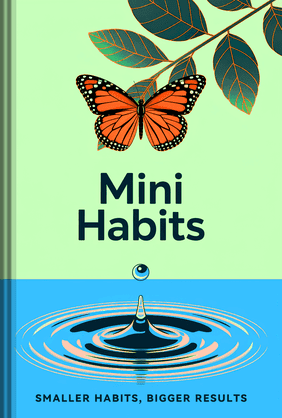
Mini Habits
Stephen Guise
39 Duration10 Key Points4.7 RateEnvironmental Design: How to Focus Working From Home
If you want to know how to stop procrastinating studying, look around your room. Willpower is finite. If your phone is face up on your desk, you are burning willpower every second you choose not to look at it. You must design an environment where doing the work is the path of least resistance.
Eliminate Visual Friction
Clear your workspace of anything that is not directly related to the task at hand. If you do not need your phone, put it in another room. Do not just put it face down; physical distance is required to break the habit loop of reaching for it. If you use a Kindle or an iPad for reading fiction on Apple Books, put those devices in a drawer. Your desk should offer you two options: do the work, or stare at a blank wall.
Create a Dedicated Work Zone
If you study on the same bed where you sleep, your brain is confused. It does not know if it should be firing up for deep work or winding down for rest.
If you live in a tiny apartment or a dorm room, create a psychological boundary. You might not have a separate office, but you can change the environment. Turn on a specific desk lamp. Play a specific instrumental playlist. Put on shoes. When the shoes are on and the lamp is lit, you are in work mode. When you finish, turn off the lamp and take off the shoes.
If your home environment is too corrupted by distractions, leave. Go to a university library or a local Barnes & Noble cafe. Sometimes, the physical act of commuting to a new location acts as a hard reset for your focus.
Engineering an environment that naturally pulls you into deep work is a superpower, especially when working or studying from home. When you eliminate visual friction and separate your relaxation zones from your workspaces, you protect your limited supply of executive function. If you are tired of losing hours to smartphone scrolling and want a comprehensive framework to safeguard your attention from digital temptations, this insightful read will help you build an impenetrable, distraction-free environment.
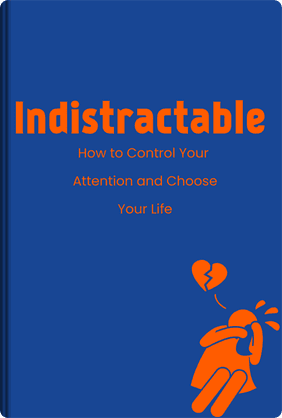
Indistractable
Nir Eyal
23 Duration10 Key Points4.5 RateBuilding a System to Prevent Relapse
Breaking the immediate freeze response is step one. Step two is structuring your days so you do not end up back in the same panic-induced paralysis tomorrow.
Decouple Planning from Execution
A major reason people freeze is that they try to figure out what to do at the exact moment they are supposed to do it. This burns through your executive function.
Separate your planning from your execution. Spend ten minutes every night outlining exactly what you need to do the next day. Write down specific, atomic tasks.
When you wake up and sit at your desk, you should not be making decisions. You should just be following the instructions left by yesterday's version of yourself.

When you wake up and sit at your desk, you should not be making decisions. You should just be following the instructions left by yesterday's version of yourself.
Use Time-Blocking with Built-In Forgiveness
The Pomodoro technique (25 minutes of work, 5 minutes of rest) is popular for a reason—it creates artificial urgency. However, if you are experiencing severe academic procrastination, 25 minutes might still feel too long.
Start with a 10-minute block. Set a timer. Work relentlessly for those 10 minutes, and then stop. The key here is strict adherence to the breaks. If you skip the breaks, your brain will quickly learn that your timers are a scam, and it will start resisting the work sessions again.
Regulate the Guilt
Guilt fuels task avoidance. If you wasted the entire morning scrolling through social media, you will likely feel so ashamed by 2:00 PM that you will write off the entire day. You must learn to compartmentalize. The morning is gone. You cannot get it back. Forgive yourself immediately and focus on salvaging the next hour. A messy, unproductive day where you get one hour of solid work done is infinitely better than a zero-hour day.
Even on those "zero-hour" days, you can still make progress. Instead of forcing yourself to sit and read when you're exhausted, you can use those low-energy moments to absorb new ideas without the friction.
Turn your commute or study breaks into productive learning sessions by listening to key ideas from nonfiction books, helping you build momentum even on low-energy days.
Download LeapAhead App now
Relying on last-minute motivation is a losing game; true productivity comes from building reliable systems that carry you through the days when you feel entirely unmotivated. By planning ahead, time-blocking, and letting go of the guilt from unproductive mornings, you create a sustainable routine. For those ready to stop treating the symptoms of procrastination and start building foolproof routines that naturally lead to success, diving into the science of habit formation is an absolute game-changer.

Atomic Habits
James Clear
26 Duration8 Key Points4.7 RateFAQ
Why do I procrastinate studying even when I know the deadline is critical?
Because knowing something is critical actually increases the pressure, which spikes your anxiety. When anxiety peaks, your brain's amygdala triggers a threat response, causing you to avoid the source of the stress (the study material). You aren't avoiding the work; you are avoiding the negative feelings associated with the work.
Because knowing something is critical actually increases the pressure, which spikes your anxiety. When anxiety peaks, your brain's amygdala triggers a threat response, causing you to avoid the source of the stress (the study material). You aren't avoiding the work; you are avoiding the negative feelings associated with the work.
Does the Pomodoro technique actually work for severe procrastination?
Yes, but you often have to modify it. If 25 minutes feels impossible, reduce the work interval to 10 or even 5 minutes. The value of a timer is not the duration; it is the definitive starting point it creates. It forces you to cross the threshold from passive avoidance to active engagement.
Yes, but you often have to modify it. If 25 minutes feels impossible, reduce the work interval to 10 or even 5 minutes. The value of a timer is not the duration; it is the definitive starting point it creates. It forces you to cross the threshold from passive avoidance to active engagement.
How do I handle the guilt of having wasted the whole day?
Treat your day like a series of independent blocks rather than a single continuous timeline. If you wasted the hours between 9:00 AM and 3:00 PM, draw a mental line in the sand. At 3:15 PM, start fresh. Do not try to compensate for the lost time by planning to stay up all night—that will just trigger more deadline anxiety. Focus entirely on executing one small task right now.
Treat your day like a series of independent blocks rather than a single continuous timeline. If you wasted the hours between 9:00 AM and 3:00 PM, draw a mental line in the sand. At 3:15 PM, start fresh. Do not try to compensate for the lost time by planning to stay up all night—that will just trigger more deadline anxiety. Focus entirely on executing one small task right now.
How can I stop procrastinating when my home is full of distractions?
You have to physically remove the distractions or yourself. Relying on willpower to ignore a TV or a smartphone never works long-term. Put the phone in a different room, use website blockers on your laptop, and if the home environment is still too chaotic, pack your bag and go to a library or coffee shop. You must engineer your environment to make working easier than slacking off.
You have to physically remove the distractions or yourself. Relying on willpower to ignore a TV or a smartphone never works long-term. Put the phone in a different room, use website blockers on your laptop, and if the home environment is still too chaotic, pack your bag and go to a library or coffee shop. You must engineer your environment to make working easier than slacking off.