

You are standing in Barnes & Noble, or hovering your mouse over the "Buy Now" button on Amazon, looking at the sheer size of Robert Greene's The Laws of Human Nature. It is a brick. Coming in at nearly 600 pages—or over 20 hours if you use an Audible credit—this is not a breezy weekend read.

Your hesitation is completely justified. You have a busy schedule, and you need to know if this time commitment pays off. Will it actually help you navigate office politics and understand people better, or is it just a repetitive rehash of dark psychology tropes?
This comprehensive laws of human nature review cuts through the marketing noise. We will break down exactly what the book delivers, compare it to Greene’s earlier work, and help you decide if it belongs on your reading list.
What Are You Actually Getting? (Moving Past the Dark Psychology Stereotype)
When people hear the name Robert Greene, they often think of ruthless manipulation. His reputation precedes him. However, The Laws of Human Nature represents a massive shift in his writing.
Instead of teaching you how to crush your enemies, this book functions as an operating manual for the human brain. Greene breaks down 18 specific "laws" that govern human behavior—ranging from irrationality and narcissism to envy and grandiosity.
The core premise is twofold:
- Inward Focus (Self-Awareness): You must recognize your own flaws, biases, and emotional triggers before you can ever hope to understand others.
- Outward Focus (Observation): People rarely tell you what they are actually thinking. You must learn to read their actions, micro-expressions, and underlying insecurities.
Greene uses extensive historical biographies to illustrate these points, dissecting the lives of figures like Martin Luther King Jr., Coco Chanel, and Anton Chekhov. But he doesn't just leave you in the past. Every chapter ends with practical strategies on how to handle these personality types in modern settings.
If you are ready to stop guessing what your coworkers or family members are really thinking, this is the definitive guide to keep on your desk. By turning the lens on your own emotional triggers first, Greene provides a deeply practical framework for understanding human behavior at its core. Grab the full book to dive into the complete 18 laws, along with the fascinating historical biographies that bring each psychological concept to life.
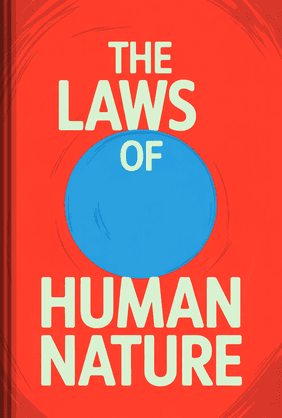
The Laws of Human Nature
Robert Greene, Paul Michael, et al.
 48 Duration
 7 Key Points
 4.5 Rate
Laws of Human Nature vs 48 Laws of Power: The Evolution of Greene
If you are a fan of Greene’s back catalog, the biggest question on your mind is likely about the laws of human nature vs 48 laws of power. How do they compare?
The 48 Laws of Power is a book about survival. It is offensive, defensive, and undeniably cynical. It assumes everyone is out to get you, and you must outmaneuver them. It is a fantastic study in Machiavellian dynamics, but trying to live by those 48 laws daily will leave you paranoid and isolated.
The Laws of Human Nature is completely different. It is mature, introspective, and heavily influenced by Stoic philosophy.
Here is the breakdown of the shift:
- The Goal: Power teaches you how to control others. Nature teaches you how to control yourself.
- The Tool: Power relies on deception and leveraging leverage. Nature relies on radical empathy and deep listening.
- The Vibe: Power feels like playing a cutthroat game of chess. Nature feels like sitting down with a seasoned therapist who forces you to look in the mirror.

If The 48 Laws of Power teaches you how to conquer a kingdom, The Laws of Human Nature teaches you how to govern yourself so you do not burn that kingdom to the ground.
As mentioned, Greene's shift toward self-mastery in this book is heavily rooted in Stoicism. If this introspective, self-governing approach resonates with you, exploring the foundations of Stoic philosophy is a fantastic next step. Ryan Holiday and Stephen Hanselman have compiled bite-sized, daily wisdom from ancient thinkers like Marcus Aurelius and Seneca. It is an excellent companion piece that will help you build the exact kind of emotional resilience and inner calm that Greene advocates for.

The Daily Stoic
Ryan Holiday & Stephen Hanselman
48 Duration9 Key Points4.6 RateCore Takeaways: Practical Value for Modern Life
So, is the laws of human nature worth reading for practical, everyday use? Absolutely. Greene’s observations map perfectly onto modern office dynamics, family relationships, and personal development. Here are three critical concepts from the book that you can apply immediately:
1. The Law of Irrationality (Master Your Emotional Self)
Greene argues that we all believe we are rational, but we are primarily driven by emotions. You cannot make good decisions if you are in the grip of anger, fear, or sudden excitement.
- The Application: Before sending a heated email to a coworker or making a massive financial decision, Greene advises increasing your "reaction time." Step back, let the emotion subside, and look at the situation objectively. He calls this riding the "Rider and the Horse" (reason guiding emotion).

The realization that humans are driven by emotion rather than logic is a major paradigm shift. If you want to explore exactly how our hidden biases dictate everything from our finances to our daily habits, behavioral economist Dan Ariely has written the gold standard on the topic. His groundbreaking research expands perfectly on Greene's first law, showing you just how predictable our seemingly irrational choices really are—and how you can outsmart your own brain.

Predictably Irrational
Dan Ariely
23 Duration10 Key Points4.6 Rate2. The Law of Narcissism (Transform Self-Love into Empathy)
Greene does not view narcissism purely as a personality disorder; he views it as a spectrum that everyone sits on. We all want to attention. However, "Deep Narcissists" lack a cohesive sense of self and suck the energy out of rooms, while healthy individuals turn their self-love outward into empathy.

- The Application: This chapter is a masterclass in identifying toxic managers and draining romantic partners early on. Greene teaches you to look for people who monopolize conversations, react with rage to minor criticism, and lack genuine curiosity about others. Once you spot them, you know to keep your distance.
For a deeper look at Greene’s methods for analyzing nonverbal cues and hidden motives, this related article is a must-read.
3. The Law of Envy (Beware the Fragile Ego)
People rarely admit they are envious, not even to themselves. Instead, envy leaks out through passive-aggressive comments, backhanded compliments, or sudden, inexplicable hostility.
- The Application: If you get a promotion or experience sudden success, do not expect everyone to be happy for you. Greene advises practicing self-deprecation. Downplay your success slightly, attribute some of it to luck, and elevate the people around you to prevent triggering their hidden envy.
While this review covers three of the core concepts, Greene's book is packed with many more.
Robert Greene Criticism: Addressing the Skeptics
No book is perfect, and this one is not without its detractors. When analyzing robert greene criticism, a few consistent themes emerge.
First, academics often accuse Greene of being a "pop historian." He has a habit of retrofitting historical events to perfectly match the psychological law he is trying to prove. He might gloss over the messy nuances of a historical figure's life to make a cleaner point.
Second, the sheer length of the book is a frequent point of contention. Some readers argue that the core lessons could have been condensed into a 300-page book without losing their impact. The historical stories, while entertaining, sometimes drag on longer than necessary before getting to the actionable advice.
If the sheer length is the main barrier holding you back, but you still want to absorb Greene's powerful insights, there are ways to get the key lessons without the 20-hour time commitment.


LeapAhead

Grasp the core ideas from dense books like this one in just 15-minute audio or text summaries, making it easy to learn even with a busy schedule.
What the Community Says: Laws of Human Nature Reddit Consensus
If you want unvarnished opinions, looking up a laws of human nature reddit thread is usually a safe bet. Across subreddits like r/books, r/Stoicism, and r/selfimprovement, the consensus is surprisingly unified.
Most Redditors consider this to be Greene’s best and most ethical work. Many users note that reading it helped them pull away from toxic friendships and understand their own self-sabotaging behaviors.
However, the Reddit community universally warns against trying to binge-read it. The most common advice you will find is: Do not read this cover-to-cover in one sitting. Treat it like a textbook. Read one chapter, put the book down for a few days to digest the concepts and observe the people around you, and then move on to the next.
The Final Verdict: Should You Invest the Time?
If you are looking for a quick listicle on how to "hack" your brain or manipulate people, skip this book. You will get bored halfway through the first historical anecdote.
However, if you are genuinely interested in psychology, self-improvement, and understanding why people do the confusing, irrational things they do, The Laws of Human Nature is a masterwork.
Who should read it:
- Managers and team leaders trying to navigate difficult personalities.
- People who have recently dealt with a toxic relationship and want to understand the red flags they missed.
- Anyone interested in Stoic philosophy and emotional regulation.
It requires patience, but the return on your time investment is immense. Buy the physical copy, keep a highlighter handy, and take your time with it.
Of course, for many people, finding 20+ hours for a single book is a major challenge. If you want to absorb the key takeaways from Greene's work and other nonfiction bestsellers while on the go, a book summary app can be a game-changer.
LeapAhead
Learn the 18 laws of human nature during your commute or workout, ensuring you don't miss out on valuable knowledge due to a packed schedule.
Finally, if you are drawn to Greene's advice on navigating difficult personalities but want something a bit lighter and faster to read, you might enjoy Thomas Erikson's runaway hit on workplace communication. It provides a simple, color-coded framework for understanding different behavior types. It is the perfect follow-up for managers or anyone looking to instantly improve how they handle office dynamics, communicate with stubborn colleagues, and protect their energy from draining individuals.

Surrounded by Idiots
Thomas Erikson
48 Duration7 Key Points4.6 RateFAQ
How long does it take to read The Laws of Human Nature?
At roughly 600 pages, a person reading at an average speed will take about 15 to 20 hours to finish the book. The audiobook version on Audible runs for 21 hours and 15 minutes. It is highly recommended to read or listen to one chapter at a time to fully absorb the material.
At roughly 600 pages, a person reading at an average speed will take about 15 to 20 hours to finish the book. The audiobook version on Audible runs for 21 hours and 15 minutes. It is highly recommended to read or listen to one chapter at a time to fully absorb the material.
Do I need to read The 48 Laws of Power before this one?
No. The Laws of Human Nature is a completely standalone book. In fact, many readers find it to be a better starting point for Robert Greene's work because it provides a foundational understanding of human psychology that is more applicable to everyday life.
No. The Laws of Human Nature is a completely standalone book. In fact, many readers find it to be a better starting point for Robert Greene's work because it provides a foundational understanding of human psychology that is more applicable to everyday life.
Is The Laws of Human Nature just about dark psychology?
Not at all. While Greene is famous for writing about manipulation in his earlier works, this book focuses heavily on empathy, emotional intelligence, and self-awareness. It teaches you how to spot toxic traits in others to protect yourself, but equally emphasizes recognizing and fixing your own flaws.
Not at all. While Greene is famous for writing about manipulation in his earlier works, this book focuses heavily on empathy, emotional intelligence, and self-awareness. It teaches you how to spot toxic traits in others to protect yourself, but equally emphasizes recognizing and fixing your own flaws.