


You checked all the boxes. You put in the 80-hour weeks, secured the promotion, organized your life around maximum productivity, and padded the bank account. Yet, the reward for winning the game often feels like a lingering sense of exhaustion. You wake up tired. Your mind races through checklists before your feet even touch the floor. You have everything you thought you wanted, but inner peace is nowhere to be found.
This is the high-achiever's trap. You treated happiness as a destination—a prize waiting at the end of a very long, grueling marathon.
Naval Ravikant, the entrepreneur and modern philosopher, completely dismantled this idea. He reframed the concept of joy for a generation of burned-out professionals. In his view, happiness is not a dopamine hit triggered by a new car, a vacation, or a spike in your stock portfolio. Happiness is the absence of desire. It is a default state you can return to once you stop letting your mind run wild.
The Core of Naval Philosophy on Life
At the core of the Naval philosophy on life is a radical redefinition of what it means to be successful. Society teaches us that success equals continuous addition: more money, more status, more possessions. Naval argues that true peace is found in subtraction.
Desire as a Contract for Unhappiness
One of Naval's most powerful mental models is his definition of desire. He states, "Desire is a contract that you make with yourself to be unhappy until you get what you want."
Think about your current goals. You want a massive exit for your startup. You want to lose 10 pounds. You want to buy a house in a better neighborhood. The moment you lock onto that desire, you secretly tell your brain: I am not enough right now. I will only be okay once this specific condition is met.

High-achievers sign hundreds of these contracts every single day. We stack them on top of each other. No wonder you feel anxious. You are in chronic default on your emotional loans. Realizing this mechanism is the first step out of the trap. You do not have to stop being ambitious, but you must become ruthlessly selective about which desires you allow into your mind. Pick one overwhelming desire at a time. Drop the rest.
Many of Naval's most powerful ideas, like this one, are distilled into memorable and thought-provoking statements that can reframe how you see the world.
Happiness is Peace in Motion
Most people confuse happiness with pleasure. Pleasure is a spike. It is the thrill of a sugar rush, the excitement of an Amazon package hitting your porch, or the instant gratification of social media likes. Pleasure is inherently fragile because it always crashes.
Naval defines happiness as peace. When you are at peace, you are not thinking about the past or worrying about the future. You are completely absorbed in the present moment. If peace is the baseline, then happiness is simply peace in motion.
If you find this redefinition of success compelling and want to dive deeper into Naval’s mental models, there is one definitive collection you should read. Gathering his best interviews, tweets, and essays, this book perfectly encapsulates how to build wealth without sacrificing your inner peace. It is the ultimate playbook for high-achievers who want to win at business while maintaining a profound sense of baseline joy.
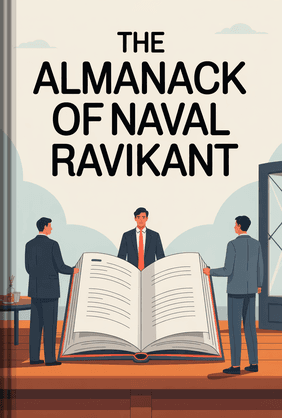
The Almanack of Naval Ravikant
Eric Jorgenson
 14 Duration
 7 Key Points
 4.7 Rate
Happiness as a Highly Trainable Skill
If you want to know how to be happy Naval style, you have to stop looking for external fixes and start treating your brain like a muscle.
Happiness is a choice you make, and then a skill you develop. You wouldn't expect to run a sub-six-minute mile without months of rigorous training. You shouldn't expect to have a peaceful mind without putting in the mental reps. Your brain is malleable. Through neuroplasticity, the habits of thought you practice daily become your permanent hardware.

The Algorithm of Contentment
High-achievers love algorithms. Here is the algorithm for building the happiness muscle:
- Observe your mind: Notice when you are judging a situation.
- Accept reality: The world does not care about your expectations. It simply is.
- Remove the friction: If you cannot change a situation, and you cannot leave it, you must accept it. Anything else is choosing to suffer.
When you sit in traffic on the 405, getting angry does not make the cars move faster. It only spikes your cortisol. The situation is neutral. Your reaction makes it miserable. Training the skill of happiness means systematically stripping away these unnecessary reactions.
The Naval Ravikant Meditation Routine
When type-A personalities decide to try mindfulness, they usually overcomplicate it. They download three different apps, buy an expensive cushion, light incense, and track their "mindful minutes" on an Apple Watch. They turn peace into another metric to optimize.
The Naval Ravikant meditation routine is shockingly simple, yet incredibly difficult for high-achievers to execute. There are no guided audios. No chanting. No specific breathing patterns to memorize.
Inbox Zero for the Brain
Naval describes his meditation practice as treating the mind like an email inbox. Throughout your life, you accumulate a massive backlog of unprocessed thoughts, fears, and regrets. Because you are constantly busy—listening to Audible on your commute, scrolling through news, answering Slack messages—you never give your brain time to process the backlog.
His method is straightforward:
- Sit in a quiet room.
- Close your eyes.
- Do absolutely nothing for 60 minutes.
The Processing Phase
When you first try this, it will feel like torture. Your mind will scream at you to check your phone. Anxiety will flare up. You will remember an embarrassing thing you said in 2014. You will worry about your Q3 projections.
Do not fight it. Let the thoughts come.
As Naval explains, these are the unread emails of your mind. You have to open them, read them, and let them go. If you do this consistently, day after day, something magical happens. The backlog starts to clear. The thoughts slow down. You eventually reach a state of mental "inbox zero." That is where profound, unshakable peace lives.
Clearing out your mental inbox and facing that backlog of unprocessed thoughts is easier said than done. If you are struggling with the friction of sitting in silence, learning a structured method to release old baggage can be a massive game-changer. This classic guide dives deeply into the mechanics of surrendering emotional attachments and dropping the heavy expectations that weigh you down, making it the perfect companion for your new meditation practice.
Letting Go
David R. Hawkins, M.D., Ph.D.
39 Duration8 Key Points4.6 RateOf course, building new habits like meditation and consistent reading is tough when you’re already overcommitted. If you want to absorb the wisdom from books like this but can't find the time for long reading sessions, there are more efficient ways to learn.

Grasp the core lessons from profound books on mindfulness and mental clarity in 15-minute audio sessions, perfect for reclaiming your learning time.

Download LeapAhead App now

Achieving Naval Ravikant Peace of Mind
Achieving true Naval Ravikant peace of mind requires a complete audit of your daily inputs. You cannot consume toxic, fear-based media for four hours a day and expect to maintain a calm baseline. Your mental diet matters just as much as your physical diet.
The Triangle of Wealth, Health, and Happiness
Naval outlines a clear hierarchy for a well-lived life. Most people prioritize it backwards. They sacrifice their health and their happiness to acquire wealth. Then, later in life, they spend all their wealth trying to buy back their health and happiness.
The correct order of operations is:
- Health: Without physical vitality, nothing else matters. A sick man only wants one thing.
- Happiness: The ability to be content with what you have.
- Wealth: Financial freedom to buy back your time.
Wealth is important, but only as a tool. The ultimate purpose of money is to solve your money problems so you can get back to the real work of mastering your mind. If your pursuit of wealth destroys your peace, you are failing the game.
While this article focuses on the happiness component, understanding Naval's framework for building wealth is crucial. He believes true wealth isn't about money, but about freedom, and it's built on unique principles of accountability and leverage.
Shifting your perspective on wealth from a status symbol to a tool for buying back your time requires a total mindset overhaul. To truly understand how financial freedom intersects with human behavior and peace of mind, consider exploring how our biases shape our money habits. This brilliant read illustrates that doing well with money has little to do with how smart you are, and everything to do with how you behave—and how you define "enough."
The Psychology of Money
Morgan Housel
48 Duration7 Key Points4.6 RateRadical Honesty and Acceptance
A major source of anxiety is the gap between reality and our expectations. We spend an enormous amount of energy trying to bend the world to our will.
To cultivate peace, you must practice radical acceptance. Tell the truth to yourself and others. Lying requires memory, maintenance, and constant cognitive load. Honesty frees up mental RAM. Accept the people around you as they are. You cannot change them. You can only change how you interact with them, or choose to walk away.
Practical Steps to Execute the Framework
Understanding the philosophy is only 10% of the battle. The remaining 90% is execution. Here is how you can start applying this framework today without quitting your job and moving to a monastery.
1. Reclaim Your Time
A busy calendar and a busy mind will destroy your peace. If your schedule is packed back-to-back from 8 AM to 6 PM, you have zero margin for reflection. Block out at least one hour of unstructured time a day. Guard it fiercely.
A busy calendar and a busy mind will destroy your peace. If your schedule is packed back-to-back from 8 AM to 6 PM, you have zero margin for reflection. Block out at least one hour of unstructured time a day. Guard it fiercely.
2. Audit Your Desire Contracts
Write down everything you are currently stressed about. Next to each item, write the "desire contract" you signed. (e.g., I am stressed because I desire a 20% revenue bump this quarter). Look at the list and ask yourself: Which of these actually matter? Cross out the bottom 80%. Release yourself from those contracts.
Write down everything you are currently stressed about. Next to each item, write the "desire contract" you signed. (e.g., I am stressed because I desire a 20% revenue bump this quarter). Look at the list and ask yourself: Which of these actually matter? Cross out the bottom 80%. Release yourself from those contracts.
3. Play Long-Term Games
Short-term games breed anxiety. Long-term games create compound interest in wealth, relationships, and peace. Stop reacting to hourly market fluctuations or daily office drama. Zoom out. Ask yourself if this will matter in five years. If the answer is no, stop giving it your emotional energy.
Short-term games breed anxiety. Long-term games create compound interest in wealth, relationships, and peace. Stop reacting to hourly market fluctuations or daily office drama. Zoom out. Ask yourself if this will matter in five years. If the answer is no, stop giving it your emotional energy.
4. Disconnect from the Outrage Machine
The modern internet is optimized for engagement, and the most engaging emotion is anger. Step away from Twitter debates and 24-hour news cycles. Read old books. Spend time in nature. The further away you get from the algorithms, the closer you get to your own baseline of peace.
The modern internet is optimized for engagement, and the most engaging emotion is anger. Step away from Twitter debates and 24-hour news cycles. Read old books. Spend time in nature. The further away you get from the algorithms, the closer you get to your own baseline of peace.
Happiness is not something that happens to you. It is a state you engineer through subtraction, acceptance, and rigorous mental hygiene. You have already proven you can master complex systems in your career. It is time to apply that same level of mastery to your own mind.
If Naval's approach to happiness resonates with you, exploring the full breadth of his philosophy is the logical next step. His book covers not just inner peace, but also wealth creation and judgment.
The best way to master your mind is to consistently expose it to powerful ideas. For busy people who struggle to find time for deep reading, fitting learning into the pockets of your day is a more realistic approach.
Learn the key ideas from books on wealth, success, and philosophy in 15-minute summaries, turning your commute or workout into a powerful learning habit.
Download LeapAhead App now
Applying these practical steps means you have to start saying "no" to the endless demands on your schedule and focus only on what truly moves the needle. If you need a framework to help you ruthlessly audit your commitments and reclaim your time, this book is an absolute must-read. It will teach you how to cut out the trivial noise so you can channel your energy into the few desires that actually matter to your long-term vision.
Essentialism
Greg McKeown
32 Duration10 Key Points4.6 RateFAQ
Did Naval actually retire to become happy?
No. Naval did not retire in the traditional sense of sitting on a beach doing nothing. He still invests, writes, and builds companies. However, he achieved financial independence, which allowed him to "retire" from doing things he doesn't want to do. He approaches work as play. You do not need to quit your career to be happy; you need to detach your self-worth from the outcome of your work.
No. Naval did not retire in the traditional sense of sitting on a beach doing nothing. He still invests, writes, and builds companies. However, he achieved financial independence, which allowed him to "retire" from doing things he doesn't want to do. He approaches work as play. You do not need to quit your career to be happy; you need to detach your self-worth from the outcome of your work.
How long does it take to see results from his 60-minute meditation style?
It varies, but most high-achievers notice a shift within 30 to 60 days of consistent practice. The first few weeks are usually highly uncomfortable as you face the "backlog" of unprocessed thoughts. Once the mental inbox starts clearing, the baseline anxiety drops significantly. The key is consistency, not immediate results.
It varies, but most high-achievers notice a shift within 30 to 60 days of consistent practice. The first few weeks are usually highly uncomfortable as you face the "backlog" of unprocessed thoughts. Once the mental inbox starts clearing, the baseline anxiety drops significantly. The key is consistency, not immediate results.
Can I be highly ambitious and still be happy?
Yes, but you must change your relationship with ambition. Unhealthy ambition is driven by a feeling of lack—believing you will only be whole once you achieve the goal. Healthy ambition (Naval's approach) is treating the pursuit as a game. You strive for excellence, build great things, and push your limits, but you remain emotionally detached from the final result.
Yes, but you must change your relationship with ambition. Unhealthy ambition is driven by a feeling of lack—believing you will only be whole once you achieve the goal. Healthy ambition (Naval's approach) is treating the pursuit as a game. You strive for excellence, build great things, and push your limits, but you remain emotionally detached from the final result.
Isn't accepting reality just an excuse to be lazy or give up?
Acceptance is not resignation. Acceptance simply means acknowledging the objective truth of a situation without emotional resistance or judgment. Once you calmly accept reality exactly as it is, you can make clear, rational decisions on how to improve it. Anger and denial waste energy; acceptance conserves energy for effective action.
Acceptance is not resignation. Acceptance simply means acknowledging the objective truth of a situation without emotional resistance or judgment. Once you calmly accept reality exactly as it is, you can make clear, rational decisions on how to improve it. Anger and denial waste energy; acceptance conserves energy for effective action.