

You are sitting in a high-stakes tech interview or an investor pitch, and the hiring manager drops the ultimate curveball. Your mind races to find a profound insight that proves your intelligence without making you sound completely unhinged. Finding the exact balance between original thinking and logical reasoning under pressure is exactly why this prompt ruins so many interviews.

Unpacking the Zero to One Interview Question
Before you can formulate a winning response, you have to understand the origin and mechanics of the prompt. Legendary Silicon Valley investor and PayPal co-founder Peter Thiel popularized this prompt in his book. The core of the Zero to One interview question centers around identifying opportunities that others miss.
When Thiel asks, "what important truth do very few people agree with you on?", he is not looking for a trivia fact or a universal moral stance. A fact is verifiable data. A truth requires human judgment, synthesis of information, and a definitive worldview.
The prompt filters candidates based on two distinct axes:
- Intellectual Autonomy: Can you think for yourself, or do you just repeat what you read in Forbes or saw on LinkedIn?
- Courage: Are you willing to hold an unpopular opinion in a room full of authority figures and defend it?
To truly master this interview question, you need to understand the fundamental worldview of the man who created it. While you shouldn't quote his own book back to him or his disciples in an interview, reading the foundational text on Silicon Valley's contrarian mindset will help you grasp why investors and founders value unique insights over incremental improvements. It is an indispensable guide for anyone looking to build products or careers that create entirely new markets instead of just competing in existing ones.
For a deeper understanding of the concepts that fuel this line of questioning, it's helpful to explore the book's core arguments.

Zero to One
Peter Thiel, Blake Masters
 47 Duration
 8 Key Points
 4.5 Rate
Reading foundational texts like these is crucial, but it can be a huge time commitment when you're busy prepping for interviews. For a faster way to grasp the core concepts, a book summary app can be a game-changer.

Grasp the core insights from Zero to One and other essential business books in 15-minute summaries to sharpen your thinking for high-stakes interviews.

Download LeapAhead App now
The Hidden Motives: Why Interviewers Love the Peter Thiel Contrarian Question
Hiring managers at companies like Amazon, Apple, and high-growth startups use the Peter Thiel contrarian question because it immediately breaks the candidate's rehearsed script. You cannot memorize an answer to this from a standard interview prep guide.
Interviewers are looking for three specific signals:
Defensibility Over Accuracy
They do not actually have to agree with your truth. They are evaluating how you build your argument. Do you rely on emotion, or do you present a structured, logical case supported by professional experience?
They do not actually have to agree with your truth. They are evaluating how you build your argument. Do you rely on emotion, or do you present a structured, logical case supported by professional experience?
Domain Expertise
A genuine contrarian truth usually stems from spending thousands of hours in a specific field. If you are a supply chain manager, your truth should probably be about logistics, not abstract philosophy. Deep expertise breeds highly specific, counter-intuitive observations.
A genuine contrarian truth usually stems from spending thousands of hours in a specific field. If you are a supply chain manager, your truth should probably be about logistics, not abstract philosophy. Deep expertise breeds highly specific, counter-intuitive observations.
Emotional Regulation
If the interviewer pushes back and challenges your truth, do you crumble and apologize? Do you become defensive and aggressive? The ideal candidate listens to the counter-argument, acknowledges its validity, and calmly defends their original premise.

If the interviewer pushes back and challenges your truth, do you crumble and apologize? Do you become defensive and aggressive? The ideal candidate listens to the counter-argument, acknowledges its validity, and calmly defends their original premise.
When interviewers test your intellectual autonomy, they are essentially looking for what organizational psychologists call "non-conformists." Cultivating a contrarian truth isn't just an interview tactic; it is a leadership trait that drives genuine innovation. If you want to dive deeper into how to champion ideas that go against the grain—and how to communicate those unpopular opinions without alienating your colleagues—exploring the science behind how non-conformists move the world forward can be an incredible asset for your professional development.

Originals
Adam Grant
37 Duration8 Key Points4.6 RateHow to Answer Peter Thiel Question: A 4-Step Framework
Figuring out how to answer Peter Thiel question requires preparation. You cannot invent a brilliant contrarian truth on the spot. Use this four-step framework to mine your own background for the right answer.
Step 1: Mine Your Professional Niche
Stay in your lane. You are not trying to predict the geopolitical future of the world 3,000 miles away. Look directly at your daily work, your specific industry, or your specific academic background.
- If you are a software engineer, think about coding practices, team structures, or product deployment.
- If you are in B2B sales, focus on lead generation, customer psychology, or CRM software.
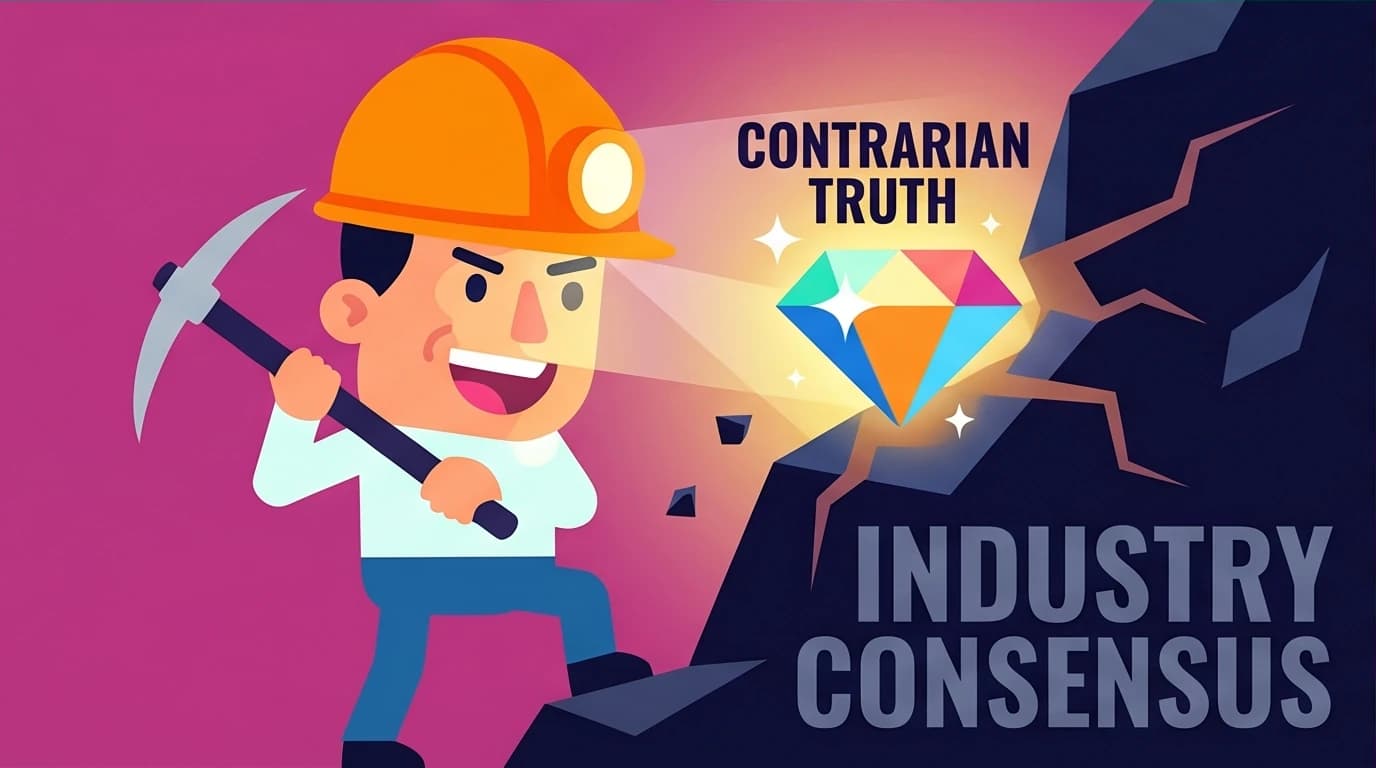
Step 2: Map the Consensus (The Dogma)
Identify what everyone in your industry accepts as a "best practice" without questioning it. What is the standard advice every mentor gives? What is the default strategy every Fortune 500 company applies?
- Example consensus: "Remote work offers the same productivity as in-office work."
- Example consensus: "Startups must obsess over customer acquisition cost (CAC) from day one."
Step 3: Pivot to Your Reality
Locate the exact point where your actual, real-world experience contradicts that consensus. What have you seen fail repeatedly, even though it is considered an industry standard?
- Your reality: Remote work actually devastates the onboarding and ramp-up speed of junior developers.
- Your reality: Early-stage startups that obsess over CAC usually fail because they optimize for cheap clicks instead of long-term product-market fit.
Step 4: Construct the Delivery
Package your answer cleanly. State the consensus, state your contrarian truth, and immediately follow up with concrete evidence. Do not ramble.
The Delivery Formula:
"Most people in my industry believe [Consensus]. But in my experience, the opposite is true: [Your Truth]. I realized this when [Specific Data Point / Experience]."
"Most people in my industry believe [Consensus]. But in my experience, the opposite is true: [Your Truth]. I realized this when [Specific Data Point / Experience]."
Real-World Examples: The Good, The Bad, and The Disastrous
To truly master the Peter Thiel interview question, you need to recognize the difference between a profound insight and a terrible cliché.
Disastrous Answers (What to Avoid)
The Universal Truth Disguised as Contrarian:
- "I believe hard work is more important than natural talent."
Everyone agrees with this. It is safe, boring, and fails the test completely.
The Unprovable Philosophical Claim:
- "I believe humans are inherently selfish."
This is a late-night dorm room debate, not a professional insight. You cannot prove this with data or professional experience.
The Combative or Offensive Opinion:
- "I believe most marketing departments are completely useless."
This shows arrogance and an inability to collaborate cross-functionally. It is a red flag for hiring managers.
Excellent Answers (What to Emulate)
Example 1: Software Engineering
"Most engineering leaders believe that moving to microservices is the inevitable next step for scaling a successful application. I think that's a massive trap. For 90% of startups, adopting a microservices architecture too early actually kills feature velocity and creates a DevOps nightmare. I saw this firsthand at my last company, where we spent six months fixing deployment pipelines instead of building features."
Why it works: It challenges a massive tech trend (microservices), targets a specific audience (startups), and provides a logical reason backed by direct experience.
"Most engineering leaders believe that moving to microservices is the inevitable next step for scaling a successful application. I think that's a massive trap. For 90% of startups, adopting a microservices architecture too early actually kills feature velocity and creates a DevOps nightmare. I saw this firsthand at my last company, where we spent six months fixing deployment pipelines instead of building features."
Why it works: It challenges a massive tech trend (microservices), targets a specific audience (startups), and provides a logical reason backed by direct experience.
Example 2: Product Management
"The accepted wisdom in SaaS is that you should always build features based on what your most vocal users request. I believe that listening strictly to user feature requests is the fastest way to ruin a product. Users are great at identifying their pain points, but they are terrible at designing scalable solutions. If you just build what they ask for, you end up with a bloated Frankenstein product."
Why it works: It takes a sacred cow ("listen to your customers") and adds a highly intelligent nuance.

"The accepted wisdom in SaaS is that you should always build features based on what your most vocal users request. I believe that listening strictly to user feature requests is the fastest way to ruin a product. Users are great at identifying their pain points, but they are terrible at designing scalable solutions. If you just build what they ask for, you end up with a bloated Frankenstein product."
Why it works: It takes a sacred cow ("listen to your customers") and adds a highly intelligent nuance.
The most effective answers often reflect Thiel's broader business philosophy: the goal isn't just to be different, but to build something so unique that it escapes competition entirely.
Brainstorming Your Personal Contrarian Truth
If you are struggling to find your own truth, sit down with a blank piece of paper and ask yourself these three questions:
- What standard industry tool or framework do I secretly hate because I know it doesn't work?
- What piece of standard advice do I actively tell my junior colleagues to ignore?
- When was the last time I looked at a successful project and realized we achieved it by doing the exact opposite of what the manual said?
Write down five to ten rough ideas. Eliminate anything political, religious, or overly pessimistic. Pick the one you can talk about passionately for five minutes using real-world metrics.
Sometimes the hardest part of brainstorming a contrarian truth is simply breaking free from the cognitive biases and dogmas you have picked up throughout your career. If you are struggling to look at your specific industry from a fresh, unbiased angle, it helps to adopt a problem-solving framework that actively forces you to question conventional wisdom, reassess hidden incentives, and strip away the "best practices" that everyone else blindly follows.
Think Like a Freak
Steven D. Levitt, Stephen J. Dubner
14 Duration7 Key Points4.6 RateNavigating the Pushback
Once you deliver your answer, expect the interviewer to challenge you. This is part of the test. They might say, "That doesn't make sense. If what you're saying is true, why is Amazon doing the exact opposite?"
Do not panic. Do not backpedal. Acknowledge their point, then hold your ground.
Response strategy: "That's a fair point, and Amazon's scale allows them to operate differently. But for companies operating under $50 million in ARR, the dynamic changes completely because..."
This shows you can handle intellectual friction without taking it personally. You are demonstrating the exact kind of clear-headed resilience required to survive in a high-pressure corporate environment.
Defending your stance when a senior executive aggressively pushes back is a high-stakes communication skill that goes far beyond a single interview question. Whether you are pitching a venture capitalist or disagreeing with your future boss, you need to know how to stay calm, validate their perspective, and articulate your logic without crossing the line into arrogance. Mastering the art of dialogue when emotions run high and opinions vary is arguably one of the most critical soft skills for advancing your career.
Crucial Conversations
Kerry Patterson, Joseph Grenny, Ron McMillan, Al Switzer
20 Duration9 Key Points4.7 RateBuilding skills like these often means absorbing ideas from many different books, which can feel overwhelming. If you want to consistently learn from the world's best thinkers without the heavy time commitment, an app can help you fit that learning into the gaps in your day.
Turn your commute into a masterclass by listening to key takeaways from books on communication and strategy to excel in any professional challenge.
Download LeapAhead App now
FAQ
Can I use a business example directly from Peter Thiel's book?
Absolutely not. Quoting Zero to One back to the interviewer defeats the entire purpose of the question. The interviewer wants to assess your original thinking and your personal experiences, not your reading comprehension. Using Thiel's own examples (like his views on monopolies or education) will immediately flag you as unoriginal.
Absolutely not. Quoting Zero to One back to the interviewer defeats the entire purpose of the question. The interviewer wants to assess your original thinking and your personal experiences, not your reading comprehension. Using Thiel's own examples (like his views on monopolies or education) will immediately flag you as unoriginal.
Is it ever okay to talk about politics or religion?
No. Even if your political or religious view is genuinely contrarian and you can defend it logically, it introduces massive subconscious bias into the interview process. It creates unnecessary tension and violates professional boundaries. Stick strictly to business, technology, human behavior, or industry-specific mechanics.
No. Even if your political or religious view is genuinely contrarian and you can defend it logically, it introduces massive subconscious bias into the interview process. It creates unnecessary tension and violates professional boundaries. Stick strictly to business, technology, human behavior, or industry-specific mechanics.
What if the interviewer strongly disagrees and gets annoyed?
If you presented your truth respectfully and backed it up with data, but the interviewer still gets angry, you have uncovered a culture mismatch. A company that punishes well-reasoned dissenting opinions during the interview will be a toxic place to work. Hold your ground calmly. You cannot control their reaction; you can only control your logical defense.
If you presented your truth respectfully and backed it up with data, but the interviewer still gets angry, you have uncovered a culture mismatch. A company that punishes well-reasoned dissenting opinions during the interview will be a toxic place to work. Hold your ground calmly. You cannot control their reaction; you can only control your logical defense.
Does my contrarian truth have to be a massive, world-changing idea?
No. Candidates often fail because they try to sound like a visionary philosopher. Your truth does not need to redefine humanity. It just needs to be a highly specific, accurate observation about your particular field that goes against the grain. A sharp insight about inventory management is infinitely better than a vague prediction about artificial intelligence.
No. Candidates often fail because they try to sound like a visionary philosopher. Your truth does not need to redefine humanity. It just needs to be a highly specific, accurate observation about your particular field that goes against the grain. A sharp insight about inventory management is infinitely better than a vague prediction about artificial intelligence.