

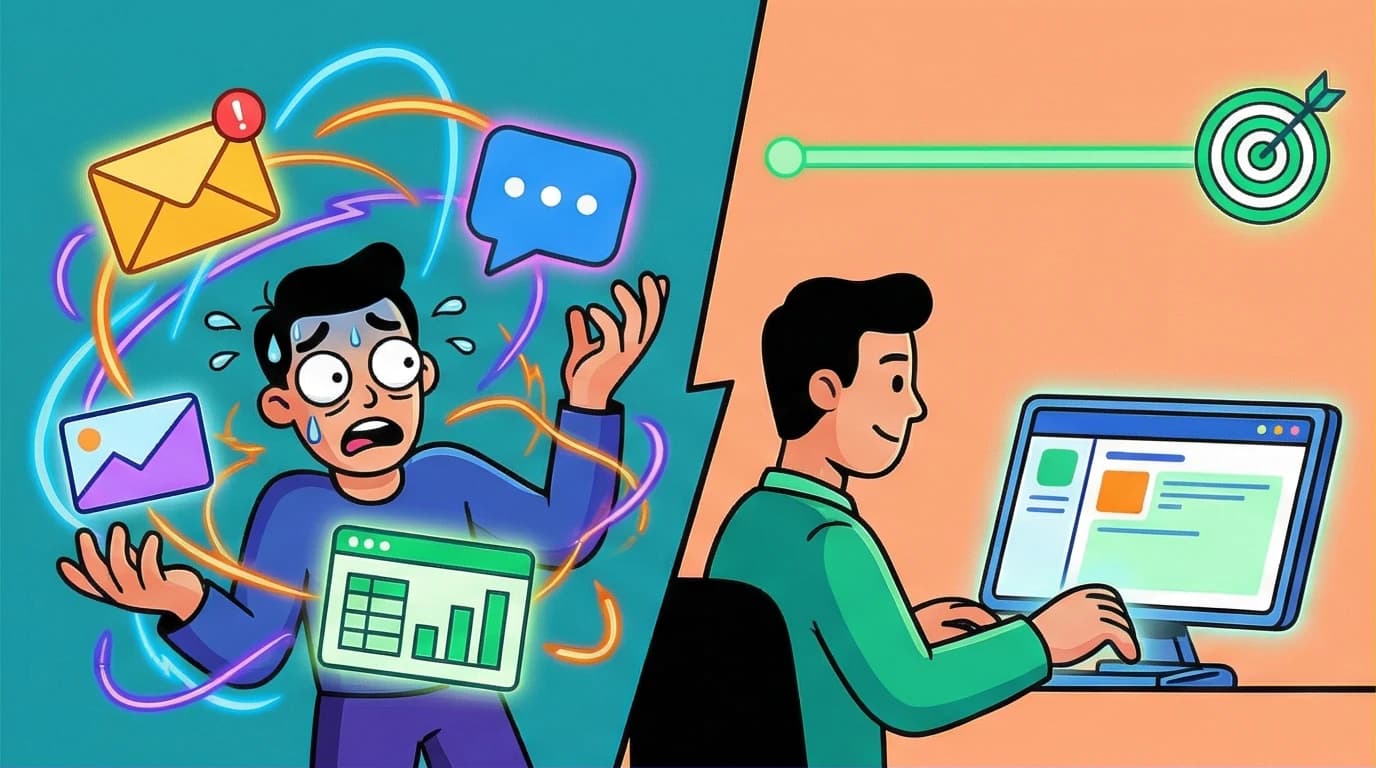
Your Slack pings. Your inbox shows 43 unread emails. You have three Google Docs open, a spreadsheet waiting for data, and your phone just buzzed with an Amazon delivery update. You bounce between these windows for eight hours. By 4 PM, you feel completely exhausted. Yet, when you look back at your day, you realize you accomplished absolutely nothing of actual substance.
This is the modern American workday. We are conditioned to believe that juggling five projects at once makes us highly productive employees. We wear busyness as a badge of honor. But science tells a completely different story.
When you compare single tasking vs multitasking, the data is brutal and definitive. Multitasking is a biological illusion that drains your energy and sabotages your career. If you want to stop feeling burned out and start getting actual work done, you have to change how you operate.
The Multitasking Myth: Why Your Brain Hates Juggling
To understand why multitasking is bad, you first need to understand a basic fact about the human brain: it cannot process two complex, independent tasks simultaneously.
When you think you are multitasking—writing an email while listening to a Zoom call—you are not doing both things at the same time. You are doing something neuroscientists call "rapid serial task switching." Your brain is frantically pausing one task, shifting its attention, and starting the other task. It does this back and forth, microsecond by microsecond.
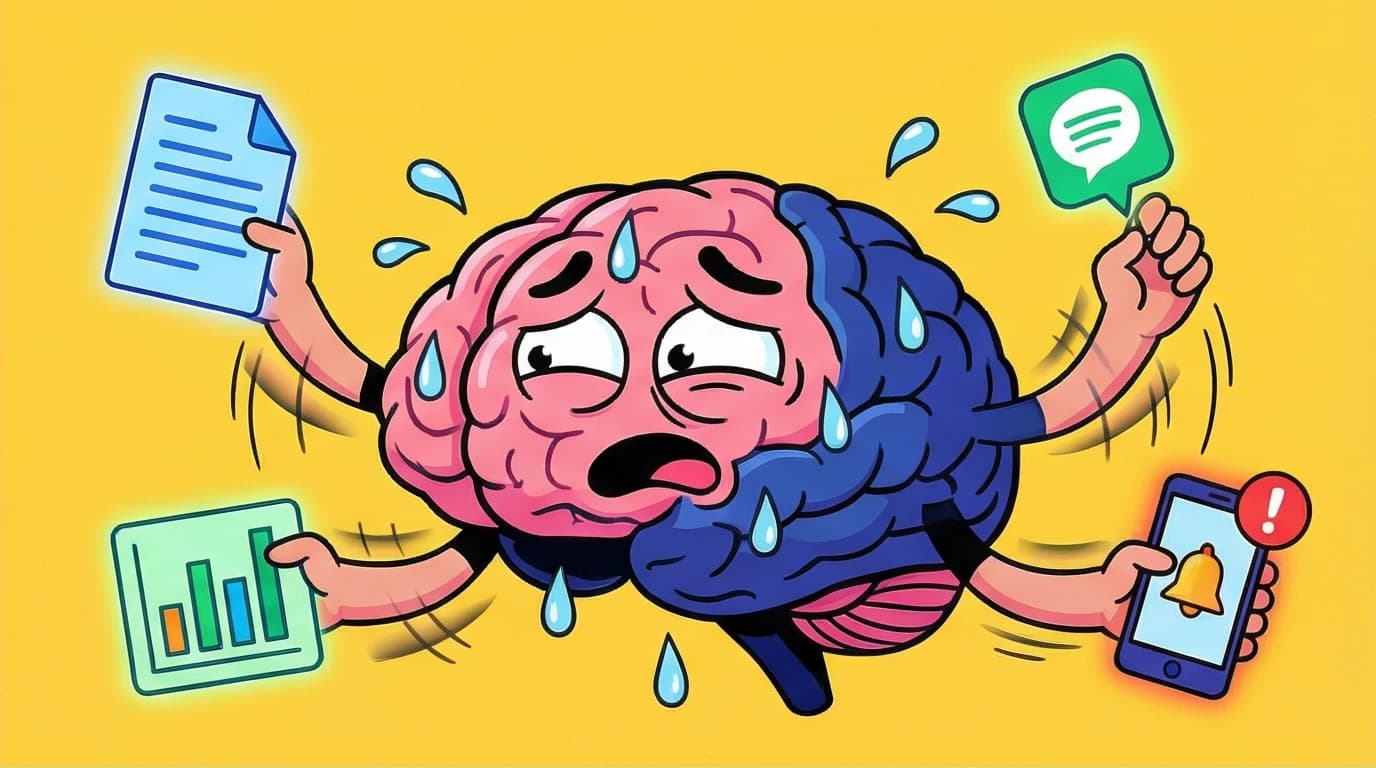
This mechanical switching burns an incredible amount of oxygenated glucose, the very fuel you need to stay alert and make good decisions.
The American Psychological Association reports that this constant mental juggling can reduce productivity by up to 40%. You are essentially running your brain like an iPhone with 50 apps open in the background. The battery drains faster, the system overheats, and everything lags. You make more mistakes. You forget critical details. You operate in a constant state of low-grade anxiety because your nervous system is trapped in a fight-or-flight response, triggered by endless notifications.
This constant mental drain is why so many people feel too exhausted to learn or read after work. If your attention is already fragmented, a better approach is to fit learning into the small gaps you already have, rather than trying to force long, focused sessions.


LeapAhead

Reclaim your personal growth by getting key ideas from bestselling books in 15-minute audio or text summaries, perfect for learning even on the most mentally draining days.
The Hidden Tax of Context Switching Cost
The most destructive element of rapid task switching is the context switching cost.
Every time you pull your attention away from a high-focus task to check a Slack message or glance at an email, your brain has to load a new "mental context." When you return to your original task, your brain has to reload the previous context.
Research shows it takes an average of 23 minutes and 15 seconds to fully regain deep focus after an interruption. If you check your email just four times an hour, you are mathematically guaranteeing that you will never reach a state of deep concentration.
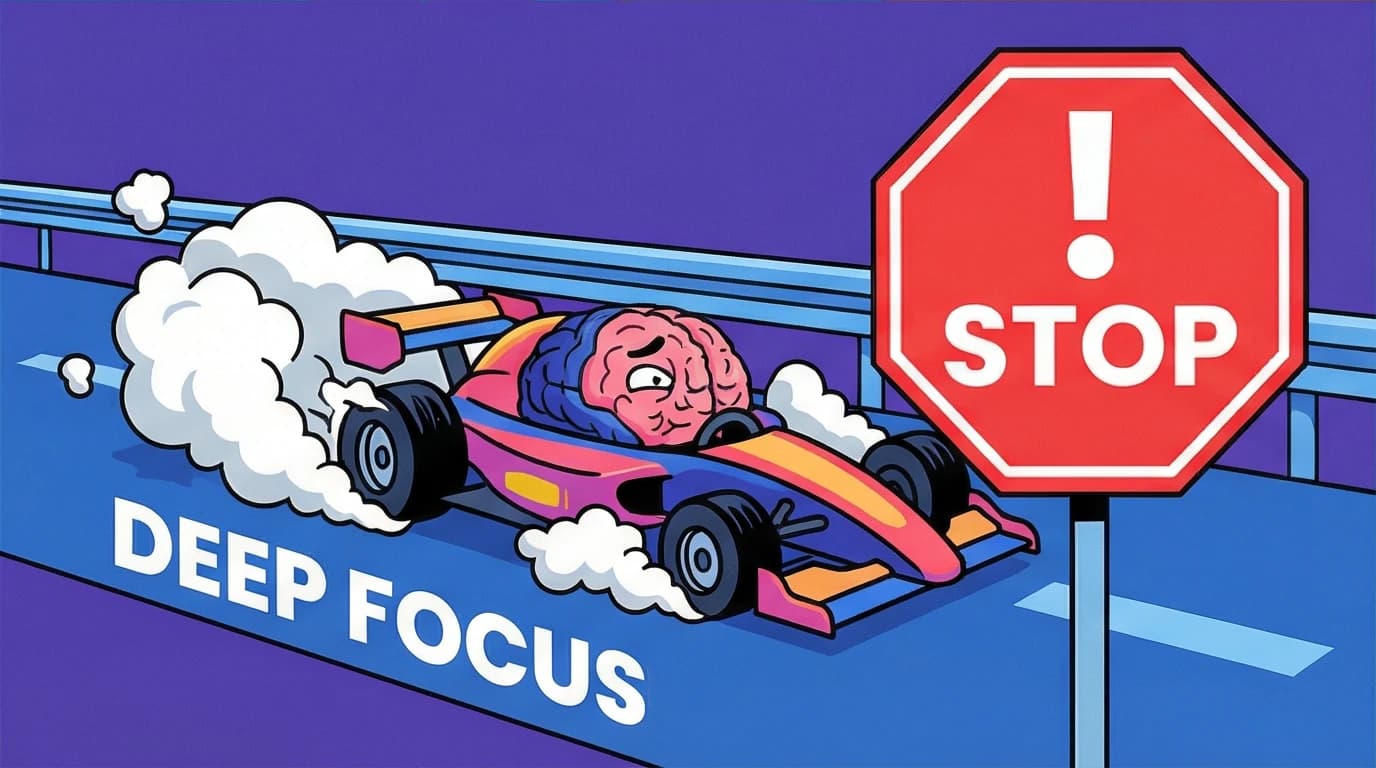
Think of it like driving down a highway at 70 miles per hour. If you slam on the brakes every half mile, stop completely, and then accelerate back to 70 mph, you destroy your gas mileage and ruin your engine. Context switching cost is the mental equivalent of slamming on the brakes. You are working longer hours, but a massive chunk of your day is simply lost to the friction of switching gears.
If you find yourself constantly battling these invisible mental drains and struggling to regain focus, it might be time to rethink how you structure your professional attention. One of the absolute best resources for learning how to cultivate extended periods of distraction-free concentration is Cal Newport's modern classic. It dives into the science of why our brains crave distraction and provides a rigorous, step-by-step framework for training your mind to ignore the noise and conquer demanding, high-value tasks.
Deep Work
Cal Newport
 47 Duration
 8 Key Points
 4.6 Rate
The Science-Backed Benefits of Single Tasking
Single tasking is exactly what it sounds like: committing your full cognitive resources to one specific objective until it is finished, or until a pre-planned block of time ends. It is the antidote to modern burnout.
When you embrace this approach, the benefits of single tasking become obvious almost immediately.
1. You Produce Higher Quality Work
Without the interference of competing thoughts, your brain can make deeper connections. You spot errors faster. Your writing becomes sharper. Your code has fewer bugs. You stop operating at a surface level and start doing the kind of deep work that actually moves the needle in your career or academic life.
Without the interference of competing thoughts, your brain can make deeper connections. You spot errors faster. Your writing becomes sharper. Your code has fewer bugs. You stop operating at a surface level and start doing the kind of deep work that actually moves the needle in your career or academic life.
Related reading: To consistently achieve this state of intense concentration, you need the right framework. Explore these powerful deep work strategies to help you get started.
2. You Finish Tasks Faster
Because you eliminate the 20% to 40% time penalty caused by the context switching cost, tasks simply take less time. A report that takes three hours of distracted, multi-window agonizing can often be knocked out in 90 minutes of pure, uninterrupted focus.
Because you eliminate the 20% to 40% time penalty caused by the context switching cost, tasks simply take less time. A report that takes three hours of distracted, multi-window agonizing can often be knocked out in 90 minutes of pure, uninterrupted focus.
3. Your Stress Levels Plummet
Single tasking lowers your cognitive load. You no longer have the nagging anxiety of five unfinished loops playing in your head. By focusing on the one thing right in front of you, you lower your heart rate and your cortisol levels. You finish your workday with enough mental energy left over to actually enjoy your evening.
Single tasking lowers your cognitive load. You no longer have the nagging anxiety of five unfinished loops playing in your head. By focusing on the one thing right in front of you, you lower your heart rate and your cortisol levels. You finish your workday with enough mental energy left over to actually enjoy your evening.
Embracing this streamlined approach to your day can feel overwhelming at first, especially if you are used to wearing busyness as a badge of honor. A great way to shift your mindset is to explore strategies that help you identify your true priority. If you want to learn how to aggressively cut away the non-essentials and channel all your energy into the objective that actually moves the needle, there is a fantastic book that outlines exactly how to narrow your focus to achieve extraordinary results.
To dive deeper into this powerful productivity philosophy, you can start with the key takeaways from The ONE Thing book summary.
The ONE Thing
Gary Keller, Jay Papasan
22 Duration10 Key Points4.5 RateReal-World Strategies: How to Single Task Effectively
Understanding the neuroscience is easy. Implementing it in an office culture that demands instant replies is hard. You cannot just turn off your computer and vanish into the woods. You have to be strategic.
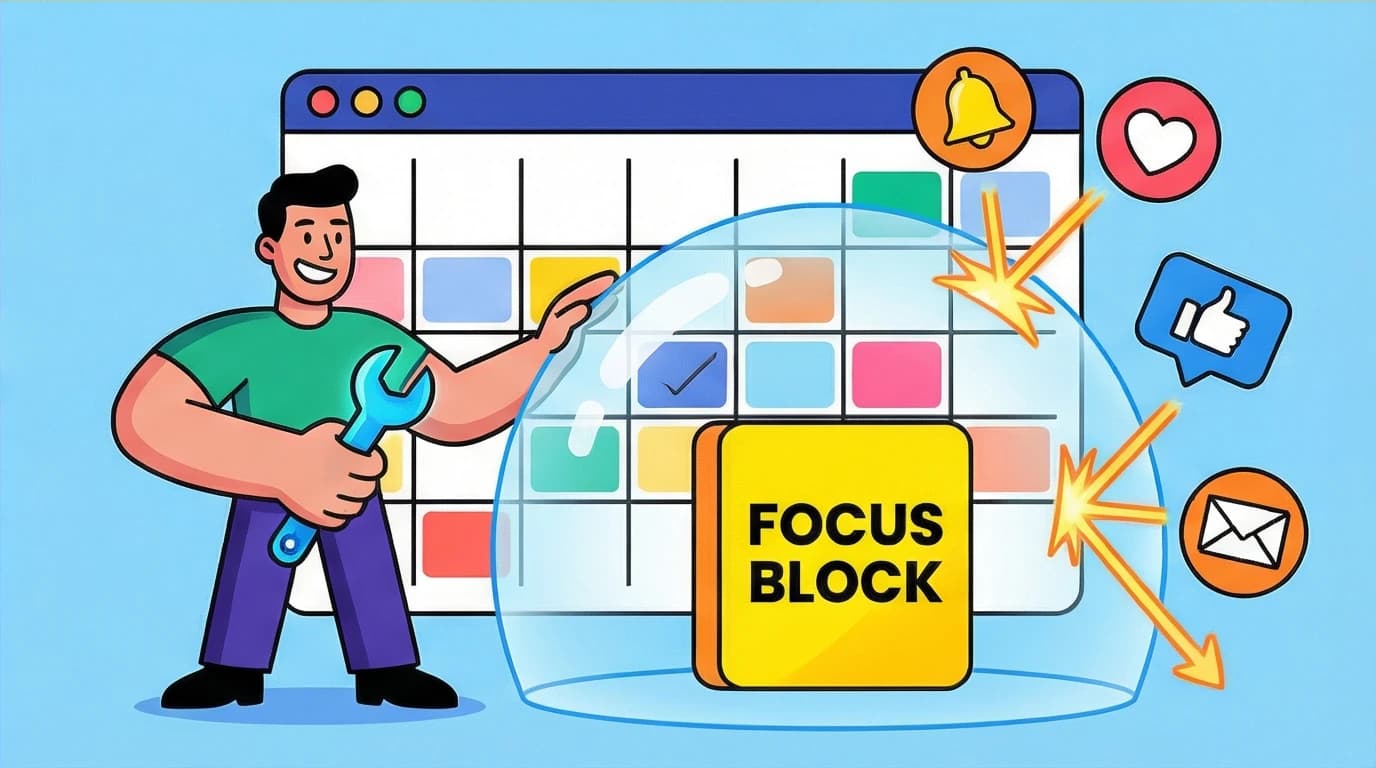
Here is how to single task effectively when everything around you is designed to distract you.
1. Master the Art of Time Blocking
Open your calendar and schedule your deep work just like you would schedule a meeting with your CEO. Block out 60 to 90 minutes for a specific task. Name the event exactly what you intend to do (e.g., "Draft Q3 Marketing Budget"). During this window, you are legally unavailable to the rest of the world. Treat this appointment with yourself as sacred.
2. Batch Your Shallow Work
Emails, Slack messages, and quick administrative approvals are "shallow work." Do not leave your inbox open all day. That invites endless context switching. Instead, batch these tasks. Check your email at 9:00 AM, 12:00 PM, and 4:00 PM. Process them aggressively, close the tab, and move on.
Of course, batching shallow work is only effective if you've already identified your most important tasks. Learning how to prioritize tasks at work is a critical first step that ensures your focused time is spent on what truly matters.
3. Build Digital Boundaries
You need to engineer your environment for focus.
- Change your Slack status: Set it to a red circle or a focus icon and write "Deep work until 11 AM - call if emergency." People will respect this far more than you think.
- Use Focus Modes: Utilize the Do Not Disturb features on your Apple or Android devices. Let only immediate family or VIPs break through the barrier.
- Single Monitor Rule: If possible, stop using three monitors. Extra screen real estate just invites extra distraction. Maximize the one window you are actively working in.
Even with the best digital boundaries in place, the urge to check our devices is often driven by internal anxiety as much as external pings. If you want a deeper understanding of the psychology behind why we constantly interrupt ourselves—and how to finally take control of your tech habits—there is a phenomenal guide on building an unbreakable attention span. It offers practical, research-backed tools to help you stay true to your intentions and thrive in an environment built to hijack your focus.
Indistractable
Nir Eyal
23 Duration10 Key Points4.5 Rate4. Use the Pomodoro Technique for Tough Tasks
If a task is daunting and you feel the urge to escape into multitasking, use a timer. Set it for 25 minutes. Commit to doing absolutely nothing but that one hard task until the timer goes off. No bathroom breaks, no phone checks. When the timer rings, step away for five minutes. This forces you into a single-tasking rhythm without feeling overwhelmed.
While setting a 25-minute timer sounds remarkably simple, the complete philosophy behind it is rooted in fascinating research on human cognition and time management. If you want to fully master this productivity method and understand exactly why these short bursts of focused effort are so effective at beating procrastination, it is highly recommended to read the foundational text written by the creator of the method himself. It offers invaluable insights into managing your mental energy and turning time into a helpful ally.
The Pomodoro Technique
Francesco Cirillo
19 Duration8 Key Points4.4 Rate5. Park Your Thoughts
When you are locked into a single task, random thoughts will inevitably pop up: Did I pay the electric bill? I need to email Sarah about the Barnes & Noble account. Keep a physical notepad next to your keyboard. When a distraction pops into your head, write it down immediately to get it out of your brain, and then instantly return to your primary task.
The Bottom Line
You are not a computer. Your brain is not built for parallel processing. The cultural obsession with multitasking has created a generation of stressed, exhausted workers who mistake motion for progress. By understanding the severe limitations of task switching and embracing the discipline of single tasking, you reclaim your time, your focus, and your sanity. Pick one thing. Finish it. Move on.
FAQ
What if my boss expects me to reply to messages instantly?
Have a direct conversation about expectations. Most managers prioritize high-quality results over a three-minute response time. Propose an experiment: explain that you are blocking out 90 minutes a day for deep focus to deliver better work on your main projects. Promise them they can call your cell phone if there is a literal emergency. Almost every reasonable boss will support a strategy that improves your output.
Have a direct conversation about expectations. Most managers prioritize high-quality results over a three-minute response time. Propose an experiment: explain that you are blocking out 90 minutes a day for deep focus to deliver better work on your main projects. Promise them they can call your cell phone if there is a literal emergency. Almost every reasonable boss will support a strategy that improves your output.
Are some people naturally good at multitasking?
No. Research shows that only about 2.5% of the population are true "supertaskers" whose performance does not degrade when juggling tasks. For the remaining 97.5% of us, we are just rapidly switching attention and doing a poor job at all of them. Ironically, studies also show that people who think they are great at multitasking are usually the worst at it.
No. Research shows that only about 2.5% of the population are true "supertaskers" whose performance does not degrade when juggling tasks. For the remaining 97.5% of us, we are just rapidly switching attention and doing a poor job at all of them. Ironically, studies also show that people who think they are great at multitasking are usually the worst at it.
Is listening to music or a podcast while I work considered multitasking?
It depends on the content and the task. Listening to familiar instrumental music (like lo-fi beats or classical) while writing or coding can actually improve focus by blocking out background office noise. However, listening to a dense podcast or an audiobook on Audible requires language processing. If you try to write an email while listening to a podcast, your brain has to fight for the same linguistic resources, causing severe context switching costs.
It depends on the content and the task. Listening to familiar instrumental music (like lo-fi beats or classical) while writing or coding can actually improve focus by blocking out background office noise. However, listening to a dense podcast or an audiobook on Audible requires language processing. If you try to write an email while listening to a podcast, your brain has to fight for the same linguistic resources, causing severe context switching costs.
How do I handle sudden, unavoidable interruptions while single tasking?
If someone walks up to your desk or a true emergency pulls you away, use the "bookmark" method. Take five seconds to write down exactly what you were thinking or the next immediate step before you turn your attention away. This tiny habit massively reduces the context switching cost when you finally return to your desk.
If someone walks up to your desk or a true emergency pulls you away, use the "bookmark" method. Take five seconds to write down exactly what you were thinking or the next immediate step before you turn your attention away. This tiny habit massively reduces the context switching cost when you finally return to your desk.