


You log off at 5 PM feeling completely drained, yet you cannot point to a single meaningful thing you accomplished. Your day was hijacked by Slack pings, endless email threads, and "quick" syncs. You are a knowledge worker, but you are not actually doing the work that requires your specific knowledge. You are merely reacting to other people's emergencies.
If you want to produce elite-level output, you cannot rely on willpower. You need a system.
The Trap of Modern Productivity: Deep Work vs Shallow Work
To fix your focus, you must first accurately diagnose the problem. Most knowledge workers confuse being busy with being productive. You must understand the harsh boundary of deep work vs shallow work.
Shallow Work consists of non-cognitive, logistical, or minor duties performed in a state of distraction. Think responding to routine emails, attending status meetings, or reorganizing your project management dashboard. Shallow work keeps you from getting fired, but it will never get you promoted.
Deep Work is professional activity performed in a state of distraction-free concentration that pushes your cognitive capabilities to their limit. These efforts create new value, improve your skill, and are hard to replicate. Writing a complex algorithm, drafting a 50-page strategy brief, or analyzing a dense financial model requires deep work.
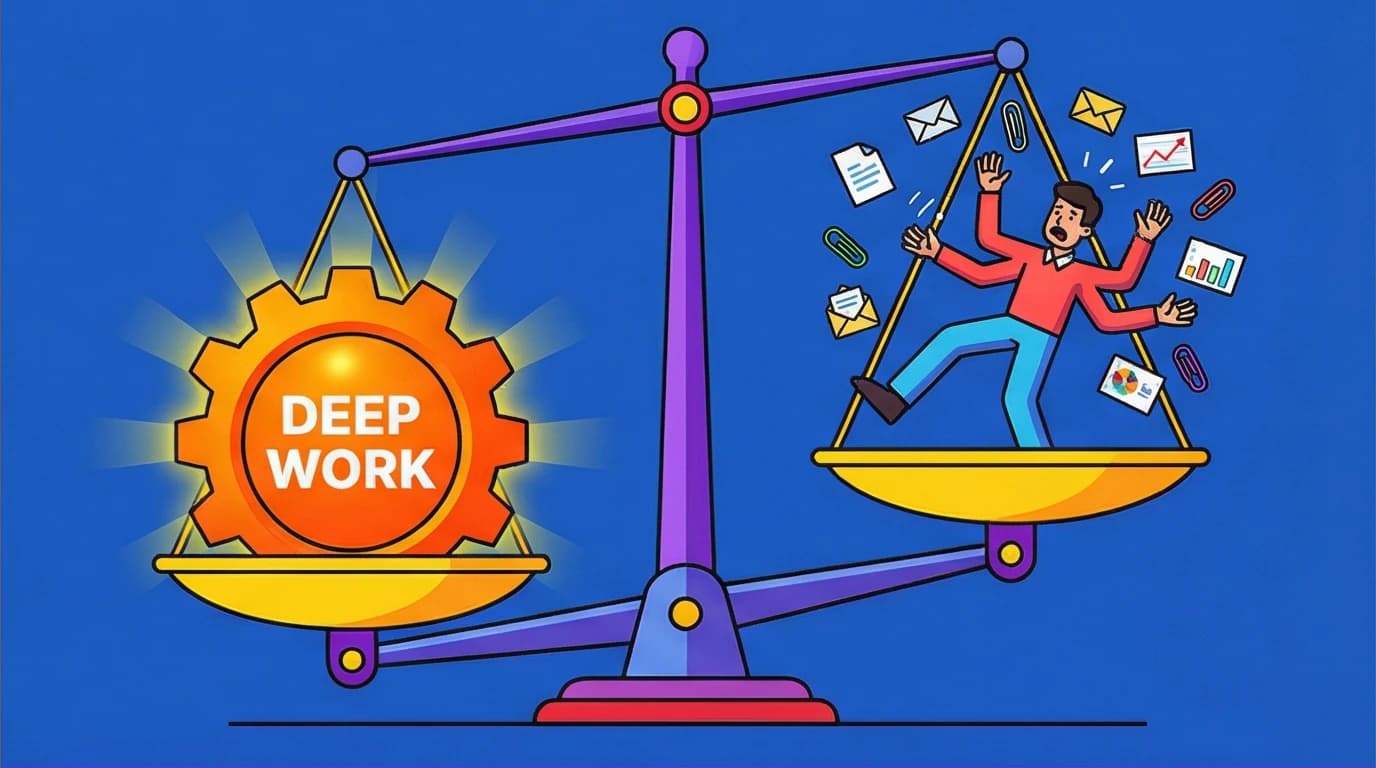
Every minute you spend on shallow tasks drains the cognitive energy required for deep tasks.
The Foundation: Cal Newport Deep Work Philosophies
The concept of deep work was formalized by computer science professor Cal Newport. If you have not listened to his audiobook on Audible or picked up a physical copy at Barnes & Noble, the core premise is brutally simple: distraction is destroying your career capital.
The Cal Newport deep work framework does not demand that you quit your job and move to a cabin in the woods. Instead, it offers four distinct scheduling philosophies. You must choose the one that fits your current career and lifestyle.
1. The Monastic Philosophy
This approach involves eliminating or radically minimizing all shallow obligations. You do not have a Twitter account. You rarely answer emails. You isolate yourself completely. This is highly effective for novelists, tenured professors, and independent researchers, but it is entirely unrealistic for a corporate software engineer or marketing director.
2. The Bimodal Philosophy
You divide your time, dedicating some clearly defined stretches to deep pursuits and leaving the rest open to everything else. During the deep time, you act monastically. For example, you might block off Tuesday and Thursday entirely for coding, leaving Monday, Wednesday, and Friday for Zoom meetings and Slack.
3. The Rhythmic Philosophy
This is the most practical choice for standard office workers. It involves creating a strict daily rhythm. You generate a habit by working deeply at the same exact time every day. Blocking out 8:00 AM to 10:30 AM every morning before turning on your phone is a classic rhythmic strategy.
4. The Journalistic Philosophy
You fit deep work wherever you can in your schedule. If a meeting gets canceled, you immediately switch into intense focus mode for 45 minutes. This requires high cognitive agility and is generally not recommended for beginners.
If you want to fully master these four scheduling philosophies, there is no better starting point than the original source material. While we have summarized the core frameworks here, reading the complete book offers a wealth of US-based corporate case studies and actionable blueprints for transforming your daily schedule. It is highly recommended for any knowledge worker looking to drastically increase their career capital and finally escape the trap of constant connectivity.
Deep Work
Cal Newport
 47 Duration
 8 Key Points
 4.6 Rate
If your schedule is too packed to read the entire book right away, you can get a head start on its core concepts.

Absorb the core principles of 'Deep Work' and other essential productivity books in just 15-minute audio or text summaries, perfect for your commute.
Download LeapAhead App now
Tactical Deep Work Strategies for the Daily Grind
Understanding the philosophy is only step one. Implementing actual deep work strategies requires ruthless execution. Here is how you protect your schedule.
Audit and Batch Your Shallow Work
You cannot eliminate shallow work entirely. Your boss still needs that report, and your team needs your approval on a pull request. The strategy is containment.
Batch your shallow work into tight, restricted time blocks. Do not keep your email open all day. Process your inbox twice: once at 11:30 AM and once at 4:30 PM. Tell your team, "I check messages at noon and 4 PM. If the server is literally on fire, call my cell phone." You will realize very quickly that 99% of "urgent" messages can wait three hours.
Containing shallow work often means having tough conversations and learning to gracefully say no to colleagues. If you struggle with the fear of missing out or feel obligated to attend every optional Zoom sync, you need a framework for determining what actually moves the needle. Discovering how to separate the "trivial many" from the "vital few" can help you reclaim hours of your workweek and focus your energy solely on high-impact projects.
Essentialism
Greg McKeown
32 Duration10 Key Points4.6 RateTo effectively separate the vital from the trivial, you need a robust system.
Implement Strict Time Blocking
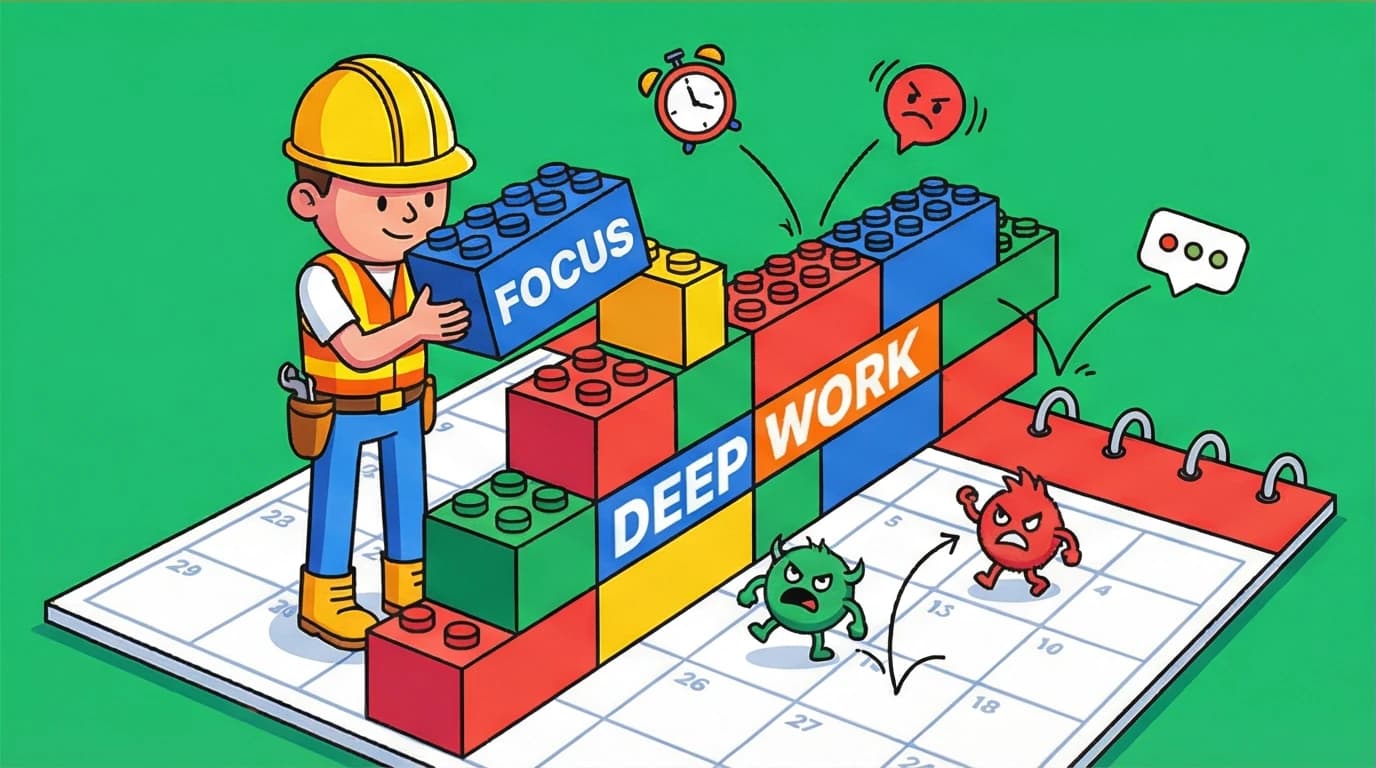
A blank calendar is an invitation for distraction. Use time blocking to give every minute of your workday a specific job.
Instead of a generic to-do list, map out your day into blocks. Schedule your deep work first. Protect it like a flight you cannot afford to miss. If someone tries to schedule a meeting during your deep block, simply say, "I have a conflict at that time." They do not need to know the conflict is with your own brain.
Measure Lead Measures, Not Lag Measures
A lag measure is the final result—like publishing a book or shipping a new app feature. A lead measure is the behavior that drives the result.
When executing deep work strategies, your primary lead measure should be the number of deep hours you log each week. Track this relentlessly. Keep a tally on your whiteboard. Aim for 12 to 15 hours of pure, unadulterated deep work a week. If you hit that number, the lag measures will take care of themselves.
The Ritual: How to Enter Flow State on Command
Deep work is the action; flow is the psychological state. Many professionals waste the first 30 minutes of their deep work block just trying to focus. You need to learn how to enter flow state rapidly.
To trigger flow, you must remove friction. The brain craves routine. Build a strict ritual around your deep work sessions to signal to your nervous system that it is time to perform.
1. Location Isolation
Do not do deep work in the same place you browse Amazon or watch YouTube. If possible, change your physical environment. Drive 5 miles to a local coffee shop, book a quiet conference room, or clear your desk entirely. Your brain must associate this specific physical location with intense focus.
Do not do deep work in the same place you browse Amazon or watch YouTube. If possible, change your physical environment. Drive 5 miles to a local coffee shop, book a quiet conference room, or clear your desk entirely. Your brain must associate this specific physical location with intense focus.
2. The Sensory Trigger
Use sensory cues to hack your brain. Wear a specific pair of noise-canceling headphones. Listen to the same video game soundtrack or lo-fi beats playlist every single time you start. Brew a specific type of coffee. Over time, simply putting the headphones on will trigger a Pavlovian response, pulling you into a flow state.
Use sensory cues to hack your brain. Wear a specific pair of noise-canceling headphones. Listen to the same video game soundtrack or lo-fi beats playlist every single time you start. Brew a specific type of coffee. Over time, simply putting the headphones on will trigger a Pavlovian response, pulling you into a flow state.
3. The Digital Fortress
Willpower always fails. Do not rely on your self-control to avoid checking the news. Use website blockers. Put your phone in another room. Close every browser tab that is not strictly necessary for the task at hand. If you do not need the internet, turn off your Wi-Fi entirely.
Willpower always fails. Do not rely on your self-control to avoid checking the news. Use website blockers. Put your phone in another room. Close every browser tab that is not strictly necessary for the task at hand. If you do not need the internet, turn off your Wi-Fi entirely.

4. Define a Clear, Singular Objective
You cannot enter flow if you do not know exactly what you are trying to accomplish. "Work on marketing plan" is too vague. "Draft the first three pages of the Q3 marketing strategy" is precise. A clear target eliminates cognitive hesitation.
You cannot enter flow if you do not know exactly what you are trying to accomplish. "Work on marketing plan" is too vague. "Draft the first three pages of the Q3 marketing strategy" is precise. A clear target eliminates cognitive hesitation.
Once you successfully strip away distractions, you will notice just how rewarding that singular focus can be. The psychological state of being completely immersed in a challenging task isn't just great for your productivity—it is fundamentally fulfilling. If you are fascinated by the science of this peak cognitive state and want to understand the decades of psychological research behind it, diving into the seminal work on the psychology of optimal experience is an absolute must.

Flow
Mihaly Csikszentmihalyi
37 Duration8 Key Points4.5 RateDefending Your Uninterrupted Focus Time
Securing uninterrupted focus time in a corporate environment requires boundary management. People will test your boundaries. You must hold the line.
Communicate Your Rules of Engagement
Set expectations with your team. Put your Slack status on "Do Not Disturb." Add a block to your shared Google Calendar titled "Deep Work - No Meetings." When you normalize this behavior, you give others permission to do the same.
Embrace Boredom
Your ability to concentrate is directly proportional to your tolerance for boredom. If you pull out your smartphone the second you have to wait in line at the grocery store or step into an elevator, you are training your brain to demand instant novelty.
You must break the addiction to rapid-fire stimuli. Stop reaching for your phone during every moment of downtime. Let your mind wander. Embracing boredom outside of work directly strengthens your capacity for uninterrupted focus time during work.
The Shutdown Routine
Deep work drains your battery. You cannot sustain intense focus for 10 hours a day. The human brain maxes out at about four hours of true deep work daily. Once you hit your limit, you must stop.
Implement a strict shutdown ritual. Review your tasks for the next day, close your laptop, and say a specific phrase like "schedule shutdown complete." Once you shut down, no checking email on the couch. No quickly reviewing code before bed. Total cognitive rest is mandatory to fuel tomorrow's deep work.
Even with a solid shutdown routine and strict rules of engagement, modern technology is quite literally engineered to hijack your attention. From smartphone notifications to algorithmic feeds, the battle for your focus is fought on multiple fronts every single day. If you are serious about taking back control of your attention span and building bulletproof habits to ignore those constant pings, exploring a systematic approach to conquering internal and external distractions will be a game-changer.
Indistractable
Nir Eyal
23 Duration10 Key Points4.5 RateWith a reading list full of heavy hitters like 'Deep Work' and 'Essentialism,' it can be tough to know where to start. If you want to absorb the core lessons from these books quickly to start building better habits now, a microlearning app can be a great first step.
Clear your new reading list by getting the main takeaways from books like 'Deep Work' and 'Indistractable' in easy-to-digest 15-minute summaries.
Download LeapAhead App now
FAQ
How many hours of deep work should I aim for each day?
For beginners, aim for one hour of continuous deep work. As you build your focus muscle, you can scale up. The absolute maximum for elite knowledge workers is typically around three to four hours a day. Beyond that, cognitive returns diminish rapidly.
For beginners, aim for one hour of continuous deep work. As you build your focus muscle, you can scale up. The absolute maximum for elite knowledge workers is typically around three to four hours a day. Beyond that, cognitive returns diminish rapidly.
What if my boss demands immediate replies on Slack?
Have a direct conversation about expectations. Propose an experiment: ask if you can have two hours of completely offline time each morning to tackle your most critical projects. Frame it around the high-value results you will deliver, not your desire to be left alone.
Have a direct conversation about expectations. Propose an experiment: ask if you can have two hours of completely offline time each morning to tackle your most critical projects. Frame it around the high-value results you will deliver, not your desire to be left alone.
Can I listen to music while doing deep work?
Yes, but it must be familiar and instrumental. Lyrics engage the language-processing centers of your brain, causing friction when you are trying to write or code. Video game soundtracks or ambient noise are optimal because they block out background distractions without demanding active attention.
Yes, but it must be familiar and instrumental. Lyrics engage the language-processing centers of your brain, causing friction when you are trying to write or code. Video game soundtracks or ambient noise are optimal because they block out background distractions without demanding active attention.
How do I handle deep work in an open-plan office?
Physical signaling is your best defense. Wear large over-ear headphones. Book meeting rooms for yourself. If your office is entirely chaotic, try arriving 90 minutes before everyone else or negotiating a work-from-home schedule two days a week specifically for deep tasks.
Physical signaling is your best defense. Wear large over-ear headphones. Book meeting rooms for yourself. If your office is entirely chaotic, try arriving 90 minutes before everyone else or negotiating a work-from-home schedule two days a week specifically for deep tasks.