
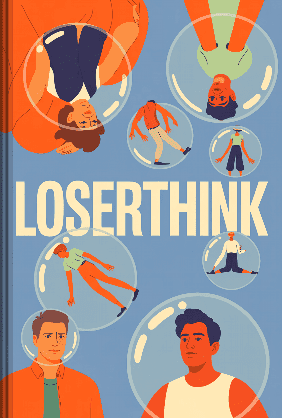
Loserthink
Scott Adams
 13 分鐘
13 分鐘 7 重點
7 重點 4.8 評分
內容重點
Explore the common cognitive biases and flawed thinking patterns that are negatively impacting society and learn how to overcome them for a better America.
您將學到
 1. Spotting and beating mind tricks2. Tips to boost your decision-making game3. Getting the hang of other people's viewpoints4. Dodging 'loserthink' pitfalls5. Winning at chats and debates6. Leveling up in life with smart thinking habits.
重點
01Even smart and seasoned folks can fall into 'loserthink'
Scott Adams has a bone to pick with the way we think. He's not saying we're dumb or uninformed. Nope, he's talking about something he calls 'loserthink.' It's not about your IQ or how much you know. It's about how you use that noggin of yours to process and interpret information. 'Loserthink' is like a mental pitfall. It doesn't care how smart you are or how many degrees you have. It's a sneaky little bugger that can trip up even the brightest minds if they're not on their toes. So, what's the deal with 'loserthink'? Well, Adams reckons that our thinking patterns are pretty much shaped by our experiences and the fields we're trained in. Let's say you're a doctor, a philosopher, a lawyer, or an engineer. You've got your own unique way of looking at the world, right? That's because of your training and experiences. But here's the kicker: if you only use that one way of thinking, you're setting yourself up for a fall. That's 'loserthink.' Every field has its blind spots, and if you're not careful, you can end up with a pretty narrow view of things. But don't worry, Adams has a solution. He says we should try to understand and use the thinking patterns from different disciplines. You don't have to be a jack-of-all-trades, but you should try to broaden your horizons. Learn to think in different ways. It's like mental cross-training. You'll end up with a more efficient and productive way of thinking, and you'll make better decisions. So, that's the lowdown on 'loserthink.' It's all about recognizing it and avoiding it. Adams gives you the tools to beef up your thinking skills. You'll not only make better decisions, but you'll also be able to spot 'loserthink' in others. So, keep your eyes peeled and your mind open. Don't let 'loserthink' trip you up.
02We often think our explanations are the simplest, but they might not be
Scott Adams, in his book, talks about a common trap we all fall into - thinking we're always right. We often believe our take on things is the simplest and most accurate. But here's the kicker - this belief can lead us down a rabbit hole of misunderstandings and flawed thinking. Let's paint a picture. You're in a heated argument with someone. You're convinced your point of view is the most logical, and you can't fathom why the other person doesn't see it your way. You might even think you know what's going on in their head, and why they're wrong. This, my friend, is what Adams calls 'loserthink'. 'Loserthink' is a mental pitfall. It's the idea that we can accurately gauge and understand what's going on in someone else's mind. But here's the truth - we're not psychic. We can't really know what someone else is thinking or feeling. When we think we do, we often misinterpret their actions and intentions, leading to misunderstandings and disagreements. This kind of flawed thinking is rampant in our digital world. Take social media, for example. People often make snap judgments about others based on a single post or comment. One wrong word and you're labeled a racist, a troll, or an apologist. This is 'loserthink' in its prime. We're making assumptions and judgments based on half-baked information, and believing our interpretation is the most accurate. Adams also highlights that this kind of thinking can make us overconfident in our own opinions. If we think we're always right, we shut ourselves off to the possibility that we might be wrong. This can stop us from learning, growing, and understanding different viewpoints. So, what's the takeaway? We often fall into the 'loserthink' trap - thinking our explanations are the simplest, and that we can accurately judge what others are thinking. This can lead to misunderstandings, disagreements, and a narrow-minded approach to different viewpoints. To dodge 'loserthink', we need to accept that our interpretations might not always be spot-on, and be open to the possibility that we might be wrong.
03Occam's razor helps us cut through the BS and keep things simple
04Use your imagination to avoid getting stuck in a mental rut
05Don't dwell on the past, it's a one-way ticket to 'loserthink'
06Break free from your mental chains and say goodbye to 'loserthink'
07Conclusion
關於 Scott Adams
Scott Adams is an American author and cartoonist, best known for creating the "Dilbert" comic strip. He's also a commentator on social and political issues, often using humor and satire. His writings explore cognitive biases, persuasion techniques, and his own experiences in the corporate world.

