
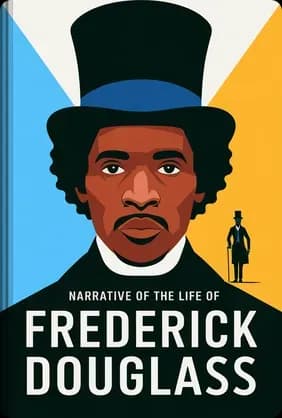
Narrative of the Life of Frederick Douglass
Frederick Douglass and Mint Editions
 20 分鐘
20 分鐘 7 重點
7 重點 4.5 評分
內容重點
Dive into the powerful autobiography of Frederick Douglass, a former slave turned influential abolitionist, and experience his journey towards freedom and advocacy for equality.
您將學到
 1. The tough life of a 19th-century slave2. Why reading and writing were key to freedom3. How grit and guts can beat tough times4. The big deal about the abolitionist movement5. Frederick Douglass: A hero against slavery6. How personal stories can change minds and laws.
重點
01Exploring the Early Life of Frederick Douglass: Born into Slavery
In the 19th century, the harsh realities of slavery were a grim fact of life for many African Americans. One such individual was Frederick Douglass, who was born into this brutal system. His early life experiences, as detailed in his narrative, provide a stark and poignant insight into the lived experience of slavery. Douglass was born in Maryland, a slave state, in the early 1800s. His mother was a slave, and his father was, in all likelihood, a white man—possibly his mother's master. This was a common occurrence in the era of slavery, where the violation of enslaved women by their masters was a grim reality. Douglass's early years were marked by deprivation and hardship. He was separated from his mother when he was just a baby, a common practice designed to break familial bonds and make slaves more compliant. This early separation had a profound impact on Douglass, who later wrote about the deep longing he felt for his mother and the pain of their enforced separation. Douglass's first master was a man named Aaron Anthony. Under Anthony's control, Douglass experienced firsthand the brutalities of slavery. He was subjected to physical abuse and harsh labor, and he witnessed the cruel treatment of other slaves. These experiences under Anthony's control were not unique to Douglass. They were part of a broader system of oppression and dehumanization that was designed to keep African Americans in a state of servitude and fear. The conditions of slavery were brutal and inhumane. Douglass and his fellow slaves were subjected to physical and psychological abuse on a daily basis. They were denied basic human rights, forced to work long hours in harsh conditions, and subjected to brutal punishments for even minor infractions. Douglass's narrative provides a vivid and harrowing account of these conditions, painting a picture of a system that was designed to break the human spirit and reduce individuals to mere property. Douglass's early life experiences provide a stark insight into the realities of slavery. His narrative serves as a powerful testament to the resilience of the human spirit in the face of systemic oppression and dehumanization. It also serves as a stark reminder of a dark chapter in American history, one that continues to have a profound impact on the nation's collective consciousness. The experiences of Douglass and countless others like him are a testament to the enduring legacy of slavery, a legacy that continues to shape American society in profound and often troubling ways.
02How Douglass Learned to Read and Write: The Power of Education in the Pursuit of Freedom
In the oppressive world of slavery, a young Frederick Douglass found himself yearning for something more. He was not content with the life of servitude that had been forced upon him. He yearned for freedom, and he found the key to it in an unlikely place: the written word. Douglass's journey towards literacy was not an easy one. He was not afforded the luxury of a formal education. Instead, he had to rely on his cunning and resourcefulness to learn. He would trick white children into teaching him to read and write, trading pieces of bread for lessons. He would scribble in the dirt and on fences, practicing his letters until they were perfect. His thirst for knowledge was insatiable, and he would stop at nothing to quench it. As Douglass's literacy grew, so did his understanding of the world. He began to read newspapers and political pamphlets, gaining insight into the world beyond his immediate environment. He learned about the abolitionist movement, about the fight for freedom, and about the inherent wrongness of slavery. This newfound knowledge ignited a spark within him, a burning desire for freedom that would not be extinguished. But with this desire came a deep sense of dissatisfaction. Douglass became acutely aware of the stark contrast between his life as a slave and the possibilities of a life beyond slavery. He yearned for more, for a life of freedom and dignity. His education had opened his eyes to the injustices of his condition, and he was determined to resist. However, this pursuit of knowledge was not without its risks. Douglass faced severe punishment if he was caught reading or writing. But he was not deterred. He was willing to risk everything for the chance to learn, to grow, and to free himself from the chains of slavery. His courage and resilience in the face of such adversity are a testament to his indomitable spirit. Education played a critical role in Douglass's pursuit of freedom. His ability to read and write gave him the intellectual tools to challenge the status quo, to question the morality of slavery, and to envision a future where he was free. His narrative serves as a powerful testament to the transformative power of education in overcoming oppression and achieving liberation. In conclusion, Douglass's story is a compelling reminder of the transformative power of education. His journey from slavery to freedom, fueled by his relentless pursuit of knowledge, is a testament to the enduring relevance of his story in contemporary discussions on education and freedom. His narrative serves as a beacon of hope, illuminating the path towards liberation through the power of education.
03"Douglass's Life and Lessons in Baltimore"
04"Douglass's Journey to Freedom: The Struggles and Triumphs"
05"Douglass's Journey to Freedom and Equality"
06Frederick Douglass: Impact and Legacy on Race and Equality
07Conclusion
關於 Frederick Douglass and Mint Editions
Frederick Douglass was an influential African-American social reformer, abolitionist, orator, writer, and statesman in the 19th century. Mint Editions is a publishing imprint that produces various classic literary works, including those from African-American authors and narratives.