


You put in the time. You show up every day, run the drills, write the code, or play the scales, yet you still feel miles away from greatness. If logging endless hours was the only requirement for mastery, anyone who drove a car for a decade would be a professional race car driver. They aren't. Time is just the raw material; what you actually do with that time determines whether you become an expert or stay an amateur.
The Origin of the Number
The phrase "Malcolm Gladwell 10000 hours" is practically burned into modern culture. Gladwell popularized the concept in his bestselling book, building heavily on the research of psychologist K. Anders Ericsson. Ericsson studied violinists at a music academy in Berlin, finding that by age 20, the elite performers had accumulated significantly more practice hours than the average players. Gladwell took this data and cemented the idea of the outliers 10000 hours benchmark.
The 10,000-hour rule is just one of many compelling ideas from the book. To understand the full picture of how success is nurtured by opportunity and cultural legacy, exploring Gladwell's other arguments is essential.
It sounds simple. You want to be great? Clock your hours.
But this widespread interpretation missed the core of Ericsson's actual research. When people ask how many hours to become an expert, they usually default to simple repetition. Ericsson explicitly stated that mindless repetition is useless. The magic isn't in the clock. The magic is in deliberate practice.
If you are curious about the book that originally sparked the global conversation around the 10,000-hour rule, Malcolm Gladwell’s groundbreaking work is a phenomenal starting point. While the rule itself is just one piece of the puzzle, Gladwell paints a brilliant picture of how timing, cultural background, and sheer opportunity combine with massive amounts of practice to forge world-class experts. It is a highly entertaining read that will completely reshape how you view success and the hidden advantages that help build true outliers.

Outliers
Malcolm Gladwell
 43 Duration
 8 Key Points
 4.5 Rate
Naive Practice vs. Deliberate Practice
Before you organize your schedule to hit your 10,000 hours, you need to audit how you currently practice. There are generally two ways people try to get better at something:
Naive Practice is just doing the thing. It is playing a weekly game of tennis, writing a blog post whenever you feel inspired, or baking the same pie recipe over and over. You hit a baseline level of competence, your brain automates the process, and you stop improving. You can spend 10,000 hours doing naive practice and you will simply be highly efficient at being mediocre.
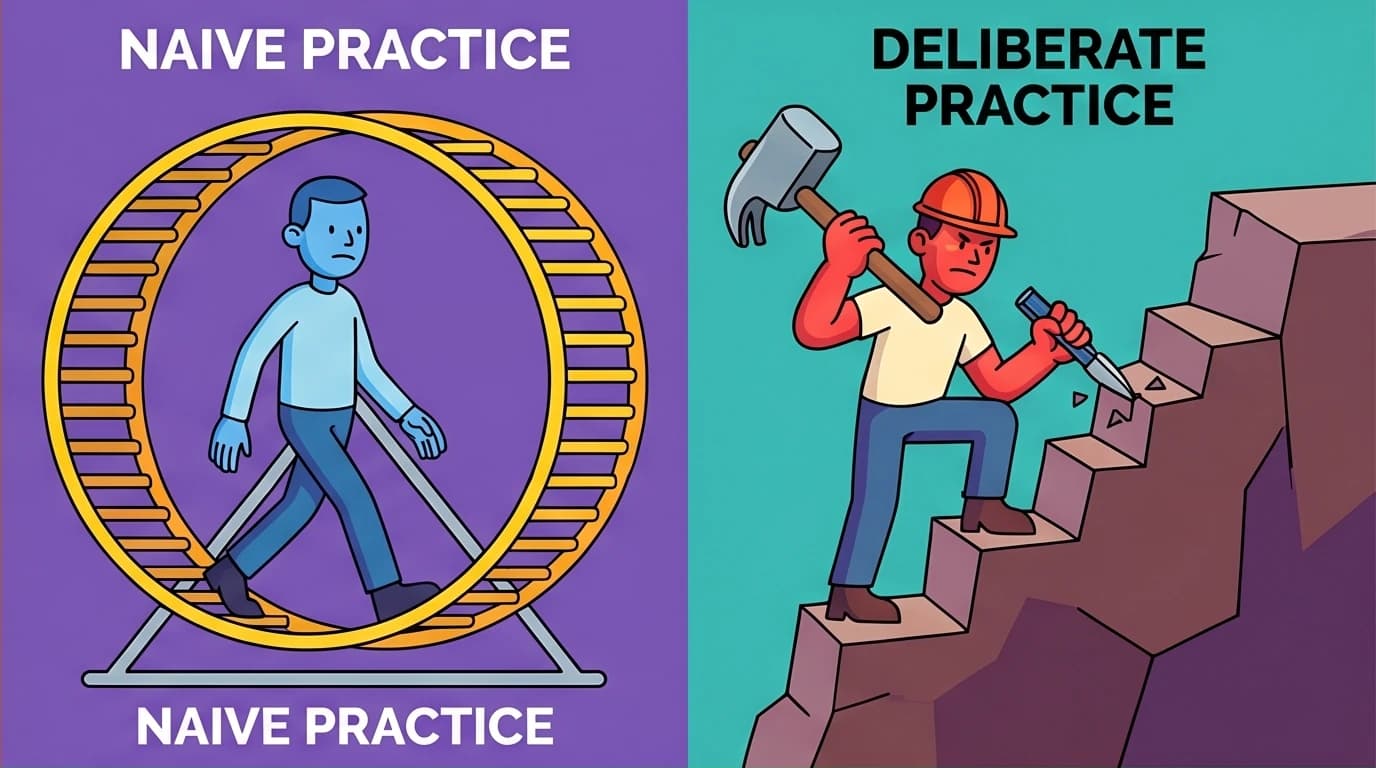
Deliberate Practice is uncomfortable. It is breaking a skill down into its smallest, ugliest micro-components. It is a tennis player hitting 500 backhands from a specific corner of the court, adjusting their grip slightly after every miss. It is a programmer purposefully learning a new, difficult language rather than defaulting to the one they already know.
The idea that it takes 10 000 hours to master a skill is only accurate if those hours are spent in the uncomfortable zone of deliberate practice.
To get the unfiltered truth about deliberate practice straight from the psychologist who actually conducted the famous Berlin violin studies, you absolutely need to dive into Anders Ericsson's foundational research. This book strips away the romanticized myths of "natural talent" and provides a rigorous, science-backed roadmap for rapid improvement. If you want to stop spinning your wheels with naive practice and learn exactly how to construct the ultimate training regimen for your craft, this is the definitive manual.

Peak
Anders Ericsson and Robert Pool
48 Duration10 Key Points4.5 RateThe Framework of Deliberate Practice
To apply the 10000 hour rule to your own career or hobby, you need a system. You cannot just rely on showing up. You must structure your practice around four non-negotiable pillars.
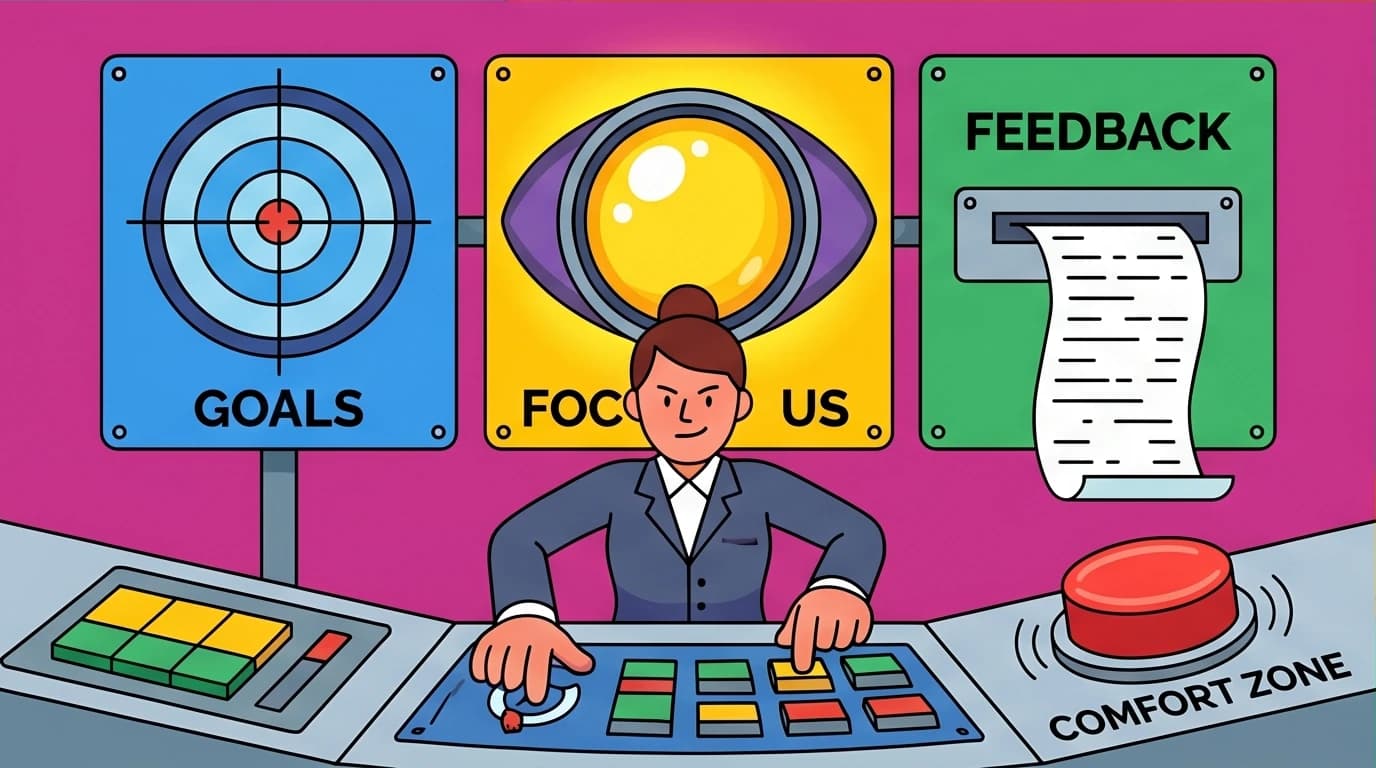
1. Laser-Specific Goals
"I want to get better at sales" is a terrible goal. It is vague and impossible to measure. Deliberate practice requires targeting specific weaknesses.
A specific goal looks like this: "I will improve my objection-handling during the first three minutes of a cold call." You aren't trying to master everything at once. You isolate one variable, focus your entire cognitive load on it, and drill it until it becomes muscle memory.
2. Intense, Distraction-Free Focus
You cannot multitask your way to mastery. Deliberate practice requires your full attention. If you are learning to code and have YouTube open on a second monitor, you are not practicing.
World-class performers usually practice in short, intense bursts. Even the elite violinists in Ericsson's study practiced for no more than two or three hours a day, broken into highly focused sessions. The mental strain of operating at the absolute edge of your ability is exhausting.
Sustaining the kind of intense, distraction-free focus required for deliberate practice is incredibly difficult, especially in a culture obsessed with notifications and multitasking. If you find yourself constantly breaking your concentration to check your phone or email, Cal Newport’s philosophy on deep work is a total game-changer. It offers practical, no-nonsense strategies for training your brain to handle extended periods of intense cognitive strain, ensuring that every hour you spend practicing actually counts toward your mastery.
Deep Work
Cal Newport
47 Duration8 Key Points4.6 Rate3. Immediate and Unforgiving Feedback
You cannot fix what you cannot see. Without feedback, you might be practicing the wrong technique, burning bad habits into your brain.
If you sell products on Amazon, your feedback is daily conversion rates and customer reviews. If you are a coffee roaster, your feedback comes from tracking exact metrics—bean color, moisture, and holding the roast exactly at 400 degrees Fahrenheit—and then blind-tasting the result. For athletes and musicians, this is why a coach is mandatory. A coach sees the mechanical flaws you cannot feel and corrects them in real-time.
4. Pushing Past the Comfort Zone
If your practice is easy, it is not deliberate practice. You must consistently attempt things that are currently out of your reach.
Whenever you successfully master a sub-skill, you must immediately raise the bar. The moment a task becomes easy, your brain puts it on autopilot. Deliberate practice is the act of intentionally avoiding autopilot.
How to Organize Your 10,000 Hours
Ten thousand hours is a massive commitment. If you practice for three hours a day, every single day, it will take you roughly ten years to hit the mark. This reality requires a strategic approach.
Step 1: Deconstruct the skill.
If you want to become a world-class graphic designer, don't just "design things." Break the field down into typography, color theory, grid systems, and software proficiency.
If you want to become a world-class graphic designer, don't just "design things." Break the field down into typography, color theory, grid systems, and software proficiency.
Step 2: Find a mentor or build a feedback loop.
Do not attempt this in a vacuum. Find someone who is further along the path than you. If you cannot afford a coach, use technology. Record yourself giving speeches. Track your time and error rates. Let the data tell you the truth about your performance.
Do not attempt this in a vacuum. Find someone who is further along the path than you. If you cannot afford a coach, use technology. Record yourself giving speeches. Track your time and error rates. Let the data tell you the truth about your performance.
Step 3: Track your deep work hours.
Not all hours are created equal. Do not count the time you spent reading an article about guitar theory as practice. Only log the hours where your fingers were on the fretboard, making mistakes and correcting them.
Not all hours are created equal. Do not count the time you spent reading an article about guitar theory as practice. Only log the hours where your fingers were on the fretboard, making mistakes and correcting them.
Step 4: Embrace the plateau.
Improvement is not linear. You will experience long stretches where you put in the hours and see zero progress. This is the plateau. Amateurs quit here. Professionals understand that the plateau is where the brain is quietly rewiring itself. You stay the course, tweak your feedback loop, and keep pushing.
Improvement is not linear. You will experience long stretches where you put in the hours and see zero progress. This is the plateau. Amateurs quit here. Professionals understand that the plateau is where the brain is quietly rewiring itself. You stay the course, tweak your feedback loop, and keep pushing.

Clocking 10,000 hours over a decade requires far more than just initial motivation—it demands an unshakable daily system. If you are struggling to build the consistency needed to push through the inevitable plateaus, optimizing your environment and micro-habits is the key. James Clear’s brilliant approach to behavior change will show you how to automate your practice sessions, break bad habits, and make showing up every single day feel practically effortless.

Atomic Habits
James Clear
26 Duration8 Key Points4.7 RateAbsorbing the wisdom from all these essential books is the first step, but it can feel like a huge time commitment. If you're looking for a way to grasp their core principles quickly, a microlearning app can be a great starting point.

Get the key insights from books on deliberate practice, focus, and habit-building in 15-minute audio or text summaries, perfect for busy schedules.

Download LeapAhead App now
The Truth About the 10000 Hour Rule
Does it literally take exactly 10,000 hours? No.
In highly structured fields like classical music, chess, or gymnastics—where the rules are fixed and the path to mastery is centuries old—it might take exactly that. In newer or more chaotic fields, like digital marketing or software entrepreneurship, the rules change so fast that a strict hour count means less than adaptability.
Genetics and natural talent also play a role. You cannot practice your way to being seven feet tall for the NBA. But talent only dictates your starting line and your absolute physical ceiling. Everything in between is dictated by deliberate practice.
While the rule is a powerful concept for understanding the importance of practice, it's not without its critics. The scientific community has extensively debated its validity and limitations in different fields, offering a more nuanced view of what it really takes to succeed.
Embracing this mindset is easier when you can consistently feed your brain with the right ideas, even when you don't have hours to spare for deep reading.
Turn your commute or workout into learning time by listening to the core ideas from bestselling books on skill acquisition and personal growth.
Download LeapAhead App now
The true value of the 10000 hour rule isn't the number itself. It is the mindset shift it forces. It strips away the illusion of overnight success. It tells you that mastery is not a magical gift bestowed upon the lucky few. Mastery is a highly mechanical, predictable process of breaking a skill down, attacking your weaknesses, and out-working everyone else in the room.
FAQ
Does the 10000 hour rule apply to every profession?
No. It works best in "kind" learning environments with clear rules, instant feedback, and recognized standards of performance (like chess, golf, or classical music). In "wicked" environments where rules shift and patterns rarely repeat (like venture capital or startup leadership), strict deliberate practice is harder to apply, and broad mental models often matter more than specialized repetition.
No. It works best in "kind" learning environments with clear rules, instant feedback, and recognized standards of performance (like chess, golf, or classical music). In "wicked" environments where rules shift and patterns rarely repeat (like venture capital or startup leadership), strict deliberate practice is harder to apply, and broad mental models often matter more than specialized repetition.
Is it too late to start my 10,000 hours if I am in my 30s or 40s?
Absolutely not. While adults may not have the exact same neuroplasticity as young children, they have massive advantages in discipline, strategic thinking, and pattern recognition. Furthermore, you likely aren't starting from zero. You bring thousands of hours of adjacent skills—communication, problem-solving, project management—that accelerate your learning curve in a new field.
Absolutely not. While adults may not have the exact same neuroplasticity as young children, they have massive advantages in discipline, strategic thinking, and pattern recognition. Furthermore, you likely aren't starting from zero. You bring thousands of hours of adjacent skills—communication, problem-solving, project management—that accelerate your learning curve in a new field.
What if I don't have time to practice 3 hours a day?
Consistency beats volume. One hour of highly focused, deliberate practice every single day is infinitely more valuable than five hours of distracted, unstructured effort on the weekend. Focus on quality over the sheer accumulation of hours.
Consistency beats volume. One hour of highly focused, deliberate practice every single day is infinitely more valuable than five hours of distracted, unstructured effort on the weekend. Focus on quality over the sheer accumulation of hours.
Can I master a skill without a coach?
You can, but it will take much longer. A coach's primary job is to provide the objective feedback you cannot give yourself. If you must go it alone, you have to engineer your own feedback systems. Record video of your form, analyze your win/loss data relentlessly, and benchmark your work directly against industry leaders.
You can, but it will take much longer. A coach's primary job is to provide the objective feedback you cannot give yourself. If you must go it alone, you have to engineer your own feedback systems. Record video of your form, analyze your win/loss data relentlessly, and benchmark your work directly against industry leaders.