


You know winning the morning leads to winning the day. But when you finally decide to overhaul your morning routine habits, you immediately run into the two heavyweights of the productivity world. You do not have the time to read hundreds of pages just to figure out what to do when your alarm goes off. You need a practical, actionable system that works for your specific life constraints.
Let's break down the mechanics, time commitments, and core philosophies of both methods so you can decide which one actually belongs in your daily schedule.
The Core Philosophies: Hal Elrod vs Robin Sharma
Before looking at the step-by-step actions, you need to understand the mindset driving each book. The authors built their routines for entirely different reasons, which directly impacts how they feel to practice.
When you look at Hal Elrod vs Robin Sharma, you are looking at recovery versus elite optimization.
Hal Elrod created his routine out of desperation. Following a near-fatal car accident and a severe financial crisis during the 2008 US economic crash, Elrod needed a way to rebuild his life from rock bottom. His philosophy centers on personal development and overcoming adversity. He built a system that focuses on mental resilience and is designed to work even when you are exhausted, stressed, or pressed for time.
Robin Sharma approaches mornings from the perspective of elite performance. He has spent decades coaching billionaires, professional athletes, and top-tier executives. His philosophy is rooted in cognitive neurobiology and the belief that isolation and early hours create a "transient hypofrontality"—a state where your brain temporarily shuts down its inner critic, allowing for deep, uninterrupted focus. His method is rigid, intense, and assumes you want to perform in the top 1% of your field.
Breaking Down The Frameworks
Both of these titles consistently rank as the best morning routine books on Amazon and Barnes & Noble because they replace vague advice with specific formulas. Here is exactly what each method asks you to do.

The 5 AM Club: The 20/20/20 Formula
Sharma's framework is non-negotiable. You must wake up at exactly 5:00 AM. You dedicate exactly one hour to the routine, divided into three 20-minute blocks. Sharma calls 5:00 AM to 6:00 AM the "Victory Hour."
- Pocket 1: Move (5:00 AM - 5:20 AM)
You must engage in intense exercise the moment you wake up. The goal is to sweat. Sweating decreases cortisol (the stress hormone) and generates the protein BDNF (Brain-Derived Neurotrophic Factor), which accelerates neural connections. - Pocket 2: Reflect (5:20 AM - 5:40 AM)
This block is for profound silence. You can meditate, pray, or write in a journal. The objective is to center yourself, express gratitude, and plan your day before the chaos of emails and family obligations begins. - Pocket 3: Grow (5:40 AM - 6:00 AM)
The final block is dedicated to personal growth. You spend 20 minutes reading a book, listening to an Audible audiobook, or studying a high-value skill. No entertainment allowed.
For many, getting through an entire book in 20-minute chunks is a challenge. If you want to make the most of this growth period, an app designed for micro-learning can help you absorb a book's main ideas in a single session.


Listen to the core insights from bestselling books in just 15 minutes, making it a perfect fit for the 5 AM Club's 20-minute growth block.
 LeapAhead
If Robin Sharma’s rigorous approach to morning optimization sounds exactly like the structure you need, diving into the source material is your best next step. The 5 AM Club expands heavily on the neurobiology behind the 20/20/20 formula and offers a fascinating, parable-style narrative that makes the concepts incredibly memorable. If you want to join the ranks of elite performers and fully understand why this specific morning framework works so well, grab a copy of the book and start reading.
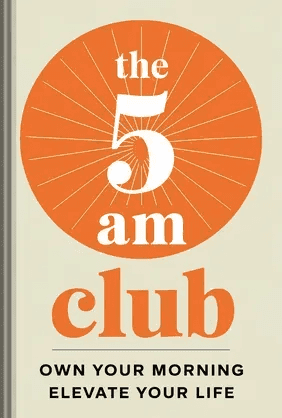
The 5 AM Club
Robin Sharma
 39 Duration
 10 Key Points
 4.6 Rate
The Miracle Morning: The S.A.V.E.R.S. Method
Elrod's framework revolves around six specific practices called Life S.A.V.E.R.S. Unlike Sharma's strict timeline, you can spend as little as one minute on each, or stretch the whole routine to an hour.
- S - Silence: Meditation, deep breathing, or prayer to reduce stress.
- A - Affirmations: Repeating positive statements about your goals and the person you need to become to achieve them.
- V - Visualization: Mentally rehearsing a successful day and imagining what it feels like to achieve your targets.
- E - Exercise: Getting your heart rate up. It does not have to be intense; doing jumping jacks or a light yoga flow works.
- R - Reading: Reading a few pages of a self-help or educational book.
- S - Scribing: Journaling your thoughts, gratitudes, or daily priorities.
Does a highly customizable, grace-filled approach to your morning sound like a breath of fresh air? Hal Elrod’s foundational book, The Miracle Morning, breaks down each of the six S.A.V.E.R.S. in much greater detail. Beyond just the mechanics, Elrod shares his deeply personal and inspiring story of bouncing back from rock bottom. If you want a step-by-step manual that teaches you how to consistently wake up with more energy and intentionality—regardless of your current circumstances—this is an essential read for your nightstand.
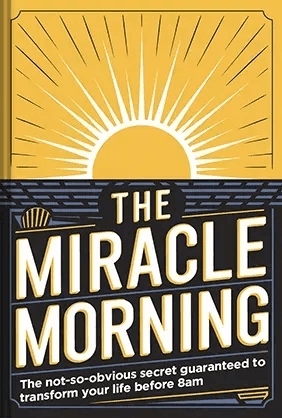
The Miracle Morning
Hal Elrod
41 Duration10 Key Points4.6 RateTime Commitment and Real-World Flexibility
The biggest friction point for most Americans trying to build morning routine habits is a lack of time. Commutes, early meetings, and getting kids ready for school quickly derail complex plans.

The 5 AM Club is highly rigid.
To successfully wake up at 5:00 AM, you must be asleep by 9:30 PM. For many adults, this is nearly impossible. If you work a later shift, have a long evening commute, or want to spend time with your family after dinner, an early bedtime feels punishing. Sharma's routine also requires an uninterrupted hour. If your toddler wakes up at 5:15 AM, the 20/20/20 formula breaks down instantly.
To successfully wake up at 5:00 AM, you must be asleep by 9:30 PM. For many adults, this is nearly impossible. If you work a later shift, have a long evening commute, or want to spend time with your family after dinner, an early bedtime feels punishing. Sharma's routine also requires an uninterrupted hour. If your toddler wakes up at 5:15 AM, the 20/20/20 formula breaks down instantly.
The Miracle Morning is heavily pliable.
Elrod does not actually care what time you wake up. He just asks that you wake up earlier than you normally do to make time for the S.A.V.E.R.S. If you work a night shift and wake up at noon, you can do your Miracle Morning at 12:15 PM. Furthermore, Elrod includes a "6-Minute Miracle Morning" fallback plan. If you overslept and only have six minutes before you need to hit the road, you spend 60 seconds on each of the S.A.V.E.R.S. You maintain the habit even on your worst days.
Elrod does not actually care what time you wake up. He just asks that you wake up earlier than you normally do to make time for the S.A.V.E.R.S. If you work a night shift and wake up at noon, you can do your Miracle Morning at 12:15 PM. Furthermore, Elrod includes a "6-Minute Miracle Morning" fallback plan. If you overslept and only have six minutes before you need to hit the road, you spend 60 seconds on each of the S.A.V.E.R.S. You maintain the habit even on your worst days.
Miracle Morning or 5 AM Club: How to Choose
If you are stuck debating between the miracle morning or 5 am club, use your current life season as the deciding factor.

Choose The 5 AM Club if:
- You are an entrepreneur, high-level executive, or creator who needs deep, uninterrupted focus.
- You thrive on strict rules and military-style discipline.
- You have full control over your evening schedule and can easily go to bed by 9:30 PM.
- You struggle to incorporate exercise into your day and need to force it first thing in the morning.
Choose The Miracle Morning if:
- You are a parent with unpredictable mornings and need a routine that can bend without breaking.
- You are entirely new to personal development and need an approachable starting point.
- You work non-traditional hours (nursing, hospitality, remote tech work across different time zones) and 5:00 AM makes no biological sense for you.
- You want the freedom to adjust the length of your routine based on how much time you have each day.
Still not entirely sure how to structure your early hours? Sometimes the best way to figure out your own optimal routine is to see what has historically worked for others. Time management expert Laura Vanderkam spent years studying the schedules of high-achieving executives, creatives, and leaders. Her insightful guide provides a fascinating look behind the curtain of how top performers utilize their mornings to tackle their biggest priorities. It is a fantastic resource if you want inspiration to craft a custom morning schedule that perfectly fits your personal goals.

What The Most Successful People Do Before Breakfast
Laura Vanderkam
32 Duration8 Key Points4.6 RateCommon Pitfalls When Building Morning Routine Habits
Regardless of which framework you adopt, avoid the traps that cause most people to quit by week two.
Sacrificing Sleep for the Routine
Waking up early while only getting five hours of sleep destroys your cognitive function. Neither author advocates for sleep deprivation. If you are going to wake up an hour earlier, you must go to bed an hour earlier. Do not rely on caffeine to bridge the gap of poor sleep hygiene.
Waking up early while only getting five hours of sleep destroys your cognitive function. Neither author advocates for sleep deprivation. If you are going to wake up an hour earlier, you must go to bed an hour earlier. Do not rely on caffeine to bridge the gap of poor sleep hygiene.
Speaking of sleep hygiene, you cannot effectively build a morning routine if you are constantly battling chronic exhaustion. Understanding the science of sleep is just as crucial as optimizing your waking hours. Matthew Walker’s groundbreaking research explores exactly why a solid eight hours is non-negotiable for cognitive performance, emotional resilience, and overall health. If you struggle to shut off your brain at night or want to learn how to improve the actual quality of your rest, this eye-opening book will completely change the way you view your bedtime.

Why We Sleep
Matthew Walker and Steve West
38 Duration8 Key Points4.6 RateTrying to Change Everything on Day One
If you currently wake up at 7:30 AM, setting your alarm for 5:00 AM tomorrow will shock your system. You will feel terrible, and you will likely hit snooze. Roll your alarm back in 15-minute increments every few days. Let your circadian rhythm adjust naturally.
If you currently wake up at 7:30 AM, setting your alarm for 5:00 AM tomorrow will shock your system. You will feel terrible, and you will likely hit snooze. Roll your alarm back in 15-minute increments every few days. Let your circadian rhythm adjust naturally.
Checking Your Phone First
Both Elrod and Sharma agree heavily on this point. The moment you open social media or check your work email, you have lost control of your morning. You enter a reactive state. Keep your phone in another room or leave it on airplane mode until your routine is complete.
Both Elrod and Sharma agree heavily on this point. The moment you open social media or check your work email, you have lost control of your morning. You enter a reactive state. Keep your phone in another room or leave it on airplane mode until your routine is complete.
Ultimately, waking up early and completing a routine is just a series of small, repeatable behaviors. If you consistently struggle to make new habits stick—whether it is going to the gym at dawn or keeping your phone on airplane mode—you might need a better system. James Clear’s runaway bestseller offers a remarkably practical framework for breaking bad behaviors and building good ones. Before you attempt to overhaul your entire morning, reading this masterclass on behavioral psychology will give you the precise tools you need to succeed.

Atomic Habits
James Clear
26 Duration8 Key Points4.7 RateWith a list of powerful books like these, it's easy to feel both inspired and overwhelmed. If the idea of adding five more books to your reading pile feels daunting, you can get the key takeaways from them and more without spending months reading.
Tackle your reading list by learning the main ideas from books like 'Atomic Habits' and 'Why We Sleep' in quick, 15-minute audio or text summaries.
LeapAheadFAQ
Do I really have to wake up at 5:00 AM to do the Miracle Morning?
No. This is a very common misconception. Hal Elrod emphasizes waking up 30 to 60 minutes earlier than your current wake-up time. If you normally wake up at 8:00 AM, doing your routine at 7:00 AM perfectly aligns with the Miracle Morning principles.
No. This is a very common misconception. Hal Elrod emphasizes waking up 30 to 60 minutes earlier than your current wake-up time. If you normally wake up at 8:00 AM, doing your routine at 7:00 AM perfectly aligns with the Miracle Morning principles.
Can I combine both routines?
Absolutely. Many high performers use the 5:00 AM wake-up time and the one-hour duration from Sharma, but fill that hour with Elrod's S.A.V.E.R.S. For example, you can use the "Reflect" and "Grow" blocks of Sharma's method to complete the Silence, Affirmations, Visualization, Reading, and Scribing steps of Elrod's framework.
Absolutely. Many high performers use the 5:00 AM wake-up time and the one-hour duration from Sharma, but fill that hour with Elrod's S.A.V.E.R.S. For example, you can use the "Reflect" and "Grow" blocks of Sharma's method to complete the Silence, Affirmations, Visualization, Reading, and Scribing steps of Elrod's framework.
Which book is a better reading experience?
It depends on your preferred reading style. Robin Sharma wrote The 5 AM Club as a parable—it tells a fictional story about an artist and an entrepreneur meeting a billionaire who teaches them the routine. Some readers find this engaging, while others find it frustratingly slow. Hal Elrod wrote The Miracle Morning as straightforward, direct nonfiction. It reads more like a classic step-by-step self-help manual.
It depends on your preferred reading style. Robin Sharma wrote The 5 AM Club as a parable—it tells a fictional story about an artist and an entrepreneur meeting a billionaire who teaches them the routine. Some readers find this engaging, while others find it frustratingly slow. Hal Elrod wrote The Miracle Morning as straightforward, direct nonfiction. It reads more like a classic step-by-step self-help manual.