

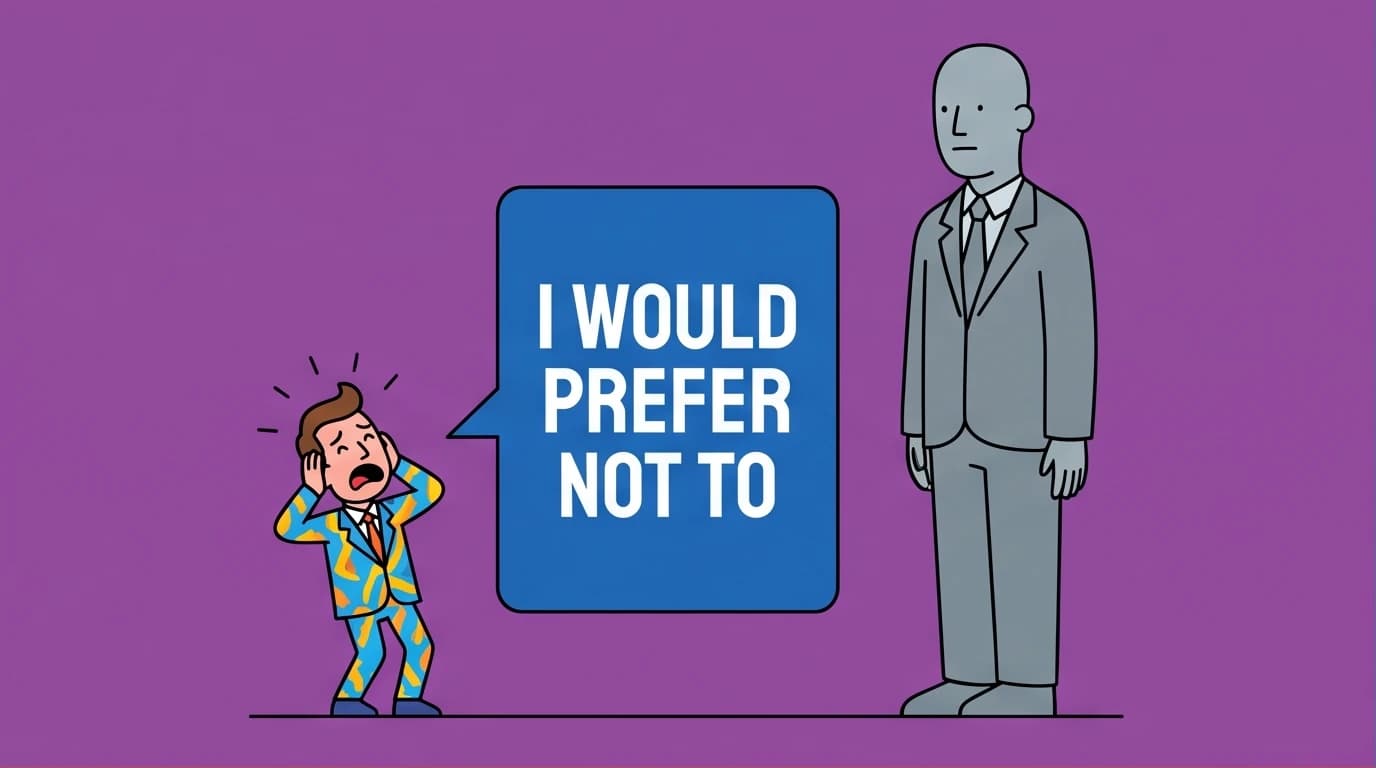
You read Herman Melville’s classic story and you immediately hit a wall of frustration. An employee is hired to copy legal documents. A few days in, he refuses to do his job with a polite but immovable "I would prefer not to." He doesn't yell. He doesn't quit. He simply stops participating in the expectations of his environment.
Why doesn't the boss fire him on the spot? Why does Bartleby choose a slow, agonizing starvation over a simple confrontation?
For decades, readers have tried to categorize this narrative as a quirky 19th-century tale of Wall Street. Today, we recognize it as an astonishingly accurate blueprint of modern workplace burnout, extreme psychological isolation, and the complex friction between capitalist utility and human compassion. To truly understand the story, we must strip away the literary academic jargon and look at the actual psychological mechanisms driving both the passive-aggressive employee and his conflicted employer.
Bartleby Character Traits: The Architecture of Isolation
When looking at specific bartleby character traits, you notice an absolute absence of traditional hostility. He is not plotting against the firm. His traits are defined entirely by subtraction: absence of emotion, absence of motion, and eventually, absence of life.
The Power of "I Would Prefer Not To"
Bartleby’s famous catchphrase is a masterpiece of passive resistance. He does not say "I will not." "Will not" implies an active rebellion, a clash of wills, and a direct challenge to authority. "Prefer not to" removes him from the power dynamic entirely.
By framing his refusal as a preference, Bartleby strips his employer of any standard disciplinary response. You can punish someone for insubordination; you cannot easily punish someone for expressing a mild, polite preference. This trait highlights a complete loss of agency. Bartleby has realized that in the machinery of Wall Street, he is merely a tool. His only remaining sliver of autonomy is the choice to do absolutely nothing.
Bartleby's quiet rebellion against the crushing weight of capitalist utility feels remarkably relevant in today's burnout-heavy culture. If you've ever felt like your identity is being entirely consumed by your 9-to-5 grind, you're not alone. To better understand this modern friction between our intrinsic human value and the relentless demands of the corporate world, there are some fantastic modern critiques available. One highly recommended read dives deep into why we are conditioned to tie our self-worth so closely to our paychecks, offering a powerful perspective shift for American workers feeling the squeeze.
Work Won't Love You Back
Sarah Jaffe
 21 Duration
 8 Key Points
 4.3 Rate
The Dead Letter Office and Existential Nihilism
To conduct an accurate bartleby psychological analysis, we must look at his history. The story eventually reveals that Bartleby previously worked in the Dead Letter Office in Washington. He spent his days sorting undeliverable mail—letters containing pardons for people who died in prison, money sent to people who starved before it arrived, messages of love sent to the deceased.
Psychologically, handling dead letters is handling the failure of human connection. Over time, Bartleby absorbed this terminal futility. If all human communication ultimately ends up in the flames, why bother communicating? Why bother copying legal documents that mean nothing? His sudden descent into catatonia—staring blankly at the brick wall outside the office window—aligns perfectly with what modern psychiatry identifies as severe clinical depression and psychomotor retardation. He is paralyzed by the meaninglessness of his reality.
The profound sense of nihilism Bartleby experiences is a stark reminder of how deeply we crave a sense of purpose. When your daily reality feels completely devoid of meaning, it's easy to slip into the same kind of paralyzing detachment that destroyed Bartleby. For those grappling with feelings of existential dread or trying to find a spark of purpose in challenging circumstances, exploring the psychology of meaning can be incredibly healing. A groundbreaking psychological memoir explores exactly how humans can discover deep, sustaining purpose even in the most unimaginably bleak environments.
Man's Search for Meaning
Viktor E. Frankl
44 Duration8 Key Points4.6 RateWhile books like Man's Search for Meaning offer profound insights, their emotional weight can make them difficult to pick up. If you want to grasp the essential wisdom from such transformative books more gently, a summary can be a great starting point.


Grasp the core wisdom of profound books on psychology and meaning in easy-to-digest 15-minute summaries, making heavy topics more accessible for daily reflection.
 LeapAhead
The Narrator in Bartleby the Scrivener: The Complacent Employer
Readers often focus so much on Bartleby that they miss the actual protagonist. The entire story is filtered through the lens of his boss. The narrator in bartleby the scrivener—an unnamed, elderly Wall Street lawyer—is a fascinating study in conflict avoidance and self-serving benevolence.
The Illusion of Safety
From the opening paragraphs, the lawyer tells us exactly who he is. He loves the "easiest way of life." He does not take cases to court. He prefers the quiet, lucrative safety of doing paperwork for rich men like John Jacob Astor.
His other employees—Turkey and Nippers—have highly predictable, manageable behavioral flaws. Turkey is a mess in the afternoon; Nippers is a mess in the morning. The lawyer tolerates them because their flaws fit neatly into a mechanical schedule. They do not challenge his worldview. Bartleby, however, presents an existential flaw. He breaks the unwritten social contract of the workplace: I pay you, so you must pretend to care about this work.
Superficial Empathy vs. Real Compassion
The lawyer considers himself a deeply moral, Christian man. When Bartleby refuses to work, the lawyer rationalizes letting him stay. He tells himself he is showing immense charity.
But a deeper psychological reading reveals a different truth. The lawyer doesn't tolerate Bartleby out of genuine compassion; he does it out of cowardice. Confronting Bartleby requires emotional labor and potential conflict, two things the lawyer avoids at all costs. He offers Bartleby small amounts of money, tolerates his sleeping in the office, and eventually moves his entire law practice to a new building rather than evict him.
The lawyer’s empathy is entirely self-serving. It is designed to soothe his own conscience rather than address Bartleby’s profound psychological crisis. He wants to buy his way out of guilt.
Bartleby and the Lawyer: A Complex Workplace Dynamic
The interaction between bartleby and the lawyer serves as a masterclass in toxic, codependent workplace dynamics. It is a slow-motion collision between a man who cannot articulate his pain and a man who refuses to see it.
The Enabler and the Pariah
The dynamic operates on a feedback loop. Bartleby pushes a boundary (refusing to examine a paper). The lawyer is stunned but retreats to avoid a scene. Bartleby learns the boundary is porous. He pushes further (refusing to write at all). The lawyer rationalizes the behavior again.
This mirrors what happens in modern organizations when leaders fail to address fundamental issues of mental health or performance. The lawyer treats Bartleby’s depression as a minor administrative inconvenience. By refusing to intervene meaningfully—by not getting him actual medical help, by not drawing firm personal boundaries, by simply leaving him behind in an empty office—the lawyer becomes an enabler of Bartleby's ultimate demise.
The dynamic between Bartleby and his employer perfectly illustrates what happens when we lack the tools to communicate our limits and enforce healthy boundaries. In a professional setting, blurred lines don't just create awkwardness—they can lead to severe emotional distress and codependency. If you find yourself constantly accommodating unhealthy behaviors at the office or struggling to protect your own mental bandwidth, mastering the art of boundary-setting is essential. Learning to clearly and compassionately draw the line can transform your work life and protect your psychological well-being.

Set Boundaries, Find Peace
Nedra Glover Tawwab
29 Duration10 Key Points4.5 RateModern Leadership Lessons: The Danger of "Nice"
If you examine this relationship through a modern management lens, the lawyer is the archetype of the "ruinously empathetic" boss.
Being nice is not the same as being kind. Letting a severely depressed, starving employee live in your office cubicle because you don't want to have a tough conversation is a failure of leadership. The lawyer completely fails to establish psychological safety or clear professional boundaries.
When modern workers engage in "quiet quitting"—doing the bare minimum to avoid being fired because they feel completely disconnected from the value of their labor—they are channeling the ghost of Bartleby. Leaders facing this cannot just look the other way, offer a token wellness program, and hope the problem fixes itself. You cannot cure systemic alienation by simply ignoring the person staring at the wall.
The lawyer’s management style is a textbook case of what modern organizational experts call "ruinous empathy." He prioritizes his own comfort and a superficial sense of workplace peace over the difficult, necessary conversations that actually help employees grow or get the support they need. If you're managing a team today, understanding the difference between simply being "nice" and genuinely caring for your team's success is a critical leadership skill. To avoid the lawyer's fatal mistakes, it pays to learn how to deliver honest, direct feedback while still maintaining deep personal compassion.
Radical Candor
Kim Scott
19 Duration7 Key Points4.6 RateReading great leadership books like Radical Candor is one thing, but finding the time when you're already drained from managing a team is another. For those who want to absorb these key ideas without the heavy time commitment, an app can help bridge that gap.
Absorb the core lessons from leadership bestsellers like Radical Candor in just 15-minute audio or text sessions, perfect for your commute or a quick break.
LeapAhead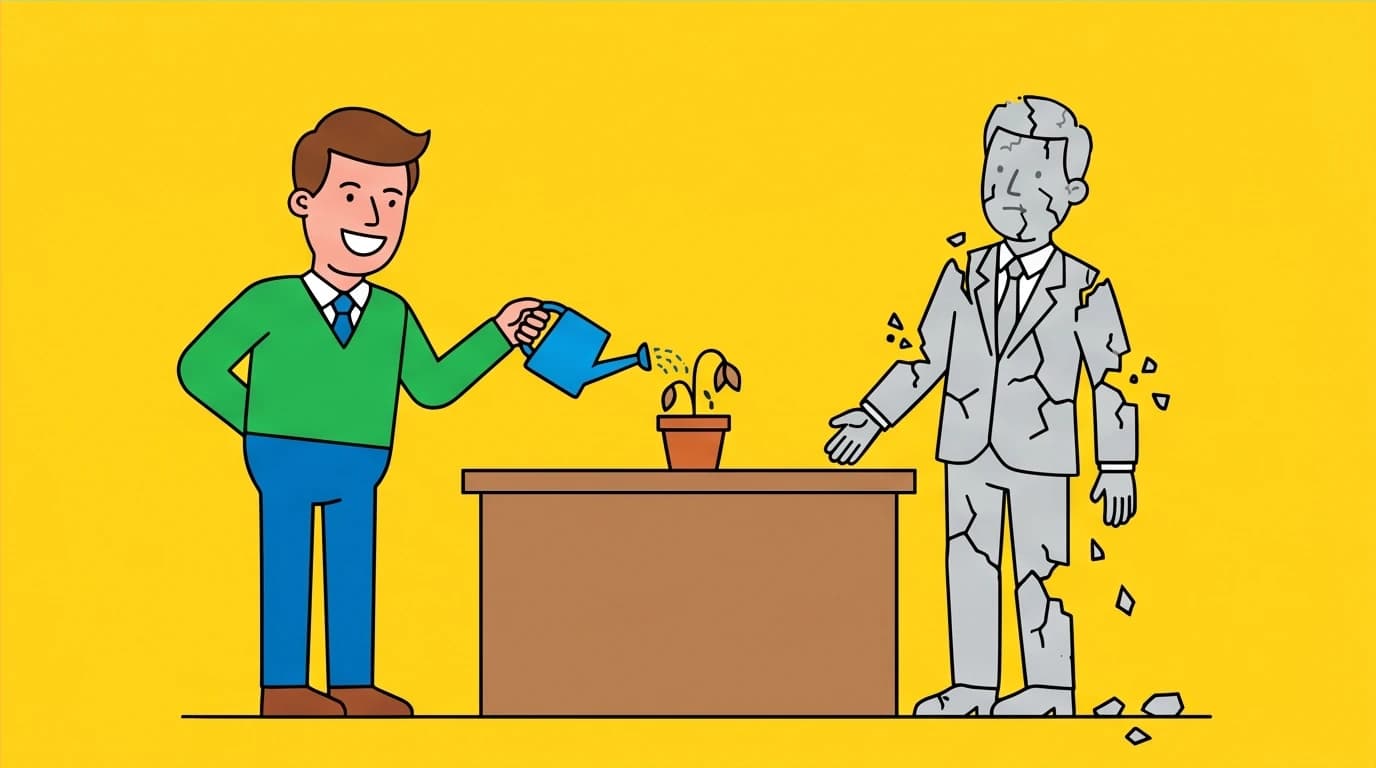
The Tragic Climax: The Tombs
When Bartleby is finally arrested and taken to the prison known as "The Tombs," the story reaches its inevitable conclusion. Even here, the lawyer tries to buy a solution, paying a grub-man to secure better food for Bartleby. But Bartleby prefers not to eat.
Bartleby dies curled up at the base of a prison wall, a final physical manifestation of his internal state. He dies not because he was violently murdered, but because he completely withdrew his participation from a society that only valued him as a human copy machine. The lawyer's final words, "Ah, Bartleby! Ah, humanity!" are a realization that comes far too late. He finally sees that Bartleby was not just a broken employee, but a symptom of a broken human condition.
FAQ
What is Bartleby's actual mental illness?
While Herman Melville wrote the story in 1853, long before modern psychiatric diagnoses existed, psychologists today widely analyze Bartleby's behavior as severe clinical depression, specifically accompanied by catatonia and anhedonia (the inability to feel pleasure or motivation). His previous traumatic experience handling dead letters likely triggered this profound existential crisis.
While Herman Melville wrote the story in 1853, long before modern psychiatric diagnoses existed, psychologists today widely analyze Bartleby's behavior as severe clinical depression, specifically accompanied by catatonia and anhedonia (the inability to feel pleasure or motivation). His previous traumatic experience handling dead letters likely triggered this profound existential crisis.
Why doesn't the narrator just fire Bartleby immediately?
The narrator is pathologically averse to conflict. He values a quiet, easy life above all else. When confronted with Bartleby's bizarre, passive resistance, the narrator rationalizes keeping him around to avoid the uncomfortable emotional confrontation of firing him. He confuses his own cowardice and conflict avoidance with Christian charity.
The narrator is pathologically averse to conflict. He values a quiet, easy life above all else. When confronted with Bartleby's bizarre, passive resistance, the narrator rationalizes keeping him around to avoid the uncomfortable emotional confrontation of firing him. He confuses his own cowardice and conflict avoidance with Christian charity.
What do the walls symbolize in the story?
Walls are a central psychological metaphor in the story. Bartleby works facing a literal brick wall outside his window. His desk is separated from the boss by a folding screen. He ends up dying against a massive wall in a prison. These walls represent the insurmountable barriers of communication, the isolating nature of modern corporate work, and the psychological traps that keep humans alienated from one another.
Walls are a central psychological metaphor in the story. Bartleby works facing a literal brick wall outside his window. His desk is separated from the boss by a folding screen. He ends up dying against a massive wall in a prison. These walls represent the insurmountable barriers of communication, the isolating nature of modern corporate work, and the psychological traps that keep humans alienated from one another.