

Your employees are overwhelmed, and hour-long training modules are sitting uncompleted in your traditional learning management system. You already know short-form, targeted content is the solution, but evaluating dozens of microlearning tools to find one that actually fits your IT infrastructure and engages your team is a massive undertaking. You need a clear, objective breakdown of which platform excels in specific enterprise use cases, without the marketing fluff.
Here is the analytical framework and objective comparison you need to select the right microlearning solution for your organization.
The Shift from Traditional Systems to Microlearning Tools
Legacy corporate training software was built for compliance, not for human attention spans. When you force a retail associate, a delivery driver, or a busy sales executive to sit through a 45-minute slide deck, retention drops to near zero.

Microlearning flips this model. By delivering targeted knowledge in three-to-five-minute bursts, it aligns with how adults naturally consume information. However, buying a specialized tool requires careful justification. You are not just buying an app; you are buying a behavior change mechanism. Your goal is to find software that removes friction from both the creator's workflow (L&D teams) and the end-user's experience (the employees).
To fully appreciate this shift, it's helpful to compare the two methodologies side-by-side to understand when each is most appropriate.
Shifting your corporate training strategy from hour-long marathon sessions to bite-sized bursts is essentially an exercise in behavioral psychology. If you want to understand why minimizing friction and delivering knowledge in small, digestible chunks is so effective for adult learners, digging into the science of continuous improvement can be a game-changer. For a fascinating look at how tiny, incremental changes lead to massive behavioral shifts and long-term success, this insightful read is highly recommended:

One Small Step Can Change Your Life
Robert Maurer, Ph.D.
 18 Duration
 7 Key Points
 4.7 Rate
Core Evaluation Criteria for Enterprise Buyers
Before looking at specific vendors, establish a baseline for what your organization actually needs. Not all microlearning tools are built the same; some are essentially flashcard apps, while others are robust enterprise systems.
1. Authoring Agility and AI Capabilities
If your instructional designers have to spend three weeks coding a five-minute lesson, the platform has failed. Look for built-in authoring tools that support rapid deployment. Top-tier platforms now feature AI-assisted authoring that can ingest your standard operating procedure (SOP) documents or PDFs and automatically generate bite-sized lessons and quizzes.
For instructional designers looking to master this new format, a clear content strategy is essential for success.
2. Native Mobile Learning Apps vs. Browser Delivery
You must map the delivery method to your workforce. If you are training deskless workers (retail, manufacturing, logistics), native mobile learning apps (iOS and Android) with push notifications and offline mode are mandatory. If you are training corporate desk workers, a browser-based delivery system or direct integration into Microsoft Teams and Slack will yield higher engagement than forcing them to download a standalone app on their personal phones.
3. Analytics and Knowledge Gap Identification
Basic completion tracking is no longer sufficient. You need a microlearning lms that measures actual knowledge retention over time. Look for systems that utilize spaced repetition algorithms—software that automatically re-tests employees on subjects they previously struggled with until mastery is achieved.
The technology behind spaced repetition is powerful, but it’s entirely based on proven cognitive science. Modern microlearning platforms work so well because they force the brain to recall information just as it’s about to forget it—cementing the knowledge permanently. If you are an L&D professional looking to design training modules that truly optimize memory retention rather than just ticking a compliance box, understanding the psychology of learning is essential. This evidence-based guide breaks down exactly why traditional studying fails and how to make new information stick:

Make It Stick
Peter C. Brown, Mark A. McDaniel, Ph.D., Henry L. Roediger III, Ph.D.
18 Duration8 Key Points4.6 Rate4. Ecosystem Integration
A standalone tool quickly becomes an administrative nightmare. The platform must offer single sign-on (SSO) and native integrations or robust APIs to connect with your core HRIS (like Workday or BambooHR) and your primary LMS. Training records must sync automatically to maintain a single source of truth for compliance audits.
---APP_DATA---
description: Turn your team's downtime into learning time with 15-minute book summaries from LeapAhead.
---END_APP_DATA---
description: Turn your team's downtime into learning time with 15-minute book summaries from LeapAhead.
---END_APP_DATA---
Top Picks: The Best Microlearning Platforms Evaluated
Based on enterprise adoption, feature depth, and specific use-case utility, here is an objective analysis of the leading platforms on the market.
Before diving into specific platforms, it can be helpful to see what the end product looks like. For inspiration on formats and delivery methods, check out these real-world applications.
1. EdApp: Best Overall for Agile Teams and Mobile Delivery
EdApp (now part of SafetyCulture) is arguably the most comprehensive mobile-first training solution available. It bridges the gap between a lightweight app and a full-scale LMS.
- Best For: Organizations that need a massive, ready-to-use content library and a highly intuitive mobile interface.
- Key Strengths: The platform features a drag-and-drop authoring tool that is exceptionally user-friendly. Its Canva integration allows L&D teams to create visually stunning content without a graphic designer. EdApp also provides an extensive library of pre-built, editable courses covering everything from OSHA compliance to leadership skills.
- Limitations: While its mobile experience is flawless, its desktop interface can feel like a direct port of the mobile app, which might not appeal to highly corporate, desk-bound environments.
- Enterprise Fit: Excellent. It supports SSO, API access, and user grouping, making it highly scalable.
2. Axonify: Best for Frontline and Deskless Workers
Axonify is engineered specifically for the frontline workforce. It is heavily utilized by massive retail and logistics brands like Walmart and Kroger.
- Best For: Large-scale operations where daily knowledge reinforcement translates directly to safety and revenue.
- Key Strengths: Axonify focuses on "daily brain bites." It integrates training into the daily workflow seamlessly, often requiring just three minutes a shift. Its proprietary algorithm is built around spaced repetition and gamification, identifying exact knowledge gaps in real-time and adjusting the content delivery accordingly.
- Limitations: The implementation process is heavy. This is not a plug-and-play tool you can roll out in an afternoon. It requires a strategic overhaul of how your organization approaches daily training.
- Enterprise Fit: Unmatched for frontline scale, but comes with a premium enterprise price tag and complex deployment.
Getting deskless workers to engage with training every single shift means you need to turn learning into a daily, automatic routine. When a three-minute training session becomes as natural as clocking in or checking a schedule, you have successfully built a culture of continuous learning. If you want a deeper understanding of how to seamlessly design these "daily brain bites" into your team's workflow and turn corporate training into an unbreakable routine, mastering the mechanics of habit formation will give you a serious edge:

Atomic Habits
James Clear
26 Duration8 Key Points4.7 Rate3. 7taps: Best for Ultra-Fast, Frictionless Deployment
7taps has disrupted the market by stripping away all the heavy LMS features and focusing purely on the speed of content consumption.
- Best For: Rapid updates, product launches, and urgent corporate communications where you cannot afford login friction.
- Key Strengths: It does not require a native app download. You create a "tap-through" course (similar to an Instagram Story) and distribute it via a simple link, SMS, or QR code. Employees click the link and start learning immediately in their browser.
- Limitations: It is not a replacement for comprehensive corporate training software. It lacks the deep tracking, complex branching logic, and robust compliance management found in heavier systems.
- Enterprise Fit: Best utilized as a supplementary tool within your broader tech stack for specific, high-urgency training campaigns.
4. LeapAhead: Best for Individual Professional Development and Soft Skills
LeapAhead offers a unique microlearning approach by providing 15-minute summaries of over 30,000 bestselling nonfiction books in both audio and text formats. It's designed for busy professionals who want to continuously learn and grow.
- Best For: Organizations looking to provide a self-directed professional development perk, helping employees build soft skills like leadership, productivity, and communication on their own time.
- Key Strengths: Its massive library of book summaries offers a cost-effective way to give employees access to a wide range of knowledge. The dual audio/text format is perfect for learning during commutes or breaks. Personalized learning plans and themed content "albums" help guide users toward specific goals, like improving negotiation skills or overcoming procrastination.
- Limitations: As content is summarized, it may not satisfy users needing deep, academic-level detail for technical subjects. The platform is built for individual use and lacks the team-based dashboards and compliance tracking required for a primary corporate training system.
- Enterprise Fit: Functions best as a supplemental learning perk or a resource for soft-skills development rather than a core compliance tool. It’s easily deployed as an employee benefit but lacks the deep HRIS/LMS integration needed for mandatory training tracking.
5. TalentCards: Best for Safety and Field Training
TalentCards takes a highly visual, flashcard-based approach to microlearning.
- Best For: Construction, manufacturing, and field service teams who need quick reference materials on site.
- Key Strengths: The platform allows administrators to build double-sided digital flashcards containing video, audio, and text. It is incredibly effective for safety protocols, equipment operation guides, and compliance refreshers. Employees can download the cards for offline viewing, which is critical for remote job sites without cell service.
- Limitations: The format is rigid. If you need to teach complex soft skills or nuanced leadership training, the flashcard model quickly becomes inadequate.
- Enterprise Fit: A highly specialized point solution that works brilliantly for hard skills and safety, but requires a primary LMS alongside it.
6. OttoLearn: Best for Adaptive Learning and Spaced Repetition
OttoLearn focuses heavily on the science of memory retention through its "Agile Microlearning" framework.
- Best For: Compliance, regulated industries, and scenarios where forgetting information presents a severe business risk.
- Key Strengths: Instead of assigning courses, administrators assign "Mastery Goals." OttoLearn's algorithm then takes over, pushing daily 2-minute "Knowledge Cards" to users. It continuously analyzes incorrect answers and forces users to review specific concepts until the data proves they have mastered the topic.
- Limitations: The authoring process requires a mindset shift. You do not build "courses"; you build individual knowledge nuggets and trust the algorithm to deliver them, which can feel jarring for traditional instructional designers.
- Enterprise Fit: Strong analytics and compliance tracking make it a favorite for finance, healthcare, and insurance sectors.
Moving away from traditional course building and trusting an algorithm to deliver individualized "knowledge nuggets" requires a fundamental shift in how your L&D team views adult education. To truly champion this adaptive learning framework within your organization, it helps to dive deep into how the human brain actually processes, filters, and retains new skills over time. This engaging exploration of cognitive science will provide your instructional designers with the perfect foundation for building mastery-focused training content:
How We Learn
Benedict Carey
22 Duration10 Key Points4.7 Rate---APP_DATA---
description: Help your employees build critical soft skills with daily insights from bestselling nonfiction books on the LeapAhead app.
---END_APP_DATA---
description: Help your employees build critical soft skills with daily insights from bestselling nonfiction books on the LeapAhead app.
---END_APP_DATA---
Integrating Microlearning into Your Tech Stack
Purchasing the software is only 20% of the battle; integration dictates the ROI. Do not fall into the trap of creating a siloed learning environment.
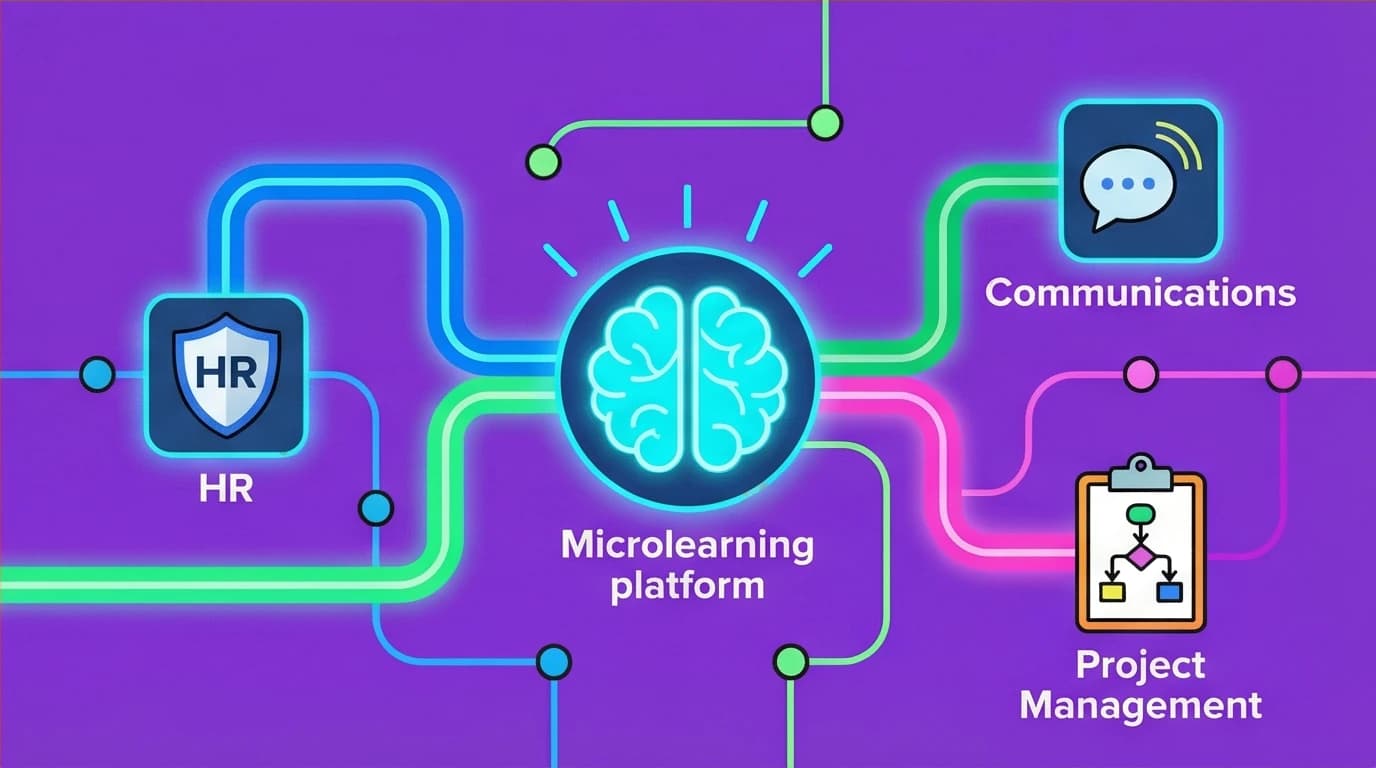
When mapping out your implementation, ensure your chosen platform supports SCORM or xAPI export if you plan to host the microlearning modules inside your legacy LMS. However, if you are using the vendor's native app, prioritize automated user provisioning via your HRIS. If an employee is terminated in Workday, their access to the mobile learning app must be revoked automatically to protect proprietary company data.
Furthermore, push training to where the employees already are. If your company lives in Slack or Microsoft Teams, select a vendor that allows course delivery directly via chat notifications. Friction is the enemy of adoption.
Making the Final Decision
Avoid evaluating platforms purely based on feature checklists. Almost all modern tools offer quizzes, videos, and basic analytics. To make a definitive choice, run a pilot program targeting a specific business metric.
Choose a single department—for example, your outbound sales team. Select two distinct platforms and split the team. Measure not just the completion rate, but the actual impact on their sales metrics after a 30-day microlearning sprint. The data will reveal which user experience genuinely resonates with your workforce. Buy the tool that employees actually use voluntarily, not the one that looks best on an IT procurement spreadsheet.
FAQ
What is the main difference between a traditional LMS and a microlearning LMS?
A traditional LMS is built to host, manage, and track long-form content (like 60-minute SCORM modules or webinar recordings) and focuses heavily on administrative compliance. A microlearning LMS is engineered to deliver 2-to-5-minute bursts of content, usually optimized for mobile devices, focusing heavily on continuous engagement, gamification, and spaced repetition to improve long-term knowledge retention.
Do we need to replace our current corporate training software to implement microlearning?
No. Most enterprise organizations use a hybrid approach. You keep your heavyweight HRIS or LMS for deep compliance tracking, onboarding documentation, and formal certifications. You then integrate a microlearning platform via API to handle daily knowledge reinforcement, product updates, and agile training, feeding the completion data back into your main system.
How do we get frontline employees to use mobile learning apps on their personal phones?
This is a common legal and cultural hurdle in the US. You cannot force hourly workers to download corporate apps on personal devices off-the-clock without compensation issues. The solution is two-fold: First, ensure the training is highly relevant, brief (under 3 minutes), and tied to incentives (gamification, shift-bidding priority). Second, utilize QR codes or SMS links (like 7taps) during paid shift hours so they can consume the content via a browser without downloading a dedicated app.
Can we just cut our existing 45-minute training videos into short clips?
While technically possible, this is a flawed strategy. Chopping up a boring, out-of-context video simply creates shorter boring videos. True microlearning requires redesigning the content to focus on a single, actionable learning objective per module. You must rewrite the material to immediately address "what to do" rather than spending time on lengthy theoretical introductions.