

You are staring at a 40-page slide deck, but your gut already told you which vendor to choose ten minutes into the meeting. The friction hits immediately. Do you trust that split-second feeling, or do you force your team to spend another three weeks gathering data just to feel safe? Managers waste hundreds of hours second-guessing themselves because they do not know how to systematically validate their own intuition.

In business, speed is a competitive advantage. If you require absolute certainty for every choice, you will always be too late. The goal is not to eliminate fast choices, but to engineer them so they are accurate.
In business, speed is a competitive advantage. If you require absolute certainty for every choice, you will always be too late. The goal is not to eliminate fast choices, but to engineer them so they are accurate.
The Mechanics of "Thin-Slicing" in Business
Malcolm Gladwell’s concept of rapid cognition is not magic. It is rooted in "thin-slicing"—the ability of our unconscious mind to find patterns in situations and behavior based on very narrow slices of experience.
Think about a veteran firefighter instantly knowing a burning building is about to collapse, or a seasoned editor at Barnes & Noble spotting a bestseller from reading just the first three pages of a manuscript. They are not guessing. Their brains are processing thousands of past data points in milliseconds.

In a professional setting, blink decision making is highly effective, provided you know exactly how to cultivate it and when to deploy it.
In a professional setting, blink decision making is highly effective, provided you know exactly how to cultivate it and when to deploy it.
The concepts of "thin-slicing" and rapid cognition were famously brought into the mainstream spotlight by Malcolm Gladwell. If you want to dive deeper into the science of how our brains can instantly recognize patterns and make snap judgments that outsmart months of analysis, his groundbreaking book is an absolute must-read. It explores real-world examples from first responders to Fortune 500 executives, revealing exactly how to harness the power of your subconscious mind in high-stakes environments.
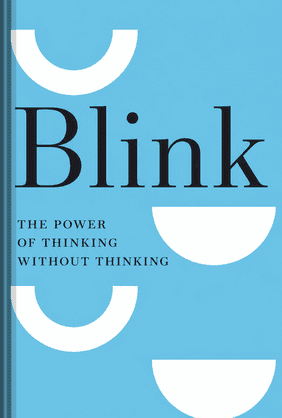
Blink
Malcolm Gladwell
 19 Duration
 9 Key Points
 4.5 Rate
How to Improve Intuition (And Make It Reliable)
People mistakenly treat intuition as an innate gift. It is not. Intuition is compressed experience. If you want to know how to improve intuition, you have to feed your brain high-quality data and structured feedback.
Immerse Yourself in Raw Data
You cannot thin-slice a market you do not fully understand. If you are launching a product on Amazon, your intuition will fail if you only read sanitized executive summaries. You need to read 1,000 raw customer reviews. You need to handle the physical product, look at its color, and test its features.
Rapid cognition requires a massive subconscious database. To build it, you must routinely dive into the tactical weeds of your industry. Once your brain absorbs the granular details, it can start recognizing patterns from a mile away.
Track Your Hits and Misses
Intuition without a feedback loop is just arrogance. To refine your rapid cognition, keep a decision journal.
When you feel a strong instinct about a hire, a market shift, or a project timeline, write it down immediately. Note what your gut says and why you think you feel that way. Revisit that journal three months later. You will quickly realize which areas of your intuition are razor-sharp and which are clouded by noise.

Keeping a decision journal is one of the most powerful habits you can build to improve your professional judgment. If you are serious about analyzing your "hits and misses" to hone your intuition, learning to think in terms of probabilities rather than absolute certainties is a massive advantage. Former professional poker player Annie Duke offers an incredible framework for evaluating the quality of your choices independent of their outcomes, helping you refine your gut instincts for the corporate world.
Thinking in Bets
Annie Duke
36 Duration8 Key Points4.6 RateAbsorbing new mental models from books like these is critical, but finding the time after a long workday can be a challenge. If your schedule is packed, you can get the core ideas from top business books in a fraction of the time.

Listen to key insights from bestselling books on decision-making and leadership in just 15-minute audio summaries, perfect for your commute or workout.

Download LeapAhead App now
Trusting Your Gut Instinct vs. Falling for Blind Spots
The hardest part of rapid cognition is knowing when it is safe to use it. Trusting your gut instinct is a calculated risk. You need to separate the environments where your intuition thrives from the ones where it crashes.
The "Green Zone" for Gut Feelings
Trust your gut when two conditions are met:
- You have deep domain expertise. If you have spent 10,000 hours in sales, trust your immediate read on a client's hesitation.
- The environment is highly predictable. Intuition works well in stable environments where cause and effect are clear. An emergency room nurse can thin-slice a patient's condition because the human body generally follows biological rules.
The "Red Zone" (When to Ignore Your Gut)
Do not rely on thin-slicing when:
- You are entering a brand new market. Your past patterns do not apply here. Your gut is literally uneducated in this space.
- You are dealing with highly complex, non-linear forecasts. You cannot thin-slice the stock market or predict a five-year macroeconomic trend. These require slow, analytical thinking.
If you are outside your zone of expertise, that feeling in your stomach is not intuition—it is just indigestion or anxiety.
Knowing when to trust your immediate instincts and when to slow down for careful analysis is the hallmark of an effective executive. To master this delicate balance, it helps to intimately understand the two distinct systems that drive the way we process information. Nobel laureate Daniel Kahneman provides the definitive guide to recognizing when your fast, intuitive brain is likely to lead you astray, and when you absolutely must engage your slower, deliberate analytical mind to avoid costly missteps.
Thinking, Fast and Slow
Daniel Kahneman
53 Duration9 Key Points4.5 RateDefeating Blink Unconscious Bias in the Workplace
Here is the dark side of rapid cognition: our subconscious is a sponge. It absorbs everything, including societal stereotypes, racist tropes, and sexist assumptions. If left unchecked, thin-slicing leads straight to Blink unconscious bias.
The Warren Harding Error in Hiring
Gladwell famously points out the "Warren Harding Error," where voters supported a president simply because he looked tall, handsome, and "presidential," despite his profound incompetence.
This happens in corporate America every day. Managers routinely hire candidates because they "feel like a good cultural fit." Often, that is code for "they look like me, they went to my college, and we like the same sports." That is not intuition; that is a dangerous bias masquerading as a gut feeling.
Building Guardrails Against Bias
To protect your organization, you must blind the data. Orchestras revolutionized their hiring by having musicians audition behind screens. The judges could only hear the music, forcing them to thin-slice the actual performance rather than the performer's gender or appearance.

You can apply this immediately:
You can apply this immediately:
- Mask Resumes: Use software to strip names, photos, and graduation years from initial applications.
- Use Standardized Rubrics: Before a candidate walks into the room, define exactly what skills you are measuring. Do not let a firm handshake or a bright smile override your baseline requirements.
- Change Your Surroundings: If you want to change your subconscious biases, you must change what you are exposed to. Read different books, listen to diverse voices on Audible or Apple Books, and actively surround yourself with people who challenge your default worldview.
Systematically masking resumes and standardizing your evaluation rubrics are crucial first steps in preventing unconscious bias from infecting your organization. However, truly dismantling these deep-seated mental shortcuts requires a proactive, sustained effort. If you are looking for actionable, science-backed strategies to identify and eliminate these hidden prejudices in your workplace, exploring how top companies have successfully tackled this exact challenge can give you a practical blueprint for creating a fairer, more objective company culture.

The End of Bias
Jessica Nordell
15 Duration7 Key Points4.6 RateBlink Leadership Lessons for High-Stakes Environments
Leaders who master rapid cognition operate fundamentally differently. They do not hoard data; they edit it. Here are the core Blink leadership lessons you can apply to run a more agile team.
Less Information is Often Better
In the age of big data, managers are terrified of missing a metric. They force their teams to build dashboards tracking 50 different KPIs. But cognitive science shows that too much information degrades decision quality. The brain becomes overwhelmed and loses the ability to thin-slice the core issue.
Identify the three to five metrics that actually move the needle. Ignore the rest. When you declutter your data, the right decision often jumps out at you instantly.
This principle of distilling information down to its essential core also applies to your personal learning. To absorb the wisdom from all the influential books recommended here without getting bogged down, a specialized app can be a game-changer.
Grasp the crucial concepts from essential business books in quick, 15-minute summaries, helping you learn the key lessons without information overload.
Download LeapAhead App now
Protect Your Team's Cognitive Space
Extreme stress destroys rapid cognition. When human heart rates push past 145 beats per minute, motor skills break down and complex thought vanishes. While you might not be in physical danger in an office, high-stress corporate environments trigger the exact same physiological panic.
If your team is working 80-hour weeks in a toxic, high-pressure culture, their intuition is broken. They will make careless, reactive choices. As a leader, your job is to organize the workload and protect the "white space" your team needs to process information clearly. Keep the temperature in the room—metaphorically and literally (keep it at a comfortable 70 degrees Fahrenheit, not a sweltering 85)—calm and focused.
Solicit the "Snap Judgment"
In your next strategy meeting, before anyone opens a laptop or presents a spreadsheet, ask the room for their raw, 10-second read on a problem. Capture those initial gut reactions. Often, the collective thin-slicing of an experienced team will point you toward the exact right strategy before the formal analysis even begins.
FAQ
How do I justify a "gut decision" to a boss who only wants hard data?
Never pitch it as a "gut feeling." Frame it as pattern recognition based on historical data. Say, "Based on my experience managing the last four product launches, the current indicators strongly suggest we should take Path A. Let's look at the three core metrics that support this trend." Translate your intuition into the language of business logic.
Never pitch it as a "gut feeling." Frame it as pattern recognition based on historical data. Say, "Based on my experience managing the last four product launches, the current indicators strongly suggest we should take Path A. Let's look at the three core metrics that support this trend." Translate your intuition into the language of business logic.
What is the difference between anxiety and intuition?
Intuition feels neutral, clear, and instant. It is a sudden crystallization of a fact (e.g., "This contract is flawed"). Anxiety feels highly emotional, chaotic, and physical (racing heart, spinning thoughts). If the feeling is driven by a fear of failure or a desire to please someone, it is anxiety, not intuition.
Intuition feels neutral, clear, and instant. It is a sudden crystallization of a fact (e.g., "This contract is flawed"). Anxiety feels highly emotional, chaotic, and physical (racing heart, spinning thoughts). If the feeling is driven by a fear of failure or a desire to please someone, it is anxiety, not intuition.
Can anyone learn how to thin-slice, or are some people just born with it?
Everyone thin-slices naturally—you do it every time you merge onto a highway driving 70 miles per hour. Applying it to business simply requires dedicated practice. By deliberately studying your field, minimizing data overload, and auditing your biases, anyone can train their brain to make highly accurate snap judgments.
Everyone thin-slices naturally—you do it every time you merge onto a highway driving 70 miles per hour. Applying it to business simply requires dedicated practice. By deliberately studying your field, minimizing data overload, and auditing your biases, anyone can train their brain to make highly accurate snap judgments.