

You are staring at a blank presentation slide or an unfinished essay, looking for the perfect hook. You know Malcolm Gladwell’s Blink: The Power of Thinking Without Thinking contains the exact psychological insight you need to explain rapid decision-making, expert intuition, or unconscious bias. The problem is time. You cannot afford to spend three hours flipping through paperbacks to extract the specific phrasing or the precise details of his famous anecdotes.

You do not just need a list of detached sentences. You need the context. When you stand on a stage or publish a piece, quoting a concept incorrectly damages your credibility. You need the complete story behind the art forgery, the marriage predictions, and the subconscious tests to seamlessly weave them into your own narrative.
This guide solves the immediate problem for Blink, but if you find yourself constantly short on time to absorb big ideas from influential books, there's a more efficient way to stay ahead.


Get the core insights from bestsellers like *Blink* in just 15 minutes, perfect for busy professionals who need to learn on the go.
 LeapAhead
Here is the definitive breakdown of the best Blink Malcolm Gladwell quotes, organized by his most famous case studies.
The Foundation: Understanding "Thin-Slicing"
Before diving into the specific stories, you must establish the core premise of the book for your audience: thin-slicing. Gladwell defines this as the ability of our unconscious to find patterns in situations and behavior based on very narrow slices of experience.
When you need to explain why an expert's gut feeling is often more accurate than a mountain of spreadsheet data, use these foundational Blink book quotes:
- "The key to good decision making is not knowledge. It is understanding. We are swimming in the former. We are desperately lacking in the latter."
- "There can be as much value in the blink of an eye as in months of rational analysis."
- "Thin-slicing is not an exotic gift. It is a central part of what it means to be human. We thin-slice whenever we meet a new person or have to make sense of something quickly or encounter a novel situation. We thin-slice because we have to, and we come to rely on that ability because there are lots of hidden fistfuls of meaning in the details of everyday life."
How to frame this in your work: Use these quotes to challenge the modern corporate obsession with "big data." They work perfectly in opening remarks for business strategy meetings, reminding leaders that endless analysis often leads to paralysis, while trained intuition leads to breakthroughs.
Understanding the concept of thin-slicing is fundamental to grasping the book's core message. For those who want to explore the cognitive science behind this phenomenon, a deeper look can provide even more powerful insights.
Of course, if you want to truly master the art of thin-slicing and understand the fascinating mechanics behind our snap judgments, going straight to the source is a must. While summaries and quotes are excellent for a quick presentation prep, reading the full text gives you the deep, narrative context that makes these psychological concepts stick. If you haven't yet added this modern classic to your personal library, it's an essential read for anyone looking to sharpen their decision-making skills in high-stakes environments.
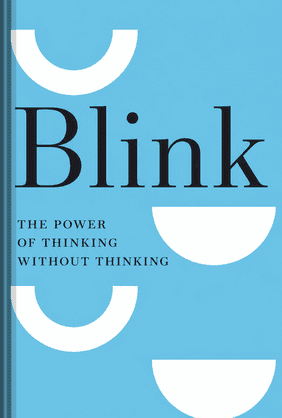
Blink
Malcolm Gladwell
 19 Duration
 9 Key Points
 4.5 Rate
The Blink Getty Kouros: When Intuition Beats Analysis
If you are speaking about the dangers of over-analyzing data at the expense of expert intuition, the Blink Getty kouros story is your ultimate case study.
In the 1980s, the J. Paul Getty Museum in California was offered a rare, perfectly preserved Greek marble statue dating back to the sixth century BC—a kouros. The museum spent 14 months conducting rigorous scientific tests. Geologists used electron microscopes, mass spectrometry, and X-ray diffraction to analyze the marble. The data said the statue was authentic. The Getty bought it for millions.
However, when leading art historians—like Evelyn Harrison and Thomas Hoving—looked at the statue, they did not need a microscope. Within a single two-second glance, they felt an immediate "gut repulsion." The statue looked fresh. It felt wrong. It was later revealed to be a modern forgery.
The scientists had overwhelming data, but they were wrong. The art experts had a two-second visceral reaction, and they were right. Their unconscious minds had instantly processed thousands of details that the scientific instruments missed.
Essential Quotes for the Kouros Case:
- "In the first two seconds of looking—in a single glance—they were able to understand more about the essence of the statue than the team at the Getty was able to understand after fourteen months."
- "We are instinctively suspicious of the kind of rapid cognition that is the engine of our unconscious."
- "Insight is not a lightbulb that goes off inside our heads. It is a flickering candle that can easily be snuffed out."
Presentation Strategy: Tell the Kouros story first to build tension. Ask your audience, "Who would you trust: 14 months of microscopic data, or a two-second glance from an expert?" Deliver the quote about the "flickering candle" to explain how easily corporate bureaucracies kill intuitive brilliance.
While Gladwell masterfully illustrates the power of our rapid, unconscious intuition, it is equally important to understand when that fast thinking fails us and when slow, deliberate analysis is actually required. For a comprehensive dive into the dual systems that drive how we think—System 1's rapid, emotional responses versus System 2's logical, calculating processes—there is no better follow-up than the groundbreaking work by a Nobel laureate in economics. It provides the perfect counterbalance to the Kouros case study, helping you build a bulletproof framework for professional decision-making.
Thinking, Fast and Slow
Daniel Kahneman
53 Duration9 Key Points4.5 Rate
Blink John Gottman: Predicting Divorce in Minutes
When your topic shifts to pattern recognition, human behavior, or predictive analytics, the Blink John Gottman chapter is the gold standard.
Gladwell introduces us to psychologist John Gottman, who runs a "Love Lab" at the University of Washington. Gottman places married couples in a room, hooks them up to sensors tracking their heart rate and sweat, and asks them to discuss a point of conflict for just 15 minutes. By observing this incredibly thin slice of interaction, Gottman can predict with 90% accuracy whether the couple will still be married 15 years later.
He does not need to know their financial history or deeply buried childhood trauma. He relies on SPAFF (Specific Affect Coding System) to track micro-expressions. He specifically looks for the "Four Horsemen": defensiveness, stonewalling, criticism, and above all, contempt.
Essential Quotes for the Gottman Case:
- "Anyone who has ever sat down with a married couple can thin-slice."
- "If Gottman observes one or both partners in a marriage showing contempt toward the other, he considers it the single most important sign that the marriage is in trouble."
- "A relationship grows and thrives on the details of everyday life. Gottman has proven that it takes only a brief observation of a couple's interaction to see the signature of their relationship."
Presentation Strategy: This story is highly effective for audiences involved in HR, negotiations, or management. It proves that massive predictive power lies in seemingly trivial daily interactions. Use the Gottman quotes to argue that identifying the right metrics (like contempt in marriage) is far more valuable than collecting all the metrics.
Gottman’s remarkable ability to predict relationship outcomes relies heavily on decoding nonverbal cues and micro-expressions that most of us completely miss. If you want to develop your own ability to "thin-slice" human behavior in real time—whether you are negotiating a business deal, interviewing a candidate, or simply navigating office dynamics—learning to read body language is a superpower. Written by a former FBI counterintelligence officer, the following guide offers practical, field-tested techniques for speed-reading people and spotting the hidden emotions they are trying to conceal.
What Every Body Is Saying
Joe Navarro, Marvin Karlins
42 Duration8 Key Points4.5 Rate
The Blink Implicit Association Test: Uncovering Hidden Biases
If you are speaking on diversity, inclusion, hiring practices, or the flaws of human judgment, you must reference the Blink implicit association test (IAT).
Gladwell explores the concept of the "Warren Harding Error"—the phenomenon where people voted for President Warren Harding simply because he looked like a strong, handsome leader, despite him being highly incompetent. To understand why we make these snap judgments, Gladwell introduces the IAT, a psychological test developed by researchers at Harvard.
The test forces participants to rapidly categorize words (like "Joy" or "Evil") alongside faces of different races or genders. The speed at which you make these associations reveals your unconscious bias. The shocking revelation? Gladwell, who is half-black, took the test and discovered he had a subconscious pro-white bias. The culture and environment he grew up in had programmed his rapid cognition, bypassing his conscious beliefs entirely.
Essential Quotes for the IAT Case:
- "Our first impressions are generated by our experiences and our environment, which means that we can change our first impressions... by changing the experiences that comprise those impressions."
- "We have, as human beings, a storytelling problem. We're a bit too quick to come up with explanations for things we don't really have an explanation for."
- "The Warren Harding error is the dark side of rapid cognition. It is at the root of a good deal of prejudice and discrimination. It's why picking the right candidate for a job is so difficult."
Presentation Strategy: Use this section to lower the defenses of your audience. When discussing bias, people often become defensive. By sharing Gladwell's own IAT results, you show that unconscious bias is not a moral failing, but an environmental programming issue. Use the first quote above to pivot toward solutions: we can change our bias by changing our environment.
The Implicit Association Test (IAT) is one of the most eye-opening tools for understanding the unconscious prejudices that shape our choices. If you want to dive deeper into the science behind the IAT and learn how to outsmart your own hidden biases, you should hear directly from the visionary psychologists who created the test. Their illuminating research provides actionable strategies for aligning your conscious values with your subconscious behaviors, making it an indispensable resource for leaders, hiring managers, and anyone committed to building an inclusive workplace.

Blindspot
Mahzarin R. Banaji and Anthony G. Greenwald
18 Duration8 Key Points5 RateCurated Standalone Quotes for High-Impact Moments
Sometimes you just need a sharp, standalone philosophical statement to drop into a paragraph or place on a title slide. Here are highly versatile excerpts categorized by the intent of your message.
On the Danger of Over-Explaining
- "We live in a world that assumes that the quality of a decision is directly related to the time and effort that went into making it."
- "The mind navigates through the world by constantly relying on its unconscious. We couldn't survive without it."
On Consumer Behavior and Market Research
- "To a novice, a product is just a product. But to an expert, a product is a language."
- "When consumers say they don't like something, they often mean they just don't understand it yet." (Perfect for framing the story of the Aeron chair or the New Coke failure discussed in the book).
On Extreme Pressure and Performance
- "In the blink of an eye, a true expert can synthesize years of experience."
- "Stress wipes out our ability to thin-slice. When our heart rate reaches 145 beats per minute, our complex motor skills begin to break down, and our vision tunnels."
How to Apply These in Your Next Project
Do not treat these quotes as decorative ornaments. Treat them as structural pillars of your argument.
If you are writing a persuasive essay, follow the Context-Quote-Application model. First, explain the environment (e.g., the Getty Museum's expensive mistake). Second, drop the Gladwell quote as the punchline. Third, apply that lesson directly to your reader's industry. "Just as the museum ignored expert intuition in favor of flawed data, modern tech companies often ignore user feedback in favor of vanity metrics."
By using these specific stories and direct excerpts, you borrow Gladwell's narrative authority. Your audience will immediately grasp complex psychological principles, and your content will stand out as thoroughly researched and deeply insightful.
If this article has you adding Blink and other classics to your reading list but you're wondering how to get through them all, an app can help you absorb the key ideas without the time commitment.
Clear your reading list by listening to the main takeaways from bestselling books while you commute, work out, or take a break.
LeapAheadBy understanding these quotes and case studies, you can powerfully leverage Gladwell's insights. These lessons are designed to be applied, helping you improve your own judgment in professional and personal settings.
It's also valuable to consider the book's broader reception and the scientific discussions it has sparked.
FAQ
Are Malcolm Gladwell's theories in Blink scientifically proven?
Gladwell is a journalist, not a scientist, and he synthesizes existing psychological research. The core concepts, such as John Gottman's marital research and the Implicit Association Test (IAT), are based on peer-reviewed academic studies. However, some critics argue Gladwell oversimplifies complex psychological mechanisms for the sake of a good narrative. It is best to present his work as highly informed psychological observation rather than absolute scientific law.
Gladwell is a journalist, not a scientist, and he synthesizes existing psychological research. The core concepts, such as John Gottman's marital research and the Implicit Association Test (IAT), are based on peer-reviewed academic studies. However, some critics argue Gladwell oversimplifies complex psychological mechanisms for the sake of a good narrative. It is best to present his work as highly informed psychological observation rather than absolute scientific law.
Can a person actually improve their "thin-slicing" ability?
Yes. Gladwell emphasizes that thin-slicing is not magic; it is the result of deep expertise and deliberate practice. The art historians who recognized the fake Getty kouros could only do so because they had spent decades studying authentic Greek antiquities. You improve your rapid cognition by immersing yourself in your field until the patterns become recognizable to your unconscious mind.
Yes. Gladwell emphasizes that thin-slicing is not magic; it is the result of deep expertise and deliberate practice. The art historians who recognized the fake Getty kouros could only do so because they had spent decades studying authentic Greek antiquities. You improve your rapid cognition by immersing yourself in your field until the patterns become recognizable to your unconscious mind.
Why is the Warren Harding Error so important in corporate hiring?
The Warren Harding Error perfectly illustrates how our unconscious biases hijack our rational decision-making. Interviewers often mistake physical appearance, height, or a deep voice for competence and leadership ability. Acknowledging this error is the first step in creating objective hiring rubrics that block out superficial traits.
The Warren Harding Error perfectly illustrates how our unconscious biases hijack our rational decision-making. Interviewers often mistake physical appearance, height, or a deep voice for competence and leadership ability. Acknowledging this error is the first step in creating objective hiring rubrics that block out superficial traits.