

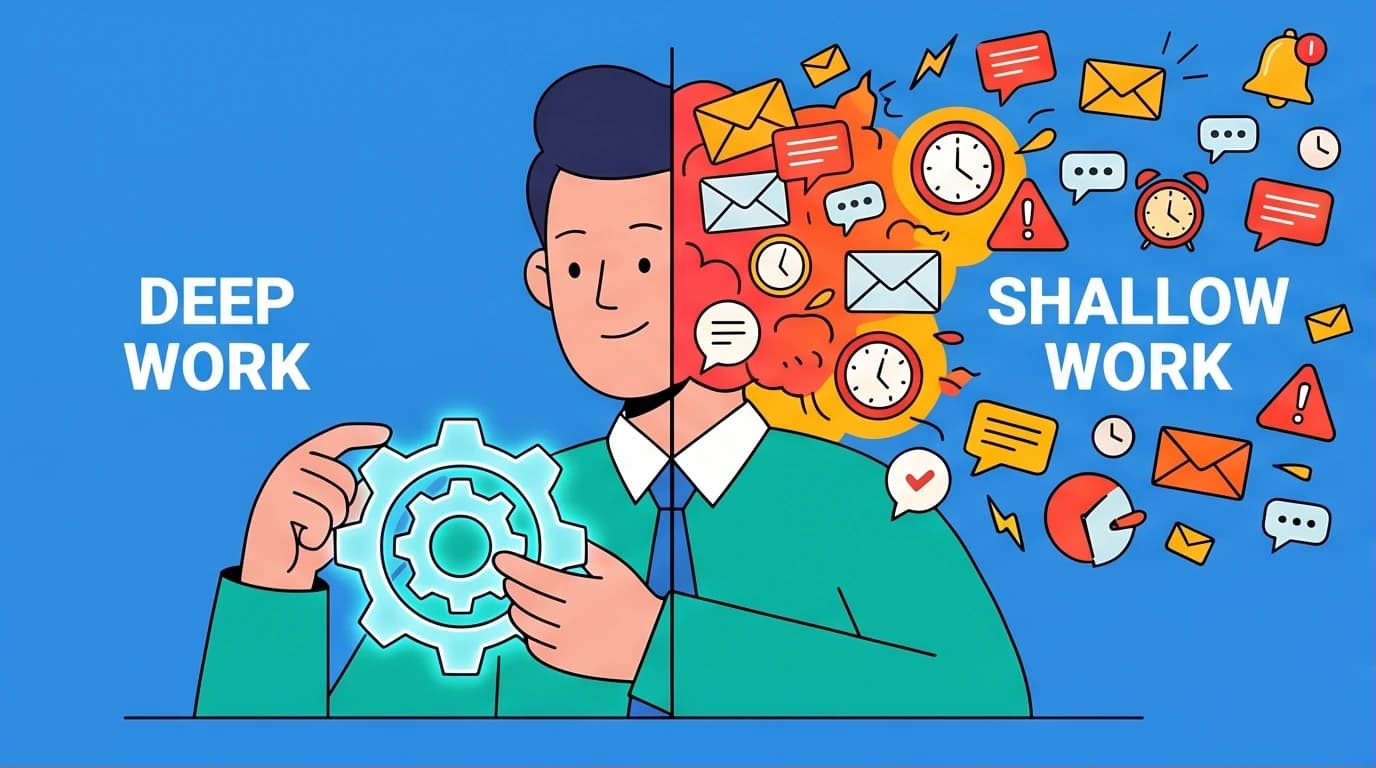
You close your laptop at 6 PM feeling completely drained. You answered dozens of emails, sat through four status meetings, and responded to a barrage of Slack pings. Yet, when you look at your actual project list, nothing moved forward. This is the modern knowledge worker's dilemma: drowning in motion but starved of actual progress. If you want to fix this exhausted-yet-unproductive cycle, you need to ruthlessly audit your daily tasks.
The Cal Newport Deep Work Concept
To fix a broken schedule, we first need a framework. The terminology we use today originates from computer science professor and author Cal Newport. In his bestselling book Deep Work (a staple on management reading lists across Barnes & Noble and highly recommended on Goodreads), he outlines a structural shift in the modern economy.
The core of the
cal newport deep work concept relies on a simple economic reality: the ability to perform deep, focused work is becoming increasingly rare at the exact same time it is becoming increasingly valuable in our information economy. Most offices are structured to interrupt you. The professionals who thrive are the ones who deliberately guard their attention and prioritize deep output over shallow motion.Since we’re already discussing the foundational framework of this entire concept, there is quite literally no better starting point than the original source material. If you want to truly master the art of intense concentration and understand why it’s the most lucrative skill in our modern economy, you owe it to yourself to read Cal Newport's definitive guide. It breaks down the exact strategies top performers use to tune out the noise and produce undeniable value in a distracted world.
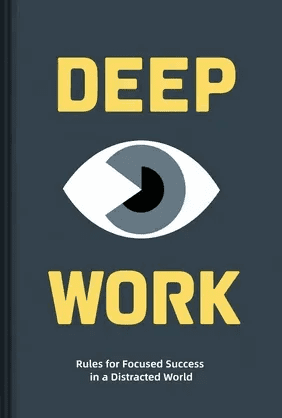
Deep Work
Cal Newport
 47 Duration
 8 Key Points
 4.6 Rate
If your schedule is already too packed with shallow work to tackle a full book, you can get a head start on these powerful concepts.

Grasp the core principles of Deep Work and other essential productivity books in 15-minute summaries, perfect for when you're too busy for a full read.
Download LeapAhead App now
To get a comprehensive overview of Newport's most powerful ideas, our detailed summary is the perfect next step.
What is Deep Work?
If you want to move the needle on your career or your business, you need to understand exactly
what is deep work and how it feels to execute it.The official
deep work definition is straightforward: professional activities performed in a state of distraction-free concentration that push your cognitive capabilities to their limit. These efforts create new value, improve your skill, and are fundamentally hard to replicate.Deep work requires a cognitive strain that feels uncomfortable at first. You cannot do it while listening to a podcast or keeping an eye on your phone for Amazon Prime delivery updates.
Examples of Deep Work:
- A software engineer writing a complex algorithm for a new app feature.
- A financial analyst building a predictive model from raw, unstructured data.
- A manager drafting a comprehensive quarterly strategy document.
- A copywriter crafting a high-conversion sales page.
When you engage in deep work, you are doing the heavy lifting that actually justifies your paycheck. This is the work that gets you promoted, lands major clients, and builds lasting products.
The Trap of Busywork
On the opposite end of the spectrum is shallow work. This is the invisible killer of productivity. Shallow work tasks are non-cognitive, logistical, or minor duties performed in a state of distraction. They do not create much new value in the world and are incredibly easy to replicate.
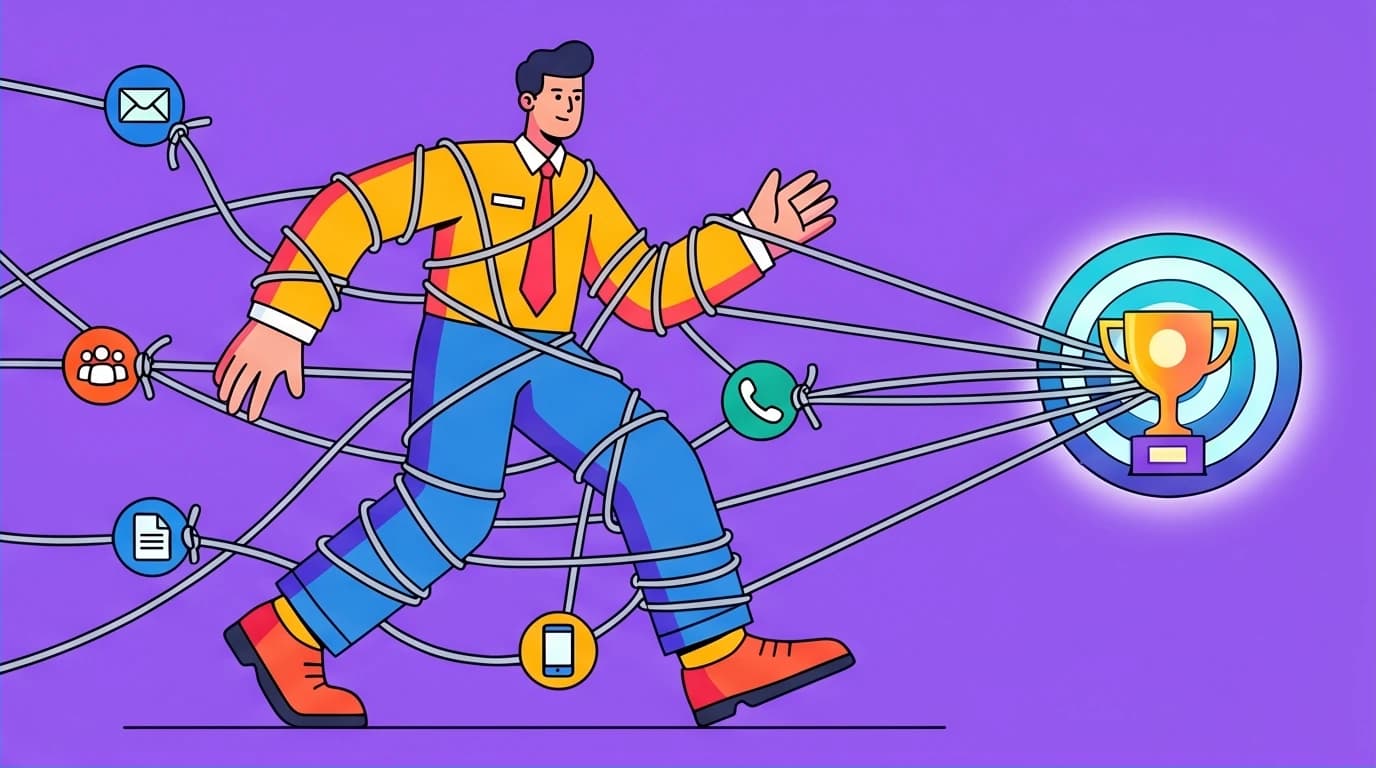
We often gravitate toward shallow work because it feels productive. Replying to an email gives you a quick hit of dopamine. Checking a box off a trivial to-do list feels satisfying. But this feeling is an illusion.
Here are common
shallow work examples that eat up your day:- Checking and sorting your email inbox every fifteen minutes.
- Attending a one-hour Zoom meeting where you only speak for two minutes and could have just read a summary.
- Moving tickets around in Jira or Asana without actually solving the underlying problems.
- Filing monthly expense reports.
- Responding to generic Slack or Microsoft Teams messages.
Shallow work keeps the lights on. It is necessary for the logistics of modern corporate life. You cannot completely ignore your boss's emails or refuse to file your expenses. The danger is not that shallow work exists; the danger is that we allow shallow work to aggressively push deep work out of our schedules.
Breaking free from the dopamine-driven cycle of shallow busywork is much easier said than done. It requires a fundamental shift in how you view your professional commitments and your time. If you constantly find yourself saying "yes" to every minor request, meeting, or Slack message, you might need a mental reset. Greg McKeown's brilliant guide to the disciplined pursuit of less is the perfect antidote to the modern workplace. It will teach you how to ruthlessly separate the trivial many from the vital few.
Essentialism
Greg McKeown
32 Duration10 Key Points4.6 RateDeep Work vs Shallow Work: The Core Contrast
When evaluating your own daily routine, you need a quick analytical framework to categorize your tasks. If you are struggling to categorize a specific duty, apply these three tests to figure out where it belongs.
1. The "Recent College Grad" Test
Ask yourself: How many months would it take to train a smart recent college graduate, with no specialized training in my field, to complete this specific task?
If the answer is a few days or weeks (e.g., managing the team calendar, pulling basic data reports), it is shallow work. If it would take years of specialized education and industry experience (e.g., architecting a database, closing an enterprise sales deal), it is deep work.
If the answer is a few days or weeks (e.g., managing the team calendar, pulling basic data reports), it is shallow work. If it would take years of specialized education and industry experience (e.g., architecting a database, closing an enterprise sales deal), it is deep work.
2. The Asynchronous Test
Does the task require constant back-and-forth communication? Deep work is almost always asynchronous and isolated. You close the door, put on noise-canceling headphones, and create. Shallow work thrives on immediate, fragmented communication—quick chats, immediate replies, and constant context switching.
3. The Value Creation Test
Imagine a scenario where you spent 40 hours a week doing absolutely nothing but this one specific task for an entire year. What would happen to your career?
If you spent a year only answering emails and organizing files, you would likely be replaced. That is shallow work. If you spent a year writing high-quality code or publishing top-tier research, you would become a highly sought-after expert. That is deep work.
If you spent a year only answering emails and organizing files, you would likely be replaced. That is shallow work. If you spent a year writing high-quality code or publishing top-tier research, you would become a highly sought-after expert. That is deep work.
Why You Feel Exhausted but Unproductive
The reason you feel terrible at the end of a busy day isn't just the sheer volume of hours worked; it is the constant context switching.
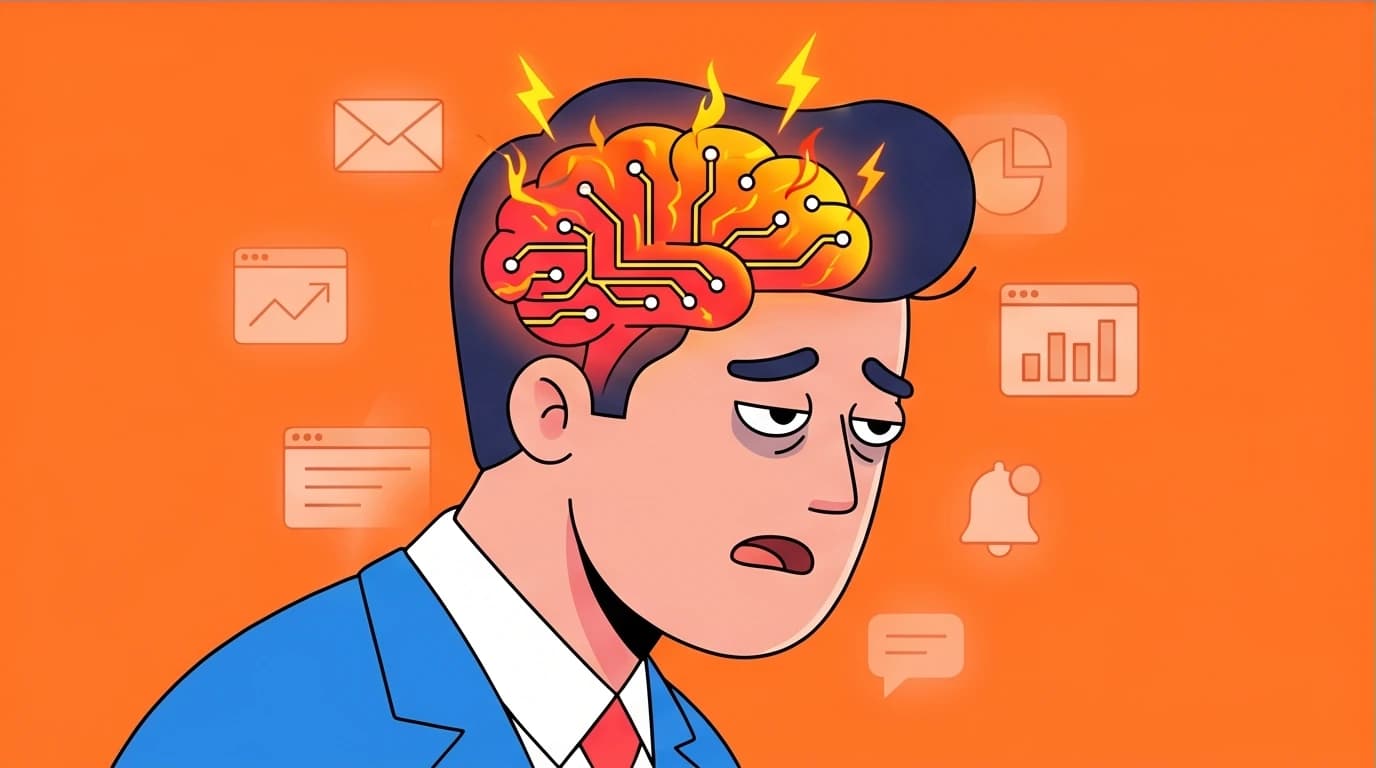
Every time you switch your attention from a deep task (like analyzing a spreadsheet) to a shallow task (like checking a group text or an email), your brain suffers from "attention residue." A part of your brain is still thinking about the email even after you turn back to the spreadsheet.
Switching tasks burns glucose and depletes your mental energy. By 3 PM, your brain is entirely fried from navigating hundreds of micro-interruptions. You have expended massive amounts of energy navigating the friction of task-switching without actually sinking your teeth into a high-value project.
This constant mental fatigue is a major reason why career-changing books sit unread on our shelves. When you're too drained to pick up a book after a long day, learning needs to adapt to your energy level.
When you're too mentally drained for a full book, use audio summaries to absorb key career insights during your commute or a short break.
Download LeapAhead App now
Realizing that task-switching is draining your energy is a huge breakthrough, but how do you actually rebuild your stamina? Managing your time won't help if you don't have any energy left by 3 PM. If you are tired of burning out before the workday is even over, it's time to stop treating yourself like a machine. This phenomenal read completely redefines how we approach productivity, teaching you how to strategically manage your physical and emotional energy rather than just meticulously tracking your hours.
The Power of Full Engagement
Jim Loehr, Tony Schwartz
46 Duration10 Key Points4.4 RateHow to Audit Your Daily Tasks and Restructure Your Workload
Understanding the
deep work vs shallow work dynamic is useless unless you actively change your daily routine. Here is a direct, executable framework to audit your workload and prioritize tasks that matter.Step 1: The 3-Day Brutal Time Audit
For three days, write down exactly what you do every 30 minutes. Do not estimate; track it in real time. At the end of the three days, grab a red pen and a green pen. Highlight every deep work task in green and every shallow work task in red. Most people are shocked to realize their green highlights account for less than an hour a day.
Step 2: Batch the Shallow Work
You cannot eliminate shallow work, but you can contain it. Stop leaving your email inbox open all day. Schedule two or three specific 30-minute blocks in your day dedicated entirely to shallow tasks. For example, process all your emails, Slack messages, and quick approvals at 11:30 AM and 4:30 PM. For the rest of the day, those applications stay closed.
Step 3: Schedule Deep Work Like a Doctor's Appointment
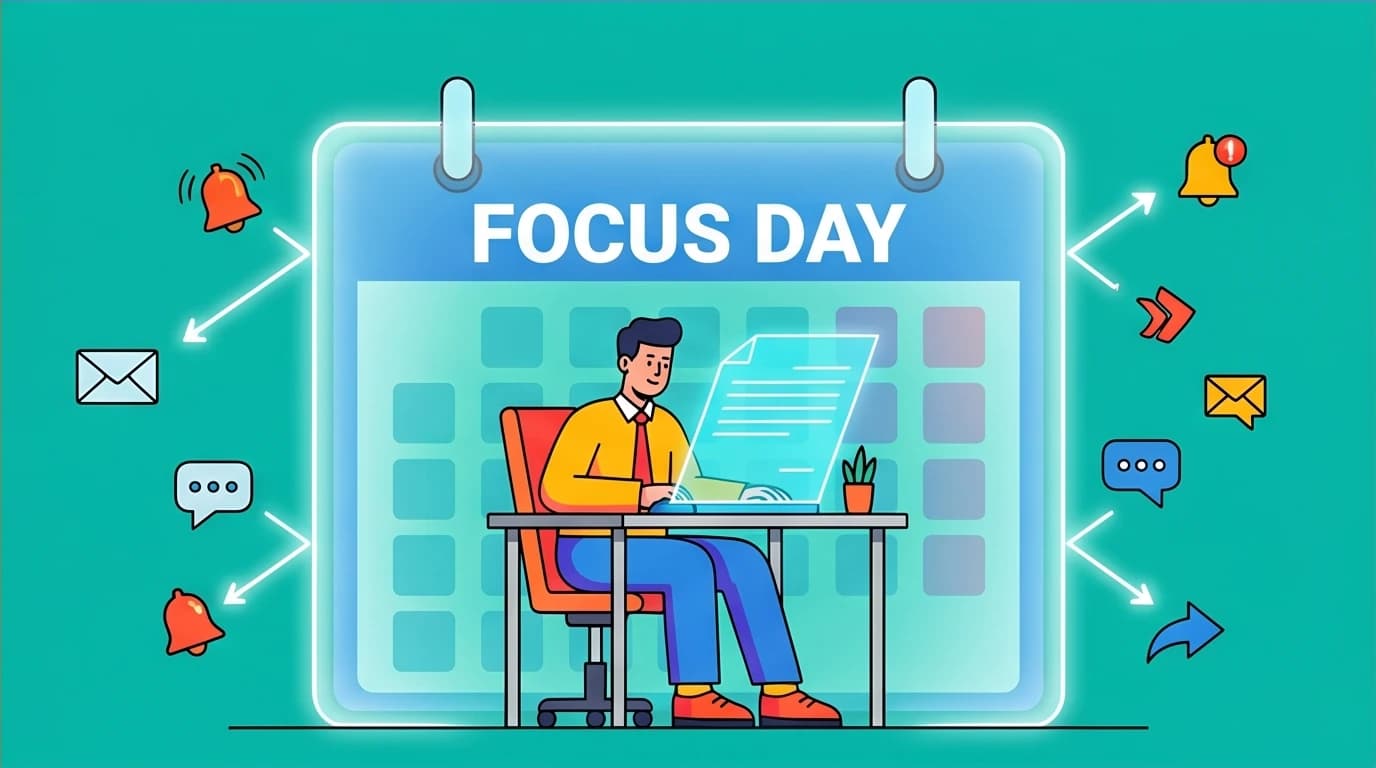
Do not wait for "free time" to do deep work. Free time never magically appears. You must claim it. Block out 90 to 120 minutes on your calendar for deep work. Treat this block with the exact same respect you would give a meeting with your CEO. You would not answer a random text message during a meeting with the CEO, and you should not answer one during your deep work block.
Step 4: Engineer Your Environment
Willpower is a finite resource; rely on systems instead.
- Turn off all push notifications on your phone and desktop.
- Leave your phone in another room if you work from home.
- Use website blockers to lock yourself out of news sites and social media during your deep work blocks.
- Communicate your availability to your team. Let them know that if they message you between 9 AM and 11 AM, you will not see it until lunch.
Even with the best intentions and a perfectly color-coded calendar, a buzzing phone or a flashy notification can easily derail your deep work block. We live in an era where technology companies spend billions trying to hijack your attention. To fight back, you need more than just willpower—you need a bulletproof system. If you want a step-by-step playbook for taking back control of your devices, managing internal triggers, and staying fully present in your most challenging tasks, this book is an absolute must-read.

Indistractable
Nir Eyal
23 Duration10 Key Points4.5 RateStep 5: Define the Output
Before you begin a deep work block, define exactly what success looks like. "Work on the marketing project" is too vague and invites procrastination. "Write the first 500 words of the Q3 product launch email sequence" is specific, measurable, and highly actionable.
The steps above provide a solid foundation for reclaiming your focus. If you're ready to build a more robust system, it's helpful to explore different scheduling philosophies and practical techniques.
FAQ
Can I eliminate shallow work entirely?
No. Shallow work handles the logistical reality of running a business. Invoices need to be paid, client emails require replies, and schedules need to be coordinated. Your goal is not elimination, but containment. You want to shrink the time shallow work takes so it stops cannibalizing your deep work hours.
No. Shallow work handles the logistical reality of running a business. Invoices need to be paid, client emails require replies, and schedules need to be coordinated. Your goal is not elimination, but containment. You want to shrink the time shallow work takes so it stops cannibalizing your deep work hours.
How many hours of deep work can a person actually do in one day?
According to cognitive science and Cal Newport's research, even experts and top-tier professionals max out at about four hours of deep, intense concentration per day. If you are new to the practice, you might only be able to handle one hour before your brain craves distraction. Start small, build your focus muscle, and aim for two to three solid hours a day.
According to cognitive science and Cal Newport's research, even experts and top-tier professionals max out at about four hours of deep, intense concentration per day. If you are new to the practice, you might only be able to handle one hour before your brain craves distraction. Start small, build your focus muscle, and aim for two to three solid hours a day.
How do I practice deep work in a noisy open-office environment?
You have to create visual and audio boundaries. Invest in high-quality noise-canceling headphones. Create a "do not disturb" signal for your coworkers—whether that is physically blocking time on your public calendar or simply communicating that when your headphones are on, you are in deep focus mode. If possible, book a private conference room for 90 minutes to escape the floor traffic entirely.
You have to create visual and audio boundaries. Invest in high-quality noise-canceling headphones. Create a "do not disturb" signal for your coworkers—whether that is physically blocking time on your public calendar or simply communicating that when your headphones are on, you are in deep focus mode. If possible, book a private conference room for 90 minutes to escape the floor traffic entirely.
How do I explain my new communication boundaries to my boss?
Frame it around business value, not personal preference. Do not say, "I am turning off email because I want fewer distractions." Instead, say, "To ensure I hit the deadline for the new client proposal with the highest quality output, I will be offline for two hours every morning to do deep, focused work. I will be fully available for meetings and emails after 11 AM." Bosses respect output and ROI.
Frame it around business value, not personal preference. Do not say, "I am turning off email because I want fewer distractions." Instead, say, "To ensure I hit the deadline for the new client proposal with the highest quality output, I will be offline for two hours every morning to do deep, focused work. I will be fully available for meetings and emails after 11 AM." Bosses respect output and ROI.