

Your calendar is a chaotic mess of Zoom calls, and Slack pings every three minutes. You reach the end of a standard 9-to-5 workday feeling completely drained, yet you haven't completed a single meaningful task. You don't have a time management problem. You have an attention management problem.
Every time you switch your focus from writing a proposal to checking an email, you experience "attention residue." A part of your brain is still thinking about that email when you return to the proposal. String a dozen of these interruptions together, and your cognitive capacity drops to near zero.
Learning exactly how to do deep work is the only way to break this cycle, produce high-value output, and actually log off at 5 PM without feeling guilty. Here is your actionable roadmap to making it happen.

Establish Your Deep Work Rules
You cannot simply wake up and decide to focus. Your brain is likely addicted to the quick dopamine hits of checking notifications. To rewire your habits, you need strict constraints. These foundational deep work rules will set the stage for actual productivity.
1. Radically Drain the Shallows
Shallow work includes the logistical, administrative tasks that don't create new value—responding to routine emails, updating spreadsheets, or attending status meetings. You cannot eliminate shallow work entirely, but you must compress it. Batch your emails. Reply to Slack only at designated hours. Free up your mental RAM for the heavy lifting.
To master this, it's helpful to get a clear picture of what constitutes each type of work. For a more detailed breakdown of how to identify and minimize low-value tasks, you can explore the key differences between deep and shallow work.
If you're struggling to figure out which tasks are just "shallow" busywork and which ones actually move the needle, you might need to completely rethink your daily priorities. Stripping away the non-essential isn't just about deleting calendar invites; it’s about shifting your entire mindset. Greg McKeown’s methodology is incredibly helpful for this exact pain point. His insights will teach you how to politely decline administrative noise and reclaim your mental energy for the projects that truly matter to your career.
Essentialism
Greg McKeown
 32 Duration
 10 Key Points
 4.6 Rate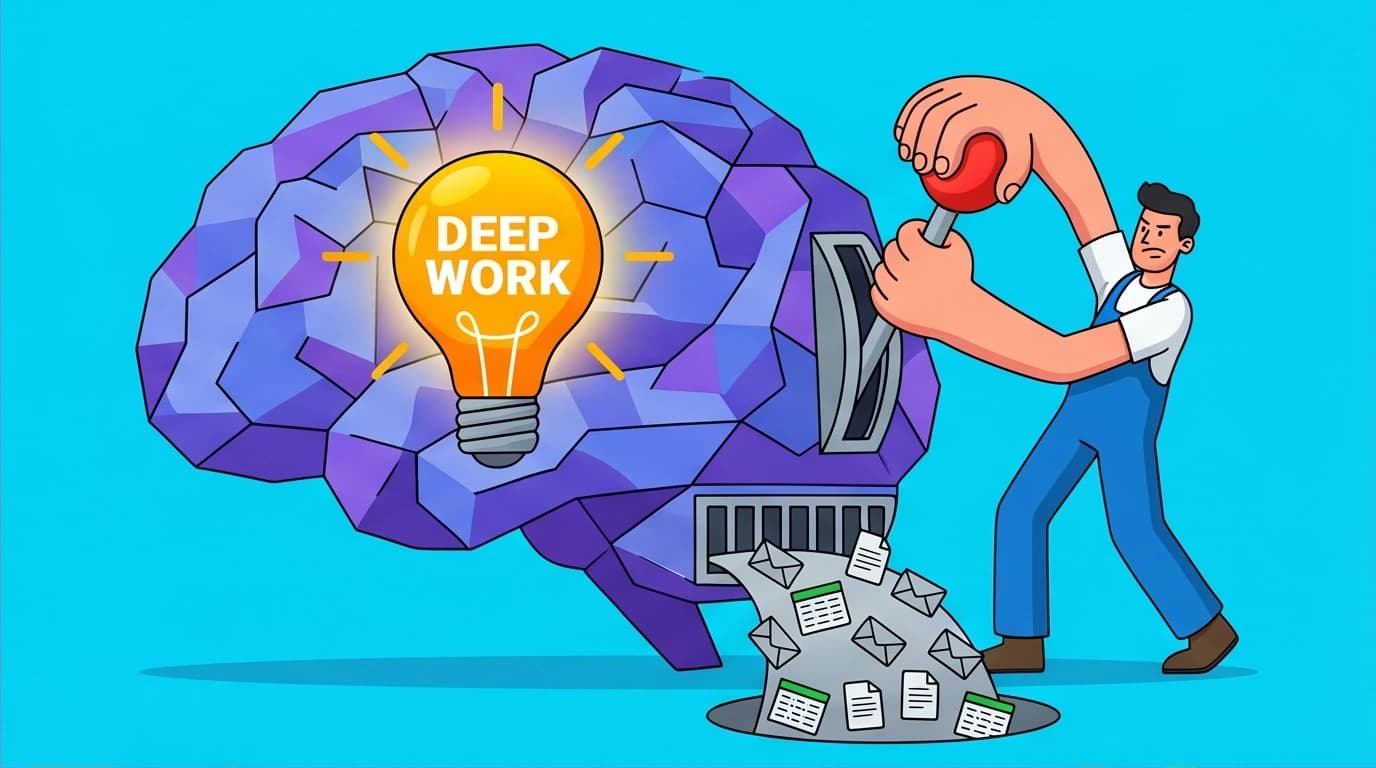
2. Embrace Boredom
If you pull out your phone the second you step into line at Starbucks or wait for a Zoom host to start a meeting, you are training your brain to reject boredom. Deep work is inherently uncomfortable at first. Stop reaching for distraction the moment you feel a lull. Train your focus muscle by learning to sit with your thoughts.
3. Make Distraction Impossible
Willpower is a finite resource. Do not rely on it. Put your phone in another room. Close every browser tab unrelated to your current task. If necessary, use website blockers to lock yourself out of social media and news sites during your working hours.
Even with the best intentions and rigorous website blockers, the psychological urge to check your phone can feel overwhelming. We are hardwired to seek out those quick hits of dopamine. If you want to understand exactly why we fall prey to these habits—and how to permanently fix them—Nir Eyal provides a phenomenal framework. His deep dive into the psychology of tech addiction gives you the practical tools you need to take back control of your attention and become completely immune to the constant pings of modern office life.
Indistractable
Nir Eyal
23 Duration10 Key Points4.5 RateIf your attention is too fragmented to tackle a full book right now, there are ways to absorb these critical ideas in a more focused format.

Get key insights from books like 'Indistractable' in 15-minute audio summaries, perfect for retraining your focus even on your busiest days.

Download LeapAhead App now
Choose Your Deep Work Schedule
There is no one-size-fits-all approach. Trying to adopt a schedule that fights your natural rhythm or job requirements will only lead to frustration. Pick the deep work schedule that fits your actual life.
The Rhythmic Philosophy
This is the most practical method for standard remote workers. You carve out the exact same block of time every single day for focused work. For example, from 8:00 AM to 10:00 AM, you are unreachable. By making it a daily rhythm, you remove the friction of deciding when to focus.
The Bimodal Philosophy
Ideal for executives, writers, or high-level creatives. You divide your time into distinct macro-blocks. You might spend Monday and Tuesday completely offline, doing nothing but deep work. Then, you spend Wednesday through Friday in the "shallow" end—taking meetings, answering emails, and collaborating.

The Journalistic Philosophy
This is the hardest method, suited for those with highly unpredictable days. You fit deep work in wherever you find a gap. If a meeting ends 45 minutes early, you immediately switch into deep focus mode. It requires immense discipline and zero warm-up time. Don't start here if you are a beginner.
Master Deep Work Time Blocking
Knowing your schedule is only half the battle. You must defend that time on your calendar. This is where deep work time blocking comes into play.
Treat a deep work block exactly like a meeting with your CEO. You would never cancel on your CEO because an urgent-but-unimportant email came through.
How to block your time effectively:
- Name the task: Never put a block on your calendar just labeled "Deep Work." Your brain won't know what to do when the time arrives. Label it specifically: "Draft Q3 Marketing Strategy."
- Schedule the shallows: Block off time for shallow work, too. Schedule 30 minutes at 11:30 AM and 30 minutes at 4:30 PM explicitly for "Email and Slack Processing."
- Use buffer zones: Transitioning from a high-energy meeting straight into focused coding or writing is nearly impossible. Schedule a 10-minute buffer to get a coffee, clear your desk, and reset your mind.
Staring at a meticulously color-coded, time-blocked calendar can sometimes feel a bit intimidating if you aren't used to proactively designing your day. If you want a hands-on, tactical guide to optimizing your daily schedule without feeling overwhelmed, Jake Knapp and John Zeratsky offer an incredibly practical approach. They show you exactly how to bypass exhausting hustle culture, carve out dedicated time for your most important daily highlight, and take back your hours from endless email threads and Zoom calls.
Make Time
Jake Knapp, John Zeratsky
21 Duration9 Key Points4.6 RateProven Deep Work Strategies to Protect Your Focus
Even with rules and a schedule, external forces will try to break your concentration. Use these deep work strategies to build an impenetrable fortress around your attention.

Communicate Your Boundaries
Remote work culture often demands hyper-availability. You have to actively reset those expectations. Talk to your manager and your team. Say something like, "I am blocking out 9 AM to 11 AM daily for heads-down work on our core deliverables. I will be offline on Slack. If there is a true emergency, call my cell." Most managers will respect this when they see your output skyrocket.
Curate Your Environment
Your physical space dictates your mental state. If your home office feels chaotic, your mind will follow. Clear your desk of yesterday's coffee mugs and paperwork. If working from home is too distracting, pack your laptop and head to a local library or a quiet corner booth at a diner.
Auditory environments matter just as much. Invest in quality noise-canceling headphones. Put on a familiar, lyric-free soundtrack. Many professionals use specific focus playlists on Apple Music or white noise tracks on Audible to signal to their brains that it is time to work.
The Strict Shutdown Ritual
Deep work depletes your cognitive reserves. You need real rest to recover for the next day. When you finish working, close your laptop and state out loud that you are done. Do not check work emails on your phone while watching TV on the couch. A clean break ensures you have the mental energy to focus again tomorrow.
Common Pitfalls: Why You Might Fail at First
Understanding how to do deep work also means knowing what mistakes to avoid.
Attempting an 8-hour sprint: The human brain is neurologically incapable of sustaining deep work for eight hours. Even top-tier experts cap out at about four hours a day. If you are just starting, aim for a single 60-minute to 90-minute session.
Leaving loopholes: Keeping your inbox open in a background tab "just in case" completely defeats the purpose. The mere anticipation of a message drains your focus. Close the tab.
Choosing the wrong tasks: Deep work is reserved for complex, needle-moving tasks. Do not waste a high-energy focus block organizing your computer's file system or updating your LinkedIn profile.
Building a deep work habit is a marathon, not a sprint, and it helps to continuously reinforce these principles. If your busy schedule makes it tough to get through all the recommended reading, you can still absorb the key takeaways.
Use your commute or lunch break to listen to 15-minute summaries of essential productivity books, turning small pockets of time into powerful learning moments.
Download LeapAhead App now
To get a clear, high-level overview of the book's foundational concepts before you commit to the full text, our detailed summary can be an invaluable resource.
Before we dive into some common questions about implementing this system, it's worth mentioning the definitive manual on this topic. If you want a complete breakdown of the philosophy and science behind these strategies, there is no better resource than the book that actually coined the phrase. Cal Newport provides an absolute masterclass on how to cultivate intense focus and thrive in a distracted economy. It is a must-read for anyone serious about producing high-value output and escaping the trap of constant connectivity.
If you aren't sure if the book is right for you, understanding the pros and cons from other readers can help. A thorough review of Deep Work can give you the perspective needed to make an informed decision.
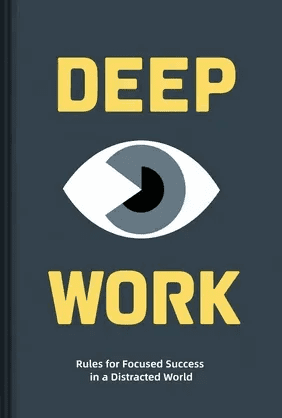
Deep Work
Cal Newport
47 Duration8 Key Points4.6 RateFAQ
Can I do deep work if my job requires me to be highly responsive?
Yes, but you have to negotiate it. Very few jobs truly require you to be available every single minute. Work with your team to establish asynchronous communication norms. Even finding two 45-minute blocks a day where you are entirely disconnected will massively improve your output.
Yes, but you have to negotiate it. Very few jobs truly require you to be available every single minute. Work with your team to establish asynchronous communication norms. Even finding two 45-minute blocks a day where you are entirely disconnected will massively improve your output.
How long should a single deep work session be?
If you are new to this, start with 45 minutes. As you train your attention span, try to push it to 90 minutes. Sessions longer than two hours usually result in diminishing returns, requiring a solid break before you attempt another block.
If you are new to this, start with 45 minutes. As you train your attention span, try to push it to 90 minutes. Sessions longer than two hours usually result in diminishing returns, requiring a solid break before you attempt another block.
What is the difference between deep work and the flow state?
Deep work is a behavior; flow is a cognitive state. Deep work is the dedicated effort and the environment you create. Flow is the feeling of effortless immersion you might eventually experience while doing deep work. You can control your work habits, but you cannot force flow on command.
Deep work is a behavior; flow is a cognitive state. Deep work is the dedicated effort and the environment you create. Flow is the feeling of effortless immersion you might eventually experience while doing deep work. You can control your work habits, but you cannot force flow on command.
Do I need to read Cal Newport's book to start doing this?
No. You can start right now using the time blocking and scheduling methods outlined above. However, if you want a complete breakdown of the philosophy and the science behind it, his book is an excellent resource you can pick up at Barnes & Noble or order on Amazon.
No. You can start right now using the time blocking and scheduling methods outlined above. However, if you want a complete breakdown of the philosophy and the science behind it, his book is an excellent resource you can pick up at Barnes & Noble or order on Amazon.