

You set a massive goal on January 1st. By February, the motivation vanishes. You jump from one new hobby to another, read half a book, launch a side hustle, and then quit the moment you hit a serious roadblock. It leaves you staring at the ceiling at 2 AM, wondering: Do I lack natural talent, or do I just lack follow-through?

Psychology points to the latter. The good news is that mental toughness is not a mystery. It is a measurable metric.
Psychologist Angela Duckworth spent years studying cadets at West Point, contestants in the National Spelling Bee, and top-tier sales professionals across the United States. She discovered that raw intelligence does not predict long-term success. Grit does.
If you want to know your baseline psychological resilience, grab a pen. Let's walk through the exact assessment used by elite coaches, identify your current baseline, and figure out how to build a tougher mindset.
What is the Angela Duckworth Grit Test?
Before we jump into the numbers, you need to know what you are actually measuring. The angela duckworth grit test does not care about your IQ, your standardized test scores, or your talent. It measures two highly specific behaviors:
- Passion: Your ability to stick to a singular goal over a long period.
- Perseverance: Your ability to push through setbacks, failures, and sheer boredom.
Together, these two elements dictate whether you will finish the marathon or drop out at mile 15. The test removes the guesswork and gives you a cold, hard number.
Take the 10-Item Grit Scale Questionnaire
This is the standard grit scale questionnaire. Do not overthink your answers. To get an accurate psychological baseline, you must be brutally honest. Do not answer based on the person you want to be. Answer based on how you have actually behaved over the last few years.
Read each statement and rate yourself using the following scale:
- Very much like me
- Mostly like me
- Somewhat like me
- Not much like me
- Not like me at all
The 10 Statements:
- New ideas and projects sometimes distract me from previous ones.
- Setbacks do not discourage me. I don't give up easily.
- I often set a goal but later choose to pursue a different one.
- I am a hard worker.
- I have difficulty maintaining my focus on projects that take more than a few months to complete.
- I finish whatever I begin.
- My interests change from year to year.
- I am diligent. I never give up.
- I have been obsessed with a certain idea or project for a short time but later lost interest.
- I have overcome setbacks to conquer an important challenge.
Write down your response to each of the 10 statements. Once you have them, move to the next step.
How to Calculate Grit Score Correctly
Now it is time to do the math. You must calculate grit score values carefully because the grading system flips depending on the type of question. The test mixes positive perseverance statements with negative distraction statements to prevent you from easily gaming the results.
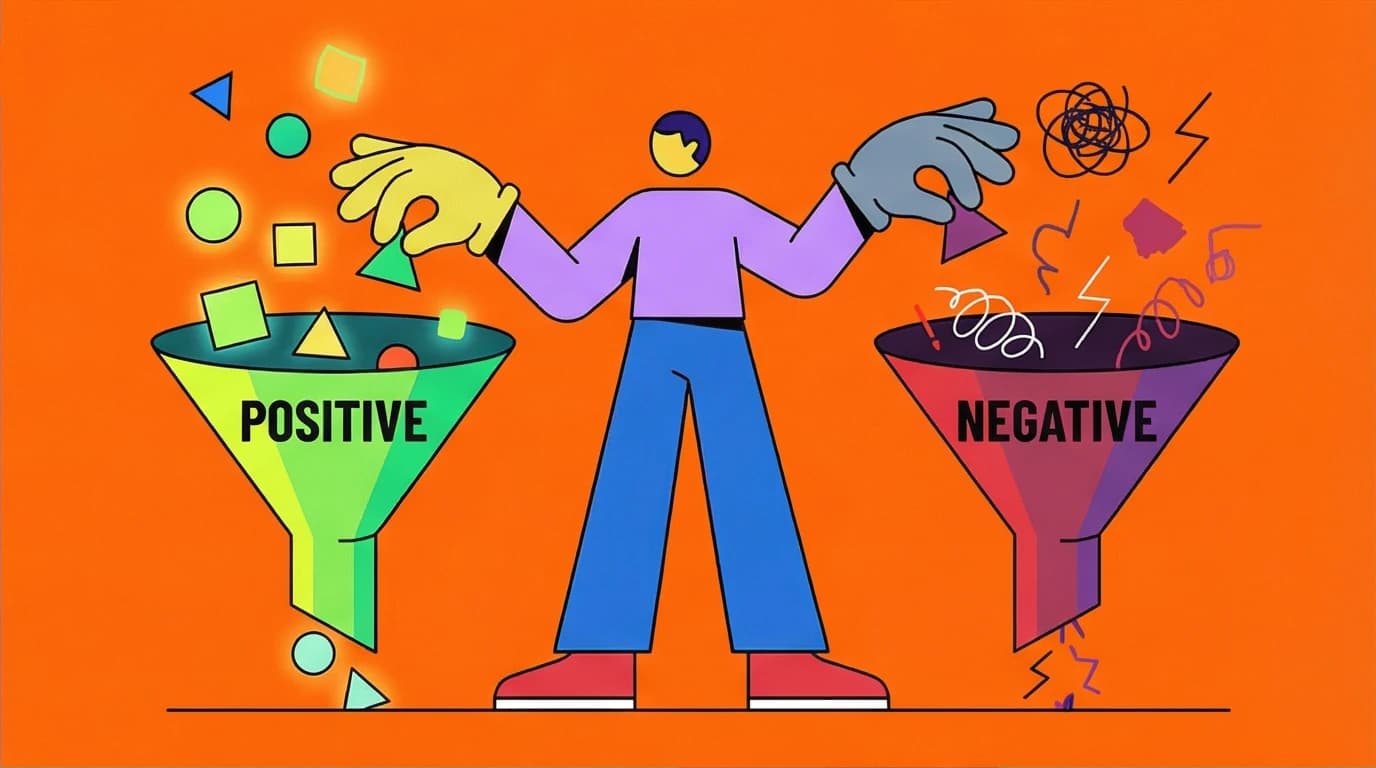
Step 1: Score the Perseverance Questions (2, 4, 6, 8, 10)
For these even-numbered questions, you earn more points for agreeing.
For these even-numbered questions, you earn more points for agreeing.
- Very much like me = 5 points
- Mostly like me = 4 points
- Somewhat like me = 3 points
- Not much like me = 2 points
- Not like me at all = 1 point
Step 2: Score the Passion/Distraction Questions (1, 3, 5, 7, 9)
For these odd-numbered questions, the scoring is entirely reversed. Agreeing means you lack focus, so you get fewer points.
For these odd-numbered questions, the scoring is entirely reversed. Agreeing means you lack focus, so you get fewer points.
- Very much like me = 1 point
- Mostly like me = 2 points
- Somewhat like me = 3 points
- Not much like me = 4 points
- Not like me at all = 5 points
Step 3: The Final Calculation
Add up the points from all 10 questions. Take that total number and divide it by 10.
Add up the points from all 10 questions. Take that total number and divide it by 10.
Your final result will be a number between 1.0 and 5.0.
What Is My Grit Score? Interpreting Your Results
You ran the calculation. Now you are staring at a number and asking: "What is my grit score actually telling me about my life?"
A standalone number is useless without context. Based on massive sample sizes of adults across the United States, here is exactly where you stand compared to the general population.
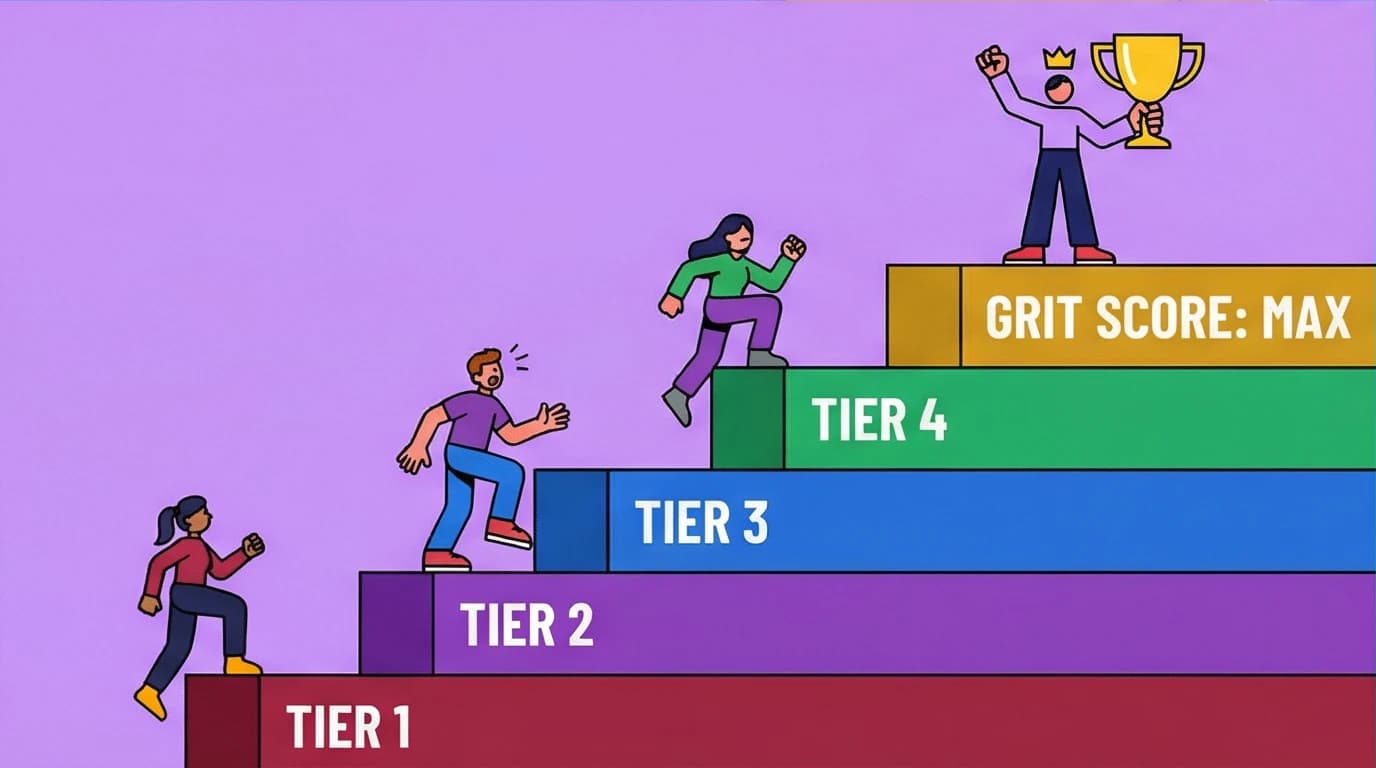
4.5 to 5.0: The Elite Grinder (90th–99th Percentile)
You possess an unusual level of mental endurance. You pick a lane and stay in it for years. When a project becomes difficult, boring, or frustrating, you double down instead of walking away. You are in the top tier of the US population for resilience.
4.0 to 4.4: Highly Resilient (70th–80th Percentile)
You have more grit than most people you meet. You finish the vast majority of what you start. You might occasionally get distracted by a shiny new idea, but you rarely let a bad month derail your primary mission.
3.5 to 3.9: The Average American (40th–60th Percentile)
You are sitting right in the middle of the pack. You can grind through challenges when the stakes are high or when a boss is holding you accountable. But when left to your own devices, you likely jump ship if a personal project takes too long or loses its initial excitement.
2.5 to 3.4: The Novelty Seeker (10th–30th Percentile)
You tend to favor new experiences over mastery. You probably have a garage or hard drive full of half-finished hobbies, abandoned business ideas, or unread books. You start with incredible enthusiasm, but the moment the honeymoon phase ends, you look for an exit.
If that pile of unread books sounds painfully familiar, you're not alone. A great first step is to build momentum by finishing what you start, and there are tools designed to help you clear that 'reading debt' quickly.


Tackle your unread book list by getting the core ideas from powerful self-improvement books in just 15 minutes, helping you build the knowledge and momentum to stick with your goals.
 LeapAhead
1.0 to 2.4: Highly Distractible (Bottom 10 Percent)
You are quickly discouraged by minor setbacks and constantly distracted by new ideas. Consistency is your biggest hurdle.
Coach's Note: Do not panic if your score is lower than you wanted. A low score does not mean you are lazy or doomed to fail. It simply means your current behavioral loops prioritize comfort over friction. Grit is highly malleable. You can train it.
The realization that your grit is highly malleable is the cornerstone of lifelong achievement. If you are struggling to break out of a cycle of distraction or feeling like you simply lack natural talent, the problem is likely your underlying belief system. Discovering the profound difference between a fixed and a growth perspective can completely rewire how you approach failure. This transformative read explores how shifting your core beliefs about your own potential can unlock an entirely new level of resilience.

Mindset
Carol S. Dweck
 51 Duration
 8 Key Points
 4.6 Rate
The Secret Split: Passion vs. Perseverance
Want an advanced insight? Split your score. Calculate your average for the odd questions (Passion) and the even questions (Perseverance).
Many people realize they score a 4.5 on Perseverance but a 2.5 on Passion. This means they know how to work incredibly hard, but they constantly change their long-term goals. They hustle, but in circles. If your scores are misaligned, you know exactly what to fix.
Common Traps That Destroy Your Grit
Before we look at how to build resilience, you need to stop doing the things that tear it down. Avoid these two massive pitfalls.
Relying on Motivation Instead of Systems
Motivation is an emotion. It comes and goes based on how well you slept, your blood sugar, and the weather. Gritty people do not rely on motivation. They build rigid systems. They automate their habits so they do not have to "feel" like working out or studying. They just do it.
Motivation is an emotion. It comes and goes based on how well you slept, your blood sugar, and the weather. Gritty people do not rely on motivation. They build rigid systems. They automate their habits so they do not have to "feel" like working out or studying. They just do it.
Confusing Grit with Stubbornness
Grit does not mean blindly slamming your head against a brick wall. Quitting a toxic job or abandoning a broken business model is not a lack of grit; it is tactical pivoting. True grit means staying committed to the ultimate objective while remaining highly flexible on the method you use to get there.
Grit does not mean blindly slamming your head against a brick wall. Quitting a toxic job or abandoning a broken business model is not a lack of grit; it is tactical pivoting. True grit means staying committed to the ultimate objective while remaining highly flexible on the method you use to get there.
As we just covered, relying on fleeting motivation is a guaranteed way to sabotage your long--term goals. To truly build your grit, you need to shift your focus toward creating reliable, automated systems that carry you through the days you don't feel like working. If you are tired of starting strong and fizzling out, mastering the art of habit formation is your next step. This phenomenal guide will show you exactly how to design an environment that makes sticking to your goals the path of least resistance.

Atomic Habits
James Clear
26 Duration8 Key Points4.7 RateHow to Build a Higher Grit Score
Improving your score is entirely possible with the right mindset and consistent practice. Before diving into the specific tactics below, it helps to understand the overarching strategies for building mental endurance.
If you scored a 3.0 today, you are not stuck there forever. You can rewire your brain to handle friction. Here is the exact playbook to increase your score before you take the test again next year.
1. Implement "The Hard Thing Rule"
Duckworth applies this rule in her own home, and it is brutally effective. The rule has three simple parts:
- You must actively pursue one hard thing that requires daily practice (learning an instrument, training for a 10K, coding).
- You can quit, but only after the natural season or interval ends. You cannot quit on a random Tuesday just because you had a bad day.
- You get to pick your own hard thing.
This trains your brain to separate temporary emotional frustration from long-term commitment.
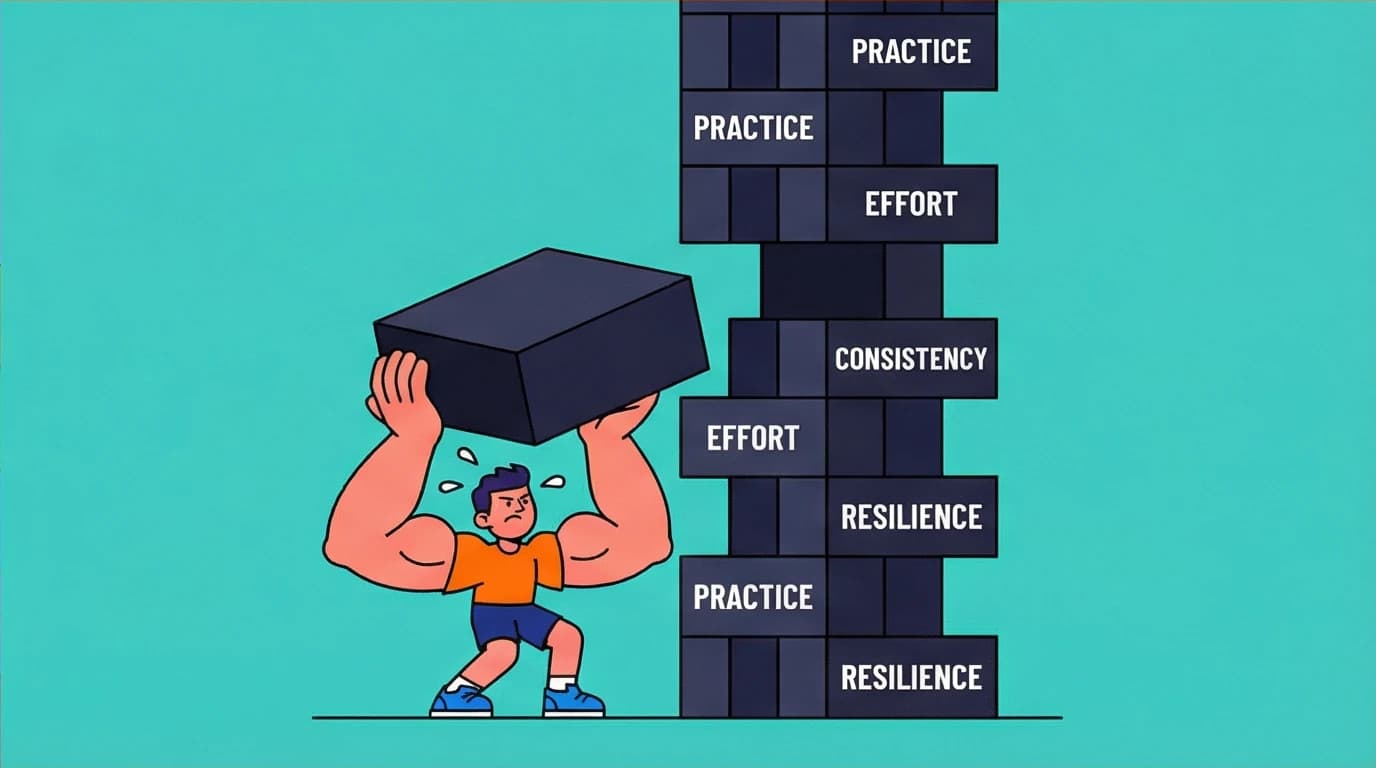
2. Practice Deliberate Discomfort
Your brain panics when things get hard because it seeks safety. You need to micro-dose discomfort to build tolerance. Take a cold shower. Leave your phone at home when you go for a walk. Run one more mile when your lungs burn. Small, voluntary exposures to physical or mental friction make involuntary setbacks feel much less intimidating.
Leaning into discomfort isn't something most of us do naturally—it requires a specific set of tools and a willingness to train your mind like a muscle. If you want a structured roadmap for navigating adversity and keeping your cool under pressure, exploring dedicated strategies for mental fortitude can be a game-changer. This practical handbook offers highly actionable exercises to help you stop avoiding friction and start using it to forge an unbreakable spirit, step by step.
The Mental Toughness Handbook
Damon Zahariades
39 Duration9 Key Points4.4 Rate3. Connect the Grind to a Higher Purpose
You will not survive the "boring phase" of any project if you only care about yourself. Research shows that people with the highest grit scores connect their personal goals to the well-being of others. If you are building a business, do not just focus on the revenue. Focus on how the product helps your customer or how the income provides security for your family. Purpose sustains you when passion fades.
4. Cultivate a Growth Mindset
When you fail, watch your internal dialogue. Do you say, "I am just not built for this"? That is a fixed mindset. It kills grit instantly. You must adopt a growth mindset. Replace "I can't figure this out" with "I haven't figured this out yet." Talent is just the starting line. Effort is the vehicle that moves you forward.
Want the complete deep dive? Pick up Duckworth’s original book on Amazon or listen to the Audible version during your morning commute. It will fundamentally change how you view effort.
For a detailed breakdown of the book's core ideas, our summary can give you the essential takeaways in just a few minutes.
If you are ready to take that deep dive and fundamentally change how you view effort, there is no better starting point than the original research itself. Angela Duckworth’s defining work unpacks the very test you just took, offering incredible case studies from National Spelling Bee champions to elite military cadets. It is a brilliant, science-backed exploration of why sustained passion and perseverance will almost always beat raw talent in the long run.
Grit
Angela Duckworth
18 Duration8 Key Points4.6 RateIf you're eager to absorb the wisdom from all these books but struggle to find the time, you can get a head start on building mental toughness during your commute or workout.
Listen to 15-minute audio summaries of books like Grit and Atomic Habits, turning your busiest days into opportunities to build the resilience you need to achieve your goals.
LeapAheadFAQ
Is grit an inherited trait or something I can learn?
It is a mix, but experience plays the dominant role. Genetics might influence baseline aspects of your personality, but grit is highly responsive to your environment and habits. You can absolutely increase your resilience through deliberate practice, challenging goals, and mindset shifts.
It is a mix, but experience plays the dominant role. Genetics might influence baseline aspects of your personality, but grit is highly responsive to your environment and habits. You can absolutely increase your resilience through deliberate practice, challenging goals, and mindset shifts.
Does a low grit score mean I will never be successful?
Not at all. A low score simply indicates that your current habits favor novelty and comfort over long-term persistence. You might be highly creative, an adaptable, and a great starter. However, to execute massive, decade-long goals, you will need to intentionally practice staying focused when the initial excitement wears off.
Not at all. A low score simply indicates that your current habits favor novelty and comfort over long-term persistence. You might be highly creative, an adaptable, and a great starter. However, to execute massive, decade-long goals, you will need to intentionally practice staying focused when the initial excitement wears off.
How often should I retake the grit scale test?
Take it once a year. Your score will fluctuate based on your environment, current career challenges, and the habits you build. Do not obsess over moving the number every single month. Focus on your daily actions, and the score will naturally take care of itself.
Take it once a year. Your score will fluctuate based on your environment, current career challenges, and the habits you build. Do not obsess over moving the number every single month. Focus on your daily actions, and the score will naturally take care of itself.
What is the difference between passion and perseverance in this test?
Perseverance is your ability to bounce back from failure and grind through hard work. Passion is your ability to maintain allegiance to the exact same top-level goal for years. You need both. Hustling hard on a brand new project every six months shows perseverance, but it lacks the passion required for true grit.
Perseverance is your ability to bounce back from failure and grind through hard work. Passion is your ability to maintain allegiance to the exact same top-level goal for years. You need both. Hustling hard on a brand new project every six months shows perseverance, but it lacks the passion required for true grit.