

You mapped out the perfect plan, bought the necessary books on Amazon, and promised yourself this time would be different. Now, weeks into the process, the initial excitement is dead. The daily grind is exhausting, the progress is invisible, and quitting feels like the most logical option in the world. You do not have a motivation problem. You lack a psychological system to endure the brutal boredom of progress.

The Brutal Truth About Motivation vs. Grit
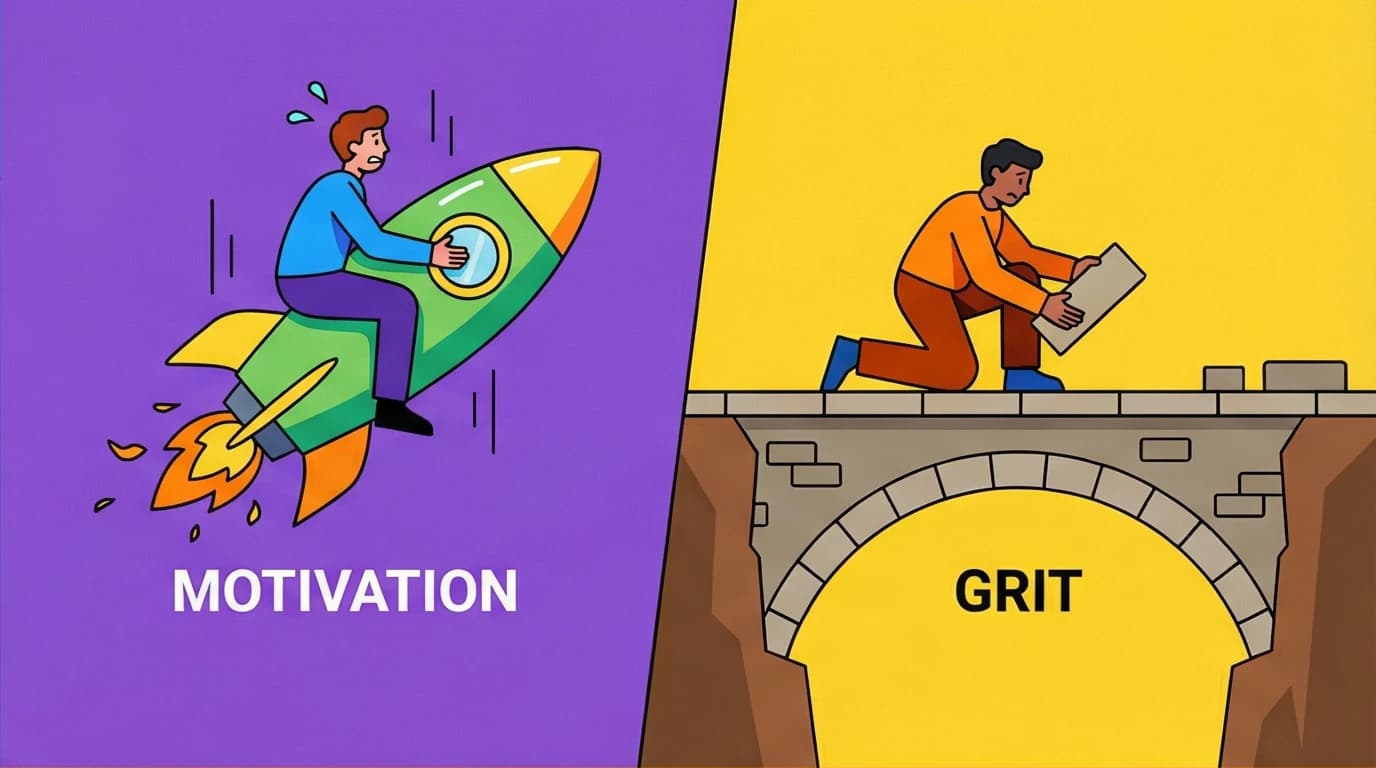
Most people fail to reach long-term goals because they misunderstand what fuels success. They wait to feel "inspired." They listen to an audiobook on Audible, get a temporary dopamine spike, and sprint for three days before collapsing.
Motivation is an emotion. It is biologically designed to be temporary.
Grit, on the other hand, is a behavioral system. Psychologist Angela Duckworth famously defined grit as "passion and perseverance for long-term goals." It is the ability to maintain your focus and effort over months or years, despite a total lack of immediate positive feedback. Grit is what keeps you running the last three miles of a marathon when your muscles are screaming. It is what makes you sit at your desk to finish a business proposal when you would rather be doing literally anything else.
If you are serious about building perseverance, you must fire motivation and hire discipline.
If you want to dive deeper into the science behind this exact concept, there is no better starting point than the foundational work by the psychologist who actually coined the term. Angela Duckworth’s groundbreaking research breaks down exactly why natural talent is vastly overrated and why sustained perseverance is the ultimate predictor of success. It is an absolute must-read for anyone serious about replacing fleeting motivation with a relentless, long-term work ethic.

Grit
Angela Duckworth
 18 Duration
 8 Key Points
 4.6 Rate
But if your to-read list is already a mile long, the thought of adding another book—no matter how essential—can feel daunting. That's where a more modern approach to learning can help.


LeapAhead

Get the core principles from 'Grit' and other essential books on mindset in just 15-minute audio or text summaries, perfect for busy days when you lack the time for a full chapter.
The Step-by-Step Blueprint: How to Develop Grit
You are not born with a fixed amount of grit. It is a trainable skill, much like lifting weights. Here is the exact roadmap to build a resilient mind.
Before you begin this process, it can be helpful to establish a baseline. Understanding your current level of perseverance will help you track your progress as you implement these new strategies.
Step 1: Anchor to a High-Level Purpose
You cannot grind through a miserable process if the destination means nothing to you. Gritty individuals organize their goals into a hierarchy. At the bottom are daily to-do lists (sending emails, running two miles). At the top is a singular, unshakeable compass (becoming a leading expert in your field, proving you can overcome physical limits).
When the bottom-level tasks become unbearable, you must instantly connect them to the top-level purpose. If you cannot draw a straight line from today's boring task to your ultimate life goal, your grit will evaporate.

Step 2: Master Deliberate Practice
Showing up is not enough. To figure out how to be more gritty, you must engage in deliberate practice. This means pushing yourself slightly outside your comfort zone every single day.
- Set a hyper-specific stretch goal.
- Focus 100% of your attention on the task (put the phone in another room).
- Seek immediate, ruthless feedback.
- Refine and repeat.
If you are a writer, deliberate practice is not writing a journal entry. It is studying the sentence structure of your favorite author and attempting to replicate their cadence for one hour straight. It is uncomfortable by design.
Mastering deliberate practice can feel overwhelming if you have never structured your efforts this way before. To truly understand how to push slightly beyond your comfort zone and accelerate your skill development, you might want to look at the definitive research on human potential. By studying how world-class experts actually train—rather than just how hard they work—you can apply these exact principles to your own goals and make your daily practice sessions highly effective.

Peak
Anders Ericsson and Robert Pool
48 Duration10 Key Points4.5 RateStep 3: Implement the "Hard Thing Rule"
To condition your brain to tolerate friction, implement the "Hard Thing Rule."
- Everyone must do one hard thing—something that requires daily deliberate practice.
- You cannot quit until a natural stopping point arrives (the end of the season, the date of the certification exam).
- You get to pick your hard thing. Nobody forces the specific task on you.
This rule trains your brain to separate the desire to quit from the action of quitting.
Increasing Grit in Adults: Rewiring a Comfortable Brain
A common myth is that grit is formed entirely in childhood. While early experiences matter, increasing grit in adults is entirely possible through neuroplasticity. The challenge is that adults have perfectly designed their lives to avoid discomfort. We control the thermostat to exactly 70 degrees Fahrenheit, order food delivery to avoid the rain, and doom-scroll to numb stress.
To increase your grit as an adult, you must artificially inject micro-adversity back into your routine.
- Delay Gratification: Force a pause between completing a task and rewarding yourself. Do not immediately check your phone after finishing a report. Sit in the silence for five minutes.
- Embrace the "Sunk Cost" Advantage: Adults have leverage. If you have spent five years in an industry, use that accumulated knowledge as leverage to push through the current plateau.
- Color Code Your Calendar: Ruthlessly block out time for your main objective. Treat that time block with the same respect you would give a meeting with an elite client.
While these strategies are designed for adults looking to rewire their habits, the principles for instilling perseverance early in life are just as important for parents and educators.
Grit in the Workplace: Surviving the Corporate Grind
Applying grit in the workplace is rarely about working 80 hours a week. It is about emotional regulation and sustained execution in the face of corporate chaos, office politics, and shifting deadlines.
Ambitious millennials often burn out because they tie their effort directly to immediate validation from a boss. When the praise stops, the effort drops. Gritty professionals decouple their work ethic from external applause.
How to execute at work when you want to check out:
- Manage the "Dip": Every major project starts with excitement, plunges into a messy, difficult middle (the Dip), and ends with completion. Recognize when you are in the Dip. Realize it is a filter that weeds out your competition.

- Focus on the Controllables: You cannot control a terrible manager, a sudden budget cut, or a delayed promotion. You can control your daily output, how you organize your digital workspace, and how quickly you recover from a bad meeting.
- Never Quit on a Bad Day: This is a golden rule stolen from ultra-endurance athletes. If you want to quit your job or abandon a massive project, fine. But you are not allowed to make that decision on a day when you are exhausted, stressed, or angry. Wait for a good day. If you still want to quit when things are going well, it is a strategic pivot. If you only want to quit when things are hard, it is a failure of grit.
Navigating that messy, frustrating middle phase of any major career project is often what separates top performers from those who constantly start over. Seth Godin actually wrote an entire brief, brilliant manual on this exact phenomenon. It helps you figure out whether you are currently facing a temporary roadblock that requires you to push harder, or a dead end where quitting is actually the smartest strategic move you can make for your long-term goals.

The Dip
Seth Godin
20 Duration9 Key Points4.6 RateThe Toxic Hustle Trap: What Grit is NOT
We need to establish a clear boundary between developing true grit and falling into toxic hustle culture.
Grit is not blind stubbornness. Sticking with a failing business model for ten years while bankrupting your family is not grit; it is ego.
This distinction is crucial, as the concept is not without its critics. Understanding the potential downsides can help you apply the principles of grit in a healthier, more sustainable way.
Grit is also not the absence of rest. The most elite performers in the United States—from Navy SEALs to Fortune 500 CEOs—take recovery as seriously as their work. You cannot maintain perseverance over a ten-year timeline if you burn out your central nervous system in year one. Prioritize sleep, take real vacations, and step away from the keyboard. Taking a day off to repair your mind is a strategic requirement, not a lack of dedication.
It is incredibly easy to confuse genuine grit with a toxic addiction to overworking. If you struggle to disconnect and feel guilty whenever you are not grinding, reframing how you view downtime is essential. Discovering how history's most prolific and successful individuals systematically used deliberate downtime to fuel their world-class output will completely change your approach. You will quickly realize that prioritizing your recovery is not a sign of weakness—it is actually your greatest competitive advantage.
Rest
Alex Soojung-Kim Pang
26 Duration9 Key Points4.5 RatePutting all these principles into practice requires consistent learning, but finding the energy after a long day can be the biggest hurdle. If you're serious about building grit but too exhausted for deep reading, there's a more efficient way to stay on track.
LeapAhead
This app delivers key insights from bestselling books on discipline and performance in short audio sessions, helping you absorb new ideas during your commute or workout.
FAQ
Can you learn grit, or are you born with it?
Grit is highly malleable. While genetics play a minor role in baseline conscientiousness, the vast majority of grit is developed through environmental conditioning, habit formation, and deliberate psychological training. You absolutely can learn it at any age.
Grit is highly malleable. While genetics play a minor role in baseline conscientiousness, the vast majority of grit is developed through environmental conditioning, habit formation, and deliberate psychological training. You absolutely can learn it at any age.
How do I know if I am being gritty or just stubborn?
Grit is stubbornly clinging to your top-level goal (the "Why"), but remaining highly flexible on the lower-level methods to get there (the "How"). Stubbornness is refusing to change a failing method even when evidence shows it does not work. If you are ignoring clear data and refusing to pivot your strategy, you are just being stubborn.
Grit is stubbornly clinging to your top-level goal (the "Why"), but remaining highly flexible on the lower-level methods to get there (the "How"). Stubbornness is refusing to change a failing method even when evidence shows it does not work. If you are ignoring clear data and refusing to pivot your strategy, you are just being stubborn.
What is the fastest way to regain grit after a major failure?
Stop trying to feel motivated. Reduce your scope to the smallest possible unit of progress. If you failed a massive professional exam, do not attempt to study for four hours the next day. Open the book for ten minutes. Re-establish the habit first; rebuild the intensity later.
Stop trying to feel motivated. Reduce your scope to the smallest possible unit of progress. If you failed a massive professional exam, do not attempt to study for four hours the next day. Open the book for ten minutes. Re-establish the habit first; rebuild the intensity later.
Does grit mean I have to suffer every single day?
No. While grit requires enduring discomfort, it must be tied to a "fascinating interest." If you absolutely hate the core nature of what you are doing, no amount of mental toughness will save you over a decade. True grit marries deep passion with relentless execution.
No. While grit requires enduring discomfort, it must be tied to a "fascinating interest." If you absolutely hate the core nature of what you are doing, no amount of mental toughness will save you over a decade. True grit marries deep passion with relentless execution.