

The modern educational landscape and corporate world have heavily embraced the concept of "grit"—defined as passion and perseverance for long-term goals. Yet, for sociologists, frontline educators, and marginalized students, this narrative often feels deeply disconnected from reality. Telling a student in an underfunded public school that they simply need more perseverance ignores the glaring realities of wealth gaps, redlining, and unequal access to basic needs. The backlash against this psychological framework is not just a semantic debate; it is a necessary defense against a modern iteration of the "pull yourself up by your bootstraps" myth.

To understand the core flaws of this psychological phenomenon, we must strip away the self-help optimism and analyze the data, the sociological context, and the structural realities that dictate success in the United States.
The Foundation of Grit Criticism: Rebranding the Bootstrap Myth
At its core, grit criticism argues that focusing intensely on individual character traits distracts from the systemic conditions that create success or failure. When society frames achievement purely as a matter of stamina, it implicitly blames those who fail for lacking character, rather than acknowledging a rigged starting line.
In American culture, this taps into a long-standing bias. We celebrate the self-made billionaire and the student who studies by streetlight to get into an Ivy League university. However, sociologists point out that highlighting these statistical anomalies creates a toxic survivorship bias. It demands superhuman resilience from disadvantaged individuals just to reach the baseline that privileged individuals are born onto.
Grit vs Privilege: The Unlevel Playing Field
The most prominent argument in this debate is grit vs privilege. Perseverance is significantly easier to maintain when you have a safety net to catch you when you fail.
Consider the trajectory of two high school students attempting to launch a startup or gain admission to a top-tier university. A student from a high-income family in a wealthy zip code can afford SAT tutors, unpaid internships, and multiple failures. Their "grit" is subsidized by capital. If they fail, they pivot.

Conversely, a student from a low-income background faces severe consequences for failure. For them, a failed academic or business venture might mean crushing debt or an inability to pay rent.
When researchers measure perseverance without measuring the risk associated with failure, the data becomes skewed. Privilege buys the time and resources necessary to be gritty. Labeling a wealthy student as "gritty" for taking unpaid internships while labeling a working-class student as "lacking grit" because they had to quit an extracurricular activity to work a minimum-wage job at a local grocery store is a fundamental misreading of human effort.
If you find yourself questioning the cultural narrative of the completely self-made billionaire or the mythical bootstrap success story, it is worth looking at the hidden advantages that actually drive high achievement. Malcolm Gladwell’s groundbreaking work dives deep into why environmental factors, timing, cultural legacies, and sheer privilege often play a much larger role in success than individual perseverance ever could. It is a fantastic read for anyone looking to understand the real anatomy of success in the United States.

Outliers
Malcolm Gladwell
 43 Duration
 8 Key Points
 4.5 Rate
Systemic Barriers to Grit: Poverty, Racism, and Trauma
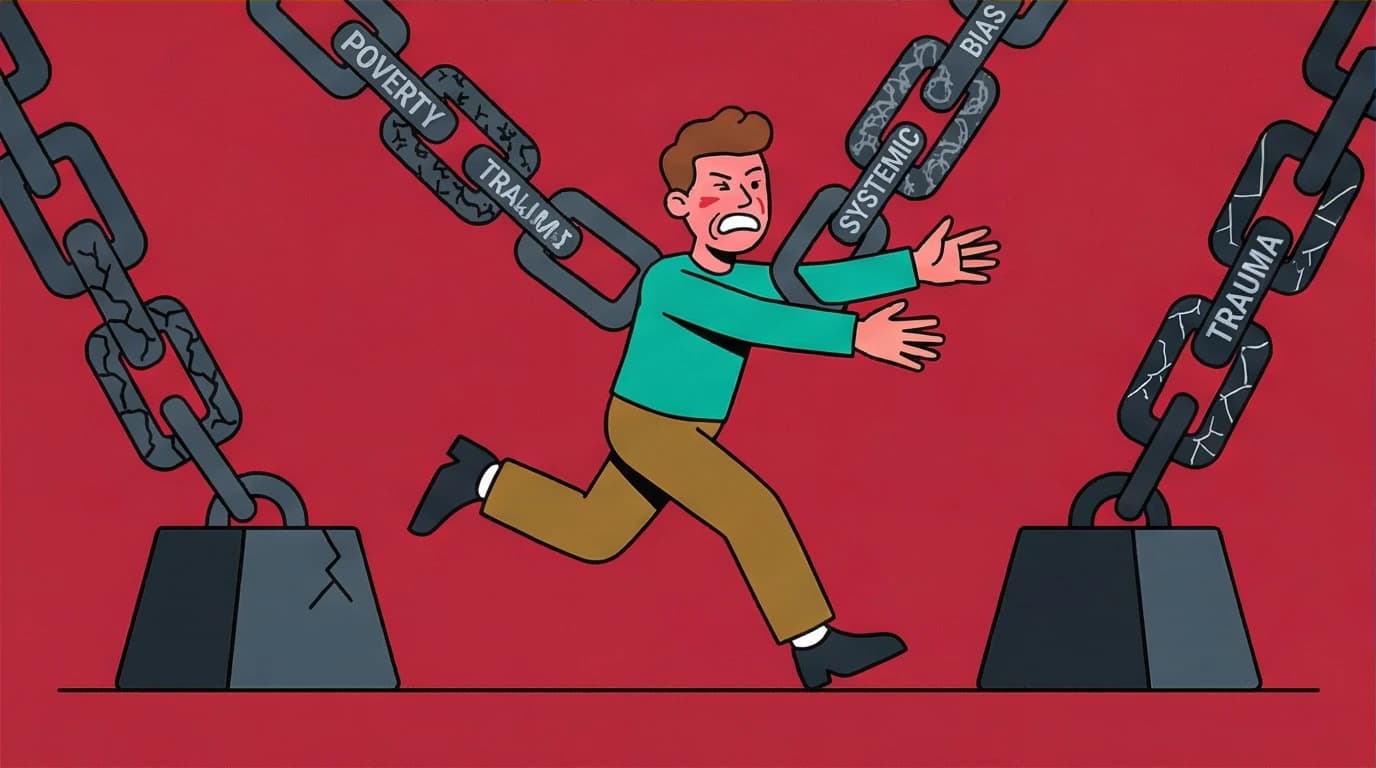
You cannot out-persevere systemic oppression. The concept of grit frequently falls apart when it meets the harsh reality of systemic barriers. The systemic barriers to grit are deeply entrenched in how American society functions, specifically regarding race, class, and mental health.
Cognitive Load and the Scarcity Mindset
Behavioral economics and sociology show that poverty imposes a massive cognitive tax. The "scarcity mindset"—constantly worrying about food security, electricity bills, or physical safety—drains the executive functioning required for long-term goal pursuit. A student who is exhausted from navigating a trauma-heavy environment does not lack grit; their psychological resources are simply deployed toward immediate survival rather than long-term academic milestones.
Structural Racism
For people of color in the United States, perseverance often yields diminishing returns compared to their white counterparts. Labor market studies repeatedly show that resumes with Black-sounding names receive fewer callbacks than identical resumes with white-sounding names. Pushing marginalized groups to simply "work harder" against institutional bias is a form of gaslighting. It places the burden of overcoming systemic racism entirely on the shoulders of those experiencing it.
To fully grasp why telling marginalized individuals to simply "work harder" fails to address the root causes of inequality, we have to look at the invisible structures governing American society. Isabel Wilkerson provides a masterful, eye-opening exploration of how an unspoken, rigid hierarchy actively limits upward mobility based on race. This essential read explains the deeply entrenched institutional barriers that no amount of individual grit or resilience can easily dismantle.

Caste
Isabel Wilkerson
25 Duration10 Key Points5 RateIs Angela Duckworth Grit Debunked? The Methodological Flaws
Beyond the sociological critiques, there is significant pushback from the scientific community regarding the actual data. For researchers and psychology students asking if the Angela Duckworth grit debunked narrative holds weight, the answer lies in meta-analyses and statistical methodology.
In 2016, a massive meta-analysis conducted by Marcus Credé, an Iowa State University psychology researcher, evaluated over 88 independent studies on grit. The findings severely undercut the hype surrounding the concept:
- The Conscientiousness Problem: Credé found that grit is almost perfectly correlated with "conscientiousness," a well-established personality trait from the Big Five personality inventory. Critics argue that grit is essentially old wine in new bottles—a rebranding of a known psychological trait heavily marketed for the self-help industry.

- Minimal Impact on Success: While Duckworth’s initial studies suggested grit was a massive predictor of success (such as making it through West Point's rigorous basic training), broader data shows its overall effect size is incredibly small. Grit accounts for very little variance in academic performance once you control for baseline intelligence and socioeconomic status.
- The Immutability Factor: One of the main selling points of grit was that it could be taught. However, because it is so closely tied to conscientiousness—a relatively stable personality trait—there is almost no empirical evidence showing that interventions actually succeed in making people significantly "grittier" over time.
Even with the robust sociological backlash and methodological critiques, it is incredibly valuable to engage with the source material that sparked this massive cultural conversation. Reading Angela Duckworth’s foundational work allows you to understand the exact definitions, initial studies, and psychological arguments surrounding passion and perseverance. It is a highly recommended read if you want to critically evaluate the nuances of the theory for yourself and see exactly how the modern obsession with grit began.

Grit
Angela Duckworth
18 Duration8 Key Points4.6 RateThe Limitations of Grit in Educational Policy
The translation of grit from a psychological hypothesis into public policy has created tangible harm. The limitations of grit become glaringly obvious when educational institutions attempt to measure and grade it.
Following the popularization of the theory, several US school districts, driven by federal frameworks like the Every Student Succeeds Act (ESSA), began experimenting with grading students on "non-cognitive skills" like grit. This led to disastrous and deeply inequitable outcomes.
Evaluating a student on their perseverance is highly subjective and prone to implicit bias. Teachers may perceive a quiet, compliant student as having grit, while viewing an outspoken or neurodivergent student as lacking it. Furthermore, focusing on teaching grit provides a convenient excuse for policymakers to ignore the difficult, expensive work of fixing systemic educational failures. It is much cheaper to host a seminar on perseverance than it is to address the fact that a public school lacks clean drinking water, updated textbooks, or adequate special education funding.
If you are an educator, parent, or policymaker looking for a more holistic approach to childhood development beyond oversimplified metrics, understanding the intersection of poverty and character is crucial. Paul Tough offers a brilliant, compassionate investigation into what actually helps kids thrive in the face of adversity. Instead of blaming students for a lack of resilience, this book explores the real environmental and psychological supports required to help vulnerable children succeed in a deeply unequal system.

How Children Succeed
Paul Tough
46 Duration9 Key Points4.6 RateReading all these foundational texts is a significant time investment. If you want to quickly get up to speed on the core ideas from these authors and others who critique simplistic success narratives, a book summary app can be a smart way to start.

Understand the key arguments from complex books on sociology and success, like *Outliers* and *Grit*, in just 15-minute audio or text explainers.

Download LeapAhead App now
Moving Toward a Nuanced Approach
Acknowledging the criticism of grit does not mean effort is meaningless. Hard work, resilience, and passion are obviously valuable components of a successful life. However, they are not a cure-all, and they cannot be effectively cultivated in a vacuum of resources.
For educators, sociologists, and leaders, the pivot must be away from individual character assessments and toward environmental design. If you want students or employees to exhibit perseverance, you must first guarantee psychological safety, equitable resource distribution, and structural support.
Continuing to learn about these complex social issues is the best way to form a nuanced perspective. For those who want to explore these topics further but struggle to find the time for deep reading, an app can help bridge the gap.
Fit learning about systemic inequality and psychology into your day by listening to key insights from bestselling authors while you commute or exercise.
Download LeapAhead App now
True empowerment does not look like handing a drowning person a book on how to swim harder; it looks like throwing them a life preserver and fixing the broken bridge they fell from.
FAQ
Does Angela Duckworth acknowledge the criticism of grit?
Yes. Over time, Duckworth has walked back some of the initial hype surrounding her theory. She has publicly stated that grit should not be used as a grading metric in schools and has acknowledged that structural factors like poverty and systemic racism play a massive role in a person's outcomes. However, critics argue her core framework still places too much emphasis on individual agency.
Yes. Over time, Duckworth has walked back some of the initial hype surrounding her theory. She has publicly stated that grit should not be used as a grading metric in schools and has acknowledged that structural factors like poverty and systemic racism play a massive role in a person's outcomes. However, critics argue her core framework still places too much emphasis on individual agency.
Is grit just another word for conscientiousness?
Statistically, yes. Extensive meta-analyses have shown that grit shares an extremely high correlation with conscientiousness, a standard personality trait defined by self-discipline, organization, and a drive for achievement. Many psychologists argue that grit does not introduce a new psychological construct, but rather repackages an existing one.
Statistically, yes. Extensive meta-analyses have shown that grit shares an extremely high correlation with conscientiousness, a standard personality trait defined by self-discipline, organization, and a drive for achievement. Many psychologists argue that grit does not introduce a new psychological construct, but rather repackages an existing one.
Why is grit considered a controversial concept in education?
Educators and sociologists find it controversial because it can easily weaponize poverty. By focusing heavily on a student's lack of "grit," school systems can deflect responsibility for their own systemic failures—such as overcrowded classrooms, lack of funding, and inadequate mental health resources. It risks blaming vulnerable children for circumstances entirely outside of their control.
Educators and sociologists find it controversial because it can easily weaponize poverty. By focusing heavily on a student's lack of "grit," school systems can deflect responsibility for their own systemic failures—such as overcrowded classrooms, lack of funding, and inadequate mental health resources. It risks blaming vulnerable children for circumstances entirely outside of their control.