

You hear the alarm. You hit snooze. You wake up 20 minutes later in a panic, rush through a shower, grab a stale coffee, and immediately check your work emails. Before you even sit at your desk, you are already playing catch-up.
You know the way you start your day dictates how you finish it. But trying to copy the 15-step, 4:00 AM routines of tech billionaires usually ends in burnout by Wednesday. You do not need to wake up in the middle of the night or take a one-hour ice bath to win the morning. You need a sustainable system.
While you don't have to copy them exactly, studying the frameworks used by top performers can provide powerful inspiration.
Here is the exact framework on how to build a morning routine for success that fits your lifestyle, eliminates decision fatigue, and sets you up for a high-output day.

The Foundation: Why Most Morning Routines Fail
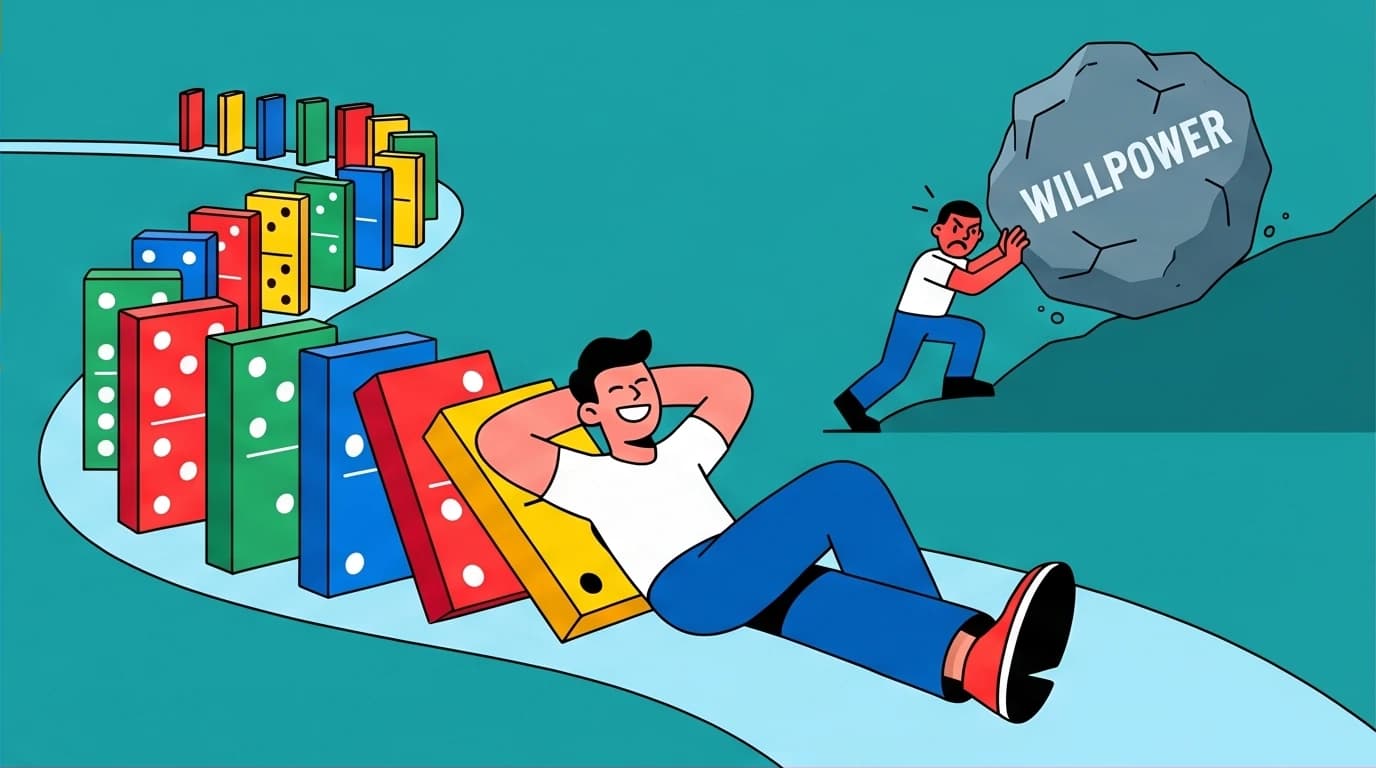
Most people fail at morning routines because they treat them as a test of willpower. They try to change everything at once.
When you wake up, your brain is transitioning out of a sleep state. Your prefrontal cortex—the part of the brain responsible for logical thinking and self-control—is not fully online. If your routine requires intense motivation right out of bed, you will fail.
A successful routine relies on environment design, not willpower. It is a sequence of actions that pull you forward automatically.
A Practical, Step by Step Morning Routine
Building your routine requires treating the morning as a chain reaction. The first domino actually falls the night before.
Step 1: The Night Before (Environment Prep)
You cannot expect to have a smooth morning if you leave a mess for your future self. Spend 10 minutes every evening removing morning friction.
- Set out your clothes: Put your gym clothes or work outfit right next to the bed.
- Prep the coffee maker: Set the timer on your machine or have the beans and water ready to go.
- Clear the workspace: A cluttered desk creates immediate stress. Clear it off so you start with a blank slate.
- Define the "One Thing": Write down the single most important task you need to accomplish the next day on a sticky note. Leave it on your keyboard.
If you find yourself constantly busy but never actually making progress on your biggest goals, mastering this evening prioritization habit is a game-changer. Figuring out your highest-leverage task can be tough when everything feels urgent. For a deeper dive into filtering out the noise and structuring your day around what truly matters, there is a fantastic framework that helps you identify the single action that makes everything else easier or unnecessary.
The ONE Thing
Gary Keller, Jay Papasan
 22 Duration
 10 Key Points
 4.5 Rate
Step 2: The Wake-Up Strategy
Figuring out how to wake up early and be productive starts with consistency, not the time on the clock.
- Pick a permanent wake-up time: Waking up at 6:00 AM on weekdays and 9:00 AM on weekends causes social jetlag. Your body loses its natural rhythm. Pick a time you can stick to 7 days a week, give or take 30 minutes.
- Move the alarm across the room: If your phone is on your nightstand, you will hit snooze. Plug it in across the bedroom. You have to physically stand up to turn it off.
- The 5-Second Rule: Once your feet hit the floor, do not get back in bed. Walk straight to the bathroom.
That simple act of counting backward and physically moving before your brain can talk you out of it is one of the most effective psychological hacks for overcoming morning resistance. If you struggle with the snooze button or find yourself paralyzed by overthinking early in the day, exploring the science behind this immediate-action technique can completely transform your mornings. It is an incredible tool for bypassing hesitation and building unstoppable momentum from the second you open your eyes.
The 5 Second Rule
Mel Robbins
36 Duration8 Key Points4.6 RateStep 3: The Biological Reset
Before you optimize your mind, you must wake up your body.

- Hydrate immediately: You lose up to a pound of water overnight through respiration. Drink 16 to 20 ounces of water before you touch coffee. This instantly boosts cognitive function and spikes your metabolism.
- Get natural sunlight: Open the blinds or step outside for 5 to 10 minutes. Sunlight hitting your eyes halts melatonin production and triggers a healthy spike in cortisol, signaling your brain that it is time to be alert.
- Delay caffeine: Wait 90 minutes after waking up before drinking your first cup of coffee. This allows your body to naturally clear out adenosine (the chemical that makes you feel sleepy), preventing the dreaded afternoon crash.
Step 4: Execute Your Anchor Habits
Now that you are awake, it is time to prime your brain. Pick one to three actions that put you in an offensive, rather than defensive, state of mind. Avoid your phone. Do not check social media. Do not read the news.
The goal of these anchor habits is to cultivate a proactive, focused mindset. Building this mental foundation is just as critical as the physical actions you take.
The Best Morning Habits for Productivity
Do not try to do all of these. Pick the ones that solve your specific bottlenecks.
For Mental Clarity: Brain Dumping
Spend 5 minutes writing down every thought, anxiety, and to-do list item bouncing around in your head. Getting it out of your brain and onto a physical notepad frees up cognitive bandwidth for actual work.
Spend 5 minutes writing down every thought, anxiety, and to-do list item bouncing around in your head. Getting it out of your brain and onto a physical notepad frees up cognitive bandwidth for actual work.
For Physical Energy: Light Movement
You do not need an intense 60-minute CrossFit session at 5:30 AM to be productive. Just 10 minutes of movement—like stretching, yoga, or a quick walk around the block—increases blood flow to the brain and shakes off residual sleep inertia.
You do not need an intense 60-minute CrossFit session at 5:30 AM to be productive. Just 10 minutes of movement—like stretching, yoga, or a quick walk around the block—increases blood flow to the brain and shakes off residual sleep inertia.
For Focus: Reading 10 Pages
Replace morning doom-scrolling with reading a non-fiction book. Reading 10 pages takes about 15 minutes. Over a year, that is roughly 15 to 20 books. It forces your brain to engage in active, focused consumption rather than passive distraction.
Replace morning doom-scrolling with reading a non-fiction book. Reading 10 pages takes about 15 minutes. Over a year, that is roughly 15 to 20 books. It forces your brain to engage in active, focused consumption rather than passive distraction.
For Efficient Learning: 15-Minute Book Summaries
If finding time to read even 10 pages feels impossible, microlearning offers a powerful alternative. Instead of a full book, you can absorb the core ideas from bestselling non-fiction in just 15 minutes. Apps like LeapAhead provide these summaries in both text and audio, making it easy to learn during a commute, while making breakfast, or during a quick workout. While it doesn't replace the depth of a full read, it is an incredibly effective way to build a consistent learning habit. This approach is ideal for busy professionals, though the summarized format might feel too high-level for those seeking deep academic analysis.
If finding time to read even 10 pages feels impossible, microlearning offers a powerful alternative. Instead of a full book, you can absorb the core ideas from bestselling non-fiction in just 15 minutes. Apps like LeapAhead provide these summaries in both text and audio, making it easy to learn during a commute, while making breakfast, or during a quick workout. While it doesn't replace the depth of a full read, it is an incredibly effective way to build a consistent learning habit. This approach is ideal for busy professionals, though the summarized format might feel too high-level for those seeking deep academic analysis.
For Direction: Daily Block Scheduling
Take your to-do list and assign specific time blocks to each task. Knowing exactly what you are doing at 9:00 AM, 11:00 AM, and 2:00 PM eliminates procrastination.
Take your to-do list and assign specific time blocks to each task. Knowing exactly what you are doing at 9:00 AM, 11:00 AM, and 2:00 PM eliminates procrastination.

Turn your commute or coffee break into a powerful learning session with 15-minute book summaries from LeapAhead.

Download LeapAhead App now
Trying to incorporate all of these new behaviors at once is a recipe for failure. The secret to a lasting routine is learning how to layer small, manageable actions—like reading a few pages or taking a short walk—so they trigger one another automatically. If you want to understand the exact psychology of how to build these positive feedback loops and make your morning habits stick without relying on sheer willpower, reading up on the mechanics of habit formation is highly recommended.

Atomic Habits
James Clear
26 Duration8 Key Points4.7 RateYour Actionable Morning Routine Checklist
Use these tiered checklists to build your momentum. Start with the "Minimalist" tier. Once you can execute it flawlessly for two weeks, graduate to the next tier.
Tier 1: The Minimalist (15 Minutes)
Use this on days when you oversleep or are traveling.
- [ ] Wake up with the first alarm (No snooze).
- [ ] Drink 16 oz of water.
- [ ] Get 2 minutes of sunlight (or turn on bright overhead lights).
- [ ] Review your #1 priority task for the day.
This minimalist approach is incredibly effective, especially for those with packed schedules.
Tier 2: The Standard (30-45 Minutes)
This is the sweet spot for most working professionals.
- [ ] Wake up, walk across the room to turn off the alarm.
- [ ] Drink 16 oz of water.
- [ ] 10 minutes of light movement or stretching.
- [ ] Shower and get dressed.
- [ ] 5 minutes of journaling or brain dumping.
- [ ] Review your daily schedule over breakfast.
Tier 3: The Deep Worker (60-90 Minutes)
For those who want to knock out heavy cognitive lifting before the world wakes up.
- [ ] Wake up, hydrate, and get sunlight.
- [ ] 15 minutes of exercise.
- [ ] Shower and get dressed.
- [ ] 15 minutes of reading (non-fiction).
- [ ] 60 minutes of uninterrupted Deep Work on your biggest project (zero internet browsing).
Dedicating an hour to uninterrupted, high-concentration tasks before the rest of the world wakes up will skyrocket your daily output. However, maintaining that level of intense focus without giving in to the urge to check your email or browse the internet takes practice. If you are ready to reclaim your cognitive bandwidth and learn how to dive into complex projects without distraction, mastering the art of focused, distraction-free work is an invaluable skill for any modern professional.
Deep Work
Cal Newport
47 Duration8 Key Points4.6 RateCommon Pitfalls to Avoid
Even with the best intentions, certain traps will derail your morning. Watch out for these three destroyers of productivity.
The Smartphone Trap
Looking at your phone within the first hour of waking up is the fastest way to ruin your day. Emails, texts, and social media notifications instantly put you in a reactive state. You start dealing with other people's emergencies instead of executing your own plan. Buy a cheap digital alarm clock and charge your phone in the kitchen.

Looking at your phone within the first hour of waking up is the fastest way to ruin your day. Emails, texts, and social media notifications instantly put you in a reactive state. You start dealing with other people's emergencies instead of executing your own plan. Buy a cheap digital alarm clock and charge your phone in the kitchen.
If you must use your phone, make it productive. Absorb key ideas from top non-fiction books in 15 minutes with LeapAhead.
Download LeapAhead App now
The Over-Optimization Trap
You do not get extra points for having a 12-step morning routine. If your routine takes two hours and stresses you out, it is counterproductive. Keep it lean. The routine is just the warm-up; your actual work is the main event.
You do not get extra points for having a 12-step morning routine. If your routine takes two hours and stresses you out, it is counterproductive. Keep it lean. The routine is just the warm-up; your actual work is the main event.
The Weekend Slip
Staying up until 2:00 AM on Friday and Saturday and sleeping until 11:00 AM destroys your circadian rhythm. Come Monday morning, you will feel like you flew across three time zones. Try to keep your sleep and wake times within a 60-minute window of your weekday schedule.
Staying up until 2:00 AM on Friday and Saturday and sleeping until 11:00 AM destroys your circadian rhythm. Come Monday morning, you will feel like you flew across three time zones. Try to keep your sleep and wake times within a 60-minute window of your weekday schedule.
FAQ
What if I am naturally not a morning person?
You do not have to be a morning person to have a solid morning routine. Your routine does not have to start at 5:00 AM. If your schedule allows you to wake up at 8:00 AM, build your routine starting at 8:00 AM. The goal is intentionality and structure, not sleep deprivation.
How long does it take for a new morning routine to become automatic?
Research shows it takes anywhere from 18 to 254 days to form a new habit, with an average of 66 days. Do not panic if it feels difficult for the first few weeks. Rely on your night-before preparation to carry you through the initial friction phase.
What should I do if my kids completely disrupt my morning schedule?
Flexibility is critical for parents. If you have young kids, your best strategy is to wake up 30 minutes before they usually do to secure a brief window of silence for your anchor habit. If they wake up early, switch to a micro-routine: drink water, do a 2-minute stretch, and mentally review your top priority while making their breakfast.
Do I have to work out in the morning to be successful?
No. Many highly productive people prefer working out at lunch or in the early evening to break up their day. Your morning routine should include some form of light movement to wake up your nervous system, but heavy resistance training or intense cardio can be scheduled for whenever you have the most physical energy.