
You add another highly-rated business strategy book to your Amazon cart. Two days later, it joins the towering stack of unread books on your nightstand. You know the knowledge inside could help your career, but after a demanding 10-hour workday, sitting down to read 300 pages feels like a second job. You want the insights. You just lack the time.

The traditional advice says you must read every single word from the prologue to the acknowledgments. That is a trap. You do not need to read faster. You need to read smarter. Knowing how to skim a book shifts your focus from word consumption to knowledge extraction.
Here is exactly how to stop feeling guilty about unread books and start mining them for actionable value.
And while the skimming techniques below are powerful, some days you don't even have 45 minutes to spare. For those moments, you can still absorb a book's core concepts in about the time it takes to drink a coffee.


LeapAhead

Tackle your unread book stack by listening to 15-minute summaries of bestsellers, making it easy to gain new knowledge during your commute or workout.
The Truth About the Publishing Industry
Before you can change your reading habits, you must understand how books are made.
Most non-fiction books do not contain 300 pages of pure, undiluted wisdom. A brilliant 30-page essay is often expanded into a 300-page manuscript because traditional publishers cannot easily sell or price a 30-page pamphlet in Barnes & Noble. To hit that 60,000-word target, authors add redundant case studies, lengthy historical contexts, and repetitive anecdotes.
Your job as a reader is not to humor the publisher's word count requirement. Your job is to find the core thesis. Learning how to read a book fast is simply the process of identifying the author's main framework and bypassing the padding. Once you accept this, skimming stops feeling like cheating and starts feeling like an essential productivity skill.
If you want to dive deeper into the mechanics of dissecting a text, there is a legendary resource that has guided readers for decades. It breaks down the exact difference between reading for simple information and reading for profound understanding, teaching you how to "x-ray" any piece of literature to find its structural core. It is an absolute must-read for anyone looking to master the art of analytical and inspectional reading.
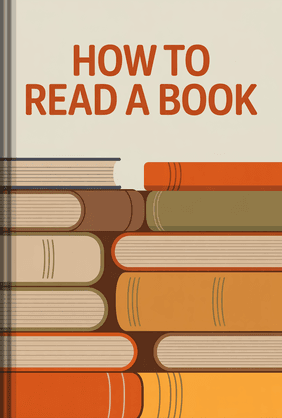
How to Read a Book
Mortimer J. Adler, Charles Van Doren
 18 Duration
 8 Key Points
 4.7 Rate
The 4-Step Skimming Reading Technique
Effective skimming is surgical. You are looking for the skeleton of the book. Leave the meat and fat behind. Follow this structured approach to extract maximum value.

Step 1: The Structural Reconnaissance (5 Minutes)
Do not open to page one and start reading. Treat the book like a map. You need to understand the terrain before you decide which path to take.
- Study the Cover and Flaps: The front cover, subtitle, and inside dust jacket flap are marketing materials, but they are also the tightest summaries of the book's promise. They tell you exactly what problem the author intends to solve.
- Analyze the Table of Contents (TOC): The TOC is your roadmap. Authors spend weeks organizing this section. Scan the chapter titles. You will usually notice a pattern. Part One often outlines the problem. Part Two introduces the framework. Part Three provides implementation strategies. Highlight the two or three chapters that actually solve your specific problem. Ignore the rest for now.
- Check the Index: Flip to the back. What terms have the most page numbers attached to them? If you are reading a book on habit formation and the index points to "dopamine" 45 times, you know dopamine is a foundational concept in the author's argument.
Step 2: The Bookends Strategy (15 Minutes)
Every non-fiction book is structured like a legal argument. The author makes a claim, provides evidence, and delivers a closing statement.
- Read the Introduction Fully: Do not skip the introduction. Authors use the first 15 pages to lay out their entire thesis. They will explicitly state, "In this book, I will show you..." Read this section carefully. It provides the lens through which you will view the rest of the text.
- Read the Conclusion Fully: Jump straight to the end of the book. The conclusion summarizes what the author believes they have successfully proven. By reading the introduction and the conclusion back-to-back, you instantly grasp the book's entire trajectory.
Step 3: Chapter Drilling (20-30 Minutes)
Now go back to the specific chapters you identified as high-value during your TOC analysis. This is where mastering skimming non fiction pays off.
- The First-and-Last Rule: Read the first paragraph of the chapter. Then, read only the first sentence and the last sentence of the subsequent paragraphs. The first sentence is almost always the topic sentence. It introduces the idea. The last sentence wraps it up or transitions to the next point. The middle is usually just a story about a company or a study involving college students. Skip the middle unless the topic sentence completely confuses you.
- Subheadings are Signposts: Treat subheadings as micro-chapters. If the subheading says "The Rule of Reciprocity," you know what the next few pages are about. If you already understand reciprocity, skip to the next subheading entirely.
- Hunt for Visual Cues: Your eyes should naturally jump to anything the publisher formatted differently. Read bulleted lists. Look at charts and graphs. Read bolded text and pull quotes. These visual breaks are intentionally designed to draw attention to the most important data.
These techniques are highly effective for general non-fiction, but academic material presents its own unique challenges. For those navigating dense college texts, a more specialized strategy is required to handle elements like complex data, chapter reviews, and extensive citations.
Skimming efficiently also requires a well-optimized brain that can process information quickly without losing comprehension. If you find yourself losing focus or struggling to keep up the pace while chapter drilling, you might benefit from techniques that naturally upgrade your cognitive performance. Learning how to unlimit your brain can dramatically improve your reading speed, memory retention, and overall ability to absorb complex topics in record time.
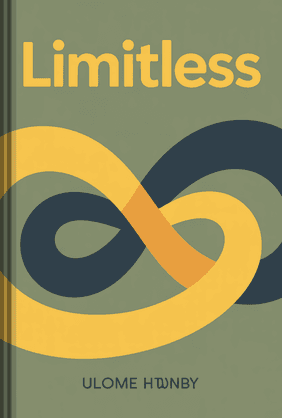
Limitless
Jim Kwik
43 Duration9 Key Points4.6 RateStep 4: Capture and Consolidate (10 Minutes)
Skimming without taking notes is just looking at paper. Because you are moving quickly, your retention will drop if you do not force yourself to synthesize the information.
Grab an index card or open Apple Notes. Write down three things:
- The author's core argument in one sentence.
- Three actionable strategies you can implement right now.
- One powerful quote or statistic.
If you are reading on a Kindle or Apple Books, use the built-in highlight feature. In Kindle, turn on "Popular Highlights" to see the exact passages thousands of other readers found valuable. This is the ultimate shortcut to read more in less time.
Once you start extracting all these brilliant insights, you will quickly realize that relying on your memory alone is a recipe for disaster. To truly leverage the knowledge you gather, you need a reliable system to store, organize, and retrieve your notes whenever you need them. Creating a personalized digital knowledge management system ensures that every actionable strategy you highlight actually gets used in your real life, rather than forgotten in an old notebook.
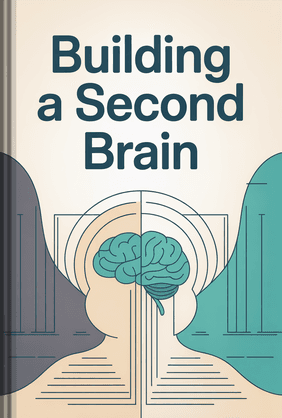
Building a Second Brain
Tiago Forte, André Santana, et al.
46 Duration9 Key Points4.4 RateWhen to Stop Skimming
Skimming is a default speed, not a strict rule. You must know when to hit the brakes.
When you uncover a concept that fundamentally challenges your worldview or directly applies to a project you are managing right now, stop skimming. Read that specific section word-for-word. Dog-ear the page. Grab a highlighter. Engage deeply with the text.
The goal of skimming is to rapidly clear away the brush so you can find the actual gold. When you find the gold, take your time digging it out.

Avoiding Common Mistakes
Many people attempt to skim and end up retaining absolutely nothing. Avoid these standard pitfalls:
Treating Fiction Like Non-Fiction
Do not use this method on a novel. Fiction is about the narrative journey, the prose, and the character development. Skimming a thriller ruins the experience. Keep this technique strictly for informational, instructional, or business texts.
Do not use this method on a novel. Fiction is about the narrative journey, the prose, and the character development. Skimming a thriller ruins the experience. Keep this technique strictly for informational, instructional, or business texts.
Speed Reading is Not Skimming
Speed reading apps and courses train you to move your eyes faster across every single word to increase your words-per-minute (WPM). That requires immense cognitive load and often destroys comprehension. Skimming is strategic skipping. You are completely ignoring large chunks of text by choice. It is a decision-making process, not an eye-tracking exercise.
Speed reading apps and courses train you to move your eyes faster across every single word to increase your words-per-minute (WPM). That requires immense cognitive load and often destroys comprehension. Skimming is strategic skipping. You are completely ignoring large chunks of text by choice. It is a decision-making process, not an eye-tracking exercise.
This strategic skipping is what sets it apart. While skimming helps you grasp the main ideas, it’s often confused with scanning, which is a different skill used to find specific facts or keywords quickly. Understanding when to use each technique is key to efficient reading.
Passive Flipping
Flipping pages while watching TV is not skimming. Active skimming requires intense focus. You are actively hunting for specific answers. Give the book your undivided attention for 45 minutes, rip the value out of it, and put it on your Goodreads "Read" shelf.
Flipping pages while watching TV is not skimming. Active skimming requires intense focus. You are actively hunting for specific answers. Give the book your undivided attention for 45 minutes, rip the value out of it, and put it on your Goodreads "Read" shelf.
You no longer have an excuse to let your personal library gather dust. Pick up that book you bought last month. Set a timer for 45 minutes. Find the thesis, extract the core strategies, and move on.
Applying these skimming techniques will transform your reading habits. But to truly compound your learning, consistency is key, even on days when you're too exhausted to open a book.
LeapAhead
Turn your commute into learning time by listening to 15-minute audio summaries of the most impactful books on career growth, productivity, and leadership.
Even with the best skimming techniques, the hardest part is often just sitting down consistently to tackle that stack of books on your nightstand. If you want to turn this 45-minute skimming routine into an automatic, daily behavior, you need to understand the science of habit formation. By making small, incremental tweaks to your environment and routine, you can effortlessly build a lifelong reading habit that compounds your knowledge over time.

Atomic Habits
James Clear
26 Duration8 Key Points4.7 RateFAQ
Will I forget what I read if I only skim?
No. Active skimming actually improves long-term retention of core concepts compared to passive cover-to-cover reading. Because you are actively hunting for the main ideas and taking targeted notes, you anchor the most critical information in your memory.
No. Active skimming actually improves long-term retention of core concepts compared to passive cover-to-cover reading. Because you are actively hunting for the main ideas and taking targeted notes, you anchor the most critical information in your memory.
How long should it take to skim a standard 300-page book?
A highly focused skimming session should take between 45 to 90 minutes. If you are spending three hours skimming, you have slipped back into traditional reading. Set a timer to force yourself to keep moving.
A highly focused skimming session should take between 45 to 90 minutes. If you are spending three hours skimming, you have slipped back into traditional reading. Set a timer to force yourself to keep moving.
Does this technique work for audiobooks?
Yes. For platforms like Audible, increase the playback speed to 1.5x or 2x. Utilize the chapter navigation feature to skip lengthy case studies. Many modern audiobooks also provide an attached PDF summary; read that file first to identify which audio chapters are worth your full attention.
Yes. For platforms like Audible, increase the playback speed to 1.5x or 2x. Utilize the chapter navigation feature to skip lengthy case studies. Many modern audiobooks also provide an attached PDF summary; read that file first to identify which audio chapters are worth your full attention.
What if I miss an important detail while skipping paragraphs?
You will miss details. That is the trade-off. However, an author rarely buries a groundbreaking concept in the middle of a random paragraph without referencing it in the introduction, conclusion, or subheadings. You will miss anecdotes, but you will rarely miss the framework.
You will miss details. That is the trade-off. However, an author rarely buries a groundbreaking concept in the middle of a random paragraph without referencing it in the introduction, conclusion, or subheadings. You will miss anecdotes, but you will rarely miss the framework.