

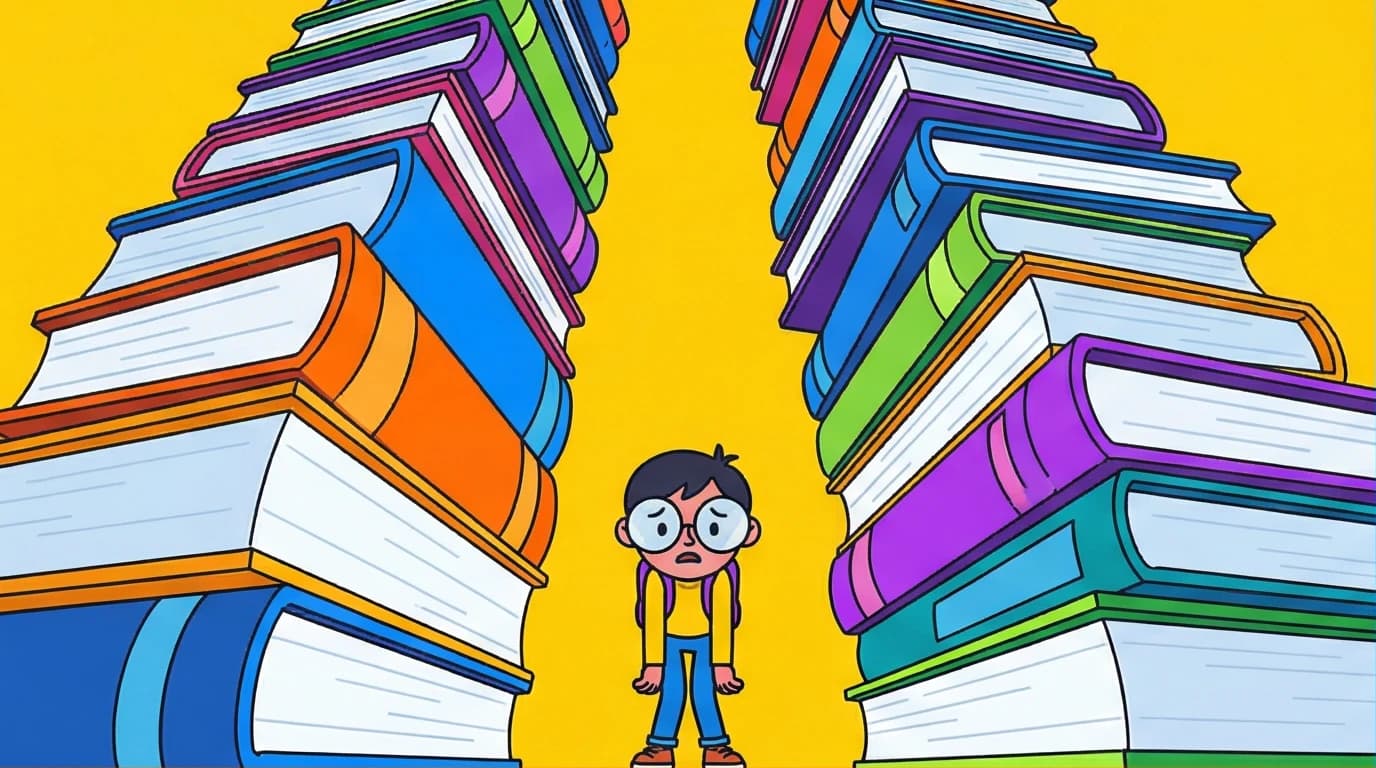
Your syllabus just dropped, and you are staring at 300 pages of assigned reading due by Tuesday. You sit down with a fresh highlighter, read three pages, and realize you absorbed absolutely nothing. You do not have the time to read every single word, but showing up to a lecture completely blind is a recipe for a wrecked GPA.
The volume of reading in higher education is designed to test your filtering skills, not your endurance. You need to stop treating your $150 textbook like a novel you bought at Barnes & Noble. Textbooks are data repositories. You do not read them; you mine them for information.
Here is the exact framework on how to skim textbooks, extract what you need for midterms, and get your life back.
Why You Must Change Your Reading Approach
Most freshmen enter college programmed to read from page one to page fifty without skipping a word. This works in high school. It fails miserably when you are juggling 15 credit hours, a part-time job, and endless assignments.
If you have five classes, and each assigns 40 pages of reading twice a week, that is 400 pages of dense academic text weekly. Reading at an average pace of two minutes per page, you are looking at over 13 hours of just reading. You have to learn how to read a textbook fast.
Textbooks are intentionally padded. Publishers add lengthy anecdotes, historical background, and repetitive examples to justify high prices and new editions. Your professor usually only cares about the core principles, the primary arguments, and the vocabulary. Skimming college textbooks is not lazy. It is a necessary survival skill. It is about maximizing your return on time invested.
While this skimming strategy helps you conquer your coursework, the problem of 'no time to read' often extends to the books you actually want to read for personal growth. When even finding 15 minutes feels impossible, a different approach is needed.


Use LeapAhead to get the core insights from bestselling nonfiction books in quick 15-minute audio or text summaries, perfect for learning on your commute or between classes.
 LeapAhead
If you are struggling to keep up with your syllabus, realizing that reading a textbook requires a completely different approach than reading for pleasure is your first major victory. To truly master the art of extracting information efficiently, you might want to explore the foundational text on the subject. This classic guide breaks down the different levels of reading, from elementary comprehension to analytical deep dives, making it an essential companion for any college student staring down a massive stack of coursework.
How to Read a Book
Mortimer J. Adler, Charles Van Doren
 18 Duration
 8 Key Points
 4.7 Rate
The Anatomy of a Textbook (And How to Exploit It)
To get through required reading quickly, you need to understand how academic publishers construct these books. They follow a predictable, rigid formula. Once you see the matrix, you know exactly where the vital information lives and what you can ignore.
- The Skeleton: The Table of Contents and Chapter Headings.
- The Meat: The first and last sentences of paragraphs.
- The Signposts: Bold words, italicized terms, and bulleted lists.
- The Cheat Code: Chapter summaries and review questions.
When you understand this structure, you realize that 80% of the value is contained in 20% of the text.

The 5-Step System for Skimming College Textbooks
Drop the highlighter. Grab a pencil or open a blank document on your laptop. Here is your operational checklist for tearing through a chapter in 20 minutes instead of two hours.
Step 1: Read the Summary First
Never start a chapter on page one. Flip straight to the end. Read the chapter summary, the conclusion, and the list of key terms. Read the review questions.
Why? Because this tells you exactly what the author thinks is the most important information in the chapter. When you know how the chapter ends, your brain becomes primed to spot the evidence that supports those conclusions when you flip back to the beginning.
Step 2: Map the Headings
Flip back to the start of the chapter. Spend two minutes doing nothing but reading the main headings and subheadings.
Look at the hierarchy. How is the author organizing their thoughts? Is it chronological? Is it cause and effect? This builds a mental scaffolding. When you actually start skimming, you are just plugging data into this pre-built structure rather than trying to figure out what is going on mid-sentence.
Step 3: The First-Sentence Rule
This is the core mechanic of how to skim textbooks. Paragraphs in academic writing follow strict rules. The first sentence is almost always the topic sentence. It tells you what the entire paragraph is about.
Read the first sentence. Read the last sentence. Skip everything in the middle. The middle is usually just examples, case studies, or extra context.
- If the first sentence makes perfect sense, move to the next paragraph.
- If the first sentence introduces a concept you do not understand, drop your eyes to the middle of the paragraph to find the explanation, then move on.

Step 4: Hunt the Visuals
Your eyes should naturally snap to anything that breaks the standard text format.
Look for:
Look for:
- Bold and italicized words: These are usually vocabulary terms that will show up on a multiple-choice exam. Read the sentence containing the word.
- Charts, graphs, and diagrams: A single infographic often summarizes three pages of dense text. Look at the axes of the graph and read the caption.
- Callout boxes: Authors use colored sidebars to highlight case studies. Check your syllabus. If your professor loves real-world examples, read these. If they only test theory, skip them completely.
Step 5: Align with the Syllabus
Do not skim blindly. Look at your syllabus before you open the book. What is the lecture topic for the week? What are the learning objectives?
If your syllabus says "Week 4: The Causes of the Great Depression," and the textbook chapter spends ten pages on the cultural impact of 1930s cinema, skip those ten pages entirely. Read defensively. Only hunt for the information your professor specifically requested.
Reading Strategies for College: Adjusting by Subject
A major mistake students make is applying the exact same reading strategy to every class. Skimming a molecular biology textbook requires a completely different approach than skimming a political science manifesto.
Humanities and Social Sciences (History, Sociology, Literature)
These textbooks are argument-driven. The author is trying to prove a thesis.
- Your Goal: Find the thesis statement and the three pieces of evidence used to support it.
- Where to Look: Introductions, conclusions, and transition paragraphs. You can aggressively skip the lengthy historical anecdotes. Focus heavily on "why" things happened.
- Keywords to spot: "However," "therefore," "in contrast," "ultimately." These words signal that the author is about to drop the main point.
STEM (Biology, Chemistry, Physics)
STEM textbooks are process-driven and definition-heavy. They build linearly. You cannot skip step two and expect to understand step three.
- Your Goal: Understand the mechanisms, memorize formulas, and learn the vocabulary.
- Where to Look: Diagrams, bolded definitions, and step-by-step process lists.
- The Strategy: You cannot skip as aggressively in STEM. Instead, skim the text but study the diagrams intensely. If you understand how the visual cycle works (like the Krebs cycle in biology), you do not need to read the three pages of text describing it.
How to Take Notes While Skimming
Skimming without taking notes is just looking at a book. You must capture the data so you never have to open that heavy textbook again before finals.
Use a highly condensed note-taking method.
- Format: Write the Chapter Title at the top.
- Headings: Turn every textbook subheading into a question. (e.g., If the heading is "The Law of Supply," write "What is the Law of Supply?").
- Bullets: Underneath the question, write 2-3 bullet points using the information you grabbed from the first/last sentences and bold terms.
- No Full Sentences: Use abbreviations. Keep it messy but functional.
By the time you finish skimming, you should have a single sheet of paper that acts as a custom study guide.
Creating a custom study guide is just the beginning of effective college note-taking. Once you get the hang of extracting key points, the next step is figuring out how to organize all those messy bullet points into a system you can actually trust when finals week rolls around. If you want to stop losing your notes and start building a digital repository of everything you learn, this incredible resource on personal knowledge management will completely revolutionize how you study and organize your academic life.
Building a Second Brain
Tiago Forte, André Santana, et al.
46 Duration9 Key Points4.4 RateFatal Mistakes to Avoid
When trying to master how to read a textbook fast, students often fall into several traps that ruin their efficiency.
The "Neon Page" Syndrome
Highlighting is a passive activity that tricks your brain into thinking it is learning. When you highlight a sentence, you are just delaying the work of understanding it. By the end of the chapter, your page is entirely neon yellow, and you still do not know what it means. Stop highlighting. Write short notes instead. Forced output guarantees comprehension.
Breaking the highlighting habit can feel incredibly uncomfortable at first, but it is deeply backed by cognitive science. When you swap passive reading for forced output and active recall, your retention skyrockets. If you want to understand exactly why your brain learns better through self-testing rather than rereading neon-colored pages, checking out the actual research on successful learning strategies will change your academic trajectory. It is an absolute game-changer for cutting down your overall study time while boosting your GPA.
Make It Stick
Peter C. Brown, Mark A. McDaniel, Ph.D., Henry L. Roediger III, Ph.D.
18 Duration8 Key Points4.6 Rate
Ignoring the Professor's Bias
Pay attention to what your professor emphasizes in class. Do they test heavily on definitions? Focus your skimming purely on the glossary and bold terms. Do they ask broad essay questions? Focus your skimming on chapter summaries and the author's overall thesis. Your skimming strategy must adapt to the person writing the exam.
Pushing Through Fatigue
Skimming requires intense focus. Your brain is working overtime to filter information. You cannot skim effectively for two hours straight. After 30 minutes, your eyes will just glaze over the pages. Use the Pomodoro technique. Skim aggressively for 25 minutes, then walk away for 5 minutes.
For those times when your brain is too fried for even a 25-minute focused skim, trying to read can be counterproductive. This is when switching from reading to listening can make all the difference, allowing you to learn without the intense visual focus.
LeapAhead lets you listen to summaries of books on productivity and success, turning your downtime into effortless learning when you're too mentally exhausted to stare at a textbook.
LeapAheadWorking in focused, timed sprints is exactly how top-tier students manage heavy workloads without burning out by midterms. Since you will be relying heavily on the Pomodoro method to keep your eyes from glazing over during those intense textbook skimming sessions, why not learn it from the creator himself? This quick, practical read will teach you how to master your time, eliminate distractions, and organize your study schedule into manageable 25-minute blocks that actually yield results.
The Pomodoro Technique
Francesco Cirillo
19 Duration8 Key Points4.4 RateFAQ
Will I miss important information if I just skim?
Yes, you will miss minor details, anecdotes, and secondary examples. However, you will capture the core concepts, main arguments, and key vocabulary—which usually make up 95% of what is tested. Skimming ensures you get the most important information rather than reading half a chapter perfectly and running out of time for the rest.
Yes, you will miss minor details, anecdotes, and secondary examples. However, you will capture the core concepts, main arguments, and key vocabulary—which usually make up 95% of what is tested. Skimming ensures you get the most important information rather than reading half a chapter perfectly and running out of time for the rest.
How long should it take to skim a 50-page chapter?
If you are reading word-for-word, 50 pages might take two to three hours. Using effective skimming strategies, you should be able to extract the necessary structure, vocabulary, and main ideas in 30 to 45 minutes.
If you are reading word-for-word, 50 pages might take two to three hours. Using effective skimming strategies, you should be able to extract the necessary structure, vocabulary, and main ideas in 30 to 45 minutes.
Is skimming effective for STEM textbooks?
Yes, but the focus shifts. Instead of looking for overarching arguments like in history or sociology, STEM skimming requires you to heavily analyze charts, diagrams, formulas, and bolded terminology. You spend less time on paragraphs and more time dissecting the visual models.
Yes, but the focus shifts. Instead of looking for overarching arguments like in history or sociology, STEM skimming requires you to heavily analyze charts, diagrams, formulas, and bolded terminology. You spend less time on paragraphs and more time dissecting the visual models.
Should I take notes while skimming or after?
Take notes concurrently, but keep them brief. If you wait until after you finish skimming the entire chapter, you will forget the specific details. Jot down bullet points under headings as you move through the text. This builds your study guide in real-time.
Take notes concurrently, but keep them brief. If you wait until after you finish skimming the entire chapter, you will forget the specific details. Jot down bullet points under headings as you move through the text. This builds your study guide in real-time.