


You sit down at your desk with a cup of coffee, ready to tackle a major project. Five minutes later, you are scrolling through Slack, checking your email, or staring blankly at a blinking cursor. Distractions are everywhere. Constant notifications and task-switching have fragmented your attention span.
If you struggle with the afternoon 2 PM slump, a racing mind, or an inability to hold a single train of thought, a new productivity app will not fix the problem. You need to upgrade the hardware. You need to train your brain.
Think of meditation not as a mystical retreat from the world, but as a rigorous workout for your attention networks. By adopting specific, pragmatic techniques, you can sharpen your cognitive edge and build a firewall against digital distractions.
And while meditation is a powerful tool for training your brain, another part of the solution is adapting how you learn to fit the reality of a busy schedule. If it's hard to find long stretches of time to read, you can still absorb key ideas in a more focused way.


LeapAhead

This app offers 15-minute summaries of bestselling books on focus and productivity, allowing you to build your knowledge on the go without requiring long, uninterrupted reading sessions.
The Neuroscience of Attention
To understand why sitting still actually makes you sharper, you need to look at what happens inside your brain when you lose focus.
When your mind wanders, a neural circuit called the Default Mode Network (DMN) takes over. The DMN is responsible for daydreaming, worrying about the future, and ruminating on the past. When you are trying to write a report but suddenly start worrying about an upcoming Zoom meeting, your DMN has hijacked your attention.
Practicing meditation for focus and concentration actively suppresses the DMN and activates the Task-Positive Network (TPN). The TPN is the network responsible for deep, sustained attention.
Every time you realize your mind has wandered during meditation and you actively pull your attention back to your breath, you are doing a "bicep curl" for your brain. This repetitive motion strengthens the prefrontal cortex—the command center for decision-making and impulse control. Over time, neuroplasticity ensures that these neural pathways become faster and stronger, making it easier to lock onto a task and ignore background noise.
If you want to dive deeper into the science of how your brain manages attention, understanding the mechanics of concentration is a game-changer. Learning how to intentionally switch between deep, sustained concentration and creative mind-wandering can completely transform your productivity. For a highly practical exploration of these concepts, there is a fantastic resource that breaks down exactly how to manage your attention space and reclaim your cognitive edge in a world full of notifications.

Hyperfocus
Chris Bailey
 17 Duration
 7 Key Points
 4.6 Rate
Core Protocol: Mindfulness Meditation for Focus
You do not need an expensive retreat or an elaborate setup to build cognitive endurance. Basic mindfulness meditation for focus relies on a single anchor—usually your breath—to train your attention mechanism.
Here is the exact protocol to execute this practice:
- Set the Environment: Sit upright in a chair with your feet flat on the floor. Keep your posture straight but not rigid. You do not need to sit cross-legged on a cushion.
- Set a Timer: Start with just 5 to 10 minutes. Consistency matters far more than duration.
- Anchor Your Attention: Close your eyes and direct all your focus to the physical sensation of breathing. Notice the air entering your nose and the rise and fall of your chest.
- Catch and Redirect: This is the most critical step. Within seconds, you will start thinking about your inbox, your grocery list, or an awkward conversation. This is not a failure. The moment you realize your mind has wandered, gently but firmly pull your attention back to the breath.
The act of noticing the distraction and returning to the anchor is the actual workout. That specific cognitive friction is what builds sustained focus.
For those just starting out, this protocol is all you need. If you'd like a more detailed walkthrough of what to expect in your first few sessions and how to handle common challenges, our beginner's guide is the perfect place to start.
Tactical Practices for the Workday
A daily morning practice is a great foundation, but you can also deploy specific techniques strategically throughout your day to solve acute cognitive problems.
The 5-Minute Transition: Quick Meditation for Work Productivity
Knowledge workers switch contexts constantly—from a high-stress management meeting to deep-focus coding, to answering rapid-fire messages. Context switching leaves "attention residue," meaning part of your brain is still stuck on the previous task.
To clear this residue, use a quick meditation for work productivity before starting a high-stakes task:
- Box Breathing Protocol: Inhale for 4 seconds, hold for 4 seconds, exhale for 4 seconds, hold empty for 4 seconds. Repeat this for 3 to 5 minutes.
- The Goal: This practice quickly down-regulates your nervous system, lowers cortisol spikes from your previous meeting, and resets your baseline. When you open your document afterward, your working memory is wiped clean of previous distractions and ready to engage.

Clearing the Afternoon Slump: Meditation for Brain Fog
Around 2:00 PM or 3:00 PM, a natural dip in circadian rhythms combined with accumulated cognitive fatigue often results in severe brain fog. Instead of reaching for a third cup of coffee—which will likely disrupt your sleep—you can use meditation for brain fog to reboot your system.
- Non-Sleep Deep Rest (NSDR) / Body Scan: Lie down or sit back comfortably. Close your eyes and mentally scan your body from the top of your head down to your toes. Focus intensely on relaxing the specific muscle groups as you scan over them.
- The Goal: A 10 to 15-minute body scan shifts your brain waves from active Beta into relaxed Alpha and Theta states without actually falling asleep. This deliberate rest clears out adenosine (the chemical that makes you feel sleepy) and restores your mental clarity for the second half of the day.
While these techniques are excellent for workday productivity, the same principles of mindful breathing and nervous system regulation are also highly effective for managing feelings of stress and worry.
Even with strong meditation practices, modern office environments and smartphones are engineered to pull you off task. If you often find yourself falling victim to context switching, the 2 PM slump, or endless scrolling when you should be working, you might need a broader strategy to protect your time. Building an environment that supports your newly trained focus is just as important as the mental reps. If you are looking to bulletproof your workday against constant interruptions and master your triggers, this is a must-read.
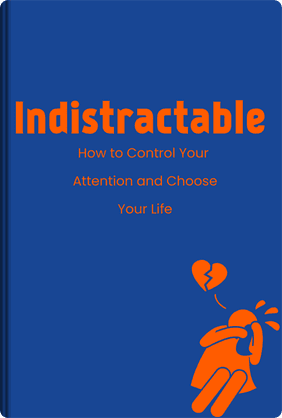
Indistractable
Nir Eyal
23 Duration10 Key Points4.5 RateBeyond Focus: How to Meditate to Improve Memory
Your ability to remember information is directly tied to your ability to pay attention to it in the first place. You cannot encode a memory if you are distracted during the input phase.
If you want to know how to meditate to improve memory, the mechanism is twofold:
- Better Encoding: By strengthening your focus, you ensure that the data you read or hear actually enters your short-term memory accurately.
- Structural Brain Changes: MRI scans show that consistent meditation increases the gray matter density in the hippocampus, the region of the brain responsible for learning and memory consolidation.
To specifically target memory, combine mindfulness with visualization. Read a complex paragraph of text or review a critical project brief. Then, close your eyes for three minutes. Focus on your breath, but keep the core concept of what you just read firmly in the center of your mind's eye. If unrelated thoughts intrude, push them away and return to the concept. This active consolidation practice forces the brain to commit the data to long-term storage.
Once you have upgraded your ability to focus, your capacity to absorb and retain new information skyrockets. But knowing how to pay attention is only the first half of the learning equation. If you are a knowledge worker, student, or professional who needs to master complex topics quickly, pairing your meditation practice with science-backed study techniques is an incredible combination. To understand the actual mechanics of how our brains lock in new information for the long haul, this book offers some of the most effective, research-driven methods available.

Make It Stick
Peter C. Brown, Mark A. McDaniel, Ph.D., Henry L. Roediger III, Ph.D.
18 Duration8 Key Points4.6 RateCommon Pitfalls and Mistakes
Many busy professionals quit meditation within the first week because they approach it with the wrong expectations. Avoid these common traps:
- Trying to "Empty Your Mind": This is the biggest myth. The human brain is designed to generate thoughts. You cannot turn it off. Your goal is not a blank mind; your goal is to choose what you pay attention to. Expect thoughts to happen, notice them, and return to the anchor.

- Meditating in Bed: If you are doing focus training, do not do it where you sleep. Your brain associates your bed with unconsciousness. Sit up in a chair or on a bench. Keep the posture alert.
- Waiting for the "Perfect" Time: You do not need absolute silence. A noisy office, a train commute, or a busy coffee shop can actually serve as an advanced training ground. The noise becomes the distraction you actively practice ignoring.
- Judging the Session: Some days your focus will feel sharp. Other days, you will spend 10 minutes wrestling with intrusive thoughts. Both sessions are equally valuable. The difficult sessions are often where you build the most cognitive endurance.
Wrestling with a hyperactive internal monologue is entirely normal when you first start training your attention. That inner voice that keeps reminding you about your inbox or criticizing your meditation efforts can be overwhelming. However, instead of fighting it, you can actually learn to harness that internal dialogue to work for you rather than against you. If you struggle with a loud, racing mind and want to turn that mental noise into a tool for better self-control and emotional regulation, I highly recommend checking out this insightful read.

Chatter
Ethan Kross, Ph.D.
23 Duration10 Key Points4.3 RateThese books offer powerful strategies, but finding the time to read them all can feel like another project on your to-do list. If you want to absorb the core ideas from these authors without adding to your reading pile, a microlearning app can be a great tool.
LeapAhead
Get the key takeaways from books on psychology and focus in short, 15-minute audio or text summaries, making it easy to learn new strategies even when you're too tired for a full chapter.
Building Your Daily Routine
To get tangible results, you need a system. Treat this exactly like a physical exercise routine.
The Baseline Protocol:
- Morning: 10 minutes of breath-focused mindfulness immediately after waking up or before starting your workday.
- Mid-Day: 5 minutes of box breathing before your most important, cognitively demanding task of the day.
- Afternoon: 10 minutes of NSDR or body scan when the 2 PM brain fog hits.
By integrating these practices, you are not just taking breaks; you are actively sharpening the tool you rely on most—your mind. In an economy where human attention is constantly harvested by algorithms, your ability to focus deeply is a massive competitive advantage. Protect it, train it, and leverage it.
Creating a system is one thing; making it stick is another. For practical strategies on integrating these sessions into your life, no matter how busy you are, explore our guide on building a consistent practice.
FAQ
How long does it take to see improvements in focus?
Most neuroscientific studies indicate that physical changes in the brain's attention networks begin to show after about 4 to 8 weeks of consistent daily practice. However, many practitioners report a subjective feeling of reduced mental clutter and better task management within the first 7 to 10 days of practicing 10 minutes a day.
Most neuroscientific studies indicate that physical changes in the brain's attention networks begin to show after about 4 to 8 weeks of consistent daily practice. However, many practitioners report a subjective feeling of reduced mental clutter and better task management within the first 7 to 10 days of practicing 10 minutes a day.
Do I need an app to meditate effectively?
No. While apps can be helpful for beginners to learn the mechanics, guided audio can sometimes become a crutch. If your goal is raw focus, a simple countdown timer is the best tool. You want to train your brain to generate its own focus, not rely on a voice in your headphones to keep you on track.
No. While apps can be helpful for beginners to learn the mechanics, guided audio can sometimes become a crutch. If your goal is raw focus, a simple countdown timer is the best tool. You want to train your brain to generate its own focus, not rely on a voice in your headphones to keep you on track.
What is the best time of day to meditate for concentration?
The most effective time is early morning, before you check your phone or open your email. By meditating before the daily influx of digital noise, you set a calm, focused baseline for your nervous system. However, doing it consistently at any time is better than doing it inconstantly at the "perfect" time.
The most effective time is early morning, before you check your phone or open your email. By meditating before the daily influx of digital noise, you set a calm, focused baseline for your nervous system. However, doing it consistently at any time is better than doing it inconstantly at the "perfect" time.
My mind races too much and I get frustrated. Should I stop?
Absolutely not. A racing mind means you are highly distracted, which means you need the training more than ever. Frustration is just another thought. When you notice you are getting frustrated, label that feeling ("I am feeling frustrated"), let it go, and return to your breath. Every time you do this, you are successfully doing the work.
Absolutely not. A racing mind means you are highly distracted, which means you need the training more than ever. Frustration is just another thought. When you notice you are getting frustrated, label that feeling ("I am feeling frustrated"), let it go, and return to your breath. Every time you do this, you are successfully doing the work.