


Telling a highly critical client to simply "be kind to yourself" is almost always ineffective. When working with trauma, perfectionism, or chronic depression, superficial positive affirmations often trigger intense resistance. Professionals need a structured, clinical method to dismantle the inner critic without sparking defensive reactions. Mindful self-compassion (MSC) offers exactly this: a robust, empirically supported architecture designed to build emotional resources.
The Clinical Architecture of Mindful Self-Compassion
Developed by Dr. Kristin Neff and Dr. Christopher Germer, mindful self compassion training is not a form of passive acceptance or self-pity. It is an active emotional regulation strategy. From a neurobiological perspective, self-criticism activates the threat-defense system (amygdala), flooding the body with cortisol and adrenaline. MSC intentionally stimulates the mammalian caregiving system, leveraging oxytocin and endorphins to downregulate nervous system arousal.
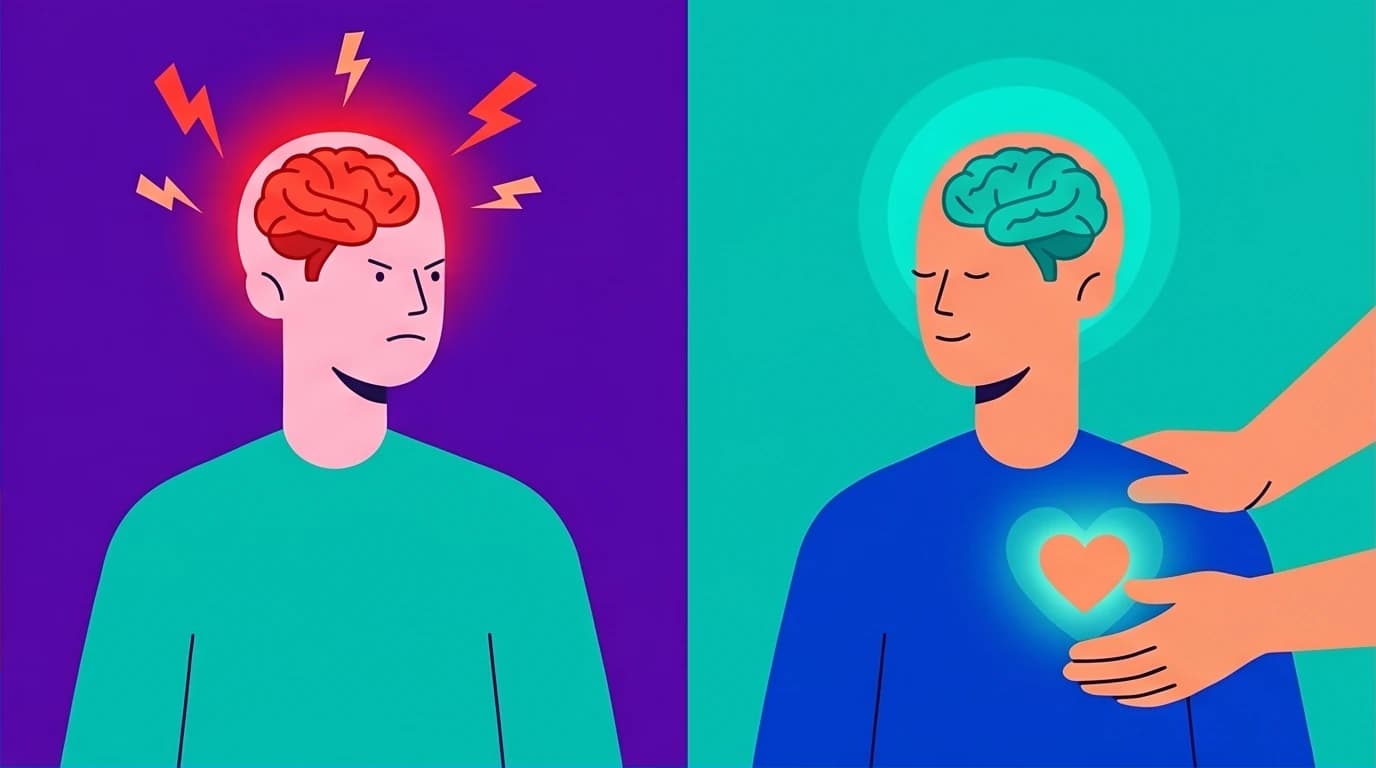
To apply this professionally, you must understand its three interconnected pillars:
1. Mindfulness vs. Over-Identification
Clients often drown in their emotional narratives. Mindfulness teaches them to observe their pain with equanimity. In a clinical setting, this means guiding a client to name their current emotional state ("I am experiencing panic right now") rather than fusing with it ("I am a panicked, broken person"). It is the prerequisite for compassion.
2. Common Humanity vs. Isolation
Deep shame convinces individuals that they are uniquely flawed and alone in their suffering. Common humanity frames personal failure or pain as a part of the universal human experience. This cognitive shift reduces isolation and builds the foundation for empathy.
3. Self-Kindness vs. Self-Judgment
This involves actively offering warmth and understanding to oneself. Rather than harshly judging personal shortcomings, the client learns to speak to themselves with the same tone they would use for a struggling friend.
As you explore the clinical architecture of this framework, diving directly into the foundational texts can be incredibly helpful. Since Dr. Kristin Neff co-developed these exact pillars of Mindful Self-Compassion, her pioneering work is essential reading for any mental health professional. It provides the empirical data and clinical anecdotes you need to confidently explain to your clients why self-kindness isn't just a feel-good buzzword, but a biologically grounded tool for building emotional resilience.
Self-Compassion
Kristin Neff, Xe Sands, et al.
 26 Duration
 8 Key Points
 4.8 Rate
Evidence-Based Self Compassion Therapy Techniques
Integrating MSC into your practice requires specific tools. These self compassion therapy techniques are designed to bypass cognitive resistance and anchor emotional regulation in the body.
The Self-Compassion Break
This technique serves as an immediate state-shifting tool when a client experiences acute distress. It walks the client through the three pillars in real-time. You can guide your client through these three distinct vocalizations:
- Mindfulness: "This is a moment of suffering." (Acknowledging the pain).
- Common Humanity: "Suffering is a part of life. Other people feel this way." (Breaking the isolation).
- Self-Kindness: "May I be kind to myself in this moment. May I give myself the compassion I need." (Applying active warmth).
Soften, Soothe, Allow
Designed specifically for somatic processing, this tool helps clients who somaticize their anxiety.
- Soften: Direct the client to locate the physical sensation of the emotion in their body and gently soften the muscles around it.
- Soothe: Apply physical comfort, such as placing a hand over the heart or on the stomach, which releases oxytocin.
- Allow: Let the discomfort exist without trying to force it away.

Addressing the physical manifestations of anxiety and shame is a critical step in the healing process. When clients somaticize their trauma, cognitive strategies often fall short, making physical soothing exercises essential. If you want to deepen your clinical understanding of how the nervous system stores emotional pain and why somatic interventions are necessary to unlock it, there is a definitive resource that every therapist and coach should keep on their desk.
The Body Keeps The Score
Bessel Van Der Kolk
32 Duration10 Key Points4.5 RateCompassionate Letter Writing
Assign this as homework for clients dealing with entrenched shame. Ask them to write a letter to themselves from the perspective of an unconditionally loving, imaginary friend who knows all their flaws and still holds them in high regard. This externalizes the compassionate voice until the client can internalize it.
For clients who respond well to structured practice, having a variety of tools can make all the difference. Building a library of go-to techniques ensures you can adapt to their needs in the moment.
Guiding a client to overcome a harsh inner critic can often feel like a constant uphill battle. Sometimes, clients benefit immensely from understanding that their judgmental thoughts are just protective "parts" of their psyche, rather than their core identity. Incorporating concepts from Internal Family Systems (IFS) alongside compassion exercises is a fantastic way to help clients safely externalize and heal their deepest shame without becoming overwhelmed.
No Bad Parts
Richard Schwartz Ph.D.
22 Duration7 Key Points4.6 RateDifferentiating MSC and Compassion Focused Therapy
Professionals often confuse mindful self-compassion with compassion focused therapy (CFT). While they share similar goals, their origins and structural frameworks differ.
Mindful Self Compassion Training (MSC):
Rooted in mindfulness and Buddhist psychology, MSC is primarily a resource-building skills training program. It focuses heavily on teaching clients how to directly experience self-compassion in daily life. It is highly practical and operates effectively as an adjunct to other therapies like CBT or EMDR.
Rooted in mindfulness and Buddhist psychology, MSC is primarily a resource-building skills training program. It focuses heavily on teaching clients how to directly experience self-compassion in daily life. It is highly practical and operates effectively as an adjunct to other therapies like CBT or EMDR.
Compassion Focused Therapy (CFT):
Developed by Dr. Paul Gilbert, CFT is a distinct psychotherapeutic model rooted in evolutionary neurobiology. It focuses specifically on the interaction between three emotion-regulation systems: the threat and protection system, the drive and resource-seeking system, and the soothing and contentment system. CFT was built explicitly for clients with high shame and severe self-criticism who find compassion threatening.
Developed by Dr. Paul Gilbert, CFT is a distinct psychotherapeutic model rooted in evolutionary neurobiology. It focuses specifically on the interaction between three emotion-regulation systems: the threat and protection system, the drive and resource-seeking system, and the soothing and contentment system. CFT was built explicitly for clients with high shame and severe self-criticism who find compassion threatening.
You do not have to choose strictly between them. Many therapists blend the evolutionary psychoeducation of CFT with the accessible, daily practices taught in MSC.
Before applying either framework, ensuring you and your client have a shared understanding of the core concepts is crucial for building trust and ensuring the techniques land effectively.
Treating deep-seated shame requires immense delicacy, especially when clients feel isolated by their perceived flaws. Understanding how to dismantle this isolation and build true shame resilience is the key to making therapies like MSC and CFT effective. If you are looking to refine your approach to treating clients paralyzed by the "I am not enough" narrative, diving into the mechanics of vulnerability and connection will absolutely transform your practice.

I Thought It Was Just Me
Brené Brown, Ph.D.
22 Duration9 Key Points4.4 RateKeeping up with essential reading from thought leaders like Brené Brown and Kristin Neff is vital for any practitioner, but finding the time between client sessions can be a real challenge.

Fit professional development into your packed schedule by listening to key insights from essential clinical books during your commute or breaks.

Download LeapAhead App now
Managing "Backdraft" in Clinical Settings
A critical concept taught in formal mindful self compassion training is "backdraft." In firefighting, backdraft occurs when a door is opened in a burning building, letting oxygen in and causing an explosion. In therapy, when a client finally opens the door to self-love, years of stored pain, grief, or trauma can rush out.

Clients might report feeling worse, anxious, or deeply sad immediately after practicing self-compassion. This is a sign the therapy is working, but it requires careful management.
- Slow the pacing: If backdraft occurs, dial back the explicit self-compassion practices.
- Pivot to behavioral compassion: Shift from emotional exercises to physical grounding. Ask the client, "What is the most compassionate thing you can do for your body right now?" (e.g., drinking warm tea, taking a walk, petting a dog).
- Normalize the experience: Assure the client that feeling old pain when they finally feel safe is a normal, documented psychological response.
Successfully navigating backdraft is key to helping clients build a lasting, compassionate inner voice. This process often involves directly addressing the habits of self-criticism that have been in place for years.
Pathways to Certification and Professional Development
If you want to move beyond applying ad-hoc tools and integrate this framework formally into your practice, pursuing a mindful self compassion certification is the gold standard. The Center for Mindful Self-Compassion (CMSC) dictates the official pathway.
Step 1: Establish a Personal Practice
Before teaching others, you must complete the standard 8-week MSC program. You can easily find an approved msc course online. These online formats are highly effective, often delivered via live video cohorts that provide both the necessary experiential learning and CE (Continuing Education) credits.
Step 2: The Teacher Training Practicum
Once you have foundational experience and a daily meditation practice, you can apply for the MSC Teacher Training. This intensive program focuses explicitly on how to teach the curriculum, handle group dynamics, manage clinical backdraft, and guide the meditations effectively.
Step 3: Certification
After completing the Teacher Training, you enter a practicum phase. You will co-teach the 8-week program under the supervision of senior MSC mentors. Upon successful completion and review of your teaching recordings, you receive official certification. This credential significantly elevates your professional authority, allowing you to run formal MSC groups and market yourself as an expert in self-compassion interventions.
FAQ
What is the difference between an MSC course and standard psychotherapy?
An MSC course is an educational, resource-building skills training program rather than traditional therapy. While highly therapeutic, it focuses on teaching clients how to relate to their suffering differently, rather than diagnosing or uncovering past trauma.
An MSC course is an educational, resource-building skills training program rather than traditional therapy. While highly therapeutic, it focuses on teaching clients how to relate to their suffering differently, rather than diagnosing or uncovering past trauma.
Do I need a mindful self compassion certification to use these techniques with clients?
No. Licensed therapists and credentialed coaches can integrate individual self-compassion techniques into one-on-one sessions without formal certification. However, you must be certified to teach the official 8-week MSC curriculum or market yourself as an MSC Teacher.
No. Licensed therapists and credentialed coaches can integrate individual self-compassion techniques into one-on-one sessions without formal certification. However, you must be certified to teach the official 8-week MSC curriculum or market yourself as an MSC Teacher.
Are online MSC courses effective for clinical training?
Yes. Live, interactive online courses approved by the Center for Mindful Self-Compassion hold the same rigorous standards as in-person training. They provide an excellent way to fulfill prerequisites for professional credentialing while earning CE credits.
Yes. Live, interactive online courses approved by the Center for Mindful Self-Compassion hold the same rigorous standards as in-person training. They provide an excellent way to fulfill prerequisites for professional credentialing while earning CE credits.
How do I know if a client is ready for self-compassion training?
Clients who exhibit chronic self-criticism, perfectionism, or caregiver burnout are prime candidates. However, if a client is actively experiencing severe, unmanaged trauma dissociation, self-compassion exercises might trigger intense backdraft. In those cases, prioritize grounding and nervous system regulation before introducing direct self-compassion work.
Clients who exhibit chronic self-criticism, perfectionism, or caregiver burnout are prime candidates. However, if a client is actively experiencing severe, unmanaged trauma dissociation, self-compassion exercises might trigger intense backdraft. In those cases, prioritize grounding and nervous system regulation before introducing direct self-compassion work.