


You sit down at your desk, coffee in hand, ready to tackle a major project. Ten minutes later, you find yourself staring at your phone, answering a random Slack message, and wondering where your morning went. The constant ping of digital notifications and the pressure to be always available have destroyed your attention span.
You do not need another time-management app or a complex color-coded calendar. You need to fix the hardware: your brain. You need a reliable cognitive tool to cut through the noise, lock onto a single task, and stay there.
The Neuroscience of Attention
Most people misunderstand meditation. They think it involves sitting in a quiet room for an hour trying to empty the mind. For busy professionals and entrepreneurs, that sounds like a massive waste of time.
Think of mindfulness meditation for focus as a bicep curl for your brain.

Your brain operates on different networks. When you are daydreaming, worrying about an upcoming Zoom meeting, or mindlessly checking your phone, your Default Mode Network (DMN) is highly active. When you are fully engaged in a demanding task, your Task Positive Network (TPN) takes over. You cannot have both fully active at the same time.
Brain fog occurs when you rapidly switch between these networks—checking an email, reading a report, glancing at a text. This context-switching drains your cognitive battery. Improving concentration with mindfulness works by physically strengthening your prefrontal cortex, the area of the brain responsible for executive control and sustained attention. Every time you realize your mind has wandered and you force your attention back to a single point, you are doing a mental rep. You are training your brain to catch the exact moment a distraction attempts to hijack your focus.
Before diving into the specific techniques for deep work, it can be helpful to build a foundational routine. For those new to the concept, this simple guide can get you started.
If you are fascinated by how your brain processes information and want to understand the mechanics of sustained attention, exploring the science behind concentration is a game-changer. Learning how to intentionally switch your brain into a state of deep focus can dramatically increase your daily output. To master the art of managing your attention rather than just managing your time, this book provides actionable, science-backed strategies to help you lock into your most critical tasks.

Hyperfocus
Chris Bailey
 17 Duration
 7 Key Points
 4.6 Rate
Breaking the Multitasking Myth
Corporate culture often praises the ability to multitask. Neuroscience proves it is a complete myth. You are not doing multiple things at once; you are micro-tasking, rapidly shifting your attention from one incomplete thought to another. This habit destroys efficiency and increases the error rate.

Using meditation for productivity flips this script. It teaches you single-tasking. When you train your mind to focus solely on your breath for five minutes, you are building the exact neurological pathways required to focus solely on a financial model, a line of code, or a legal brief for two hours. You learn to recognize the urge to check your phone as just an urge, and you choose to ignore it.
Shifting away from the illusion of multitasking requires a practical approach to mental training, especially if you are not the type to sit cross-legged on a yoga mat. If you are a high-achieving professional who still feels hesitant about mindfulness, you need a no-nonsense, pragmatic guide. This excellent read strips away the mystical fluff and explains how busy, skeptical individuals can actually integrate meditation into their chaotic lives to build an unshakable ability to single-task.

Meditation for Fidgety Skeptics
Dan Harris, Jeff Warren, Carlye Adler
36 Duration9 Key Points4.6 RateWhile books like these offer deep dives, finding the time to actually read them amidst a chaotic schedule is another challenge entirely. If you want to absorb these powerful ideas on focus and productivity during your commute or lunch break, a more modern approach can help.

Learn the core principles from bestsellers on deep work and focus in 15-minute audio summaries, perfect for building a focused mindset on a busy schedule.

Download LeapAhead App now
Deep Work Meditation Techniques
You do not need a yoga mat or a retreat to build this skill. You just need your office chair and a few minutes before you start your hardest work of the day. Here are three highly effective deep work meditation techniques designed for the modern professional.
1. The 5-Minute Pre-Work Reset
Use this technique immediately before starting a heavy cognitive task. Close your laptop, put your phone in a drawer, and sit up straight.
- Set a timer: Give yourself exactly five minutes.
- Pick an anchor: Focus entirely on the physical sensation of breathing. Notice the air moving in and out of your nose, or the rise and fall of your chest.
- Expect the wandering: Within 15 seconds, your mind will drift to an email you forgot to send.
- The Rep: The moment you realize you are thinking about the email, mentally label it as "thinking," drop the thought, and forcefully return your attention to your breath.
Do not get frustrated when you get distracted. Catching the distraction and returning to the breath is the entire point of the exercise.
2. The Noting Method for Brain Fog
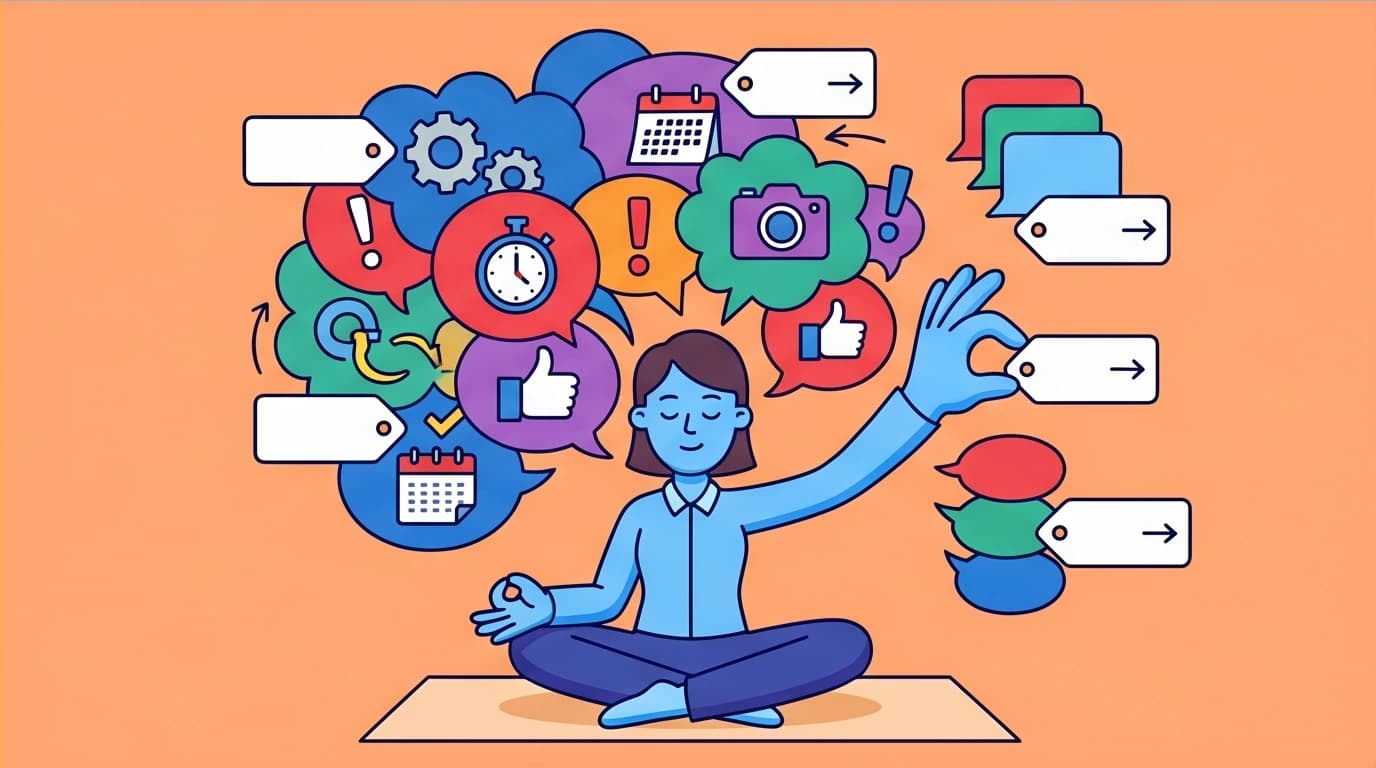
When you feel overwhelmed by a massive to-do list, your brain panics and refuses to focus on anything. The Noting Method helps you untangle this mental knot.
Sit quietly and observe the thoughts racing through your head. Instead of getting dragged into them, categorize them. If you worry about a deadline, silently note "planning." If you hear a truck outside, note "hearing." If your back hurts, note "feeling." By labeling these inputs, you create psychological distance. You strip them of their urgency, allowing your brain to calm down and select one single task to execute.
This technique is incredibly powerful for untangling thoughts, and its benefits extend beyond just brain fog. Many people find that a similar approach helps them manage feelings of stress and overwhelm.
3. Micro-Dosing Focus (The 60-Second Anchor)
You will face high-stress moments—a difficult client call, an unexpected server outage, or a harsh critique. Before you react, take 60 seconds. Take ten deep, controlled breaths. Count them out. This brief pause drops your heart rate and forces your brain out of its reactive fight-or-flight mode, bringing your executive function back online so you can make logical, focused decisions.
Implementing Mindfulness at Work
Integrating mindfulness at work requires strategy. If you try to meditate for 45 minutes on your first day, you will fail, get frustrated, and quit. Build the habit by tying it to existing workplace triggers.
Transition Protocols
Use the gaps between your daily activities. When a Zoom meeting ends, do not immediately open a new tab to check email. Take two minutes to practice breath awareness. Clear the mental residue from the last meeting before you shift into the next task.
Use the gaps between your daily activities. When a Zoom meeting ends, do not immediately open a new tab to check email. Take two minutes to practice breath awareness. Clear the mental residue from the last meeting before you shift into the next task.
Manage Your Environment
Mindfulness cannot out-compete extreme environmental chaos. If your phone is buzzing every three seconds, your brain will struggle to maintain the focus you are trying to build. Treat your focus as your most valuable asset. Turn off all non-essential notifications. Put your phone in another room or out of arm's reach. Schedule specific times to check emails. Combine physical environment management with your internal mental training to maximize results.
Mindfulness cannot out-compete extreme environmental chaos. If your phone is buzzing every three seconds, your brain will struggle to maintain the focus you are trying to build. Treat your focus as your most valuable asset. Turn off all non-essential notifications. Put your phone in another room or out of arm's reach. Schedule specific times to check emails. Combine physical environment management with your internal mental training to maximize results.
Even with a solid mindfulness habit, trying to focus in an environment built for constant interruption is an uphill battle. To truly take control of your workspace, you need to understand the psychology behind why we reach for our devices in the first place. If you are ready to completely overhaul your relationship with technology, silence the constant pings, and build an environment that fosters uninterrupted concentration, this resource offers a brilliant framework to bulletproof your attention span.
Indistractable
Nir Eyal
23 Duration10 Key Points4.5 RateReframing Productivity
We often measure productivity by hours spent at a desk. Real productivity is measured by high-quality output. Spending four hours in a state of distracted half-focus yields worse results than two hours of intense, uninterrupted deep work. By dedicating just 10 minutes a day to sharpening your attention through mindfulness, you buy back hours of wasted time. You will read a document once and actually retain the information. You will write an entire strategy brief without breaking your flow state.
We often measure productivity by hours spent at a desk. Real productivity is measured by high-quality output. Spending four hours in a state of distracted half-focus yields worse results than two hours of intense, uninterrupted deep work. By dedicating just 10 minutes a day to sharpening your attention through mindfulness, you buy back hours of wasted time. You will read a document once and actually retain the information. You will write an entire strategy brief without breaking your flow state.
Stop viewing meditation as a relaxation tool. View it as a sharpening stone for your intellect. The modern economy rewards those who can sustain focus on complex problems while everyone else is addicted to cheap dopamine and rapid-fire distractions. Claim that competitive advantage.
Sharpening your intellect and dedicating yourself to distraction-free concentration is the ultimate competitive advantage in today’s noisy corporate environment. If you want to take the concept of cognitive endurance to the absolute highest level, you must learn how to systematically eliminate shallow tasks and protect your most valuable mental energy. For anyone serious about producing elite-level output and transforming their career trajectory through intense concentration, this foundational book is required reading.
Deep Work
Cal Newport
47 Duration8 Key Points4.6 RateBuilding this competitive advantage requires consistent learning, but a packed schedule can make it difficult to get through your reading list. To absorb the key ideas from these and other career-changing books without adding more hours to your day, you can use a microlearning tool.
Grasp the core insights from books on productivity and leadership in minutes, turning your commute or workout into a consistent learning habit for that competitive edge.
Download LeapAhead App now
FAQ
How long does it take to see actual improvements in my focus?
Neuroscience studies indicate that practicing mindfulness for just 10 to 12 minutes a day can produce measurable changes in attention and executive function within four to eight weeks. However, you will likely notice a decrease in the immediate urge to check your phone or switch tasks within the first few days of consistent practice.
Neuroscience studies indicate that practicing mindfulness for just 10 to 12 minutes a day can produce measurable changes in attention and executive function within four to eight weeks. However, you will likely notice a decrease in the immediate urge to check your phone or switch tasks within the first few days of consistent practice.
What if my mind constantly wanders and I cannot sit still?
A wandering mind means you have a normal human brain. The goal is not to clear your mind completely; that is biologically impossible. The goal is to notice when your mind wanders. Every time you catch yourself drifting and force your attention back to your breath, you perform one successful rep. Frequent wandering just means you are getting more reps in.
A wandering mind means you have a normal human brain. The goal is not to clear your mind completely; that is biologically impossible. The goal is to notice when your mind wanders. Every time you catch yourself drifting and force your attention back to your breath, you perform one successful rep. Frequent wandering just means you are getting more reps in.
Can I do this at my desk or do I need a quiet space?
You can and should do this at your desk. The purpose of this specific training is to improve your focus in the exact environment where you do your work. Sit in your office chair, plant your feet flat on the floor, keep your back straight, and set a timer. You do not need a specialized environment to train your attention.
You can and should do this at your desk. The purpose of this specific training is to improve your focus in the exact environment where you do your work. Sit in your office chair, plant your feet flat on the floor, keep your back straight, and set a timer. You do not need a specialized environment to train your attention.
Should I use guided meditation apps?
Guided apps can be useful training wheels if you have never tried mindfulness before. But for deep work preparation, silence is often better. You want to train your brain to generate its own focus without relying on an external voice. Try starting with an app for a week, then transition to using a simple, silent timer.
Guided apps can be useful training wheels if you have never tried mindfulness before. But for deep work preparation, silence is often better. You want to train your brain to generate its own focus without relying on an external voice. Try starting with an app for a week, then transition to using a simple, silent timer.