

You binge-watch a new series on Netflix, scroll social media for three hours straight, or eat an entire pint of ice cream. While you are engaged in the act, you feel stimulated and invincible. The second the screen goes dark or the carton is empty, a crushing wave of restlessness hits you. You feel hollow, irritable, and paradoxically worse than before you started.
This is not a character flaw. It is not a lack of discipline. It is pure neurobiology reacting to an unnatural spike in neurochemicals. You triggered a massive release of neurotransmitters, and your brain is now violently correcting the system.
How Dopamine Works in the Brain
Before you can fix the crash, you have to understand the molecule causing it. Most people think dopamine is the "pleasure chemical." It is not. Dopamine is the molecule of motivation, craving, and pursuit. It is what makes you want things.
If you look closely at how dopamine works in the brain, you see that it operates across several neural pathways, most notably the mesolimbic pathway. When you anticipate a reward—whether that is an Amazon package arriving, a text message from a crush, or a sugary donut—dopamine spikes. This spike focuses your attention and drives you to act.
But evolution did not design your dopamine system for an environment of endless abundance. It was designed to motivate you to walk ten miles across a savanna to find water. Today, you can trigger that same massive dopamine release without moving a muscle. This profound mismatch between our ancient brains and our modern, highly stimulating environment breaks the natural regulatory system.
The Anna Lembke Seesaw
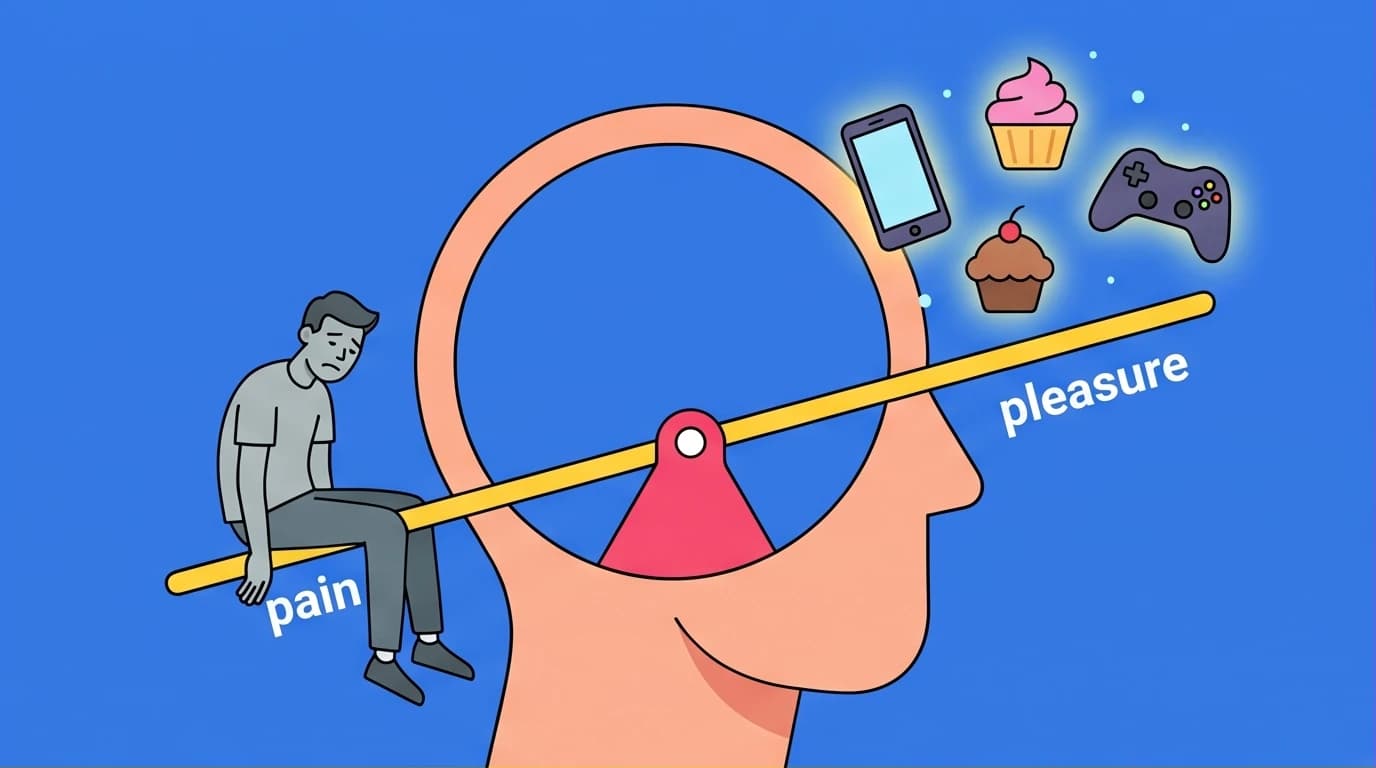
To grasp why the crash happens, you need a mental model of the brain's regulatory system. In her extensive clinical work, Stanford psychiatrist Dr. Anna Lembke illustrates this perfectly. If you dive into the Dopamine Nation pain and pleasure paradigm, you discover one foundational rule: pleasure and pain are processed in overlapping brain regions.
Imagine a seesaw inside your brain. It represents the pleasure pain balance dopamine regulates.
When nothing is happening, the seesaw is level. This is homeostasis.
When you experience something rewarding—eating chocolate, getting a cascade of likes on a post, or winning a video game—dopamine is released. The seesaw tips to the side of pleasure.
When nothing is happening, the seesaw is level. This is homeostasis.
When you experience something rewarding—eating chocolate, getting a cascade of likes on a post, or winning a video game—dopamine is released. The seesaw tips to the side of pleasure.
But your brain hates being out of balance. It views any extreme departure from baseline as a threat to survival. The moment the seesaw tips toward pleasure, your brain employs a self-regulating mechanism called neuroadaptation to bring it back to level.

Think of this mechanism as a group of invisible gremlins jumping on the pain side of the seesaw to counterbalance the weight on the pleasure side.
Here is the catch: the gremlins do not jump off the moment the pleasure stops. They stay on the pain side just a little bit longer. Once the initial stimulus fades, the pleasure side empties out, but the heavy gremlins remain. The seesaw slams down onto the side of pain.
This is the psychological crash. This is the exact reason why you feel an intense wave of anxiety, emptiness, or a profound lack of motivation right after a heavy dopamine binge. You are literally experiencing a biological pain response.
For a deeper dive into the book that pioneered this framework, you can explore its core ideas and most important concepts.
Since this article directly explores the framework pioneered by Dr. Anna Lembke, you might be looking to dive even deeper into the mechanics of your brain's reward system. Her groundbreaking work explains exactly why our modern environment of endless abundance is making us so unhappy. If you want to understand the full scope of the pleasure-pain balance and read fascinating clinical case studies on how people have successfully rewired their brains, this book is an absolute essential for your reading list.
Dopamine Nation
Anna Lembke, M.D.
 20 Duration
 8 Key Points
 4.6 Rate
If your dopamine-depleted focus makes tackling a full book feel daunting right now, there are ways to absorb these crucial concepts more efficiently.

Get the core insights from books like Dopamine Nation in just 15 minutes, making it easier to learn these powerful ideas without the heavy time commitment.

Download LeapAhead App now
The Spiral of Dopamine Tolerance
If you stop the behavior and wait, the gremlins eventually hop off. The seesaw levels out. You feel normal again.
But that is rarely what people do.
When that feeling of emptiness hits, the immediate instinct is to fix it. How do you fix it? By reaching for another slice of pizza, opening another tab, or loading up another game. You throw more weight onto the pleasure side to force the seesaw back up.
Your brain responds by recruiting more gremlins. They get bigger, faster, and stronger. Over time, your brain fundamentally alters its dopamine receptors. It down-regulates them.

This creates dopamine tolerance.
Because your brain has stripped away dopamine receptors to defend itself against the constant flood of stimulation, your baseline drops. Now, you need a massive amount of stimulation just to feel "normal," let alone experience a high. The things that used to bring you joy—reading a book, walking outside, having a normal conversation—no longer register. They do not release enough dopamine to move the heavy gremlins weighing down the pain side of your seesaw.
You find yourself in a state of chronic dopamine deficit. You are not pursuing the behavior to feel good anymore. You are doing it just to temporarily stop feeling bad.
The constant stimulation from our devices is one of the biggest contributors to this tolerance spiral. Understanding how they're designed to manipulate our reward system is a critical first step.
Breaking the cycle of dopamine tolerance often means taking a hard look at the devices designed to hijack our attention. If you are struggling to step away from the endless feeds and notifications that constantly fry your reward receptors, adopting a more intentional relationship with your smartphone is the logical next step. For a practical, philosophy-driven approach to cutting out digital noise and reclaiming your focus, this insightful guide will show you how to thrive with far less screen time.
Digital Minimalism
Cal Newport
20 Duration8 Key Points4.7 RateReverse Engineering the Seesaw: The Biohacker’s Approach
You cannot permanently trick the Anna Lembke seesaw. It will always seek balance. But you can use its mechanics to your advantage. If putting weight on the pleasure side brings inevitable pain, what happens when you intentionally put weight on the pain side?

When you subject yourself to controlled, intentional discomfort, your brain initiates the exact same balancing sequence—but in reverse.
When you sit in a 40-degree Fahrenheit cold plunge for three minutes, lift heavy weights, or practice intermittent fasting, you are forcefully pressing down on the pain side of the seesaw. Your brain recognizes the distress. To restore homeostasis, it starts manufacturing gremlins for the pleasure side.
When the painful stimulus ends—when you step out of the cold water or finish the grueling workout—the pain weight is removed. But the pleasure gremlins stay behind.
Your dopamine baseline rises. It stays elevated for hours. You experience clear focus, calm energy, and a sustained mood boost without any of the destructive crashes associated with cheap dopamine hits. You have essentially flipped the pleasure pain balance dopamine equation in your favor.
Are you ready to try out the biohacker's approach and use intentional discomfort to reset your baseline? Engaging in cold exposure is one of the most effective, scientifically backed ways to push down on the pain side of the seesaw and experience that sustained, natural dopamine release. If you want to safely start a cold plunge and breathwork routine to elevate your mood and energy levels, this comprehensive guide by the master of cold therapy is the perfect place to begin.

The Wim Hof Method
Wim Hof
20 Duration8 Key Points4.6 RateStrategies to Reset Your Baseline
If your receptors are fried from modern overindulgence, you need a systemic reset. This is not about permanent asceticism. It is about restoring your brain's capacity to process standard rewards.
1. The 30-Day Dopamine Fast
For any high-reward behavior causing disruption in your life—whether it is alcohol, sugar, or scrolling—a 30-day abstinence period is the clinical gold standard.
For any high-reward behavior causing disruption in your life—whether it is alcohol, sugar, or scrolling—a 30-day abstinence period is the clinical gold standard.
- Days 1 to 14: The pain gremlins are dominating. You will experience severe cravings, irritability, and anxiety. Your brain is throwing a tantrum, demanding the cheap dopamine it is used to.
- Days 15 to 21: The neuroadaptation begins to reverse. The brain realizes the massive spikes are not coming back. It slowly starts up-regulating your dopamine receptors.
- Days 22 to 30: The seesaw levels out. You regain the ability to find joy in low-dopamine, high-effort tasks.
Committing to this process requires a clear plan. If you're ready to take the leap, it's helpful to know exactly what to do and what to avoid.
2. Practice Radical Honesty
Stop lying to yourself about your consumption. Track your screen time. Look at your bank statements. Awareness breaks the autopilot loop of dopamine-seeking behavior. You cannot fix a neurological imbalance if you refuse to look at the data.
Stop lying to yourself about your consumption. Track your screen time. Look at your bank statements. Awareness breaks the autopilot loop of dopamine-seeking behavior. You cannot fix a neurological imbalance if you refuse to look at the data.
3. Categorize Your Dopamine Sources
Separate your activities into "Effortless Dopamine" and "Effort-Driven Dopamine."
Effortless dopamine includes TikTok, junk food, and online shopping. These crash your baseline.
Effort-driven dopamine includes intense exercise, learning a complex skill, or building a project. These elevate your baseline. Shift your daily allocation heavily toward the effort-driven side.
Separate your activities into "Effortless Dopamine" and "Effort-Driven Dopamine."
Effortless dopamine includes TikTok, junk food, and online shopping. These crash your baseline.
Effort-driven dopamine includes intense exercise, learning a complex skill, or building a project. These elevate your baseline. Shift your daily allocation heavily toward the effort-driven side.
Once you successfully complete your dopamine fast, the real work begins: building a life that prioritizes effort-driven dopamine over cheap thrills. To stay off the seesaw's extremes, you will need to construct healthy, sustainable routines that reward you for doing hard things. If you are looking for a foolproof, step-by-step system to help you seamlessly integrate these new positive behaviors while breaking the old loops of overindulgence, this phenomenal bestseller will be your ultimate roadmap.

Atomic Habits
James Clear
26 Duration8 Key Points4.7 RateBuilding these effort-driven habits is key, but it can feel impossible when you're exhausted after a long day. If you find yourself too tired to read but still want to learn, an audio-based approach can be a game-changer.
Listen to key ideas from bestselling books on your commute or during a workout, turning low-energy moments into productive, effort-driven learning time.
Download LeapAhead App now
FAQ
Why do I feel anxious instead of happy when I check my phone?
You have built severe dopamine tolerance. The initial novelty of social media or notifications used to provide a positive dopamine spike. Now, your brain expects the stimulus, so the reward value is zero. However, your brain still triggers the pain side of the seesaw to anticipate the spike, leaving you with nothing but the biological anxiety and restlessness of the "pain gremlins."
You have built severe dopamine tolerance. The initial novelty of social media or notifications used to provide a positive dopamine spike. Now, your brain expects the stimulus, so the reward value is zero. However, your brain still triggers the pain side of the seesaw to anticipate the spike, leaving you with nothing but the biological anxiety and restlessness of the "pain gremlins."
How long does it take for dopamine receptors to physically reset?
Clinical data suggests it takes about 30 days of complete abstinence from a high-dopamine stimulus to reset the brain's reward pathways and up-regulate down-regulated receptors. Minor resets (like a weekend off social media) help reduce acute brain fog but are not long enough to cause structural changes in neuroadaptation.
Clinical data suggests it takes about 30 days of complete abstinence from a high-dopamine stimulus to reset the brain's reward pathways and up-regulate down-regulated receptors. Minor resets (like a weekend off social media) help reduce acute brain fog but are not long enough to cause structural changes in neuroadaptation.
Is all dopamine bad? Should I try to keep my levels as low as possible?
Absolutely not. Without dopamine, you would literally lose the will to move, eat, or survive. The goal is never to eliminate dopamine. The goal is to rely on natural, effort-driven dopamine sources rather than synthetic, high-velocity spikes. You want a steady, robust baseline, not a volatile chart of aggressive peaks and deep valleys.
Absolutely not. Without dopamine, you would literally lose the will to move, eat, or survive. The goal is never to eliminate dopamine. The goal is to rely on natural, effort-driven dopamine sources rather than synthetic, high-velocity spikes. You want a steady, robust baseline, not a volatile chart of aggressive peaks and deep valleys.
Does medication for ADHD affect this seesaw?
Yes. Stimulant medications work by increasing dopamine availability in the brain. However, at therapeutic doses prescribed by a doctor, they aim to raise a chronically low baseline to a normal level, rather than creating the massive euphoric spikes associated with recreational abuse. Still, managing the pleasure-pain balance through behavioral tools remains critical even when properly medicated.
Yes. Stimulant medications work by increasing dopamine availability in the brain. However, at therapeutic doses prescribed by a doctor, they aim to raise a chronically low baseline to a normal level, rather than creating the massive euphoric spikes associated with recreational abuse. Still, managing the pleasure-pain balance through behavioral tools remains critical even when properly medicated.