

You have seen Sapiens sitting on shelves at Barnes & Noble and heard it praised by top CEOs, but finding the time to read a dense 400-page history book is tough. You need a fast, clear breakdown of Yuval Noah Harari's massive timeline without getting bogged down in academic tangents.
This comprehensive Sapiens book summary delivers exactly that. We will break down the timeline, unpack the core arguments, and give you the exact insights you need to understand how a marginal African ape became the ruler of planet Earth.
For those who want to apply this fast-track approach to other essential non-fiction, there's a way to absorb the core ideas from bestsellers without carving out weeks for reading.


Get the key insights from dense, important books like Sapiens in just 15-minute reads or listens, perfect for when you're short on time but eager to learn.
 LeapAhead
Yuval Noah Harari Sapiens Summary: The Three Major Revolutions
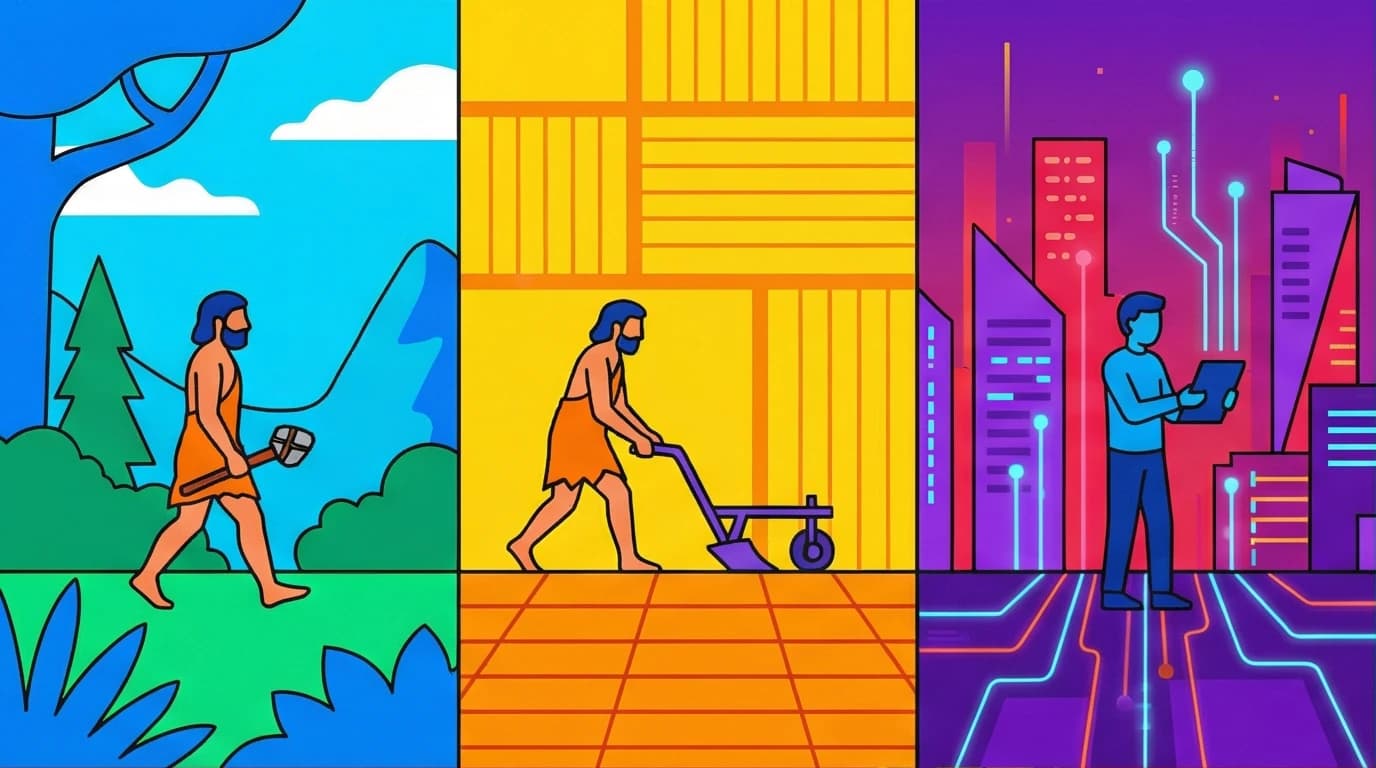
Harari structures human history around three primary revolutions. Understanding these three shifts is the key to grasping the entire premise of the book.
The Cognitive Revolution (c. 70,000 BCE)
Before the Cognitive Revolution, Homo sapiens were unremarkable animals. We sat somewhere in the middle of the food chain, foraging for plants and occasionally scavenging meat, constantly in fear of larger predators.
Around 70,000 years ago, a genetic mutation changed the wiring of the Sapiens brain. This sparked the Cognitive Revolution, granting us a completely new type of language. Unlike other animals that use language simply to warn of danger ("Watch out, a lion!"), Sapiens began using language to gossip and, most importantly, to talk about things that do not physically exist.

This ability to create fictions (myths, gods, laws) allowed humans to cooperate in massive numbers. In the wild, a tribe can only hold together if everyone knows each other—usually capping out at around 150 people (the Dunbar number). But if thousands of strangers all believe in the same imagined reality—like a shared god or a shared tribal identity—they can work together. This cooperative edge allowed Sapiens to outcompete and outlive other human species, like the Neanderthals.
This concept of fictions, or imagined realities, is perhaps the most critical idea in the entire book, underpinning everything from religion to corporate law.
The Agricultural Revolution (c. 10,000 BCE)
For roughly 2.5 million years, humans fed themselves by gathering plants and hunting animals. Around 10,000 years ago, Sapiens began manipulating the lives of a few plant and animal species, marking the start of the Agricultural Revolution.
Harari presents a highly controversial argument here: The Agricultural Revolution was history's biggest fraud.
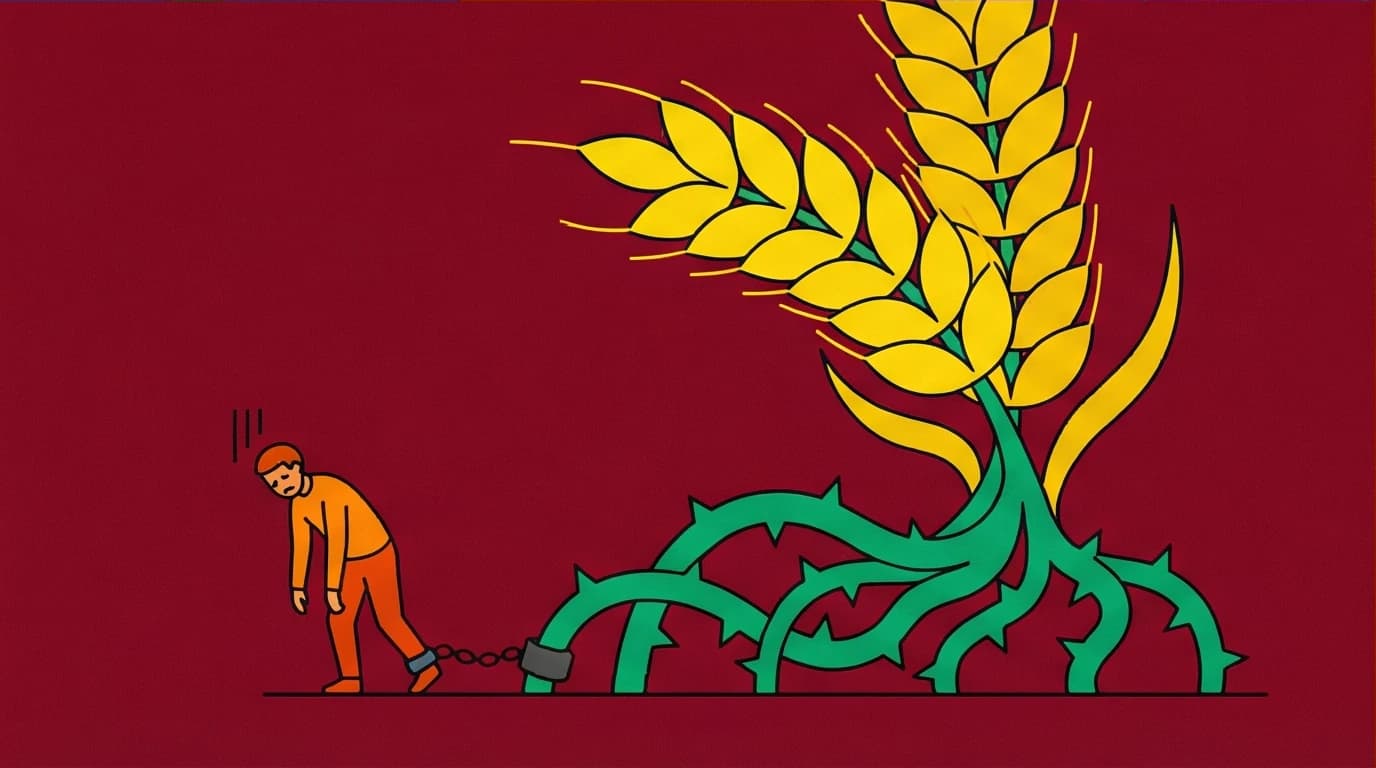
Instead of humans domesticating wheat, Harari argues that wheat domesticated humans. Farming required humans to settle down next to their crops, laboring under the hot sun from dawn to dusk. While farming produced more food per square mile, allowing the total human population to explode, it drastically reduced the quality of life for the average individual. Diets became less nutritious, diseases spread rapidly in crowded settlements, and the concept of "ownership" led to violent territorial wars and rigid social hierarchies.
Harari's provocative take on the Agricultural Revolution is just one of many points that have sparked debate among historians and anthropologists since the book's publication.
If Harari's perspective on the Agricultural Revolution—the idea that farming was history's biggest fraud—captured your interest, you might want to explore the environmental factors that made this shift possible. Jared Diamond’s Pulitzer Prize-winning classic takes a deep dive into why certain societies developed agriculture, technology, and empires while others did not. It is an essential companion read that expands on how geography, rather than genetics, shaped the modern world.

Guns, Germs, and Steel
Jared Diamond, Ph.D.
 16 Duration
 7 Key Points
 4.8 Rate
The Scientific Revolution (c. 1500 CE)
The last major turning point began roughly 500 years ago. Before this era, human cultures believed that the golden age was in the past and that the gods or ancient texts held all the answers.
The Scientific Revolution began with a radical shift in human thought: the discovery of ignorance. Humans finally admitted, "We do not know everything." This admission sparked an unprecedented drive to observe, experiment, and conquer the unknown.
Science quickly partnered with Imperialism and Capitalism. European empires funded scientific expeditions to map the world, discover new resources, and build stronger weapons. Meanwhile, the invention of credit allowed the economy to grow infinitely, operating on the trust that the future will always be wealthier than the present. Today, this revolution continues to accelerate, bringing us to the brink of intelligent design (AI and genetic engineering), which may eventually replace natural selection entirely.
Sapiens Chapter Summary: A Part-by-Part Breakdown
If you are looking for a rapid Sapiens chapter summary to understand how Harari structures his arguments across the book, here is the roadmap.
Part 1: The Cognitive Revolution
This section explains how Sapiens evolved in East Africa and migrated across the globe. It details the transition from insignificance to world domination. Harari explains that our unique language skills allowed us to invent imagined realities—the foundational glue for large-scale human cooperation. He also highlights our destructive nature; wherever early Sapiens migrated, mass extinctions of large flora and fauna followed.
Part 2: The Agricultural Revolution
Harari dismantles the romantic view of the transition from foraging to farming. He introduces the "luxury trap"—how making life supposedly easier (farming) actually resulted in a harder, more restricted existence. This section also explores the origins of writing and numbers, which were invented purely to keep tax and property records for newly established agricultural empires, eventually leading to unjust social hierarchies like the caste system or racial segregation.
Part 3: The Unification of Humankind
How did scattered, isolated villages merge into a globalized world? Harari identifies three universal orders that forced humanity to unite:
- The Economic Order (Money): The ultimate system of mutual trust.
- The Political Order (Empires): The violent but effective engine of cultural assimilation.
- The Religious Order (Universal Religions): Belief systems that transcended local territories to unite vast demographics.
Part 4: The Scientific Revolution
The final section covers the last 500 years. Harari explains the feedback loop of science, empire, and capital. He explores the Industrial Revolution, the rise of the state and market (replacing the family and community), and asks the ultimate question: Has all this progress actually made us happier? He concludes by looking at the future, suggesting that Sapiens might soon engineer themselves out of existence by creating superior, non-biological entities.
Sapiens Key Takeaways for Modern Thinkers
To truly absorb the value of this book, you must look past the timeline and understand the philosophical arguments. Here are the most profound Sapiens key takeaways.
1. Imagined Realities Run the World
Everything that structures modern human life is an imagined reality. Take a massive US corporation like Amazon. Amazon is not the buildings, the delivery trucks, or the employees. If all of Amazon's warehouses burned down and its employees quit, the legal entity of "Amazon" would still exist. It is a legal fiction. Laws, human rights, nations, and borders do not exist in the physical world; they exist only in our collective imagination. Because we all believe in them, they exert real power.
2. Money Is the Ultimate Trust System
You might think of religion or empire as the great unifiers of humanity, but Harari argues that money takes the crown. Money is the only trust system that can bridge any cultural gap. Two people who do not speak the same language, worship different gods, and live thousands of miles apart can seamlessly cooperate through the medium of the US dollar or gold. Money is not a material reality; it is a psychological construct based entirely on mutual trust.
Once you realize that money is essentially a massive, shared fiction, your entire perspective on economics begins to shift. If you are intrigued by the psychological side of wealth and how our beliefs shape our financial behavior, Morgan Housel’s brilliant work is a must-read. Instead of focusing on the math behind investing, it explores the emotional and cognitive blind spots we have around money—proving that building wealth is really just a matter of managing your psychology.

The Psychology of Money
Morgan Housel
48 Duration7 Key Points4.6 Rate3. The "Luxury Trap" Is Real
Harari uses the Agricultural Revolution to illustrate a terrifying pattern in human behavior: luxuries quickly become necessities, and then they become burdens. Early farmers started planting wheat to create a small surplus for hard times. Soon, populations exploded, and they had to work twice as hard just to survive.
We see this today. The invention of email was supposed to save time, allowing people to communicate instantly and go home early. Instead, it accelerated the pace of work, creating an expectation that employees are available 24/7.

4. Progress Does Not Equal Happiness
Harari forces readers to ask: Are we happier than our hunter-gatherer ancestors? Despite our massive technological advancements, modern humans suffer from severe alienation, anxiety, and stress. Our bodies and minds evolved to forage in small, tight-knit tribes over a few square miles. Today, we sit in isolated cubicles or apartments, staring at screens. Technological capability does not automatically translate to individual well-being.
The realization that our hunter-gatherer brains are entirely mismatched with modern, screen-dominated cubicle culture is profound. If you have ever felt a sense of burnout or anxiety despite having all the comforts of modern life, Johann Hari offers a brilliant investigation into why. He takes Harari's observation about our lost tribal connections a step further, unpacking how rebuilding meaningful social bonds can be the ultimate antidote to today's epidemic of alienation.

Lost Connections
Johann Hari
53 Duration11 Key Points4.7 RateWith so many life-changing books to get through, it can feel overwhelming. If you want to absorb the key ideas from all these recommendations without dedicating months to reading, an app can bridge that gap.
Quickly grasp the core arguments from books like Sapiens and the others recommended here, helping you build a powerful reading habit even on the busiest days.
LeapAheadAfter grasping Harari's revolutionary ideas, many readers are eager to find other books that challenge their perspectives on human history and our future.
Sapiens Cliff Notes: Fast Facts to Remember
If you are jumping into a discussion and need the absolute fastest Sapiens cliff notes, memorize these bullet points:
- Our Species: Homo sapiens means "Wise Man." We are not the only humans to have existed; we shared the earth with Neanderthals, Homo erectus, and others. We just outlived (and likely wiped out) the rest.
- The Power of Gossip: The development of complex language allowed humans to gossip. Knowing who to trust in a tribe was the first step to social cooperation.
- The Dunbar Number: Humans can only maintain stable, personal relationships with about 150 people. Any organization larger than 150 people requires "imagined realities" (rules, myths, corporate culture) to function.
- The Gilgamesh Project: Harari points out that modern science has one overarching goal: overcoming death. Every medical advancement is a step toward immortality, shifting humans from natural selection to intelligent design.
- Capitalism as a Religion: Capitalism is not just an economic theory; Harari frames it as the most successful religion in history, based on the fundamental belief that economic growth is the supreme good.
A summary can give you the core framework, but nothing compares to experiencing the full depth of Yuval Noah Harari's original masterpiece. If you found these cliff notes fascinating, diving into the complete, unabridged text will fundamentally change how you view humanity's past, present, and future. Grab a copy to explore the vivid historical examples, thought-provoking theories, and incredible storytelling that made this book an international sensation.

Sapiens
Yuval Noah Harari
45 Duration8 Key Points4.5 RateFAQ
Is Sapiens a hard book to read?
No. Despite its massive scope and 400-page length, Sapiens is highly accessible. Harari intentionally uses conversational language, modern analogies (like comparing ancient myths to corporate branding), and a clear chronological structure to make complex historical and biological concepts easy for anyone to digest.
No. Despite its massive scope and 400-page length, Sapiens is highly accessible. Harari intentionally uses conversational language, modern analogies (like comparing ancient myths to corporate branding), and a clear chronological structure to make complex historical and biological concepts easy for anyone to digest.
What is the main point of Sapiens by Yuval Noah Harari?
The main point is that human dominance is not due to physical strength or individual intelligence, but our unique ability to cooperate flexibly in massive numbers. We achieve this cooperation by creating and believing in shared fictions—such as money, gods, laws, and nations.
The main point is that human dominance is not due to physical strength or individual intelligence, but our unique ability to cooperate flexibly in massive numbers. We achieve this cooperation by creating and believing in shared fictions—such as money, gods, laws, and nations.
Did humans domesticate wheat, or did wheat domesticate humans?
One of the most famous arguments in the book is that wheat domesticated humans. Before farming, humans had a varied diet, plenty of free time, and robust health. Wheat forced humans to settle, perform grueling physical labor, defend territory, and suffer through plagues—all to ensure the survival and multiplication of the wheat plant.
One of the most famous arguments in the book is that wheat domesticated humans. Before farming, humans had a varied diet, plenty of free time, and robust health. Wheat forced humans to settle, perform grueling physical labor, defend territory, and suffer through plagues—all to ensure the survival and multiplication of the wheat plant.
Does Harari talk about the future of humanity?
Yes. In the final chapters, Harari suggests that the Scientific Revolution is ending the era of Homo sapiens. Through bioengineering, cyborg engineering, and artificial intelligence, we are replacing the laws of natural selection with intelligent design, effectively turning ourselves into gods (a premise he expands upon in his follow-up book, Homo Deus).
Yes. In the final chapters, Harari suggests that the Scientific Revolution is ending the era of Homo sapiens. Through bioengineering, cyborg engineering, and artificial intelligence, we are replacing the laws of natural selection with intelligent design, effectively turning ourselves into gods (a premise he expands upon in his follow-up book, Homo Deus).