

You just finished listening to Sapiens on Audible, or maybe you finally closed your paperback copy. Your entire worldview is likely shifted. But when you try to explain to a friend how wheat domesticated humans, or why money is just a collective illusion, you stumble. You cannot quite capture Harari's brilliance from memory. You need his exact words to make your point hit hard.
Whether you are writing a script, preparing a presentation, or just reflecting on human existence, you need the right phrasing. Finding the best quotes from Sapiens means looking past the dense historical data and isolating the specific sentences that upend how we view our daily lives.
Here is a curated breakdown of the most impactful Sapiens quotes, organized by their core philosophical themes.
The Cognitive Revolution: The Power of Fiction
Harari’s most famous argument is that Homo sapiens conquered the world not because we are the smartest or strongest animals on an individual level, but because we are the only species capable of flexible, large-scale cooperation. And we do this through shared myths.
"Large numbers of strangers can cooperate successfully by believing in common myths."
The Insight: You cannot organize a million chimpanzees to build a skyscraper or fight a war. They only cooperate with intimate group members. Humans bypass this biological limit through imagination. If two strangers both believe in the United States Constitution, the value of the dollar, or human rights, they can work together.

"You could never convince a monkey to give you a banana by promising him limitless bananas after death in monkey heaven."
The Insight: This is perhaps the most famous and highly shared quote from the book. It perfectly illustrates the boundary between objective reality (the physical banana) and imagined reality (heaven). This quote is highly effective for public speakers or writers trying to inject humor into discussions about human belief systems.
"We study history not to know the future but to widen our horizons, to understand that our present situation is neither natural nor inevitable, and that we consequently have many more possibilities before us than we imagine."
The Insight: We often accept modern systems like the 40-hour workweek, national borders, or nuclear families as the "default" human condition. History proves they are just temporary structures. If you are creating content about lifestyle design, remote work, or challenging the status quo, this quote provides an instant intellectual anchor.
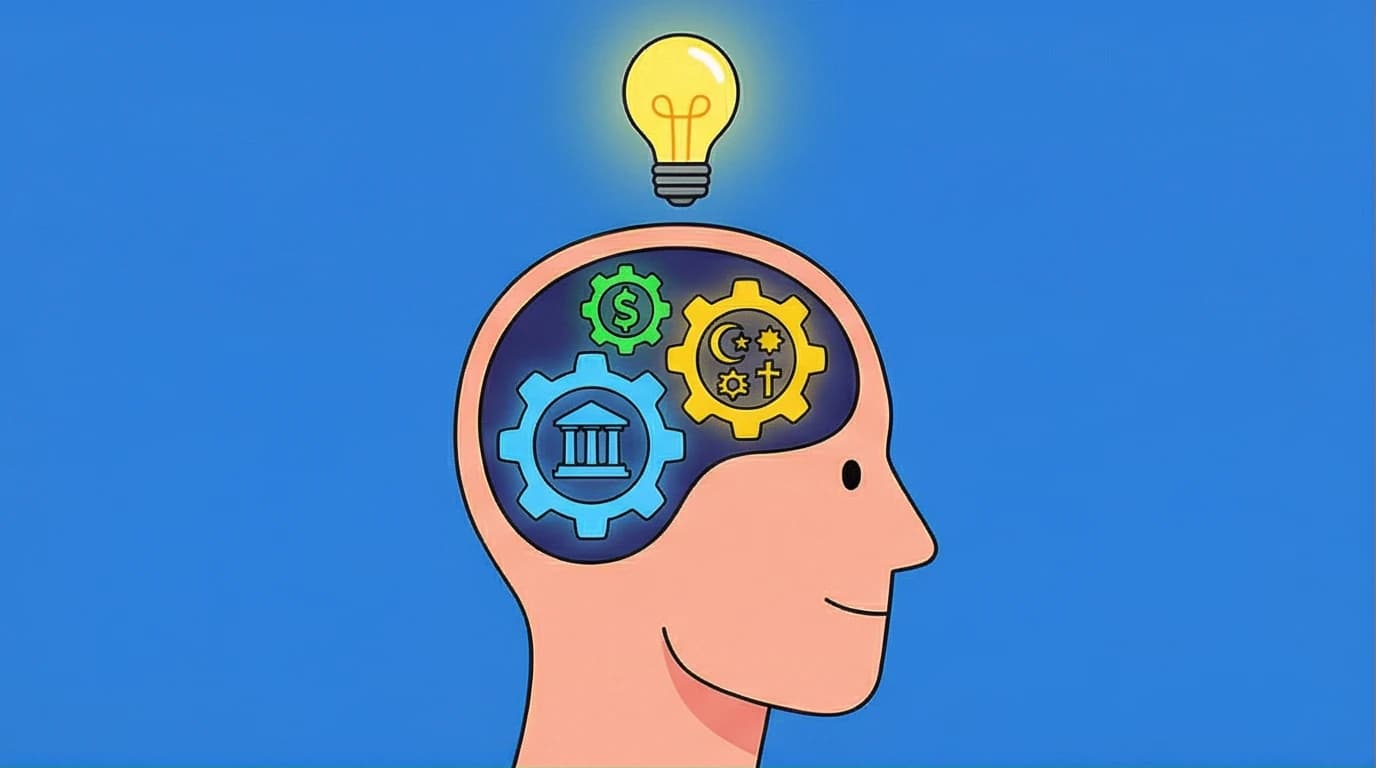
The concept of "imagined realities" is the central engine of the book, driving everything from the rise of empires to the creation of money. Understanding this idea is crucial to grasping Harari's entire argument.
If these quotes are making you realize you need the full context—or if you just want to experience the complete journey from our humble beginnings to modern global dominance—there is absolutely no substitute for the original text. Diving into the complete book allows you to fully grasp how our unique ability to believe in shared myths shaped every aspect of human history.

Sapiens
Yuval Noah Harari
 45 Duration
 8 Key Points
 4.5 Rate
But if the thought of tackling all 464 pages feels daunting, you can still absorb Harari's most critical arguments in a fraction of the time.

Get the key ideas from complex books like Sapiens in just 15-minute summaries, perfect for understanding big concepts on a busy schedule.

Download LeapAhead App now
Sapiens Quotes About Religion and Ideology
Harari approaches religion strictly as an evolutionary historian. He does not debate theology. Instead, he looks at religion as a brilliant survival tool that unites vast networks of humans. Sapiens quotes about religion can be polarizing, but they are undeniable thought-starters.
"Religion can thus be defined as a system of human norms and values that is founded on a belief in a superhuman order."
The Insight: Harari strips away the mysticism and defines religion strictly by its function in society. He later argues that under this exact definition, modern ideologies like Capitalism, Communism, and Liberalism function identically to traditional religions. They all offer a set of rules based on a "superhuman" or undeniable natural order.
"As far as we know, only Sapiens can talk about entire kinds of entities that they have never seen, touched or smelled."
The Insight: This is the bedrock of Harari’s view on faith and myth. It is a powerful reminder that our greatest strength as a species is our ability to visualize the invisible.
"How do you cause people to believe in an imagined order such as Christianity, democracy or capitalism? First, you never admit that the order is imagined."
The Insight: To maintain social stability, humans must believe that their current rules are dictated by God or the laws of nature. If everyone realizes the rules are made up, the system collapses. This quote is incredibly sharp for discussions about media, political propaganda, or institutional power.
The Agricultural Revolution: History's Biggest Fraud
Most textbooks frame the shift from foraging to farming as a massive leap forward for humanity. Harari calls it a trap.

"We did not domesticate wheat. It domesticated us."
The Insight: Think about the physical toll of farming. A hunter-gatherer worked a few hours a day and had a diverse diet. A farmer broke his back clearing rocks, carrying water, and defending a single patch of land, only to eat a nutrient-poor diet of grain. Wheat multiplied its DNA across the globe while making the individual human life significantly harder. You can easily adapt this quote to modern technology: We did not domesticate the smartphone. It domesticated us.
"One of history’s few iron laws is that luxuries tend to become necessities and to spawn new obligations."
The Insight: When early humans adopted farming, they thought they were making life easier. Instead, it led to population explosions and endless labor. Today, we buy smart appliances and subscribe to Amazon Prime to save time, yet we are busier and more stressed than ever. Use this quote when discussing consumerism, lifestyle creep, or burnout.
Harari's provocative claims, especially his reframing of the Agricultural Revolution, have sparked significant debate among historians and anthropologists. While his narrative is powerful, it's also important to understand where his arguments have faced criticism.
Harari isn't the only historian to challenge our assumptions about human progress and the shift to agriculture. If you are fascinated by how geography, crops, and disease shaped the modern world rather than human ingenuity alone, you will want to explore other foundational works in this space. This Pulitzer Prize-winning masterpiece perfectly complements the theories presented in Sapiens and will fundamentally change how you view global inequality.

Guns, Germs, and Steel
Jared Diamond, Ph.D.
16 Duration7 Key Points4.8 RateCapitalism, Money, and Society
When people search for Yuval Noah Harari quotes Sapiens is usually the book they have in mind because of how brutally he deconstructs modern economics. He views money not as coins or paper, but as a psychological construct.
"Money is the most universal and most efficient system of mutual trust ever devised."
The Insight: Money has no inherent value. A hundred-dollar bill cannot be eaten or used for warmth. It only works because everyone else believes in it. It crosses borders, languages, and cultures seamlessly. Osama bin Laden hated American culture, but he happily used American dollars.
"Capitalism began as a theory about how the economy functions... but it gradually became an ethic—a set of teachings about how people should behave, what they should educate their children to do, and even how they should think."
The Insight: We no longer view capitalism just as a way to trade goods. It defines our moral compass. Growth is viewed as inherently "good." If a company is not growing, it is failing. This quote is a staple for content dissecting startup culture, hustle culture, and corporate ethics.
The realization that money is entirely driven by collective belief and human behavior can completely shift how you handle your own finances. If you want to dive deeper into why we make the financial choices we do, you need a resource that strips away the complex math and focuses purely on mindset. This incredible read explores the strange ways people think about wealth, greed, and risk in the modern capitalist system.

The Psychology of Money
Morgan Housel
48 Duration7 Key Points4.6 RateSapiens Quotes on Happiness
What was the point of all this progress? Are we happier now than the hunter-gatherers who painted caves 30,000 years ago? When readers look for Sapiens quotes on happiness, they usually find a rather sobering, biological perspective.
"Happiness does not really depend on objective conditions of either wealth, health or even community. Rather, it depends on the correlation between objective conditions and subjective expectations."
The Insight: If you expect a horse-drawn cart and get a horse-drawn cart, you are thrilled. If you expect a brand-new luxury car and get a used sedan, you are miserable. Our modern misery is often tied to massive, media-driven expectations rather than our actual physical conditions.

"If happiness is determined by expectations, then two pillars of our society—mass media and the advertising industry—may unwittingly be depleting the globe’s reservoirs of contentment."
The Insight: Social media algorithms and endless advertising are built to make you feel inadequate. You cannot sell a product to someone who is perfectly content with what they have. This is an essential quote for anyone writing about mental health, digital minimalism, or self-improvement.
"We are more powerful than ever before, but have very little idea what to do with all that power... Is there anything more dangerous than dissatisfied and irresponsible gods who don’t know what they want?"
The Insight: This serves as the haunting conclusion to the book. We have the technology to edit genes, split atoms, and artificially generate intelligence, but our emotional maturity remains primitive.
Harari’s biological and expectation-driven view of human satisfaction is deeply thought-provoking, but it only scratches the surface of why we are so bad at predicting what will actually make us happy. If you are intrigued by the gap between our expectations and reality, you will love exploring the cognitive science behind our emotional blind spots. This insightful read will help you understand exactly why your brain keeps tricking you into chasing the wrong goals.

Stumbling on Happiness
Daniel Todd Gilbert
23 Duration10 Key Points4.6 RateInspired to dive into all these books but not sure where you'll find the time? You can start absorbing the core lessons from these and thousands of other titles today, even during a commute or coffee break.
Turn your new reading list into knowledge by listening to 15-minute takeaways from bestsellers like Sapiens and The Psychology of Money.
Download LeapAhead App now
If Harari's grand narrative has you eager to explore other transformational books on human history and behavior, you're not alone. Many readers finish Sapiens hungry for more.
FAQ
What is the central message of the book Sapiens?
The central message of Sapiens is that Homo sapiens came to dominate the world not through physical superiority, but through the unique cognitive ability to believe in shared fictions. Things like religion, money, laws, and nations do not exist in the physical world; they exist purely in our collective imagination. This ability allows millions of strangers to cooperate effectively.
What does Harari say about human happiness in Sapiens?
Harari argues that human happiness has not necessarily increased alongside technological and agricultural progress. He posits that happiness is largely determined by the gap between our expectations and our reality, and is ultimately regulated by our biochemistry. Despite our modern comforts, sky-high expectations fueled by media and advertising often leave modern humans feeling deeply dissatisfied.
Are these the only notable Yuval Noah Harari quotes?
While Sapiens provides the foundational concepts of Harari's philosophy, he has written two other major follow-up books: Homo Deus: A Brief History of Tomorrow and 21 Lessons for the 21st Century. If you are looking for quotes specifically about the future of artificial intelligence, data religion, and biotechnology, Homo Deus is the best resource.