

You are staring at a flat growth chart or a disengaged team. You try dropping prices, running new promotions, or offering team bonuses. These tactics work for a week, maybe a month. Then the numbers slip right back down. You know Simon Sinek’s famous TED Talk has the answers, but you don't have the time to drive to Barnes & Noble and spend your weekend reading a 250-page hardcover. You need a fast, actionable breakdown of his philosophy to apply to your business right now.
This is a common frustration for busy leaders. If you constantly find yourself wanting to absorb key ideas from influential books but can't find the hours to read them, an app that summarizes these concepts can be a game-changer.


Get the core ideas from bestselling business books like Start with Why in just 15 minutes, making it easy to absorb powerful concepts on a tight schedule.
 LeapAhead
Here is the exact blueprint. Sinek’s entire premise rests on a single, powerful shift in perspective. Most organizations operate from the outside in. The great ones operate from the inside out.
The Core Framework: Simon Sinek Golden Circle
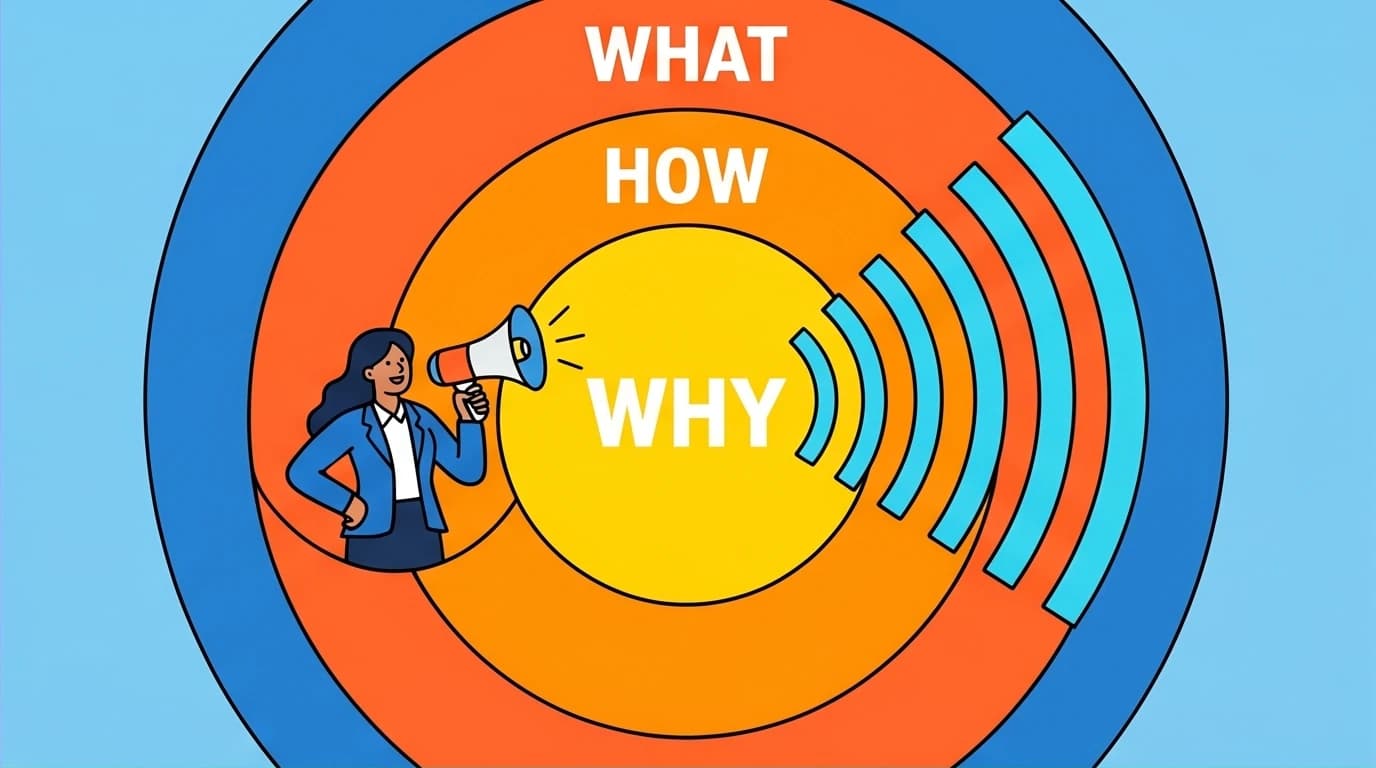
The foundation of Sinek’s theory is a simple target with three rings. This is the Simon Sinek Golden Circle.
1. WHAT (The Outer Ring)
Every single company and person on the planet knows WHAT they do. These are the products you sell or the services you offer. For an automaker, it's building cars. For a software firm, it's writing code. It is easy to define and easy to measure.
2. HOW (The Middle Ring)
Some companies know HOW they do what they do. These are your differentiating value propositions, your proprietary processes, or your unique selling points. You might use recycled materials, or you might have a patented algorithm. HOWs are used to explain why something is better or different.
3. WHY (The Center Ring)
Very few people or companies can clearly articulate WHY they do what they do. This is not about making money—making money is a result. Your WHY is your purpose, cause, or belief. It is the very reason your organization exists, and the reason anyone should care.
When communicating, normal companies start with the WHAT, move to the HOW, and ignore the WHY completely. They say: "We make great computers. They are beautifully designed and easy to use. Want to buy one?"
It is completely uninspiring.
Leaders who understand Sinek's framework flip the script. They communicate from the inside out. They start with the WHY.
Think about Apple. Apple's message sounds like this: "Everything we do, we believe in challenging the status quo and thinking differently. We do this by making our products beautifully designed and easy to use. We just happen to make great computers. Want to buy one?"
The difference is night and day. People don't buy what you do; they buy why you do it.
The Apple example is just the beginning. Seeing how other visionary companies structure their messaging can make this concept click.
The Biology Behind the Golden Circle
This is not clever marketing terminology. It is hardwired human biology.
The structure of the Golden Circle maps perfectly to the cross-section of the human brain.
The outer layer, the neocortex, corresponds to the WHAT level. The neocortex is responsible for rational and analytical thought, as well as language. It understands facts, figures, and features.
The middle two sections make up the limbic brain, which corresponds to the HOW and WHY levels. The limbic brain is responsible for all of our feelings, like trust and loyalty. It is also responsible for all human behavior and all of our decision-making. Crucially, the limbic brain has zero capacity for language.
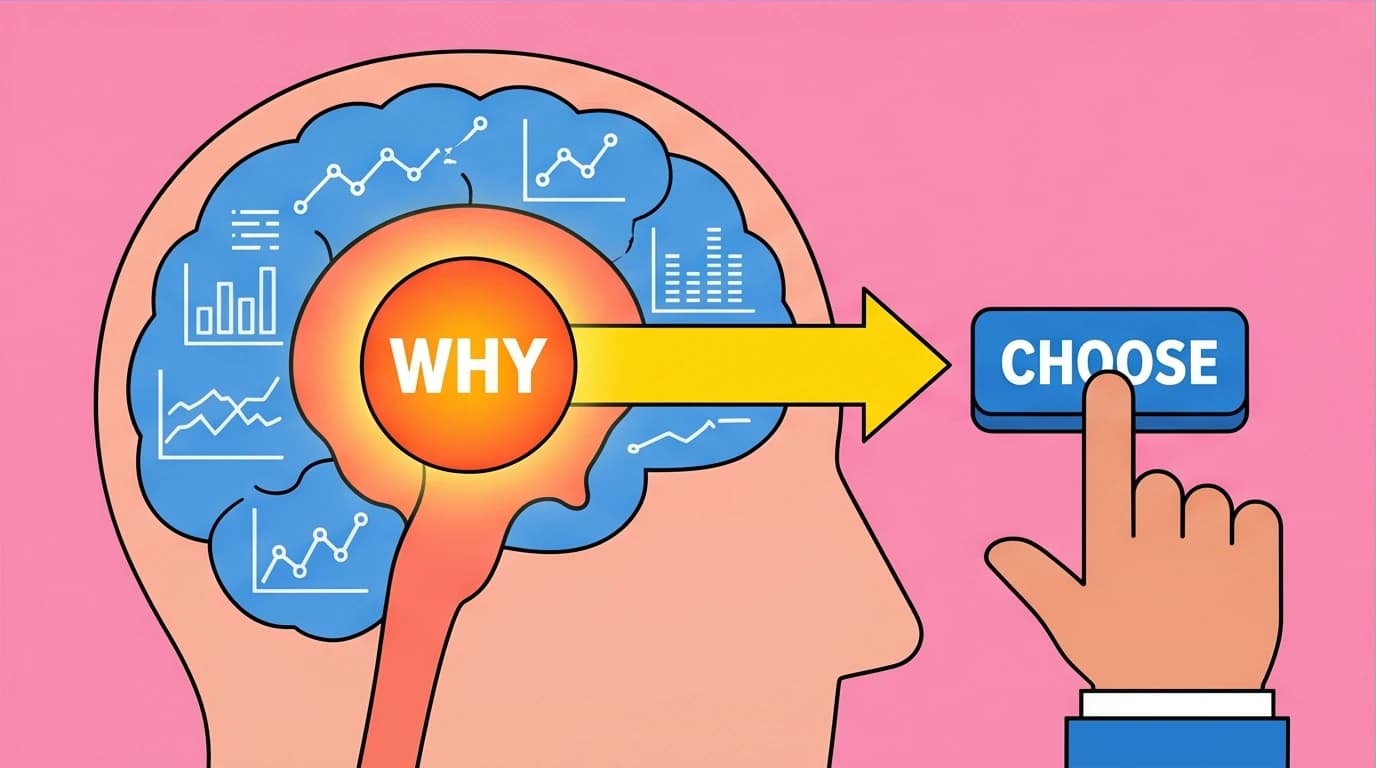
When you pitch raw data and features (the WHAT), you are talking to the neocortex. People can understand the complex information, but it doesn't drive their behavior. When you communicate your purpose (the WHY), you speak directly to the part of the brain that controls decision-making.
This is where "gut decisions" come from. A customer will pay a premium for an Apple product or an enthusiastic employee will take a pay cut to join a visionary startup because it simply "feels right."
While this summary gives you the foundational blueprint of the Golden Circle, nothing beats reading the original source material. If you want to truly master how to communicate from the inside out and understand the deeper biological drivers behind customer loyalty, you need to explore Simon Sinek’s full text. It is packed with real-world case studies from Apple, Southwest Airlines, and Martin Luther King Jr. that will fundamentally change how you lead.
Start with Why
Simon Sinek
 45 Duration
 7 Key Points
 4.6 Rate
For those whose 'to-read' pile is already overflowing, getting the distilled insights first can be a more practical approach to clear that reading debt.
Absorb the key lessons from Start with Why and other essential leadership books in 15-minute audio or text summaries to clear your reading list faster.
LeapAheadStart with Why Key Takeaways for Busy Professionals
To extract maximum value from this framework, you need to understand how to apply it across different facets of business. Here are the start with why key takeaways you can bring into your next strategy meeting.
Manipulation vs. Inspiration
There are only two ways to influence human behavior: you can manipulate it, or you can inspire it.
Manipulations are the standard tools of business: dropping the price, running a sale, using fear (FOMO), or peer pressure. Manipulations absolutely work. They drive transactions. But they never breed loyalty.
When you rely on manipulation, you are renting your customers. As soon as a competitor drops their price by one dollar, your customer is gone. Inspiration, rooted in a clear WHY, creates a loyal following that ignores the competition.
If you are fascinated by the psychology behind what truly motivates people beyond simple rewards and punishments, you will want to dig deeper into the science of human drive. Moving away from manipulative tactics like bonuses or fear requires a solid understanding of intrinsic motivation. Daniel Pink's groundbreaking work explores why autonomy, mastery, and purpose are the real keys to unlocking high performance and deep loyalty in any organization.

Drive
Daniel H. Pink
24 Duration11 Key Points4.5 RateThe Law of Diffusion of Innovation
If you want mass-market success, you must understand how ideas spread. The population is broken down into a bell curve:
- Innovators (2.5%)
- Early Adopters (13.5%)
- Early Majority (34%)
- Late Majority (34%)
- Laggards (16%)
You cannot achieve tipping-point success until you penetrate the Early Majority. Sinek notes a critical rule: the Early Majority will not try something until someone else tries it first. You need the Innovators and Early Adopters.
These groups make gut decisions based on what they believe. They buy to express their own identity. Align your WHY with their beliefs, and they will champion your product to the masses.
The Celery Test (Decision Making Filter)
How do you know if you are staying true to your WHY? Use Sinek's Celery Test.
Imagine you are at a networking event. Someone tells you that you need M&Ms to grow your business. Another says you need almond milk. Another says Oreos, and another says celery. You go to the supermarket and buy all of them. You spend a fortune, and your cart is a confusing mess.
Now, imagine your clear WHY is: "To always do things that promote a healthy lifestyle."
You go to the same supermarket with the same advice. This time, you only buy the almond milk and the celery. You filter out the noise. Your decisions become faster, cheaper, and entirely consistent with your core belief. Everyone looking at your cart instantly knows what you stand for.
The Celery Test is a fantastic tool for staying on track, but actually filtering out the daily noise of business is incredibly difficult. If you constantly find your shopping cart full of distractions and conflicting priorities, it is time to embrace a more disciplined approach to your workload. Learning to relentlessly pursue less but better will ensure that your time and energy are completely aligned with your core purpose.
Essentialism
Greg McKeown
32 Duration10 Key Points4.6 Rate
Implementing Simon Sinek Leadership Principles
Understanding the theory is useless if you don't execute. For newly promoted managers and founders, applying simon sinek leadership principles requires intentional practice.
Hire for Attitude, Not Just Skill
Great leaders do not hire skilled people and motivate them. They hire already motivated people and inspire them.
When you sit down for an interview, do not obsess over the resume. Skills can be taught in weeks. Belief systems cannot. Ask candidates about the work environments where they thrived. Look for alignment with your company's WHY.
As Sinek puts it: "If you hire people just because they can do a job, they’ll work for your money. But if you hire people who believe what you believe, they’ll work for you with blood and sweat and tears."
Build the Megaphone Correctly
Your organization is simply a megaphone. The WHY is the message coming out of the megaphone. The WHAT is the volume.
Founders often start with a very clear message. As the company scales, they get obsessed with volume—bigger offices, more sales, expanding product lines. If the underlying message (the WHY) gets fuzzy, all that extra volume just creates noise in the market. Keep the message crystal clear, no matter how large the megaphone gets.
Earn Trust Through Consistency
Trust is not a checklist. You cannot tell your team, "You need to trust me."
Trust emerges only when your team and your customers see consistent behavior. Your WHY is a belief. Your HOWs are the actions you take to realize that belief. Your WHATs are the results of those actions.
When all three are aligned, you project authenticity. If you claim your WHY is "putting people first," but your HOW involves laying off staff to hit a quarterly target, you break the alignment. Trust vanishes instantly.
Earning true trust through consistency is the bedrock of any successful company, but getting your entire executive team aligned on these behaviors is another challenge entirely. When a group lacks trust, they struggle to commit to the company's "Why" and often fall back into toxic, metric-driven habits. If you want to build a cohesive team that operates with absolute vulnerability and alignment, diving into the mechanics of team dynamics is an essential next step.

The Five Dysfunctions of a Team
Patrick Lencioni
33 Duration8 Key Points4.5 RateThe Danger of "The Split"
This is exactly how great leaders inspire action over decades, rather than just years. They avoid "The Split."
When a company is founded, the WHY is often perfectly tied to the founder's personality. Think of Sam Walton and Walmart. Walton’s WHY was a deep belief in helping everyday Americans stretch their hard-earned dollars. It wasn't just about cheap goods; it was a crusade for the working class.
As a company grows, it requires more structure, more management, and more executives. The founder eventually leaves or passes away. If the founder’s WHY was never clearly articulated and institutionalized, the new executives will only know the WHAT (retail) and the HOW (low prices).
Without the WHY, the company becomes purely metric-driven. They squeeze suppliers. They treat employees poorly. They lose the magic. This is The Split.
To prevent this, leaders must document their exact purpose and ensure it is the primary filter for every hire, every product launch, and every marketing campaign.
Action Plan: Put This Into Practice Today
Stop theorizing and start doing. Take these exact steps this week:
- Write down your current pitch. Look at the last email you sent to a prospect or your current website homepage. Is it entirely WHAT-focused?
- Draft your WHY statement. Use Sinek's exact format: "To [Contribution] so that [Impact]." Example: "To inspire people to do the things that inspire them so that, together, we can change our world."
- Rewrite your pitch from the inside out. Start with your new WHY statement. Then list the HOWs that make it possible. End with the WHAT. Read it aloud. Notice the shift in power.
- Run the Celery Test. Look at your budget for the next quarter. Are you funding M&Ms (distractions) or celery (initiatives aligned with your purpose)? Cut the M&Ms.
When you root your operations in a powerful core belief, you eliminate the daily friction of management. You stop pushing your team from behind and start pulling them forward.
Once you have mastered the art of starting with your 'Why,' the next step is to create an environment where your team feels safe enough to execute on that vision. Sinek explores this concept of psychological safety in another one of his bestselling books.
FAQ
What is the main point of Start with Why?
The central thesis is that people do not buy what you do; they buy why you do it. Successful leaders and organizations communicate from the inside out (Why -> How -> What), speaking directly to the part of the brain that controls decision-making, loyalty, and trust.
The central thesis is that people do not buy what you do; they buy why you do it. Successful leaders and organizations communicate from the inside out (Why -> How -> What), speaking directly to the part of the brain that controls decision-making, loyalty, and trust.
Is Start with Why worth reading for new managers?
Yes, but you do not need to memorize the entire book to see results. Grasping the Golden Circle framework is enough to instantly change how you conduct 1-on-1s, pitch projects to stakeholders, and filter job candidates. It shifts your focus from micro-managing tasks to aligning team purpose.
Yes, but you do not need to memorize the entire book to see results. Grasping the Golden Circle framework is enough to instantly change how you conduct 1-on-1s, pitch projects to stakeholders, and filter job candidates. It shifts your focus from micro-managing tasks to aligning team purpose.
How do you actually find your "Why"?
Your Why is rarely invented; it is discovered. It comes from looking into your past. Analyze your biggest successes and your moments of deepest professional fulfillment. Look for the common thread. What was the exact contribution you were making to others in those moments? That pattern is your underlying Why.
Your Why is rarely invented; it is discovered. It comes from looking into your past. Analyze your biggest successes and your moments of deepest professional fulfillment. Look for the common thread. What was the exact contribution you were making to others in those moments? That pattern is your underlying Why.
What is the difference between "Start with Why" and "Find Your Why"?
Start with Why is the foundational philosophy book that introduces the Golden Circle concept and explains the biology and psychology behind it. Find Your Why is a practical, step-by-step workbook released later by Sinek and his team. It provides specific exercises to help individuals and corporate teams actually uncover and draft their precise Why statements.
Start with Why is the foundational philosophy book that introduces the Golden Circle concept and explains the biology and psychology behind it. Find Your Why is a practical, step-by-step workbook released later by Sinek and his team. It provides specific exercises to help individuals and corporate teams actually uncover and draft their precise Why statements.