


You know you need to build better routines. Maybe you want to hit the gym before work, read more books, or stop scrolling social media in bed. But reading a full 300-page book feels impossible when your calendar is already packed with meetings and deadlines. You do not have time for a drawn-out philosophical debate on productivity. You need the exact framework to change your behavior right now.
If the specific habit of 'reading more' is a priority but time is your biggest obstacle, starting with powerful book summaries can be an effective way to build momentum.


LeapAhead

Get the core principles from books like Atomic Habits in 15-minute summaries, making it easy to learn on a packed schedule without the pressure of a 300-page book.
This comprehensive Atomic Habits summary strips away the filler and gives you the exact psychological levers you need to redesign your daily life.
The Core Philosophy: Systems Over Goals
Forget about setting goals. Goals are about the results you want to achieve. Systems are about the processes that lead to those results.
If you want to run a marathon, the goal is crossing the finish line after 26.2 miles. The system is your training schedule, what you eat, and what time you go to bed. James Clear argues that winners and losers have the same goals. Every Olympian wants the gold medal. The difference lies in their systems.
The Power of 1% Better
Habits are the compound interest of self-improvement. Getting 1% better every day might not seem noticeable in the moment. However, over the span of a year, the math is staggering. If you get 1% better each day for one year, you will end up 37 times better by the time you are done.
The reverse is also true. A 1% decline daily takes you down to nearly zero.

You do not need massive action. You need atomic-sized actions repeated consistently.
You do not need massive action. You need atomic-sized actions repeated consistently.
The idea of getting 1% better every day is a powerful motivator. For more inspiring messages from James Clear on systems, identity, and consistency, you'll want to check out these key quotes.
If the idea of compounding 1% daily improvements resonates with your current goals, you will absolutely want to explore the broader mathematics of success. While optimizing your daily environment gives you an excellent tactical framework, learning how those tiny actions multiply over years of practice can supercharge your long-term motivation. For a deep dive into why consistency always beats intensity and how everyday decisions seamlessly shape your ultimate trajectory, this next read is the perfect companion to keep your momentum going strong.
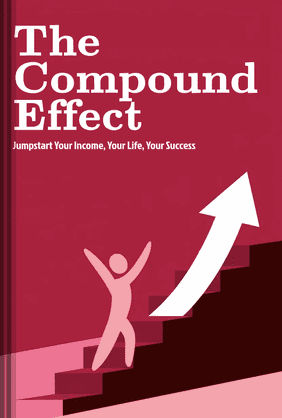
The Compound Effect
Darren Hardy
 17 Duration
 7 Key Points
 4.7 Rate
Change Your Identity, Not Just Your Outcomes
Most people try to change their habits by focusing on what they want to achieve (outcomes). True behavior change happens when you focus on who you wish to become (identity).
- Outcome-based: "I want to read 20 books this year."
- Identity-based: "I am a reader."
When a habit becomes part of your identity, you no longer need willpower. You do not have to force yourself to do it because it is simply who you are. Every time you read a page, you cast a vote for your identity as a reader.
The Four Laws of Behavior Change (Atomic Habits Key Takeaways)
Every habit goes through a neurological loop: Cue, Craving, Response, and Reward. If you want to understand the essential atomic habits key takeaways, you must master how to manipulate these four stages.

Want to understand the fascinating neuroscience behind this exact cue-and-reward loop? Long before you start tweaking your daily environment, it is incredibly helpful to understand how deeply ingrained these behavioral patterns are within the human brain. If you are curious about the underlying science of why we do what we do—and how major corporations use these same psychological loops to influence consumer behavior—exploring the foundational research on habit formation will give you a massive advantage in identifying your own subconscious triggers.
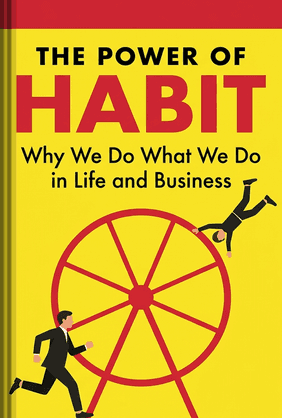
The Power of Habit
Charles Duhigg
31 Duration10 Key Points4.6 Rate1st Law (Cue): Make It Obvious
Your brain operates on autopilot. To build a new habit, you must make the triggers for that habit impossible to ignore.
- Implementation Intention: Do not leave habits to chance. Use this formula: "I will [BEHAVIOR] at [TIME] in [LOCATION]." Instead of saying "I will exercise more," say "I will work out for 30 minutes at 6:00 AM at the local YMCA."
- Habit Stacking: Tie a new habit to an existing one. "After [CURRENT HABIT], I will [NEW HABIT]." Example: "After I pour my morning coffee, I will meditate for two minutes."
- Environment Design: Willpower is highly overrated. People with the best self-control simply design their environments better. If you want to practice guitar, place the guitar stand in the center of your living room, not hidden in the closet.
2nd Law (Craving): Make It Attractive
We are driven by dopamine. The anticipation of a reward gets us to take action. You need to make your new habits irresistible.
- Temptation Bundling: Pair an action you want to do with an action you need to do. You can only listen to your favorite true crime podcast on Audible while running on the treadmill. You can only watch Netflix while folding laundry.
- Join the Right Culture: Humans are herd animals. We want to fit in. Join a group where your desired behavior is the normal behavior. If you want to read more, join a local book club at Barnes & Noble.
3rd Law (Response): Make It Easy
The biggest barrier to starting a habit is friction. We naturally gravitate toward the option that requires the least amount of effort.
- Reduce Friction: Prime your environment to make future actions easier. Lay out your gym clothes the night before. Chop your vegetables on Sunday so cooking dinner on Tuesday is effortless.
- The 2-Minute Rule: When you start a new habit, it should take less than two minutes to do. "Read before bed each night" becomes "Read one page." "Do 30 minutes of yoga" becomes "Take out my yoga mat." The goal is to master the art of showing up. You have to establish a habit before you can optimize it.
For many, the biggest friction point in building a reading habit is the time commitment. Applying the 'Make It Easy' principle to learning itself can be a game-changer.
LeapAhead
Master the art of showing up for your learning goals by absorbing a book's key ideas in just 15 minutes, a perfect way to make your reading habit easy and consistent.
The brilliance of the 2-Minute Rule is deeply rooted in decades of professional behavior design research. If you frequently struggle with the idea of starting small, or if you feel constantly overwhelmed by the friction of trying to make massive life changes all at once, diving deeper into the science of micro-habits can be a total game-changer. Learning how to strategically anchor tiny, effortless behaviors to your existing daily routines is the ultimate life hack for anyone who feels they naturally lack discipline.
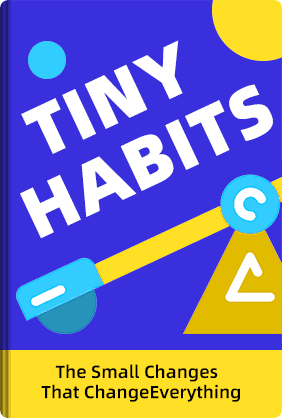
Tiny Habits
BJ Fogg, Ph.D.
40 Duration8 Key Points4.7 Rate4th Law (Reward): Make It Satisfying
We repeat behaviors that produce a satisfying conclusion. The human brain prioritizes immediate rewards over delayed rewards.
- Immediate Reinforcement: Give yourself an immediate reward when you complete your habit. If you skip buying a $5 latte to save money, immediately transfer $5 into a separate vacation savings account. Seeing the balance go up provides instant gratification.
- Use a Habit Tracker: Get a wall calendar and put a big red "X" over every day you complete your habit. Don't break the chain. Tracking your progress is visually satisfying and acts as a built-in trigger for the next day.
- Never Miss Twice: Life happens. You will miss a day. The rule is simple: missing once is an accident; missing twice is the start of a new, bad habit. Get back on track immediately.
Now that you have the framework, the next step is putting it into practice. For more detailed strategies and real-world examples, from habit stacking to environment design, it's worth exploring the specifics.
Breaking Bad Habits: Invert The Four Laws
Building good habits is only half the battle. To eliminate negative routines—like eating junk food or checking your phone during deep work—you simply invert the Four Laws.

- Make it Invisible (Cue): Unfollow distracting social media accounts. Put your phone in another room while working. Remove the junk food from your pantry.
- Make it Unattractive (Craving): Highlight the benefits of avoiding your bad habit. Reframe your mindset.
- Make it Difficult (Response): Increase friction. Delete the Amazon shopping app from your phone so you have to log in on a desktop to buy something.
- Make it Unsatisfying (Reward): Get an accountability partner. Create a habit contract where you have to pay a friend $50 every time you smoke a cigarette.
Understanding the summary is a great first step, but you might be wondering how Atomic Habits stacks up against other popular productivity books or if it's the right choice for your specific goals.
Atomic Habits Chapter Summary Overview
If you need a rapid atomic habits chapter summary to understand the flow of the book, it breaks down into three distinct phases:
- The Fundamentals (Chapters 1-3): Establishes the core philosophy of marginal gains (1% better), the critical difference between systems and goals, and how identity shapes your actions.
- The Four Laws (Chapters 4-17): The bulk of the book. It provides granular, psychological breakdowns of Cue, Craving, Response, and Reward, complete with practical frameworks like Habit Stacking and the 2-Minute Rule.
- Advanced Tactics (Chapters 18-20): Covers how to move from being merely "good" to "great." It introduces the Goldilocks Rule (how to stay motivated when habits get boring) and the downside of habits (when you stop paying attention to small errors).
If you are reviewing your James Clear atomic habits notes, ensure your focus remains heavily on the middle section—the Four Laws. That is where the actual behavioral modification happens.
While a quick chapter breakdown provides a fantastic roadmap for action, absolutely nothing replaces the nuance, historical anecdotes, and in-depth psychological research found in the source material itself. If you are serious about mastering the Four Laws and permanently redesigning your environment, you owe it to yourself to study the complete text. Grabbing your own copy allows you to dig into Clear's advanced tactics, take personal notes, and start building unbreakable systems that guarantee long-term success without relying on fleeting willpower.

Atomic Habits
James Clear
26 Duration8 Key Points4.7 RateYour Everyday Atomic Habits Cheat Sheet
Reading theory is useless without execution. Here is your actionable atomic habits cheat sheet. Screenshot this, print it out, and use it to map your next move.
To Create a Good Habit:
- [ ] Write down exactly when and where you will do it.
- [ ] Stack it directly after something you already do every day.
- [ ] Alter your environment so the tools you need are visible.
- [ ] Scale it down so it takes less than 2 minutes to complete.
- [ ] Track it visually on a calendar or app.
To Break a Bad Habit:
- [ ] Remove the trigger from your visual environment.
- [ ] Add a 5-minute delay before giving in to the craving.
- [ ] Make it highly inconvenient to perform the action.
- [ ] Set a penalty (financial or social) for failing.
FAQ
How long does it actually take to form a new habit?
Forget the myth of "21 days." James Clear points out that habit formation is not based on the amount of time that has passed, but on the frequency of the behavior. It is about repetitions. Doing something 100 times in 10 days will build a habit faster than doing it 10 times in 30 days. Focus on getting reps in, not counting days.
Forget the myth of "21 days." James Clear points out that habit formation is not based on the amount of time that has passed, but on the frequency of the behavior. It is about repetitions. Doing something 100 times in 10 days will build a habit faster than doing it 10 times in 30 days. Focus on getting reps in, not counting days.
Do I still need to read the full book if I understand the Four Laws?
This summary provides the operational framework you need to start changing your life today. However, the full book offers hundreds of highly specific examples, historical anecdotes, and a deeper dive into the neuroscience of why our brains operate this way. If you need inspiration and deeper context to stay committed, picking up a copy is highly recommended.
This summary provides the operational framework you need to start changing your life today. However, the full book offers hundreds of highly specific examples, historical anecdotes, and a deeper dive into the neuroscience of why our brains operate this way. If you need inspiration and deeper context to stay committed, picking up a copy is highly recommended.
Why is the 2-Minute Rule effective if I actually need a 45-minute workout?
The 2-Minute Rule overcomes the friction of starting. A habit must be established before it can be improved. If you cannot master the simple act of putting on your running shoes and stepping outside for two minutes, you will never sustain a 45-minute workout routine over six months. Standardize the beginning, then optimize the rest.
The 2-Minute Rule overcomes the friction of starting. A habit must be established before it can be improved. If you cannot master the simple act of putting on your running shoes and stepping outside for two minutes, you will never sustain a 45-minute workout routine over six months. Standardize the beginning, then optimize the rest.