

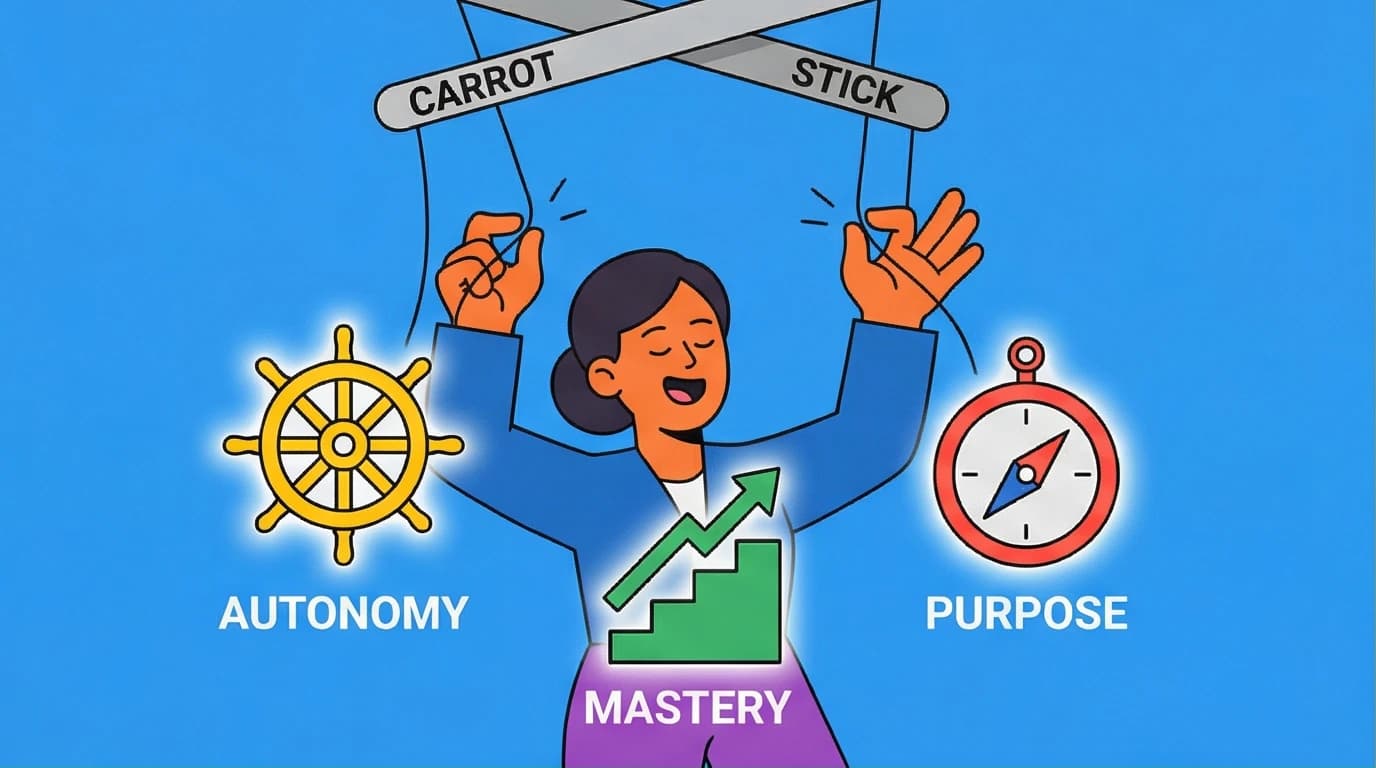
You offer competitive salaries, excellent health benefits, and a solid 401(k) match. Yet, your employee engagement metrics are flatlined, and your top performers are quietly quitting. You run team-building events and offer performance bonuses, but the creative energy in your organization feels stagnant.
This happens because modern businesses are trying to solve 21st-century problems with 19th-century psychology.
Traditional "carrot-and-stick" management works well for routine, algorithmic tasks—like packing boxes in an Amazon fulfillment center. But for complex, creative, and cognitive work, relying heavily on external rewards actually narrows focus and diminishes performance. To build a highly engaged, high-performing team, leaders need to understand and apply the principles of autonomy mastery purpose.
What is Motivation 3.0?
Before diving into the pillars, you need to understand the evolution of workplace behavior. In his bestselling book Drive, Daniel Pink categorizes human motivation into three distinct operating systems. Understanding what is motivation 3.0 is the prerequisite for modern leadership.
- Motivation 1.0 (Biological): The basic human drive to survive. Finding food, water, and shelter.
- Motivation 2.0 (Extrinsic): The industrial age model. People respond to rewards (carrots) and punishments (sticks). This assumes work is inherently unpleasant and people must be coerced into doing it.
- Motivation 3.0 (Intrinsic): The modern knowledge economy model. It recognizes that humans have a deep-seated desire to direct their own lives, create new things, and do better by the world.
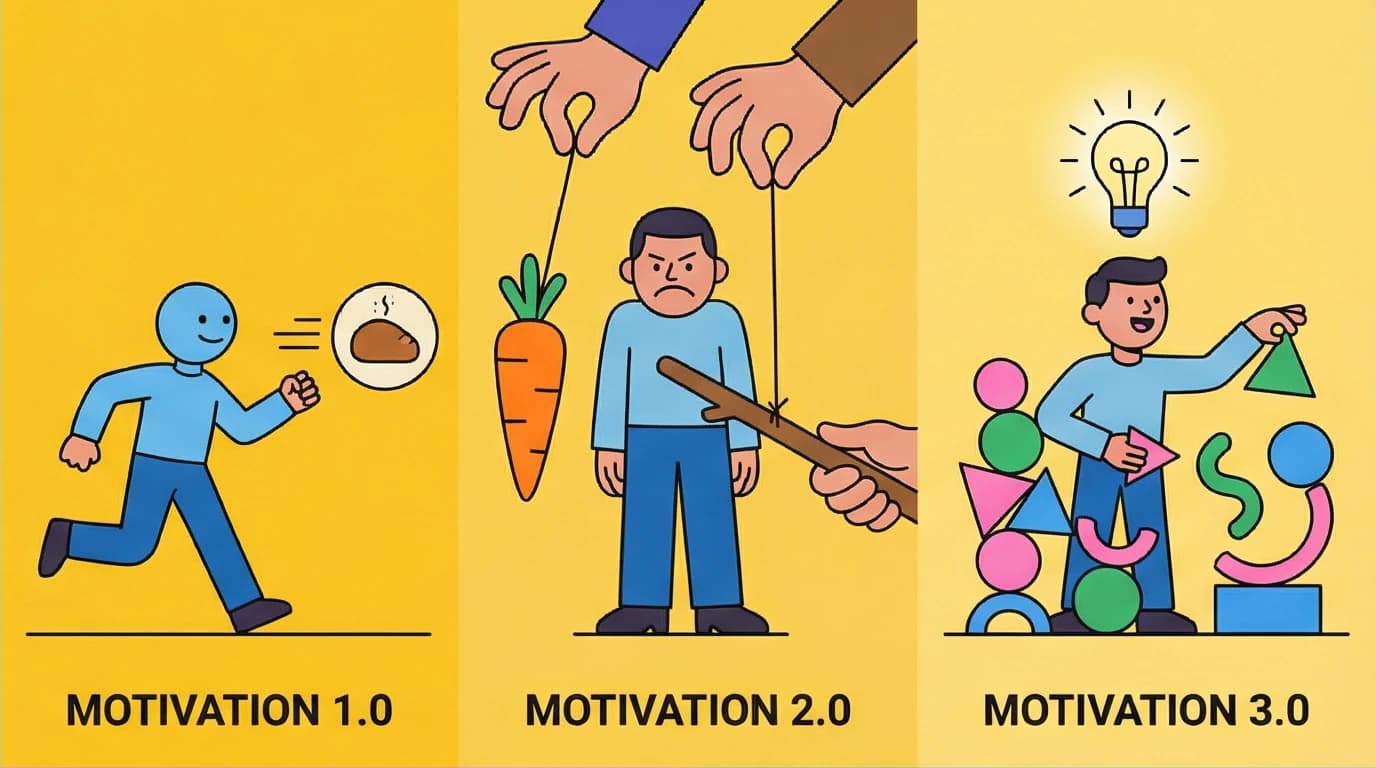
The Daniel Pink motivation theory argues that the secret to high performance isn't our biological drive or our reward-and-punishment drive, but our deep-seated intrinsic drive.
The framework we are exploring originates from a groundbreaking shift in how we understand human behavior at work. If you want to completely overhaul your leadership style and dive deeper into the science behind Motivation 3.0, going straight to the source is your best bet. Daniel Pink’s foundational book unpacks decades of psychological research to show exactly why the old carrot-and-stick approach is failing your business. It’s an essential read for any American business leader looking to build a genuinely engaged, future-proof workforce.

Drive
Daniel H. Pink
 24 Duration
 11 Key Points
 4.5 Rate
Decoding Daniel Pink 3 Elements of Motivation
To operationalize this theory, Pink breaks intrinsic motivation down into three actionable pillars. For HR professionals, agile coaches, and team leaders, understanding how these pillars function is the blueprint for transforming company culture.
1. Autonomy: The Desire to Direct Our Own Lives
Autonomy is not about working in isolation; it is about acting with choice. It means giving employees agency over how they approach their work. Traditional management focuses on compliance, but autonomy focuses on engagement.
To implement autonomy effectively, leaders should focus on the "Four Ts":
- Task: Allowing employees to choose what they work on. (e.g., Atlassian’s "ShipIt Days" where developers have 24 hours to work on any problem they want).
- Time: Moving away from strict billable hours toward a Results-Only Work Environment (ROWE). The focus shifts entirely to the output rather than the hours spent at a desk.
- Technique: Giving teams a clear goal but letting them figure out the "how." An agile coach might define the sprint goal, but the engineering team decides the coding architecture and a technical approach.
- Team: Allowing employees some choice over who they collaborate with on specific projects.
When people have autonomy, they take ownership. They stop acting like compliant factory workers and start acting like invested stakeholders.
2. Mastery: The Urge to Get Better at Stuff that Matters
Humans love to learn. We play instruments on the weekends, solve crossword puzzles, and contribute to open-source software—all without getting paid. Why? Because getting better at something is inherently satisfying.
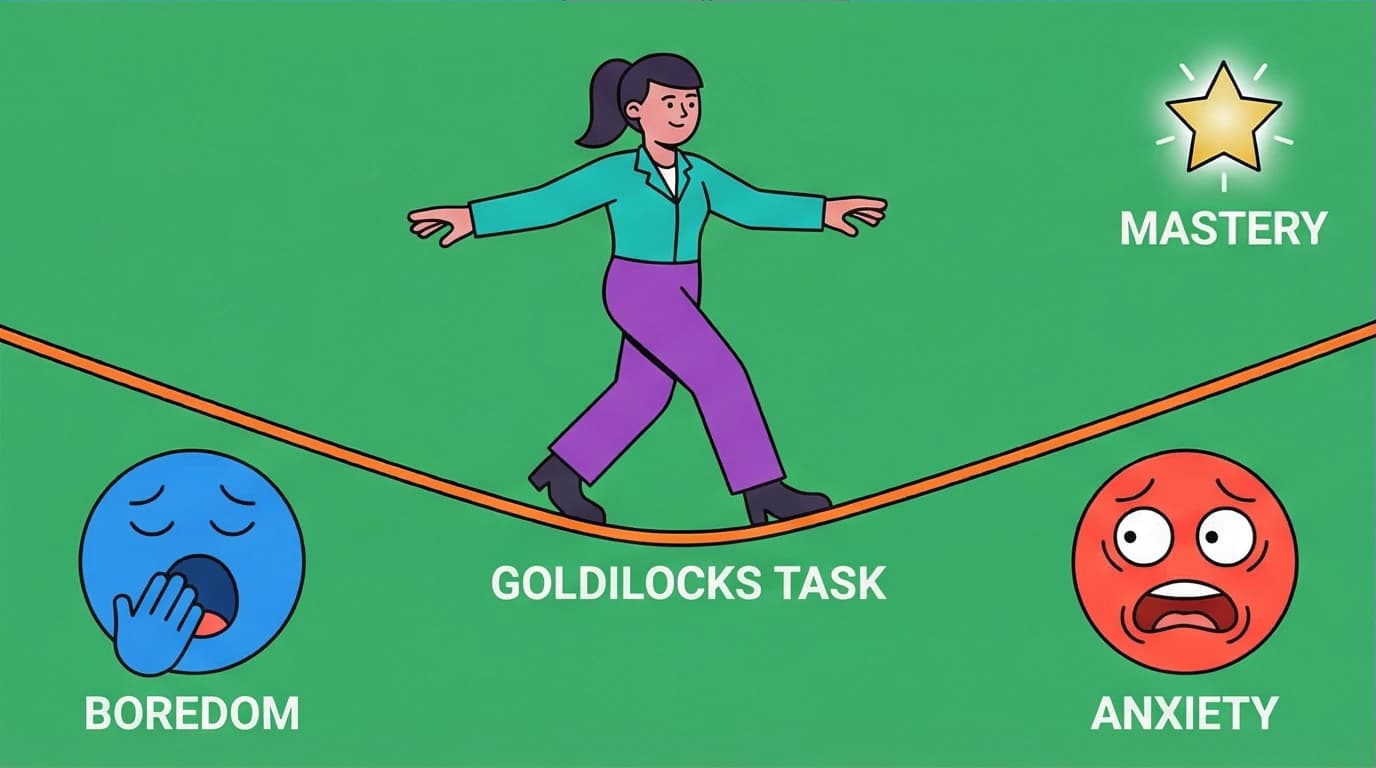
Mastery in the workplace requires creating an environment where employees can experience "flow"—a state of deep work where the challenge perfectly matches the individual's skill level.
- Goldilocks Tasks: If a task is too easy, the employee gets bored. If it is too hard, they get anxious. Mastery requires assigning "Goldilocks tasks"—challenges that are just right, pushing the employee slightly beyond their current capabilities.
- Clear Feedback Loops: You cannot master a skill without knowing how you are doing. Annual performance reviews are useless for mastery. Agile teams use daily stand-ups and sprint retrospectives precisely because they provide immediate, actionable feedback.
- Continuous Learning: Providing educational stipends, access to platforms like Audible or local workshops, and dedicated time for upskilling signals that the company values growth over immediate, short-term output.
But getting your team to read dense business books on top of their workload can be a challenge. If you want a way for them to absorb key leadership concepts in just 15 minutes during their commute or lunch break, an app like LeapAhead can be a powerful tool.


LeapAhead

Get the core insights from bestselling leadership books like Drive and Start with Why in 15-minute audio or text summaries, perfect for busy professionals.
Mastery is heavily dependent on those elusive moments of "flow," where an employee is so immersed in a Goldilocks task that the rest of the world just fades away. But how exactly do you engineer a workplace that consistently triggers this state? If you're eager to learn more about the psychology behind optimal performance and deep engagement, Mihaly Csikszentmihalyi’s pioneering work on the subject is an absolute must-read. He outlines the exact conditions required to turn everyday tasks into highly rewarding, skill-building experiences.

Flow
Mihaly Csikszentmihalyi
37 Duration8 Key Points4.5 Rate3. Purpose: The Yearning to Serve Something Larger
The final pillar is the context for the first two. You can have autonomous employees mastering their craft, but if they don't know why they are doing it, burnout is inevitable.
Purpose provides the "why." It connects daily tasks to a broader, meaningful objective.
- Profit vs. Purpose: Motivation 2.0 focused solely on profit maximization. Motivation 3.0 recognizes purpose maximization. Companies like Patagonia don't just sell outdoor gear; they are in business to save the home planet.
- Translating Purpose to the Frontline: Purpose doesn't have to mean saving the world. It can simply mean making a customer's life easier. A hospital IT worker isn't just maintaining servers; they are ensuring doctors have instant access to patient records, directly impacting patient care and saving lives.
Creating a purpose-driven environment is often the hardest pillar for organizations to get right, especially when quarterly profits are breathing down your neck. If you need a practical roadmap for uncovering your organization's deeper mission and communicating it in a way that truly resonates with your frontline workers, Simon Sinek’s classic book is a phenomenal resource. It provides a brilliant framework for inspiring your team by leading with your core beliefs, ensuring everyone is genuinely aligned with the bigger picture.
Start with Why
Simon Sinek
45 Duration7 Key Points4.6 RateAutonomy Mastery Purpose Examples in the Real World
How do you know if your team is operating on intrinsic motivation? Let’s look at practical autonomy mastery purpose examples and how to diagnose your current environment.
Scenario 1: The Micromanaged Software Team (Fixing Autonomy)
The Problem: An engineering team is missing deadlines. The tech lead responds by requiring daily hourly reports and dictating exactly which code libraries the developers must use. Morale plummets.
The Fix: The leader shifts to an autonomous approach. They present the business problem: "Our mobile app loading time is costing us conversions." They give the team a deadline and say, "You decide the technical solution to reduce load times by 2 seconds." The team, feeling trusted, works late voluntarily and finds an innovative caching solution.
The Fix: The leader shifts to an autonomous approach. They present the business problem: "Our mobile app loading time is costing us conversions." They give the team a deadline and say, "You decide the technical solution to reduce load times by 2 seconds." The team, feeling trusted, works late voluntarily and finds an innovative caching solution.
Relinquishing control can be terrifying for managers accustomed to calling all the shots, but true autonomy requires stepping back. If you want a real-world blueprint on how to successfully execute this shift, the story of Captain David Marquet is incredibly inspiring. He took one of the worst-performing submarines in the US Navy and transformed it by abandoning the traditional command-and-control model. His book is a masterclass in giving your team the autonomy they need to step up and act like true leaders.
Turn The Ship Around
L. David Marquet
23 Duration10 Key Points4.6 RateScenario 2: The Stagnant Top Performer (Fixing Mastery)
The Problem: Your best marketing manager has been doing the same job for three years. She is highly efficient but seems disengaged and is browsing LinkedIn for new roles.
The Fix: You recognize a lack of mastery. You sit down and map out a new challenge. You assign her to lead a cross-functional project integrating AI into your marketing pipeline—a skill she hasn't mastered yet. You provide a budget for an AI certification. Her engagement spikes because she is back in the "flow" channel, tackling a Goldilocks task.
The Fix: You recognize a lack of mastery. You sit down and map out a new challenge. You assign her to lead a cross-functional project integrating AI into your marketing pipeline—a skill she hasn't mastered yet. You provide a budget for an AI certification. Her engagement spikes because she is back in the "flow" channel, tackling a Goldilocks task.
Scenario 3: The Disconnected Sales Reps (Fixing Purpose)
The Problem: The sales team is hitting their quotas, but turnover is high. They view the job as a relentless, meaningless grind of cold calls.
The Fix: The VP of Sales brings in actual customers—small business owners—to speak at the quarterly kickoff. A bakery owner explains how the company’s point-of-sale software saved her business from bankruptcy during a tough season. The sales team realizes their calls aren't just about hitting numbers; they are helping small businesses survive. Cold call reluctance drops significantly.
The Fix: The VP of Sales brings in actual customers—small business owners—to speak at the quarterly kickoff. A bakery owner explains how the company’s point-of-sale software saved her business from bankruptcy during a tough season. The sales team realizes their calls aren't just about hitting numbers; they are helping small businesses survive. Cold call reluctance drops significantly.
Common Pitfalls When Implementing Motivation 3.0
Transitioning to a framework built on intrinsic motivation sounds ideal, but execution requires nuance. Avoid these critical mistakes:
1. Ignoring Baseline Compensation
Daniel Pink is very clear about this: You must pay people adequately and fairly. If an employee is worried about paying their mortgage or feels they are vastly underpaid compared to the market, no amount of autonomy or purpose will motivate them. Money is a threshold motivator. You must pay people enough to take the issue of money off the table, allowing them to focus entirely on the work.
Daniel Pink is very clear about this: You must pay people adequately and fairly. If an employee is worried about paying their mortgage or feels they are vastly underpaid compared to the market, no amount of autonomy or purpose will motivate them. Money is a threshold motivator. You must pay people enough to take the issue of money off the table, allowing them to focus entirely on the work.
2. Confusing Autonomy with Abandonment
Giving people autonomy does not mean saying, "Do whatever you want, see you in six months." That is managerial abandonment. True autonomy exists within clear guardrails. You define the destination and the boundaries (budget, deadlines, core values), but you let the employee chart the exact route.
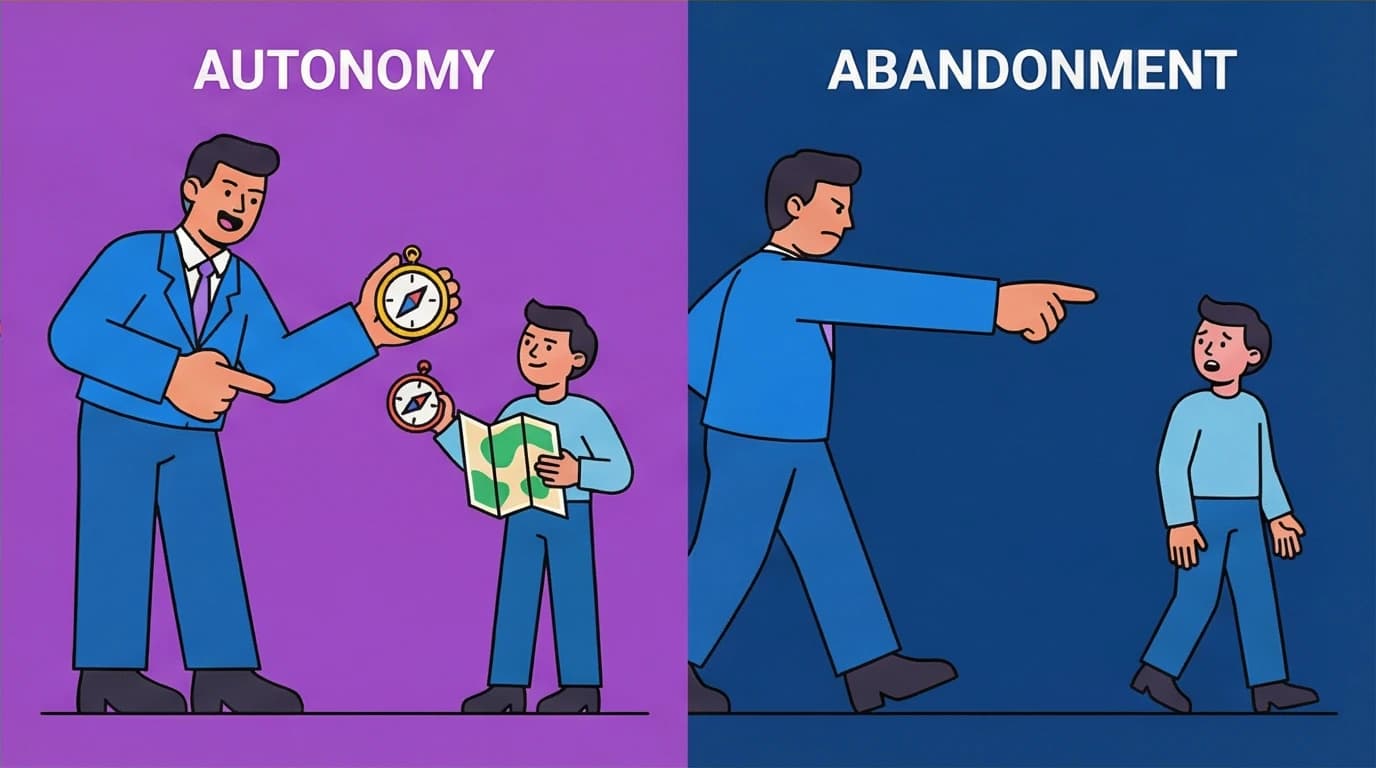
Giving people autonomy does not mean saying, "Do whatever you want, see you in six months." That is managerial abandonment. True autonomy exists within clear guardrails. You define the destination and the boundaries (budget, deadlines, core values), but you let the employee chart the exact route.
3. Treating Purpose as a PR Stunt
Millennials and Gen Z have zero tolerance for corporate hypocrisy. If you plaster a noble purpose statement on the breakroom wall ("We care about the community!") but your actual business decisions prioritize short-term profits over community well-being, employees will see right through it. Purpose must be authentic and reflected in daily leadership decisions.
Millennials and Gen Z have zero tolerance for corporate hypocrisy. If you plaster a noble purpose statement on the breakroom wall ("We care about the community!") but your actual business decisions prioritize short-term profits over community well-being, employees will see right through it. Purpose must be authentic and reflected in daily leadership decisions.
4. Expecting Overnight Results
If a team has been operating under strict micromanagement (Motivation 2.0) for years, suddenly giving them complete autonomy will cause panic. They need time to rebuild the muscle of independent decision-making. Introduce autonomy progressively. Start with "Time" or "Technique" before moving to complete task autonomy.
If a team has been operating under strict micromanagement (Motivation 2.0) for years, suddenly giving them complete autonomy will cause panic. They need time to rebuild the muscle of independent decision-making. Introduce autonomy progressively. Start with "Time" or "Technique" before moving to complete task autonomy.
Implementing the Autonomy-Mastery-Purpose framework requires a deep understanding of these principles, but finding the time to read all the foundational books can be a challenge for any busy leader. For those looking to get up to speed quickly, there are tools designed for efficient learning.
LeapAhead
Quickly absorb the key ideas from all the books mentioned in this article and more, turning your commute into a powerful leadership masterclass.
FAQ
Does the autonomy mastery purpose framework mean bonuses and commissions are useless?
No. External rewards are highly effective for routine, mechanical tasks (like data entry or basic assembly). However, for complex, creative work, "if-then" rewards can actually reduce creativity. Pink suggests using "now-that" rewards—unexpected bonuses or recognition given after a project is successfully completed, rather than holding it hostage as a contingent carrot.
No. External rewards are highly effective for routine, mechanical tasks (like data entry or basic assembly). However, for complex, creative work, "if-then" rewards can actually reduce creativity. Pink suggests using "now-that" rewards—unexpected bonuses or recognition given after a project is successfully completed, rather than holding it hostage as a contingent carrot.
How do I measure if my team has enough autonomy?
During one-on-one meetings, ask direct questions like: "What percentage of your day do you feel you have control over how you do your work?" or "Are there unnecessary approvals slowing down your workflow?" If employees constantly wait for your permission to make minor decisions, your team lacks autonomy.
During one-on-one meetings, ask direct questions like: "What percentage of your day do you feel you have control over how you do your work?" or "Are there unnecessary approvals slowing down your workflow?" If employees constantly wait for your permission to make minor decisions, your team lacks autonomy.
How can agile teams and Scrum Masters apply this theory?
Agile frameworks are inherently built for Motivation 3.0. Scrum Masters can empower autonomy by letting the development team pull their own tasks during Sprint Planning rather than assigning them. Mastery is nurtured during Sprint Retrospectives by identifying bottlenecks and improving team skills. Purpose is reinforced when Product Owners clearly explain the user value of the backlog items, rather than just handing over technical requirements.
Agile frameworks are inherently built for Motivation 3.0. Scrum Masters can empower autonomy by letting the development team pull their own tasks during Sprint Planning rather than assigning them. Mastery is nurtured during Sprint Retrospectives by identifying bottlenecks and improving team skills. Purpose is reinforced when Product Owners clearly explain the user value of the backlog items, rather than just handing over technical requirements.
Does this framework apply to non-creative or blue-collar jobs?
Yes. While cognitive work benefits most visibly, intrinsic motivation applies everywhere. A factory worker can be given autonomy over organizing their workstation (Technique). A barista can achieve mastery in latte art or customer de-escalation. A sanitation worker connects to purpose by recognizing they are keeping their city safe and disease-free. The key is how leaders frame the work and empower the worker.
Yes. While cognitive work benefits most visibly, intrinsic motivation applies everywhere. A factory worker can be given autonomy over organizing their workstation (Technique). A barista can achieve mastery in latte art or customer de-escalation. A sanitation worker connects to purpose by recognizing they are keeping their city safe and disease-free. The key is how leaders frame the work and empower the worker.