

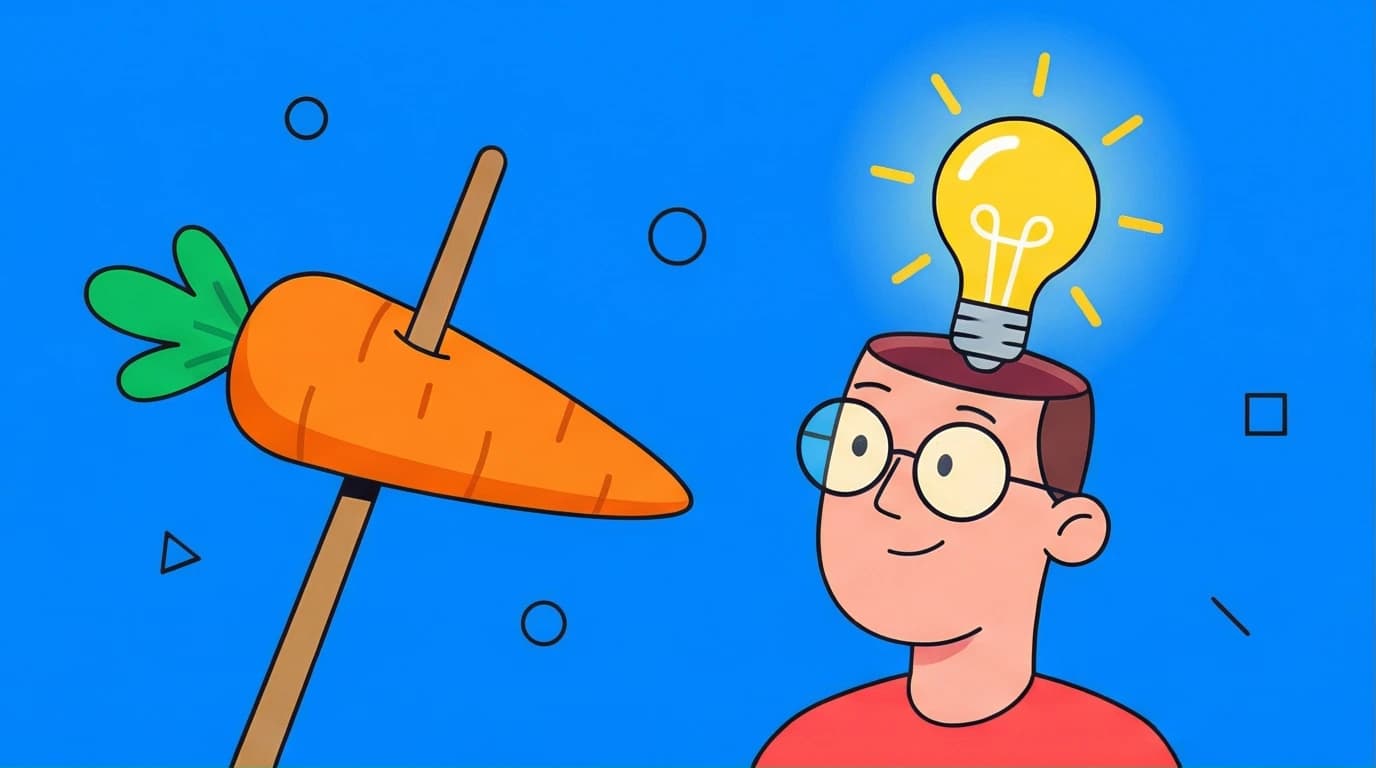
You rolled out a new performance bonus for your software engineers, or perhaps you offered your students a tangible prize for reading more books. You expected a massive spike in engagement and productivity. Instead, the exact opposite happened. Output flatlined, creative problem-solving vanished, and participants did exactly the bare minimum required to secure the payout. The system you designed to accelerate performance actually crushed it.
This frustration is not a localized management failure. It is a fundamental mismatch between human biology and modern organizational design. To fix it, you need to understand the behavioral science behind intrinsic vs extrinsic motivation Daniel Pink outlines in his landmark framework.
The Operating Systems of Human Drive: Motivation 2.0 vs 3.0
For most of the 20th century, businesses and schools operated on a simple assumption: the way to improve performance is to reward the good and punish the bad. This is the foundation of carrot and stick motivation.
Daniel Pink categorizes human drive into distinct operating systems to explain why this industrial-age thinking is failing in the modern economy.
Motivation 1.0 was pure biological survival. We ate to avoid starvation and sought shelter to survive the elements.
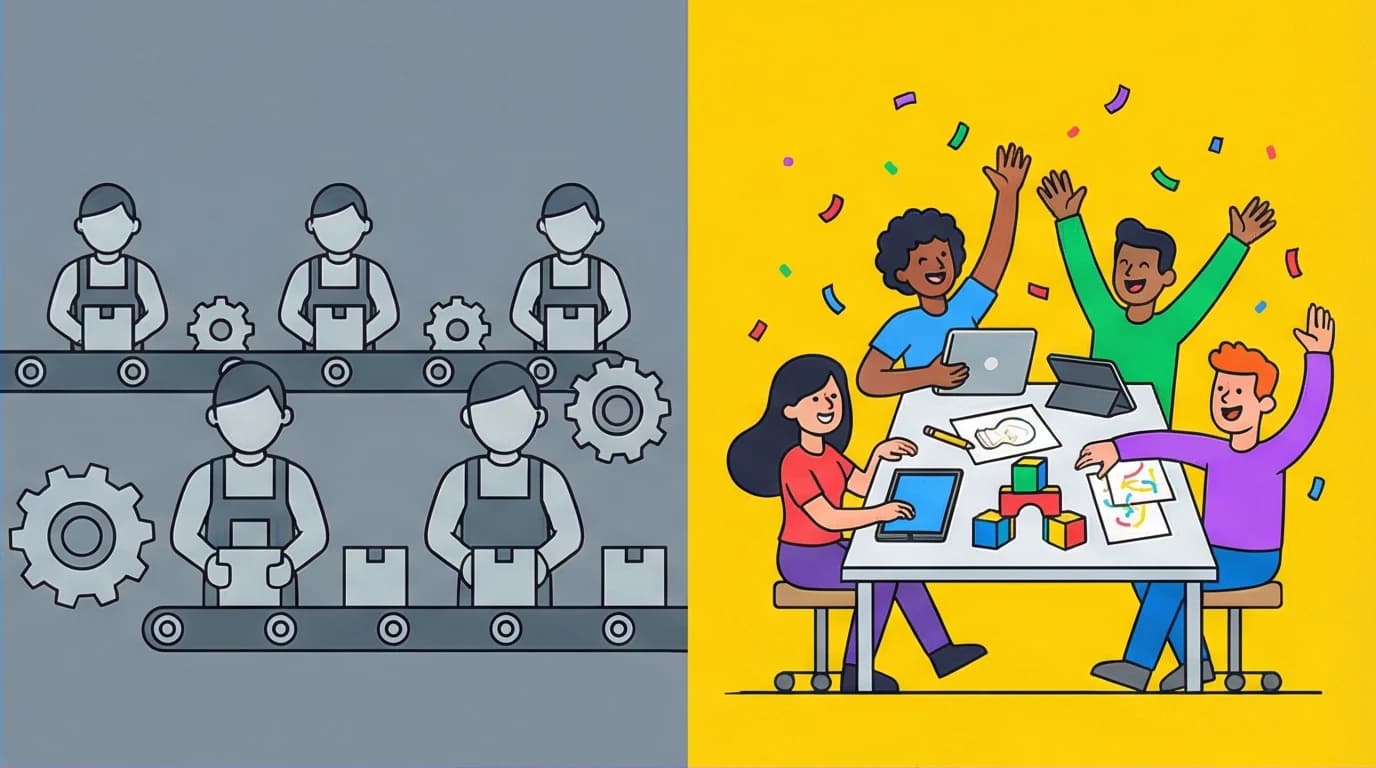
Motivation 2.0 emerged during the Industrial Revolution. Factory lines required compliance and standardization. Workers were essentially parts of a massive machine. To ensure the machine ran smoothly, management used extrinsic motivation: financial incentives for higher output, and the threat of termination for mistakes. This system assumes that work is inherently unpleasant and that people must be coerced into doing it.
Motivation 3.0 is the upgrade required for the 21st century. As automation and AI absorb routine work, the tasks left for humans are highly cognitive, creative, and complex. These "heuristic" tasks—like designing an app for Apple, crafting a marketing strategy, or developing a new curriculum—cannot be mapped out in a simple checklist. Motivation 3.0 relies entirely on intrinsic drive: the desire to direct our own lives, to get better at something that matters, and to contribute to a larger cause.
The friction you experience in your team or classroom happens because organizations are trying to run a Motivation 3.0 workforce on a Motivation 2.0 operating system.
If you want to dive deeper into the exact framework discussed here, there is no better starting point than Daniel Pink’s groundbreaking book on the subject. It completely dismantles the outdated corporate playbook of carrots and sticks, offering a science-backed blueprint for what actually makes us tick. Whether you're a manager trying to boost team morale or just someone looking to understand your own productivity hurdles, this read is an absolute game-changer for navigating the modern workplace.

Drive
Daniel H. Pink
 24 Duration
 11 Key Points
 4.5 Rate
If you're eager to apply these insights but find your reading list is already a mile long, a summary app can be a great way to grasp the core concepts from books like Drive without the heavy time commitment.

Get the key principles from Daniel Pink’s Drive and other essential business books in 15-minute summaries, perfect for learning on a tight schedule.

Download LeapAhead App now
The Science of Demotivation: Why Rewards Fail Daniel Pink Explains
When exploring why rewards fail Daniel Pink points to a robust body of behavioral science that dismantles the traditional compensation model.
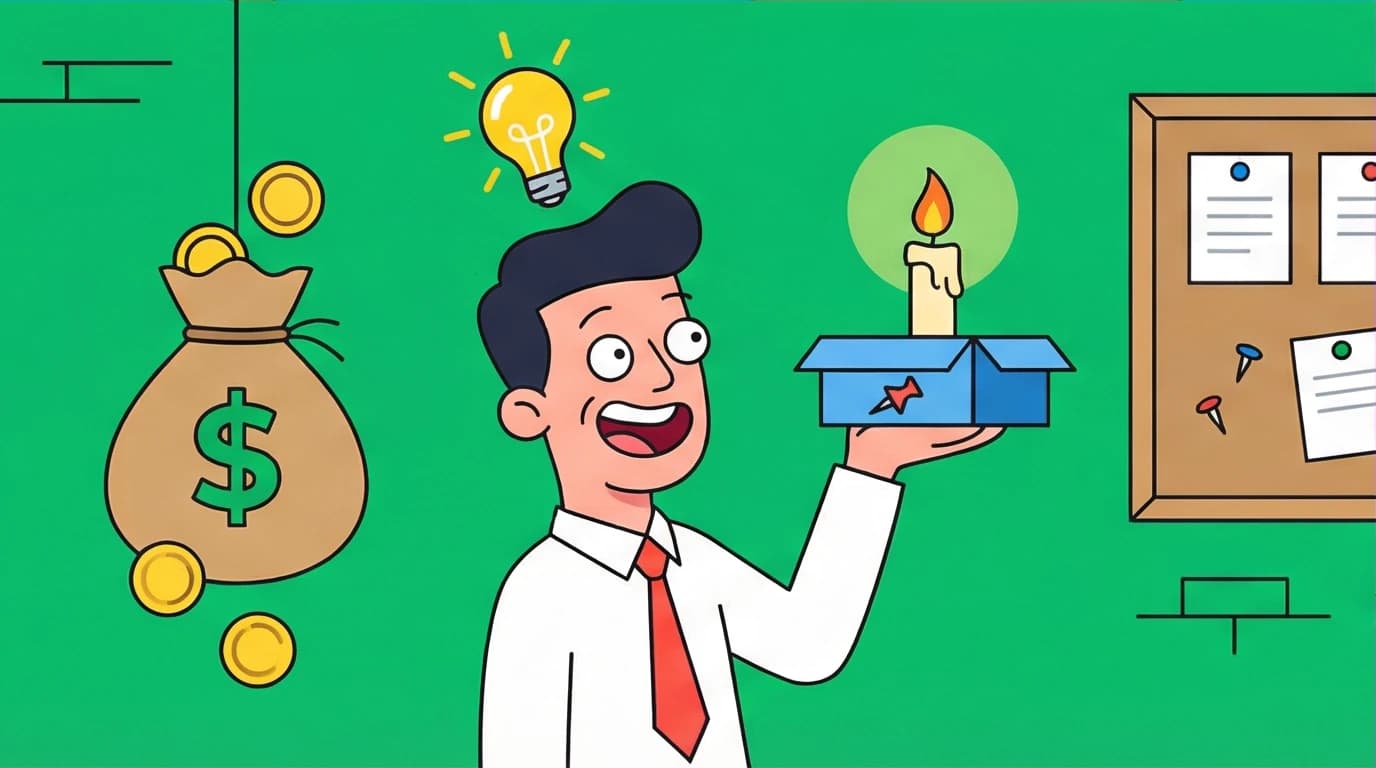
The most famous illustration of this is the "Candle Problem," created by psychologist Karl Duncker in 1945 and later adapted for behavioral economics by Sam Glucksberg.
In Glucksberg's experiment, participants were given a candle, a box of thumbtacks, and a book of matches. Their task was to attach the candle to the wall so that wax would not drip onto the table.
Glucksberg split the participants into two groups:
Glucksberg split the participants into two groups:
- Group A was told they were being timed just to establish a baseline for how long the problem typically takes.
- Group B was offered a financial reward. The fastest 25% would get a cash bonus, and the absolute fastest would get an even larger sum.
The solution requires out-of-the-box thinking: realizing that the box holding the tacks can be used as a platform for the candle. This requires overcoming "functional fixedness."
The results shocked the business world. Group B—the group incentivized with cash—took significantly longer to solve the problem than Group A.
Why the "If-Then" Reward Backfires
Extrinsic rewards narrow our focus. When a task is mechanical and straightforward (an "algorithmic" task, like stuffing envelopes or scanning barcodes at an Amazon warehouse), a narrow focus is exactly what you want. You see the finish line, and you run toward it faster because of the cash waiting there.
However, when a task requires conceptual thinking, a narrowed focus is destructive. The reward acts like blinders. The pressure to win the bonus prevents the brain from scanning the periphery for novel solutions. The carrot and stick motivation literally limits cognitive capacity.
How Extrinsic Rewards Decrease Intrinsic Motivation
Decades of psychological research, pioneered by Edward Deci and Richard Ryan through Self-Determination Theory, prove a devastating reality for managers: extrinsic rewards decrease intrinsic motivation.
If a person genuinely enjoys writing code or painting, introducing an "if-then" reward (e.g., "If you write 500 lines of code, you get $50") changes the psychological nature of the task. It turns play into work. The brain reclassifies the activity from "something I do because I enjoy it" to "something I am being bribed to do."
Once the reward is removed, the baseline intrinsic desire does not return; it drops below where it was before the reward was ever introduced. The internal fire is extinguished.
Understanding how our brains reclassify tasks based on financial incentives is just the tip of the behavioral economics iceberg. If you're fascinated by the hidden forces that shape our decisions—like why we might happily do a favor for free but refuse to do it for a few dollars—you'll want to explore the quirks of human psychology further. Unpacking these irrational behaviors can help you avoid designing reward systems that accidentally self-destruct.

Predictably Irrational
Dan Ariely
23 Duration10 Key Points4.6 RateThe 7 Deadly Flaws of Traditional Carrots and Sticks
Before restructuring your organizational incentives, you must recognize the objective risks associated with Motivation 2.0. Relying heavily on extrinsic motivation triggers seven specific flaws in environments demanding high cognitive output:
- They extinguish intrinsic motivation: They turn interesting tasks into chores.
- They diminish performance: By narrowing focus, they hinder problem-solving.
- They crush creativity: Innovation requires risk; rewards demand safe, guaranteed paths to the payout.
- They crowd out good behavior: Introducing fines for late parents at daycares often increases lateness, as the fine acts as a "fee" that removes the moral obligation to be on time.
- They encourage cheating and shortcuts: Think of the Wells Fargo scandal, where extreme sales quotas led employees to open fake accounts.
- They become addictive: Once you start offering bonuses for reading books, you can never stop. The moment the reward ceases, the reading stops.
- They foster short-term thinking: Wall Street traders focused on quarterly bonuses often take catastrophic long-term risks.
The Architecture of Drive: Building Motivation 3.0
If carrots and sticks are toxic to cognitive work, what replaces them?
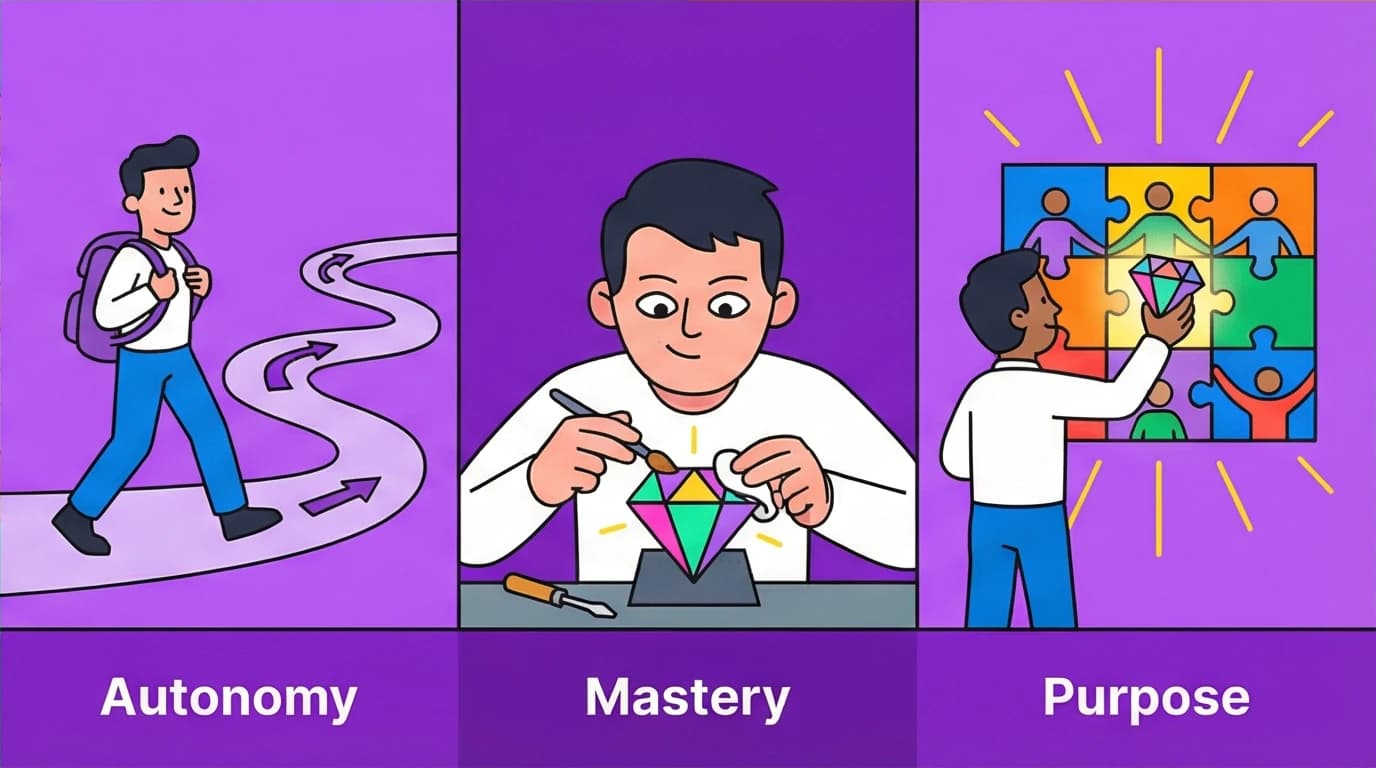
Daniel Pink isolates three core pillars that foster intrinsic motivation. However, there is a strict prerequisite: Baseline compensation must be adequate and fair. If people are struggling to pay rent or feel they are paid less than their peers, nothing else matters. You must pay people enough to take the issue of money off the table.
Once money is no longer the focal point, you can activate the three pillars of Motivation 3.0.
1. Autonomy: The Desire to Direct Our Own Lives
Management is great if you want compliance, but if you want engagement, self-direction works better. Autonomy is not about giving employees total anarchy; it is about giving them control over the four T's:
- Task: What they do. (e.g., Google’s famous 20% time, where engineers could work on any project they wanted, which birthed Gmail).
- Time: When they do it. (Moving toward Results-Only Work Environments, or ROWE, where schedules are entirely flexible as long as the work gets done).
- Technique: How they do it. (Providing the goal, but letting the expert figure out the methodology).
- Team: Who they do it with.
2. Mastery: The Urge to Get Better at Something That Matters
Humans inherently want to improve. We play instruments on weekends and write Wikipedia articles for free because getting better at something is deeply satisfying.
To foster mastery in a professional or educational setting, tasks must fall into the "Goldilocks Zone." If a task is too easy, the person gets bored. If a task is too hard, they experience crushing anxiety. Mastery happens when tasks are perfectly matched perfectly to a person's current abilities, stretching them just slightly beyond their comfort zone. It also requires clear, immediate, and constructive feedback.
To foster mastery in a professional or educational setting, tasks must fall into the "Goldilocks Zone." If a task is too easy, the person gets bored. If a task is too hard, they experience crushing anxiety. Mastery happens when tasks are perfectly matched perfectly to a person's current abilities, stretching them just slightly beyond their comfort zone. It also requires clear, immediate, and constructive feedback.
Hitting that "Goldilocks Zone" is what experts call deliberate practice—the secret sauce behind world-class performance in any field. If you are serious about developing mastery, whether in coding, playing an instrument, or leading a team, it helps to study the science of expertise. Learning how to structure your practice and feedback loops can drastically accelerate your growth and keep you engaged long after the initial excitement wears off.

Peak
Anders Ericsson and Robert Pool
48 Duration10 Key Points4.5 Rate3. Purpose: The Yearning to Serve Something Larger Than Ourselves
Motivation 2.0 focused on profit maximization. Motivation 3.0 requires purpose maximization.
The most motivated people are those who hitch their desires to a cause larger than themselves. When employees understand why they are doing a task—how their specific line of code helps a doctor save a life, or how their logistical planning helps a family get their groceries faster—their endurance and creativity skyrocket. Without purpose, autonomy and mastery are just personal hobbies.
The most motivated people are those who hitch their desires to a cause larger than themselves. When employees understand why they are doing a task—how their specific line of code helps a doctor save a life, or how their logistical planning helps a family get their groceries faster—their endurance and creativity skyrocket. Without purpose, autonomy and mastery are just personal hobbies.
Transitioning your team from a profit-driven mindset to a purpose-driven culture doesn't happen overnight. It starts with leadership clearly articulating the core reason the organization exists beyond making money. If you are struggling to define that larger cause or figure out how to communicate it in a way that truly inspires your team, exploring the mechanics of purpose-driven leadership is the perfect next step.
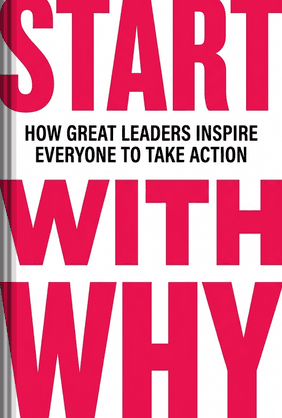
Start with Why
Simon Sinek
45 Duration7 Key Points4.6 RateJuggling a busy schedule while trying to absorb the wisdom from all these essential books can be a real challenge. For those who want to turn insights into action, a microlearning app can help you consistently build your knowledge base in just a few minutes a day.
Master the core frameworks from books on leadership, psychology, and performance during your commute or workout with powerful 15-minute summaries.
Download LeapAhead App now
FAQ
Do extrinsic rewards ever work?
Yes. Extrinsic rewards are highly effective for routine, algorithmic tasks that do not require creativity. If you need a team to stuff envelopes, do data entry, or move boxes, an "if-then" cash bonus will increase speed and output because the task is straightforward and narrowing focus is beneficial.
Yes. Extrinsic rewards are highly effective for routine, algorithmic tasks that do not require creativity. If you need a team to stuff envelopes, do data entry, or move boxes, an "if-then" cash bonus will increase speed and output because the task is straightforward and narrowing focus is beneficial.
Does Daniel Pink suggest eliminating bonuses entirely?
No. Pink suggests that baseline pay must be high enough to take money off the table. For bonuses, he recommends using "now-that" rewards rather than "if-then" rewards. A "now-that" reward is an unexpected bonus given after a project is successfully completed (e.g., "Now that we shipped this software on time, here is a team bonus"). Because it is unexpected, it does not narrow focus or ruin intrinsic motivation during the work.
No. Pink suggests that baseline pay must be high enough to take money off the table. For bonuses, he recommends using "now-that" rewards rather than "if-then" rewards. A "now-that" reward is an unexpected bonus given after a project is successfully completed (e.g., "Now that we shipped this software on time, here is a team bonus"). Because it is unexpected, it does not narrow focus or ruin intrinsic motivation during the work.
How is praise classified in the intrinsic vs extrinsic model?
Praise is technically an extrinsic reward, but its impact depends on how it is delivered. Expected, conditional praise ("If you get an A, I will tell you I am proud") operates like a dangerous carrot. However, specific, informational feedback ("The way you structured the data in this report made it incredibly easy to understand") feeds into a person's sense of Mastery, thereby boosting intrinsic motivation.
Praise is technically an extrinsic reward, but its impact depends on how it is delivered. Expected, conditional praise ("If you get an A, I will tell you I am proud") operates like a dangerous carrot. However, specific, informational feedback ("The way you structured the data in this report made it incredibly easy to understand") feeds into a person's sense of Mastery, thereby boosting intrinsic motivation.
Can I transition my team to Motivation 3.0 immediately?
Transitioning takes time. If a team has been heavily reliant on carrot and stick motivation for years, suddenly removing all metrics and granting total autonomy will likely cause panic and a drop in productivity. It requires a phased approach: auditing baseline pay, introducing small pockets of autonomy (like a self-directed Friday afternoon), and slowly shifting language from profit-driven to purpose-driven.
Transitioning takes time. If a team has been heavily reliant on carrot and stick motivation for years, suddenly removing all metrics and granting total autonomy will likely cause panic and a drop in productivity. It requires a phased approach: auditing baseline pay, introducing small pockets of autonomy (like a self-directed Friday afternoon), and slowly shifting language from profit-driven to purpose-driven.