

Mid-level management is a grind. You are constantly caught between executive expectations and frontline realities. You do not have time to read 400 pages of academic theory that fails to survive first contact with your actual team.

When your direct reports are missing targets, or cross-functional alignment breaks down, you need immediate, field-tested frameworks. You need tools to organize chaos, build high-performing cultures, and realize your company's strategic goals.
This guide breaks down the absolute best management books available today. Instead of a random reading list, we have categorized these titles by the exact problems they solve. Whether you are ordering a hardcover from Amazon to mark up with a highlighter, or downloading an audiobook on Audible for your morning commute, these selections will upgrade your operational skills.
For those just stepping into a leadership position, building a solid foundation from day one is crucial.
1. Operational Excellence: Fixing the Machine
Before you can dream up a grand vision, you need a team that executes flawlessly. These are the must read management books for building efficient, predictable workflows.
High Output Management by Andrew S. Grove
If there is a bible for Silicon Valley operators, this is it. Former Intel CEO Andy Grove wrote this decades ago, yet it remains the ultimate guide on how to actually manage.
- The Core Problem Solved: How to measure the output of a manager. Grove establishes that a manager's output is not what they do, but the output of their team plus the output of neighboring teams under their influence.
- The Framework: Leverage. Grove breaks down how simple activities (a 15-minute 1-on-1 meeting) can yield immense leverage, changing a subordinate's trajectory for weeks.

- Actionable Takeaway: Stop treating meetings as an interruption to your work. Meetings are the work. Use them to gather intelligence and course-correct. Buy a physical copy of this one—you will want to tab the pages on performance reviews.
If you're serious about mastering the art of operational efficiency, getting your hands on Grove’s original text is a non-negotiable step. It is packed with timeless wisdom on delegation, motivation, and maximizing your team's daily output. Whether you manage a small startup crew or a massive corporate division, this playbook will fundamentally change how you approach your managerial duties.
High Output Management
Andrew S. Grove
 30 Duration
 13 Key Points
 4.8 Rate
Measure What Matters by John Doerr
Execution fails when teams do not know what they are aiming for. John Doerr introduced Objectives and Key Results (OKRs) to Google, driving massive scale.
- The Core Problem Solved: Goal misalignment. When sales pushes one product and marketing promotes another, growth stalls.
- The Framework: OKRs. The Objective is what you want to achieve (inspiring and qualitative). The Key Results are how you get there (measurable and time-bound).
- Actionable Takeaway: Limit your team to 3-5 objectives per quarter. If everything is a priority, nothing is. This is one of the top books for managers who need to align hybrid or remote teams fast.
To truly master the OKR framework and get your entire department rowing in the same direction, you should dive straight into Doerr’s comprehensive guide. He doesn't just explain the theory; he provides behind-the-scenes case studies from some of the most successful tech giants in the United States. It is an indispensable resource for turning your strategic vision into measurable reality.

Measure What Matters
John Doerr
47 Duration9 Key Points4.5 Rate2. Team Dynamics: Communication and Culture
A perfect strategy means nothing if your team hates working together. Managing humans is messy. These books provide blueprints for handling conflict, giving feedback, and building trust.
Radical Candor by Kim Scott
Feedback is the breakfast of champions, but most managers deliver it poorly. They either stay silent to avoid hurting feelings, or they act like jerks.
- The Core Problem Solved: The anxiety of performance conversations.
- The Framework: Care Personally + Challenge Directly. If you do both, you achieve Radical Candor. If you challenge directly but don't care, it is Obnoxious Aggression. If you care but fail to challenge, it is Ruinous Empathy (the most common manager trap).

- Actionable Takeaway: Have a five-minute conversation today with an underperformer. Tell them directly what needs to change, but make it clear you are doing this because you want them to succeed. This is a great title to grab on Audible—Kim Scott’s narration drives the tone home perfectly.
Mastering the delicate balance between empathy and accountability is arguably the hardest part of mid-level management. Scott’s groundbreaking guide offers incredibly practical advice, complete with actionable scripts and relatable anecdotes from her time leading teams at Apple and Google. If you want to build a culture of trust where feedback actually drives performance, you need to add this to your library.
Radical Candor
Kim Scott
19 Duration7 Key Points4.6 RateThe Five Dysfunctions of a Team by Patrick Lencioni
Written as a leadership fable, this book cuts straight to the root causes of office politics and toxic work environments.
- The Core Problem Solved: Why smart, capable individuals fail to work together as a unit.
- The Framework: The pyramid of dysfunction. It starts at the base with an Absence of Trust, leading to Fear of Conflict, Lack of Commitment, Avoidance of Accountability, and finally, Inattention to Results.
- Actionable Takeaway: You cannot hold people accountable if there is no trust. Start by creating an environment where team members can admit mistakes without fear of immediate punishment.
The skills needed to handle team dynamics are often the most difficult to develop. For a deeper look into this area, it's worth exploring additional resources.
LeapAhead: A Microlearning Library for Busy Managers
Identifying which books to read is only half the battle; the other is finding the time to actually read them. LeapAhead offers a practical solution by transforming how managers consume business knowledge. It’s a microlearning app designed to deliver the core ideas of bestselling nonfiction books in 15-minute audio and text summaries. While it won't replace a deep, academic dive into a complex subject, it’s an incredibly efficient tool for discovering new frameworks and reinforcing key concepts.
- The Core Problem Solved: The "reading debt" that accumulates when managers buy books with good intentions but lack the time and energy to read them after a long day. It solves the problem of learning consistency.
- The Framework: Microlearning. The app provides access to a library of over 30,000 book summaries. It uses personalized recommendations, daily learning goals, and visual infographics to make learning a sustainable habit that fits into the fragmented moments of a modern workday.
- Actionable Takeaway: Before committing 8-10 hours to a full book, use LeapAhead to listen to its 15-minute summary on your commute. You can quickly determine if the book's core principles are relevant to your current challenges, helping you prioritize your limited reading time far more effectively.


Get key insights from top management books like *Good to Great* and *Radical Candor* in just 15 minutes a day with the LeapAhead app.
 LeapAhead
3. High-Level Strategy: Thinking Like an Executive
Once your daily operations run smoothly, you must pivot from managing the present to designing the future. Among the classic management books, these stand out for elevating your strategic horizon.
This transition from tactical management to strategic leadership is a critical career milestone. While management focuses on executing a plan, leadership involves defining the vision.
Good to Great by Jim Collins
Why do some companies make the leap from average to exceptional, while others go bankrupt? Jim Collins and his research team spent years analyzing data to find out.
- The Core Problem Solved: Stagnation. How to push an established team past the plateau of "good enough."
- The Framework: The Hedgehog Concept. Greatness happens at the intersection of three circles: what you are deeply passionate about, what drives your economic engine, and what you can be the best in the world at.
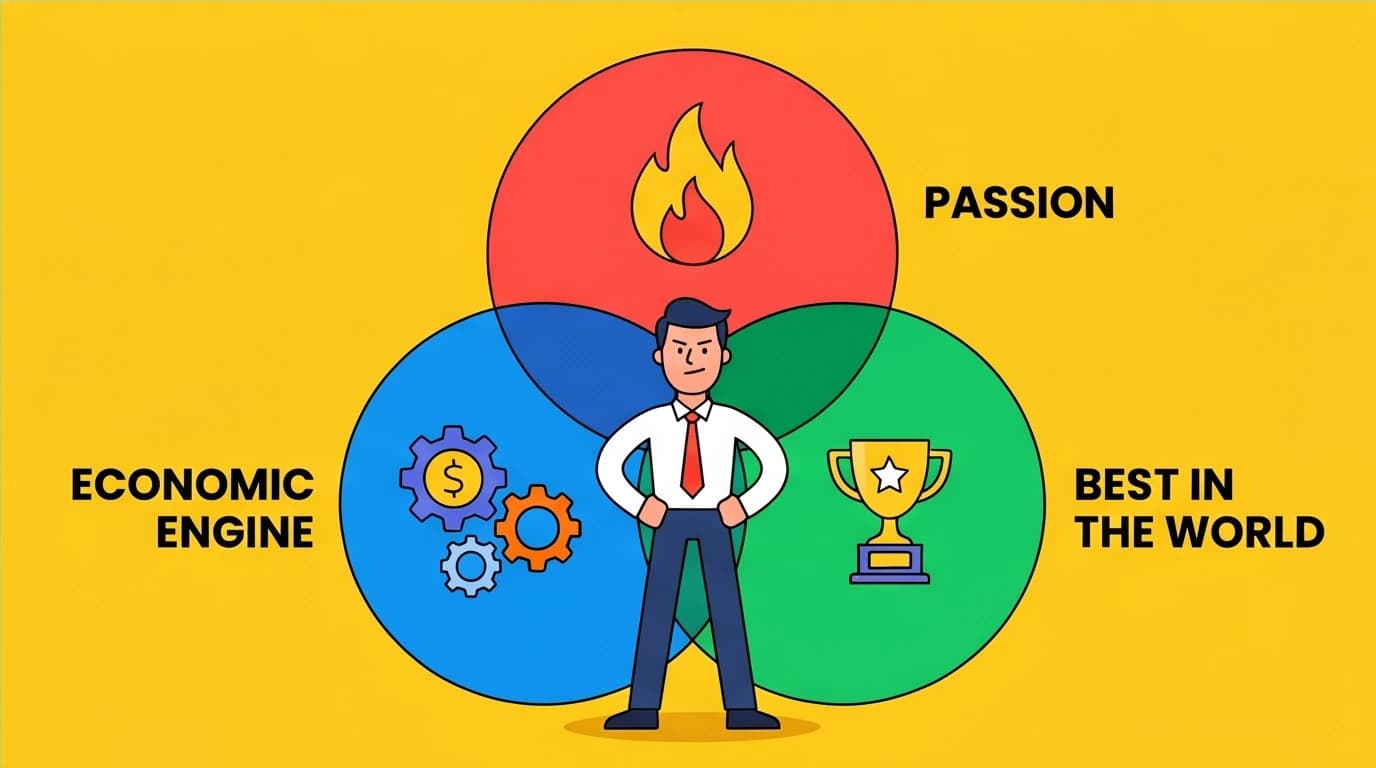
- Actionable Takeaway: Find your team's Hedgehog Concept. Stop wasting energy on projects that fall outside of those three circles.
Jim Collins spent years compiling empirical data to figure out why certain organizations thrive while their competitors fade into obscurity. If you are determined to push your team past the plateau of simply being "good," this meticulously researched classic is your roadmap. It is required reading for anyone looking to build a resilient, high-performing culture that lasts for decades.
Good to Great
Jim Collins
45 Duration7 Key Points4.6 RatePlaying to Win by A.G. Lafley and Roger L. Martin
Strategy is not a vision statement; it is a series of hard choices. Former Procter & Gamble CEO A.G. Lafley explains how to beat the competition.
- The Core Problem Solved: Confusing operational effectiveness with actual strategy.
- The Framework: The five choices of strategy. What is our winning aspiration? Where will we play? How will we win? What capabilities must be in place? What management systems are required?
- Actionable Takeaway: Define "Where NOT to play." Strategy is just as much about what you choose to ignore as what you choose to pursue. If you are curating a library of essential business management books, this belongs on the top shelf.
4. The Modern Leader: Adaptability and Innovation
The corporate landscape shifts rapidly. You must unlearn old habits to lead modern, agile workforces.
Multipliers by Liz Wiseman
Some leaders make everyone around them smarter. Others drain the intelligence out of the room.
- The Core Problem Solved: Micromanagement and bottlenecking.
- The Framework: Multipliers vs. Diminishers. Diminishers need to be the smartest person in the room. Multipliers act as genius-makers, extracting the best ideas from their staff.
- Actionable Takeaway: Stop answering every question your team brings to you. Start asking, "What do you think our next move should be?" Force the cognitive load back onto them.
The Innovator's Dilemma by Clayton M. Christensen
This book explains why great companies fail precisely because they do everything right. They listen to their customers and invest in their most profitable products, leaving them vulnerable to disruptive technologies.
- The Core Problem Solved: Blind spots. Missing the next big industry shift because you are too focused on optimizing current revenue.
- The Framework: Sustaining vs. Disruptive Innovation.
- Actionable Takeaway: Carve out a small budget and resource pool to experiment with high-risk, low-margin ideas that could eventually replace your core product.
To ensure your business isn't caught off guard by the next wave of industry disruption, you need to understand the mechanics of market shifts. Christensen's legendary work is essential for leaders who want to balance the demands of their current customer base with the necessity of future-proofing their products. Grab a copy to start thinking two steps ahead of the competition.
The Innovator's Dilemma
Clayton M. Christensen
22 Duration7 Key Points4.8 RateHow to Consume These Books Effectively
Managers lack free time. Buying a stack of books from Barnes & Noble is easy; reading them is hard. Here is how to actually extract value without burning out:
- Read for the problem at hand. Do not read a book on scaling organizational culture if your current problem is fixing a broken sales funnel. Match the book to your immediate pain point.
- Skim aggressively. Most business books have one core concept padded with fifty case studies. Read the introduction, the conclusion, and the first few pages of each chapter. If a chapter grabs you, slow down.
- Deploy the 1.5x speed rule. Download the audiobooks. Listen to them at 1.5x speed while driving or working out. If you hear a framework you love, buy the physical copy later to put on your desk.
Don't have time for a full audiobook? Absorb the core ideas of the best business books during your commute with 15-minute summaries from LeapAhead.
LeapAhead- Create a team book club with boundaries. Pick one chapter, not the whole book. Have your leadership team read chapter three of Radical Candor and spend 20 minutes discussing how to apply it to your next performance review cycle.
FAQ
Are classic management books still relevant in today's remote work era?
Yes. While the tools have changed from conference rooms to Zoom, human psychology remains identical. Books like High Output Management were written before Slack existed, but the principles of leverage, motivation, and task-relevant maturity apply perfectly to distributed teams. The medium changes; the management physics do not.
Yes. While the tools have changed from conference rooms to Zoom, human psychology remains identical. Books like High Output Management were written before Slack existed, but the principles of leverage, motivation, and task-relevant maturity apply perfectly to distributed teams. The medium changes; the management physics do not.
Should I read these books on Audible or buy a physical copy?
It depends on the book's structure. For narrative-driven books that focus on mindset and culture (like Radical Candor or The Five Dysfunctions of a Team), Audible is fantastic. For framework-heavy books that require you to look at charts, graphs, and bulleted lists (like Measure What Matters or Playing to Win), buy the physical or Kindle version.
It depends on the book's structure. For narrative-driven books that focus on mindset and culture (like Radical Candor or The Five Dysfunctions of a Team), Audible is fantastic. For framework-heavy books that require you to look at charts, graphs, and bulleted lists (like Measure What Matters or Playing to Win), buy the physical or Kindle version.
I don't have time to read. How can I extract value from top books for managers quickly?
Stop treating business books like novels. You do not have to read them cover to cover. Look at the table of contents, identify the one chapter that addresses your current biggest headache, and read only that chapter. Treat these books as reference manuals, pulling them off the shelf only when you need to fix a specific engine part.
Stop treating business books like novels. You do not have to read them cover to cover. Look at the table of contents, identify the one chapter that addresses your current biggest headache, and read only that chapter. Treat these books as reference manuals, pulling them off the shelf only when you need to fix a specific engine part.
What is the difference between leadership books and business management books?
Leadership books generally focus on vision, emotional intelligence, and human influence—how to inspire people to follow you. Business management books focus on the mechanics of execution—how to structure a team, measure output, allocate resources, and optimize processes. A great executive needs both sets of skills to survive.
Leadership books generally focus on vision, emotional intelligence, and human influence—how to inspire people to follow you. Business management books focus on the mechanics of execution—how to structure a team, measure output, allocate resources, and optimize processes. A great executive needs both sets of skills to survive.