


Your title says executive, founder, or director. Yet, lately, your days likely feel more like putting out tactical fires than charting a visionary course. The strategies that brought you early success—relentless hustle, sheer willpower, and micromanaging outcomes—are now the exact bottlenecks stalling your organization's growth.
You have hit a wall. You cannot scale a company by simply commanding people to work harder.
To break through this ceiling, you need a fundamental shift in your approach. You must transition from a manager of tasks to an architect of human potential. This requires a deep understanding of human psychology, emotional intelligence, and group dynamics. The insights required for this transformation are locked inside some of the brightest minds in business and psychology. We have distilled the absolute top leadership books that offer the visionary advice you need to build a resilient, empowered, and highly motivated company culture.
Why Executives Must Rethink Leadership Development Books
Most standard management literature focuses on operational efficiency. That is the wrong medicine for your current problem. When a company stalls, it is rarely an operations issue; it is a behavioral issue.

The best books on leadership focus entirely on the human element. They strip away corporate jargon and force you to look in the mirror. They ask hard questions about your empathy, your ability to regulate your own emotions, and how your presence impacts the psychological safety of the room. By reading—or listening on platforms like Audible during your commute—you expose your brain to new paradigms of organizational behavior.
Below is a curated breakdown of the most effective leadership books, categorized by the exact cultural friction points you are facing right now.
While the visionary advice in these leadership books is crucial for scaling, mastering the fundamentals of operational management is equally important. For leaders looking to strengthen their team's core processes, a different set of texts can provide the necessary foundation.


LeapAhead

Turn your commute into a leadership masterclass. Absorb the key ideas from bestselling business books in just 15 minutes with the LeapAhead app.
Books for Leaders Seeking to Master Emotional Intelligence
Before you can lead a Fortune 500 company or scale a brilliant startup, you have to lead yourself. If your emotional baseline is chaotic, your organization will be chaotic.
1. Dare to Lead by Brené Brown
Brené Brown took her extensive research on shame and vulnerability and applied it directly to corporate leadership. The core premise is that courage and fear are not mutually exclusive. True leadership requires stepping into the arena and embracing vulnerability.
- The Psychological Insight: Perfectionism and armor keep leaders disconnected from their teams. When an executive refuses to admit a mistake, it signals to the entire organization that failure is fatal. This instantly kills innovation.
- The Executive Action: Next time a major project fails, own your part of it publicly. Say the words, "I missed the mark on this strategy, and here is what I learned." Watch how fast the tension leaves the room and how quickly your team pivots to problem-solving instead of finger-pointing.
Brené Brown's research fundamentally changes how executives view vulnerability in the boardroom, proving that it is a strategic strength rather than a liability. If you are ready to drop the armor, build profound psychological safety, and lead your team with authentic courage, diving into the complete framework of her work is an absolute must. It will give you the practical, actionable tools you need to navigate tough corporate conversations and foster real human connection.
Dare To Lead
Brené Brown, Ph.D.
 43 Duration
 9 Key Points
 4.6 Rate
2. Primal Leadership by Daniel Goleman, Richard Boyatzis, and Annie McKee
Daniel Goleman introduced the concept of Emotional Intelligence (EQ) to the business world. This book argues that a leader’s emotions are highly contagious.
- The Psychological Insight: Your mood operates like a thermostat for the entire office. If the founder walks in stressed and abrasive, the amygdalae of everyone in the room hijack their brains, pushing them into fight-or-flight mode. Creative problem-solving shuts down entirely in this state.
- The Executive Action: Audit your emotional wake. Before stepping into a critical board meeting or an all-hands call, take two minutes to regulate your nervous system. Your calmness will breed team confidence, even in the middle of a terrible Q4 earnings report.
The Best Books on Leadership for Shaping Company Culture
Culture is not ping-pong tables or Friday happy hours. Culture is the accepted standard of behavior within your walls. It is how people treat each other when you are not in the room.
3. The Culture Code by Daniel Coyle
Coyle studied the world’s most successful groups—from the US Navy SEALs to the San Antonio Spurs and Zappos. He found that successful cultures are not built on matching personalities, but on three specific communication signals.
- The Psychological Insight: Humans are constantly scanning their environment asking one subconscious question: Am I safe here? Coyle reveals that high-performing teams continuously send "belonging cues" to establish psychological safety, share vulnerability, and establish a clear, shared purpose.
- The Executive Action: Stop demanding trust and start engineering it. Over-communicate your intent. When delivering hard feedback, frame it by saying, "I am giving you these comments because I have very high expectations, and I know you can reach them." This simple phrase changes the feedback from a threat to a signal of belonging.
Coyle's insights offer a literal masterclass in organizational psychology, breaking down the invisible dynamics that make group collaboration either succeed beautifully or fail miserably. If you want to dive deeper into the exact communication frameworks that elite military units and top-tier tech companies use to build unbreakable trust and a unified team identity, you should grab a copy of this remarkable guide. It is packed with actionable strategies you can implement by Monday morning.
The Culture Code
Daniel Coyle
41 Duration8 Key Points4.5 Rate
4. LeapAhead: For the Executive Who Lacks Time, Not Ambition
For many leaders, the biggest obstacle to reading isn't a lack of desire—it's a lack of time. LeapAhead is a microlearning app designed to solve this exact problem by distilling the key insights from over 30,000 bestselling nonfiction books into 15-minute audio and text summaries. It's a tool for absorbing the wisdom from books on this very list while commuting, working out, or during a short break.
- The Psychological Insight: Modern work life fragments our attention and drains our energy. Ambitious leaders often accumulate a "reading debt"—a pile of unread books that creates a low-grade sense of guilt. The desire to learn is high, but the traditional method of sitting down to read for an hour feels impossible on most days.
- The Executive Action: Adapt your learning method to fit your reality. Instead of waiting for the perfect, uninterrupted hour, use small pockets of time to your advantage. By listening to a summary of The Culture Code on your way to the office, you can absorb its core principles and arrive ready to apply them. This approach transforms "dead time" into a powerful, consistent learning habit.
While LeapAhead is excellent for grasping core concepts quickly and staying consistent, users seeking deep, academic-level detail may find the summaries too concise. It's a mobile-first experience, which is perfect for on-the-go learning but may feel limiting for those who prefer to study on a desktop. However, for busy executives aiming to build a broad base of knowledge across multiple leadership disciplines, it's an incredibly efficient tool.
LeapAhead
Start building a consistent learning habit today. Get key insights from over 30,000 leadership and self-improvement books with the LeapAhead app.
5. Start with Why by Simon Sinek
If your team is experiencing burnout, it is likely because they know what they are doing and how they are doing it, but they have completely lost sight of why.
- The Psychological Insight: The human brain's limbic system, which controls decision-making and loyalty, does not understand language or numbers; it understands feelings and purpose. People do not buy what you do; they buy why you do it. The same goes for your employees. They do not give you their discretionary effort for a paycheck; they give it for a mission they believe in.
- The Executive Action: Rewrite your company's core messaging. Strip out the revenue targets from your internal motivation speeches. Connect the daily grind of your engineering, sales, or customer support teams directly to the human impact your product makes in the real world.
Sinek's concept of anchoring your leadership in a core purpose is not just a motivational theory; it is a profound operational strategy. To truly understand how to communicate your vision and inspire fiercely loyal teams that will gladly push through inevitable corporate adversity, reading his foundational work will give you the exact blueprint you need. It completely reframes how you look at employee engagement and long-term organizational success.
Start with Why
Simon Sinek
45 Duration7 Key Points4.6 RateBuilding an inspiring culture and managing the individuals within it are two sides of the same coin. The books above provide the 'why,' but effective leaders also need the 'how' for guiding their teams through day-to-day challenges and fostering growth.
Leadership Development Books for Navigating Scale and Crisis
When a company grows from 50 to 500 employees, the informal networks break down. You need frameworks that hold the organization together during massive structural stress.
6. Trillion Dollar Coach by Eric Schmidt, Jonathan Rosenberg, and Alan Eagle
This book chronicles the leadership principles of Bill Campbell, the legendary coach who mentored Silicon Valley giants like Steve Jobs, Larry Page, and Sundar Pichai.
- The Psychological Insight: The higher you go in an organization, the lonelier it gets, and the less honest feedback you receive. Campbell proved that you can demand operational excellence while still genuinely loving and caring for your people. He blurred the lines between relentless business execution and deep personal empathy.
- The Executive Action: Start your next executive team meeting with "trip reports" or personal updates before diving into the metrics. Force your C-suite to connect as human beings first. Teams that trust each other fundamentally perform faster and survive crises intact.
Bill Campbell's legendary approach to coaching the brightest minds in tech proves that leading with heart and demanding high performance can beautifully coexist. If you are scaling a fast-paced startup or managing a major corporate transition, learning how to mentor elite, ambitious talent while managing massive stress is crucial. This playbook from Silicon Valley's most trusted confidant is simply required reading for any executive managing a growing enterprise.

Trillion Dollar Coach
Eric Schmidt, Jonathan Rosenberg, and Alan Eagle
25 Duration12 Key Points4.6 Rate7. Good to Great by Jim Collins
A classic in American business literature, this book studies companies that made the leap from average results to sustained, market-beating greatness.
- The Psychological Insight: The transition to greatness relies heavily on "Level 5 Leadership." These leaders possess a paradoxical blend of intense professional will and extreme personal humility. They channel their ego away from themselves and into the larger goal of building a great company.
- The Executive Action: Confront the brutal facts of your current reality without losing faith that you will prevail in the end (The Stockdale Paradox). Get the wrong people off the bus immediately, and put the right people in the right seats before you dictate the new vision.
Jim Collins's rigorous, data-driven research on what actually separates phenomenal organizations from merely average ones is essential for anyone looking to leave a lasting business legacy. For those serious about developing that rare blend of personal humility and unwavering professional will, you will want to keep this timeless business classic readily available on your desk. It provides the ultimate roadmap for pushing your company beyond its current plateau.
Good to Great
Jim Collins
45 Duration7 Key Points4.6 RateAvoiding the "Book of the Month" Trap
A common pitfall among passionate founders is reading a new book over the weekend and coming into the office on Monday demanding a total organizational pivot based on chapter three. This creates extreme initiative fatigue.
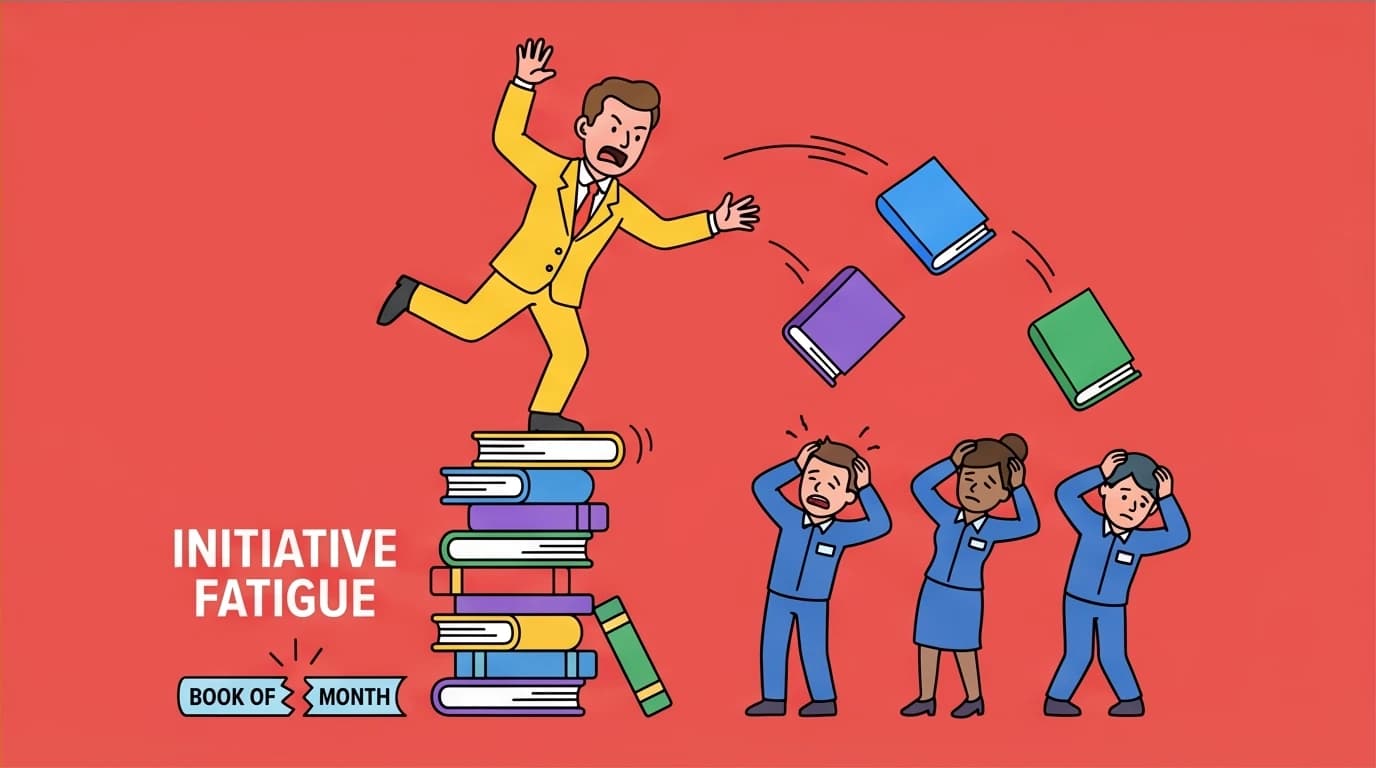
While diving into leadership development books is crucial, application requires discipline.
- Do not mandate reading: Handing out copies of a book to your entire department rarely works. It feels like homework.
- Extract and model: The most effective way to leverage books for leaders is to internalize the core thesis and model the behavior yourself.
- Implement one framework at a time: If you choose to adopt radical candor or a new goal-setting framework, stick with it for at least four quarters. Let the roots take hold.
This principle of modeling behavior is especially critical when developing the next generation of leaders within your company. While this article focuses on executive-level thinking, it's vital to equip your newly promoted staff with the right tools for their own journey.
By selecting the right texts and applying their insights with patience, you transform from a reactive manager into a visionary leader. You will no longer have to push your team forward; your culture will naturally pull them toward greatness.
FAQ
How many leadership books should an executive read a year?
Quality vastly outweighs quantity. Reading two books deeply and actually executing their frameworks will yield higher ROI than skimming 50 books. Aim for one high-impact book per quarter. Spend the rest of the quarter applying its principles to your daily team interactions and strategic planning.
Are audiobooks effective for leadership development?
Absolutely. Many executives leverage platforms like Audible to consume effective leadership books during their commutes, flights, or workouts. Because leadership concepts are highly conceptual and narrative-driven, listening is an excellent way to absorb the psychological insights without needing to sit down with a physical copy.
How do I get my management team to adopt the principles I read about?
Do not force them to read the book. Instead, change your own vocabulary and behavior first. Introduce a specific concept (like "psychological safety" or "starting with why") during your executive meetings. Once they see the positive impact these frameworks have on your decision-making and stress levels, they will naturally ask you for the resource. You lead by example, not by assignment.