


You know you need more presence in your life. You have tried the apps, read the quick articles, and maybe even sat on a cushion a few times, but surface-level tips are no longer cutting it. Searching Amazon or Barnes & Noble yields thousands of titles, leaving you completely paralyzed by choice. You want profound insights that actually change how your mind operates, not another generic self-help manual.
Finding the right resource is critical. Read the wrong book, and mindfulness feels like an esoteric chore. Read the right one, and it becomes a practical tool for psychological resilience.
Why You Need More Than Just a Meditation App
Meditation apps are excellent for building a daily habit. They act as training wheels. But to truly integrate mindfulness into your daily life—during a stressful commute, a difficult conversation, or a moment of deep anxiety—you need to understand the underlying mechanics of your own mind.
Books provide the necessary depth. They allow you to step off the cushion and explore the psychology, neuroscience, and philosophy that make mindfulness work. When you understand exactly why your brain reacts to triggers, the practice of observing your thoughts shifts from a blind exercise to a precise psychological intervention.
To help you cut through the noise, we have categorized the best mindfulness books based on specific goals. Whether you want hard scientific data, practical daily habits, or deep emotional healing, these selections represent the absolute best in the field.

For the Scientific Skeptic: Hard Evidence and Neuroscience
Many lifelong learners hesitate to dive into mindfulness because of its mystical reputation. If you need empirical data, brain scans, and evolutionary psychology to buy into the practice, these are the top books on mindfulness for you.
1. Altered Traits by Daniel Goleman and Richard J. Davidson
You have likely heard that meditation changes the brain. This book actually proves it. Written by a science journalist and a leading neuroscientist, Altered Traits strips away the hype and looks at what rigorous, peer-reviewed science actually says about mindfulness.
The authors distinguish between "states" (temporary feelings of calm during meditation) and "traits" (lasting changes in your baseline personality and brain function). They detail how sustained practice shrinks the amygdala (the brain’s fear center) and strengthens the prefrontal cortex. If you want to know exactly how your brain physically reorganizes itself through meditation, this is your definitive guide.
2. Why Buddhism is True by Robert Wright
Do not let the title fool you. This is not a religious text. Robert Wright uses evolutionary psychology to explain why human beings are biologically hardwired to suffer, feel anxious, and constantly crave more.
Wright argues that our brains evolved to survive in a prehistoric environment, not to be happy in modern society. He positions mindfulness as a profound psychological rebellion against our own evolutionary programming. By observing your thoughts without attachment, you effectively short-circuit the brain's default mode network. It is a brilliant, logical breakdown of why mindfulness is the most rational approach to modern life.
For readers who appreciate this logical, evolutionary breakdown of the human mind, you might also want to explore the intersection of neuroscience and contemplative practice. When you approach meditation from a purely rational standpoint, it becomes much easier to trust the process. If you are a skeptic looking for another brilliant, science-backed exploration of consciousness that completely avoids religious dogma, this next recommendation is a mandatory addition to your reading list.

Waking Up
Sam Harris
 15 Duration
 6 Key Points
 4.6 Rate
For the Daily Practitioner: Building a Sustainable Habit
If you already accept the science but struggle to make mindfulness a reality when you are late for a meeting or overwhelmed with emails, you need highly practical, recommended mindfulness books that focus on integration.
3. Wherever You Go, There You Are by Jon Kabat-Zinn
Jon Kabat-Zinn is largely responsible for bringing mindfulness into the American medical mainstream through his Mindfulness-Based Stress Reduction (MBSR) program at the University of Massachusetts.
This book is a modern classic. It is structured in short, highly readable chapters that you can consume in five minutes. Kabat-Zinn removes all the spiritual dogma and focuses on raw, simple presence. He teaches you how to be mindful while walking up the stairs, washing the dishes, or standing in line. It is the ultimate manual for people who think they "do not have time" to meditate.
If you are ready to stop making excuses about not having enough time to meditate, this is exactly where you should start. Jon Kabat-Zinn's straightforward, no-nonsense approach strips away the intimidation factor, making it incredibly easy to integrate small moments of awareness into your hectic daily routine. Grabbing a copy of this foundational text is the perfect first step toward building a sustainable, lifelong practice without feeling like you need to retreat to a mountaintop.

Wherever You Go, There You Are
Jon Kabat-Zinn
19 Duration8 Key Points4.6 Rate4. LeapAhead: For a Consistent Micro-Learning Habit
While not a single book, LeapAhead functions as a vast digital library designed for the modern practitioner who struggles to find time for deep reading. This microlearning app distills the key ideas from over 30,000 bestselling nonfiction books—including many on mindfulness and psychology—into 15-minute audio and text summaries. Its core strength lies in habit formation. By setting daily learning goals and leveraging short windows of time like a commute or lunch break, users can build a consistent practice of absorbing powerful concepts without the pressure of finishing a full-length book.
It’s the perfect tool for integrating wisdom into a busy schedule, especially with its curated learning paths on topics like reducing anxiety or improving focus. However, it’s important to know its limitations. The summarized format provides the essential framework of a book but may not satisfy those seeking deep, academic nuance. Furthermore, its mobile-first design is optimized for on-the-go learning and might feel less ideal for users who prefer to study on a desktop.
5. The Miracle of Mindfulness by Thich Nhat Hanh
Written by the late Zen master Thich Nhat Hanh, this book is poetic, profound, and relentlessly practical. Originally written as a long letter to a fellow monk during the Vietnam War, it explains how to find peace in the middle of absolute chaos.
The core premise is simple: mindfulness is not something you do on a cushion away from the world. It is something you do while peeling an orange, drinking tea, or interacting with your family. The writing is deceptively simple, but the applications are profound.
For further reading on this topic, explore these practical strategies for establishing a consistent practice.


LeapAhead

Absorb the core lessons from top mindfulness books in just 15 minutes a day. LeapAhead helps you build a consistent learning habit, even on your busiest days.
Once you experience the calming clarity of Thich Nhat Hanh's writing, you will likely want to explore more of his practical philosophy. His teachings excel at taking the frustration out of modern inconveniences—like being stuck in rush hour traffic or waiting in a long grocery line. If you are looking to turn those mundane, often irritating daily moments into beautiful opportunities for breath and presence, his companion work is an absolute must-read.

Peace is Every Step
Thich Nhat Hanh
37 Duration8 Key Points4.6 Rate
For Emotional Healing: Overcoming Anxiety and Self-Judgment
Sometimes, mindfulness is not just about focus; it is about learning how to sit with difficult emotions without running away from them.
6. Radical Acceptance by Tara Brach
Tara Brach is a clinical psychologist and a meditation teacher. In Radical Acceptance, she addresses what she calls the "trance of unworthiness"—the persistent, nagging feeling that we are somehow flawed or not doing enough.
Brach merges Western psychology with Eastern philosophy to teach the practice of letting things be. She provides clear techniques for recognizing painful emotions, allowing them to exist without judgment, and responding to them with self-compassion. If you struggle with perfectionism, anxiety, or harsh inner criticism, this book offers a literal lifeline.
While books like Radical Acceptance provide the foundational philosophy for emotional healing, applying these concepts in moments of high stress requires specific exercises.
Maximizing Your Reading When Short on Time
As a busy professional or active learner, sitting down with a 300-page book is not always feasible. You can still absorb these psychological frameworks by changing how you consume the content.
Leverage Audio Format
Audiobooks about mindfulness offer a unique advantage over physical text: the transmission of tone. Listening to Jon Kabat-Zinn or Tara Brach read their own work on Audible provides an immediate calming effect. The pacing of their speech naturally slows down your own racing thoughts.
Audiobooks turn dead time into growth time. A 45-minute commute or a treadmill session becomes a masterclass in psychology. For titles focused on guided practices or emotional healing, audio is often the superior format.
Speaking of audio formats, if you are a chronically busy professional who still feels resistant to traditional meditation, listening to a fellow skeptic's journey can be incredibly motivating. Hearing a relatable, down-to-earth voice explain how they overcame their own anxiety and resistance makes the practice feel much more accessible. This next recommendation is perfect for your morning commute, offering a humorous, highly practical roadmap for anyone who thinks their mind is just too active to sit still.
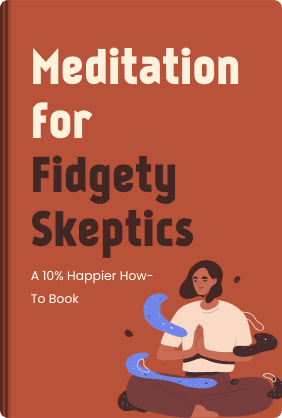
Meditation for Fidgety Skeptics
Dan Harris, Jeff Warren, Carlye Adler
36 Duration9 Key Points4.6 RateUtilize Summaries for Filtration
With so many titles available, you do not need to commit 10 hours to a book just to see if its framework resonates with you. Using mindfulness book summaries is a highly efficient strategy for lifelong learners.
Services and written summaries allow you to digest the core thesis, the primary psychological models, and the main actionable takeaways in about 15 minutes. Use summaries to audit a book. If the core concepts of Altered Traits or Radical Acceptance spark a real shift in your thinking during the summary, you then buy the full book to dive deep into the nuances and case studies.
LeapAhead
Turn your reading list into actionable knowledge. LeapAhead summarizes thousands of books like the ones in this article, making deep learning accessible anytime.
The Biggest Pitfall: The Intellectualization Trap
The most common mistake intelligent, curious people make is mistaking intellectual understanding for actual practice.
You can read all the best mindfulness books on the market. You can memorize the function of the default mode network. You can perfectly articulate the philosophy of non-attachment. But none of that matters if you do not actually sit and observe your breath.
Reading about push-ups does not build muscle. Reading about mindfulness does not rewire your nervous system.
To avoid the intellectualization trap, change your reading habits. Do not binge-read a mindfulness book over a weekend. Read one chapter. Then, put the book down and spend the next three days practicing the specific technique or perspective discussed in that chapter. Treat these books as laboratory manuals, not novels.
If you're ready to move from reading to doing, our beginner's guide provides the perfect first steps.
FAQ
What is the absolute best mindfulness book for a complete beginner?
Wherever You Go, There You Are by Jon Kabat-Zinn is the undisputed starting point. It requires zero prior knowledge, carries no religious baggage, and offers immediate, practical exercises you can start using the exact same day you read it.
Wherever You Go, There You Are by Jon Kabat-Zinn is the undisputed starting point. It requires zero prior knowledge, carries no religious baggage, and offers immediate, practical exercises you can start using the exact same day you read it.
Are audiobooks about mindfulness as effective as reading physical copies?
Yes, and in some cases, they are better. Hearing an experienced teacher pace their words can actively calm your nervous system. Audio formats are especially effective for books that include guided breathing exercises or focus on self-compassion. However, for dense, science-heavy books like Altered Traits, a physical copy might be better for taking notes and reviewing data.
Yes, and in some cases, they are better. Hearing an experienced teacher pace their words can actively calm your nervous system. Audio formats are especially effective for books that include guided breathing exercises or focus on self-compassion. However, for dense, science-heavy books like Altered Traits, a physical copy might be better for taking notes and reviewing data.
How do I use mindfulness book summaries without missing the core message?
Use summaries as a filtration system, not a replacement for deep reading. Read a summary to understand the author's primary framework. If the framework directly addresses your current psychological bottlenecks, buy the full book. Mindfulness requires nuance, context, and time to absorb—things a 10-minute summary simply cannot fully provide.
Use summaries as a filtration system, not a replacement for deep reading. Read a summary to understand the author's primary framework. If the framework directly addresses your current psychological bottlenecks, buy the full book. Mindfulness requires nuance, context, and time to absorb—things a 10-minute summary simply cannot fully provide.
I have read several books, but my mind still wanders constantly. Am I doing it wrong?
No. Mind-wandering is not a failure; it is the biological reality of the human brain. Every time you realize your mind has wandered and you gently bring your focus back to the present, you are doing a "rep." The books listed above, particularly Why Buddhism is True, emphasize that realizing you are distracted is the actual moment of mindfulness.
No. Mind-wandering is not a failure; it is the biological reality of the human brain. Every time you realize your mind has wandered and you gently bring your focus back to the present, you are doing a "rep." The books listed above, particularly Why Buddhism is True, emphasize that realizing you are distracted is the actual moment of mindfulness.