

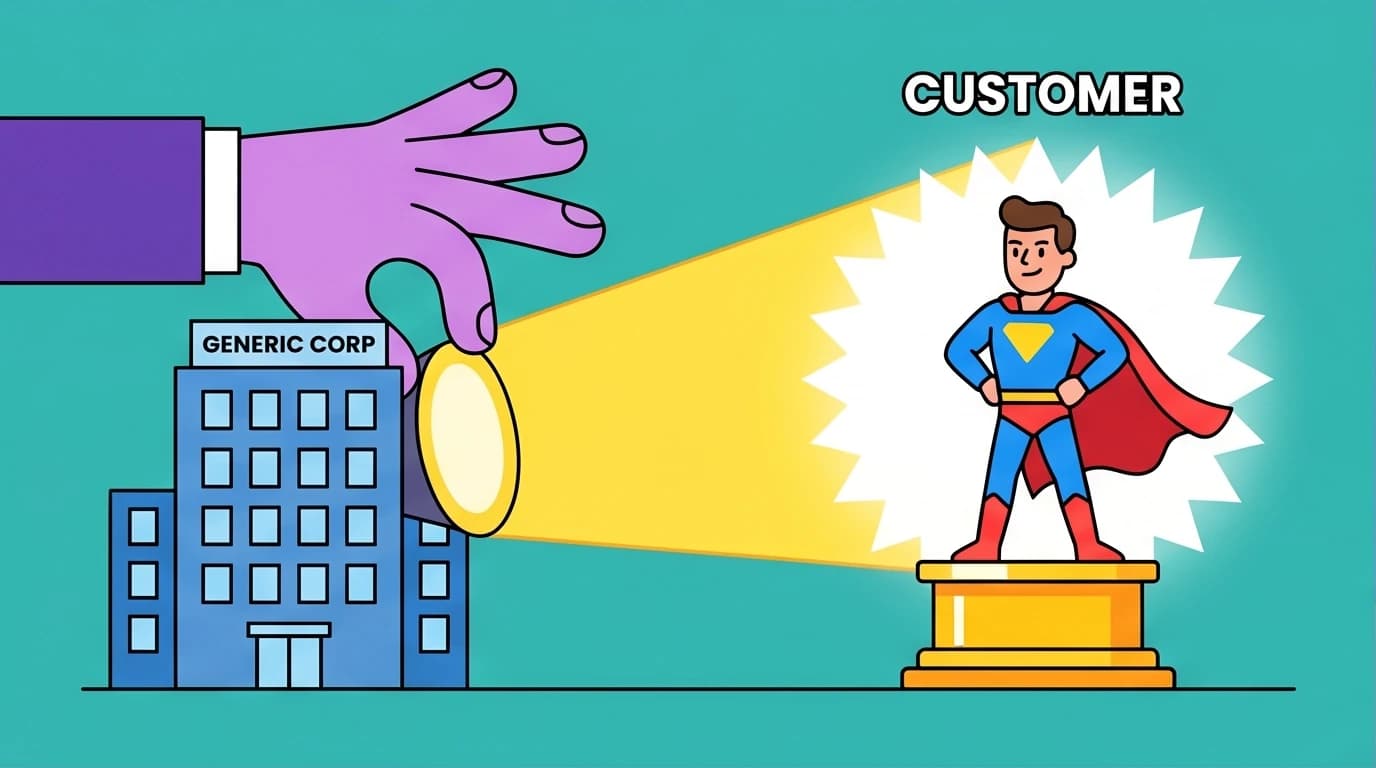
You pour money into ads, launch a beautiful website, and optimize your funnels. Yet, visitors bounce without buying. The hard truth is that people do not buy the best products; they buy the products they can understand the fastest. If your marketing message is confusing, you are losing customers to competitors who communicate clearly.
When your marketing focuses on how long your company has been in business or how advanced your features are, you are asking your customers to burn mental energy. The brain is wired to conserve calories. If a visitor cannot figure out exactly how you survive or thrive within five seconds of landing on your site, they leave.
If you are looking for a practical building a StoryBrand summary, you are in the right place. We are going to strip away the noise and break down the exact methodology thousands of businesses use to clarify their message.
The Core Philosophy: The Customer is the Hero
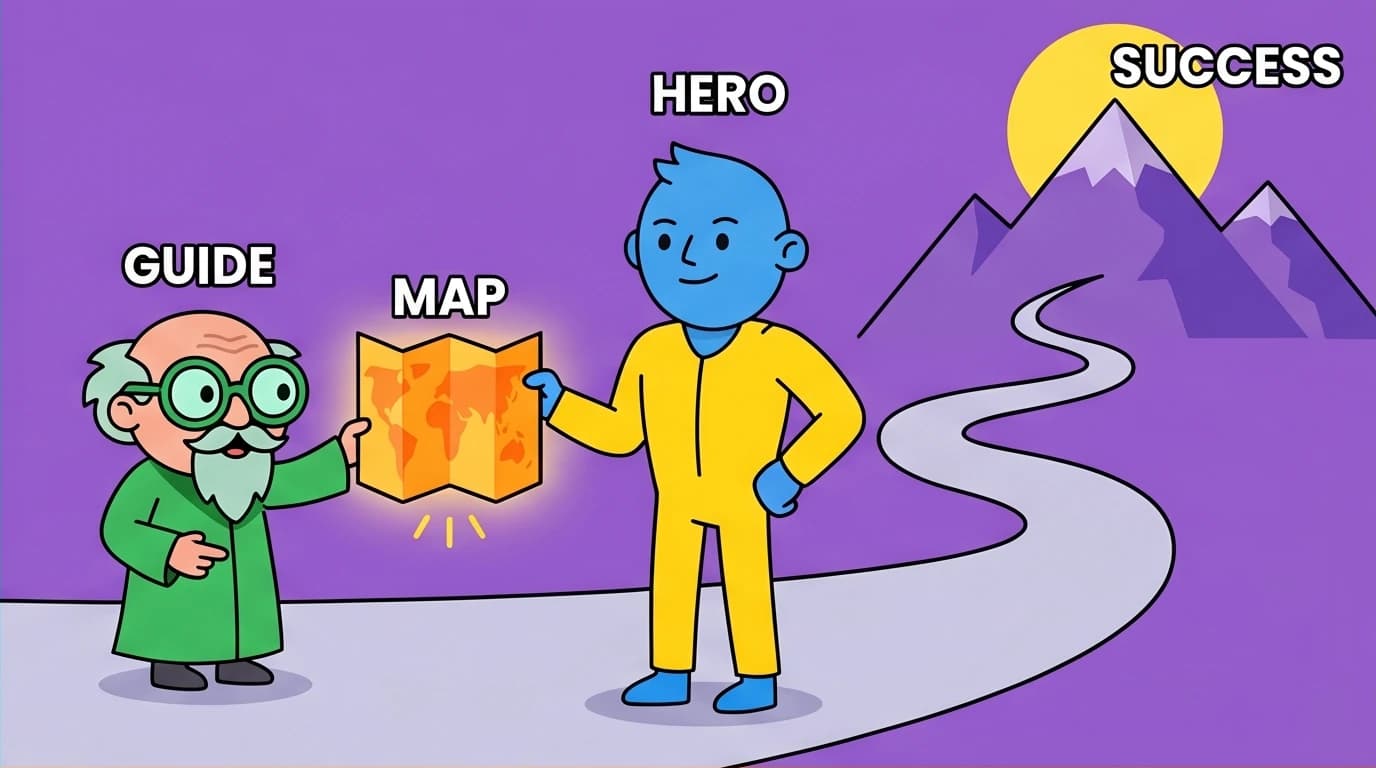
Before diving into the steps, you must realize the fundamental paradigm shift Donald Miller introduces. In every great movie, a hero goes on a journey, meets a guide, and overcomes a conflict.
Most companies make a fatal mistake: they position themselves as the hero. They talk about their awards, their massive office, and their grand vision. Customers do not care about your story. They care about their own.
To win in today's market, your brand must play the role of the Guide (like Yoda), helping the Hero (Luke Skywalker) win the day. This is the foundation of any comprehensive Donald Miller book summary. When you play the guide, you empower the customer.
This fundamental shift is the most powerful takeaway from Miller's work. To see a detailed breakdown of how this approach works in practice, it's worth exploring the concept more deeply.
If this core philosophy is resonating with you, there is no better next step than diving directly into the source material. Donald Miller’s complete book lays out exactly how to shift your brand’s focus from being the hero to playing the guide. It is packed with real-world examples and deep dives into customer psychology that will completely transform how you talk about your business and connect with your audience.
Building a StoryBrand
Donald Miller
 25 Duration
 11 Key Points
 4.5 Rate
If you're eager to apply this framework but find your reading list is already packed, you can get a head start by absorbing the book's core concepts first.

Grasp the essentials of *Building a StoryBrand* and other business bestsellers with 15-minute summaries you can read or listen to.
Download LeapAhead App now
The StoryBrand 7 Part Framework
The core engine of this methodology is the SB7 Framework. It maps the structure of nearly every successful movie and novel directly onto your marketing strategy. Here is the StoryBrand 7 part framework broken down into actionable business principles.
1. A Character (The Customer)
Every story starts with a character who wants something. In your marketing, you must identify a clear, singular desire your customer has regarding your product or service.
Do not dilute your message by listing 15 different things your customer wants. Pick one core desire.
- Bad: "We offer accounting, tax prep, HR consulting, and wealth management."
- Good: "Keep more of the money you make."
When you define exactly what the customer wants, you invite them into a story. They immediately recognize, "This is for me."
2. Has a Problem
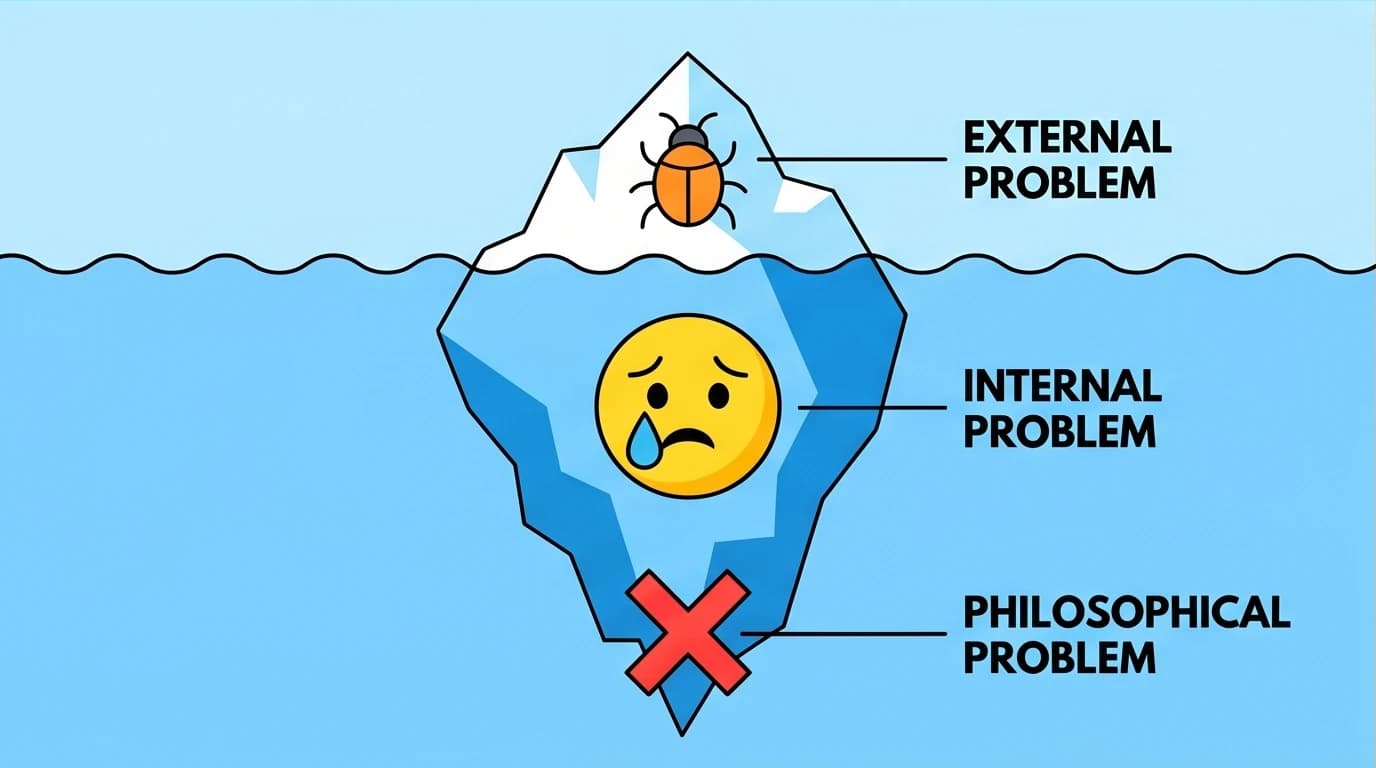
This is the most critical part of having the StoryBrand framework explained. Customers buy solutions to internal problems, not just external ones. Miller divides problems into three levels:
- External Problem: The physical, tangible issue. (e.g., A messy lawn).
- Internal Problem: How the external problem makes them feel. (e.g., I feel embarrassed when my neighbors see my yard).
- Philosophical Problem: Why it is just plain wrong for them to carry this burden. (e.g., You shouldn't have to spend your only day off sweating in the yard).
If you sell a pest control service in Florida, the external problem is bugs. But the internal problem is the feeling that their home is unsafe or unclean. Address the internal problem in your copy, and your conversion rates will spike.
3. And Meets a Guide (Your Business)
If the hero could solve the problem alone, they would have done it already. They are stuck. They need a guide.
To establish your business as the guide, you must demonstrate two qualities:
- Empathy: Show them you understand their pain. ("We know how frustrating it is to waste money on ads that don't convert.")
- Authority: Prove you can help them. This is where you place a few recognizable logos, quick testimonials, or statistics. You do not need to brag; just show them you have the map to get them out of the woods.
Stepping into the role of the guide requires a fundamental shift in how you view your marketing efforts. Instead of shouting to get attention, the goal is to show up with genuine empathy and offer real solutions. If you want to master this modern, customer-centric approach to connecting with your audience, Seth Godin’s profound insights on the subject are an absolute must-read. He beautifully explains how to market by serving others rather than just selling to them.
This Is Marketing
Seth Godin
36 Duration8 Key Points4.5 Rate4. Who Gives Them a Plan
Even if the hero trusts the guide, taking action is scary. Buying a new software, hiring a contractor, or changing a diet requires a leap of faith. You must eliminate the risk by providing a simple plan.
A Process Plan removes the fog. It should be no more than three or four steps:
- Schedule a quick discovery call.
- Get a customized strategy.
- Watch your revenue grow.
When you break down the buying process into three simple steps, the customer thinks, "I can do that."
5. And Calls Them to Action
Heroes do not take action unless they are forced to. You must challenge your customers to buy.
Weak calls to action (CTAs) like "Learn More" or "Get Started" are passive. You need a Direct Call to Action. It should be obvious and repeated frequently across your website.
- Examples: "Buy Now," "Schedule an Appointment," "Claim Your Free Trial."
You should also offer a Transitional Call to Action for those who are not ready to marry you on the first date. This is a lead generator, like downloading a free PDF or watching a webinar, in exchange for their email address.
6. That Helps Them Avoid Failure
Every good story has stakes. If there is no danger of failure, there is no story. What happens if your customer decides not to do business with you?
You must politely but clearly remind them of the negative consequences of inaction. Will they lose weekends to manual data entry? Will they waste thousands of dollars? Will their health deteriorate?
Don't use fear-mongering, but don't hide the stakes. A pinch of salt brings out the flavor; a pinch of failure brings out the urgency.
7. And Ends in Success
You must cast a vision of how great the customer's life will be after using your product. Tell them what their life will look like.
Use vivid imagery and clear copy to paint a picture of resolution. If you sell organizing solutions for closets, show them the pristine, color-coordinated wardrobe and the feeling of a stress-free morning routine. Tell them they will save time, gain status, or experience peace of mind.
Once you have mapped out your customer's journey from their initial problem to their ultimate success, the next challenge is making sure your message actually stays in their minds. You want your marketing to be so clear and memorable that it immediately clicks for your audience. If you are struggling to make your core ideas resonate, exploring the science behind why certain messages thrive while others fade away can give you a massive competitive advantage.
Made to Stick
Chip Heath, Dan Heath
52 Duration9 Key Points4.5 RateExecuting the Strategy: The Grunt Test
Understanding the framework is only half the battle. The real value comes when you apply it to your digital storefront.
Donald Miller talks about the "Grunt Test." Imagine a caveman looking at your website. Can he grunt the answers to these three questions within five seconds?
- What do you offer?
- How will it make my life better?
- What do I need to do to buy it?
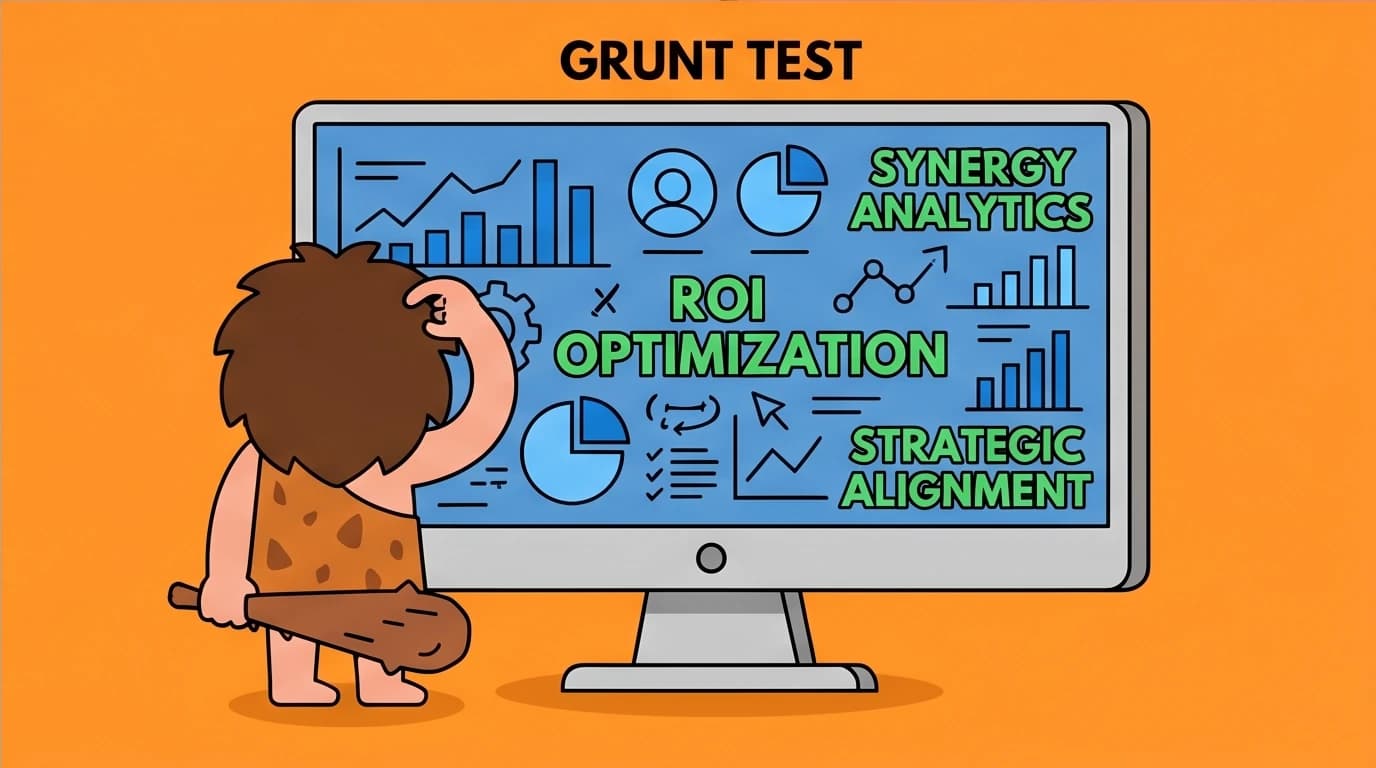
If your website header says, "Synergistic Solutions for a Better Tomorrow," you fail the test.
Instead, change it to: "Software That Automates Your Payroll. Save 10 Hours a Week. Start Your Free Trial."
Seeing this principle applied to a full homepage is the best way to understand its power. For inspiration, you can review websites that have successfully implemented this clear messaging approach.
Building Your BrandScript
To implement this framework, you need to map out your own BrandScript. This is a single document that organizes your marketing message according to the seven steps above.
Many teams create a physical document to align their sales, marketing, and product departments. If you search for a StoryBrand PDF summary online, you will often find templates specifically designed to help you fill in the blanks for your Character, Problem, Guide, Plan, CTA, Failure, and Success.
While a blank template is a good start, seeing completed examples for different types of businesses can provide the clarity needed to craft your own powerful message.
Whether you grab the book off Amazon, listen on Audible on your commute, or pick it up at Barnes & Noble, the real work begins when you take a blank sheet of paper and write down exactly who your customer is and what problem you are solving for them.
For busy entrepreneurs who want to learn from books like these but struggle to find the time, fitting learning into the gaps of your day is key.
Master the core ideas of top business books like *Building a StoryBrand* in just 15 minutes during your commute or workout.
Download LeapAhead App now
Once your BrandScript is clear, you use it to write your website, email campaigns, lead generators, and sales pitches. You will never stare at a blank screen wondering what to write again.
Filling out your BrandScript is incredibly empowering, but weaving those elements into a compelling narrative across your website and emails is an art form in itself. Once you know your customer's journey, you need to confidently tell the specific stories that will capture their attention and drive conversions. If you are ready to take your brand's storytelling to the next level and put your newly clarified message into action, learning how to craft captivating business narratives is the perfect next step.
Stories That Stick
Kindra Hall
29 Duration9 Key Points4.7 RateFAQ
Does the StoryBrand framework work for B2B companies?
Yes. B2B buyers are still human beings whose brains are trying to conserve calories. In fact, because B2B products (like enterprise software or logistics services) are often complex, using a simple, story-driven framework is even more critical. It cuts through industry jargon and clearly communicates the return on investment.
How long does it take to create a BrandScript?
A dedicated founder or marketing team can map out a solid first draft of a BrandScript in a few hours. However, refining it often takes a few days of iteration, testing it against the "Grunt Test," and getting feedback from actual customers to ensure the internal and external problems hit the mark.
Should I create a different BrandScript for every product?
Yes. If you serve entirely different customer avatars or sell distinct products, you should create an overarching "Corporate BrandScript" for the company as a whole, and then separate, specific BrandScripts for individual products or services. Mixing multiple target audiences into one script dilutes the message.
Can I use StoryBrand for my personal brand or resume?
Absolutely. When applying for a job or building a personal brand, the hiring manager or client is the Hero. You are the Guide. Your resume or LinkedIn profile should clearly state the problems you solve for companies (the Hero), the plan you use to execute your work, and the success you have generated for past employers.