


You work long hours, hit your metrics, and wait for recognition. Yet, the major promotions and high-stakes projects go to someone else. Hard work without a strategic direction is a fast track to burnout. To break out of the mid-level grind, you need a precise system to map your trajectory and force the outcomes you want. Hope is not a strategy. You need a deliberate framework to transform vague ambitions into inevitable realities.
Reverse Engineering Your 5 Year Career Plan
Most professionals look at where they are today and try to guess the next logical step. High achievers do the exact opposite. They define the endpoint and build the bridge backward. A robust 5 year career plan acts as your personal GPS, filtering out distractions and low-value tasks.

Define the Endpoint Concrete Metrics
Stop using abstract goals like "become a senior manager." Define the exact parameters of your target role five years from now.
- What is the exact job title?
- What is the target salary or equity package?
- What scale of budget or headcount will you manage?
- What specific industry problems will you be solving?
The Milestone Breakdown
Once the five-year marker is set, divide the timeline into ruthless, actionable increments:
- Year 3 Objective: The necessary stepping-stone role. If you want to be a VP of Marketing in five years, Year 3 requires you to be a Director managing a specific channel.
- Year 1 Objective: The immediate pivot. This involves acquiring the exact certification, leading the specific project, or building the exact network required to qualify for the Year 3 role.
- 90-Day Sprints: The daily execution. What can you do this quarter? It might mean taking an online course, shadowing a senior executive, or migrating a legacy system to a new platform to prove your technical chops.
Breaking down long-term career ambitions into 90-day sprints is often where professionals struggle the most. If you find yourself overwhelmed by the sheer scale of a five-year roadmap, it helps to compress your timeline. A highly effective framework for this is treating a 12-week period as a standalone year, forcing you to maintain urgency and focus on high-impact tasks. For a deep dive into mastering this quarterly execution cycle, check out this transformative guide.

The 12 Week Year
Brian P. Moran, Michael Lennington
 39 Duration
 7 Key Points
 4.6 Rate
Of course, a plan is only as good as its execution. Turning these 90-day sprints into consistent action requires discipline and the right systems. To learn more, read our detailed guide on how to ensure your roadmap leads to real results.
Architecting Professional Development Goals That Drive Value
Companies do not pay you for your internal growth; they pay you for the value you deliver. Your professional development goals must directly increase your market value and solve critical business problems.
Conduct a Ruthless Skill Gap Analysis
Identify the leaders you admire in your industry. Analyze their LinkedIn profiles, read the books they recommend (whether that means browsing Barnes & Noble or listening on Audible), and dissect their career paths. List the skills they possess that you currently lack. Categorize these into:
- Hard Skills: Data analytics, specific software proficiency, financial modeling.
- Soft Skills: Conflict resolution, public speaking, cross-functional communication.
The "Learn-Apply-Teach" Framework
Do not just list "improve communication" as a goal. Structure your development around actionable proof.
- Learn: Read industry-standard materials or take an executive course.
- Apply: Implement a new framework in your current role within 30 days.
- Teach: Organize a lunch-and-learn session for your team to share the methodology. Teaching solidifies your knowledge and visibly positions you as a subject matter expert in the eyes of your peers.
But finding the time to read every recommended book on leadership, productivity, and strategy can be a challenge, especially when you're already working long hours.

This app helps you absorb the core insights from bestselling business books in just 15 minutes, making it easy to stay sharp during your commute or lunch break.

Download LeapAhead App now

Gaining these rare and valuable skills—what many call "career capital"—is the true secret to standing out in a crowded United States job market. Rather than just following your passion, strategically acquiring the hard and soft skills that companies desperately need gives you unparalleled leverage. If you want a proven philosophy on how to deliberately build a skillset that makes you an indispensable asset to any organization, this read is an absolute game-changer.

So Good They Can't Ignore You
Cal Newport
22 Duration9 Key Points4.6 RateMastering Leadership Goal Setting Before You Have the Title
Leadership is a behavior, not a title. If you wait until you are promoted to act like a leader, the promotion will never happen. Leadership goal setting requires a shift from individual execution to systemic impact.

Shift from Output to Leverage
Individual contributors focus on their own task completion. Leaders focus on multiplying the output of others. Set goals that demonstrate leverage:
- Mentoring junior team members to reduce onboarding time by 20%.
- Creating standard operating procedures (SOPs) that automate repetitive team workflows.
- Volunteering to mediate and solve bottlenecks between departments (e.g., aligning Sales and Marketing on lead definitions).
Cultivate Executive Presence
Set clear goals around your visibility. Commit to speaking up in high-stakes meetings with data-backed insights. Take ownership of project failures without throwing colleagues under the bus, and distribute credit during wins. These deliberate actions signal to current executives that you are ready to join their ranks.
Moving from a high-performing individual contributor to an executive role requires a fundamental shift in behavior. The technical skills that helped you crush your early career goals are often the exact things holding you back from the C-suite. To successfully cultivate that coveted executive presence and eliminate the unconscious workplace habits that derail promotions, consider diving into this classic leadership manual. It perfectly illustrates why a change in mindset is required for that next upward leap.

What Got You Here Won't Get You There
Marshall Goldsmith
15 Duration7 Key Points4.3 RateSetting Goals for Performance Review Success
Performance reviews should never be a surprise. You must control the narrative by front-loading the expectations. Setting goals for performance review cycles requires treating your boss as your most important client.
Align with the Company OKRs
Your manager is under pressure to hit specific metrics. Your goals must be the solution to their problems. If the company's Q3 objective is to reduce customer churn by 15%, your personal goal must map directly to that outcome. Propose a project where you audit customer feedback loops. When review time comes, you are not asking for a promotion based on tenure; you are asking for fair compensation for driving bottom-line revenue.
While this article focuses on aligning with existing company objectives, understanding the mechanics behind them can give you a significant advantage. For a deeper look into popular systems like SMART and OKRs, explore our guide to help you set more powerful and measurable objectives.
Aligning your personal career goals with massive corporate objectives can sometimes feel like trying to steer a cruise ship with a paddle. However, when you understand the mechanics of how top-tier organizations set and execute their most wildly important goals, you can position your own projects right in the center of their strategy. For a masterclass in how to bridge the gap between daily operations and overarching company targets, this book offers an indispensable framework.
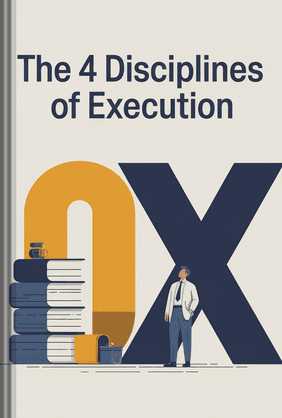
The 4 Disciplines of Execution
Chris McChesney, Sean Covey, and Jim Huling
20 Duration9 Key Points4.6 RateCreate a "Brag Document"
Human memory is flawed. Your manager will only remember what you did in the four weeks leading up to the review. Set a recurring weekly goal to log your wins, positive client feedback, and metrics exceeded. When you sit down for the review, present a concrete, data-heavy portfolio of your achievements.
Fatal Traps That Derail Career Roadmaps
Even the best strategies fail when executed poorly. Avoid these critical mistakes:
- The Loyalty Illusion: Believing that simply staying at a company for years guarantees advancement. Tenure means nothing without expanding your impact.
- Over-Index on Certifications: Collecting degrees and certificates without applying them to real-world business problems. A certification is a tool, not an outcome.
- Failing to Manage Up: Keeping your goals a secret. If your manager does not know you want to be a Director, they will not give you the projects required to prove you can do the job.
Avoiding these traps often comes down to understanding the mental roadblocks that sabotage our best intentions. If you want to explore the underlying reasons why we sometimes fail to follow through, our article on the topic offers powerful insights into overcoming these barriers.
Your career is your most valuable asset. Treat it like a high-growth startup. Define the vision, allocate your time rigorously, and ruthlessly measure your progress.
To keep that high-growth mindset sharp, you need a steady intake of powerful ideas. If you’re too exhausted to pick up a book after a long day, there’s a smarter way to keep learning.
Use your commute or workout time to listen to key ideas from books on leadership and strategy, ensuring you’re always learning without facing burnout.
Download LeapAhead App now
FAQ
How often should I review and update my career goals?
Review your 90-day sprint goals monthly to ensure you are on track. Conduct a deep dive into your 5-year plan annually. Market conditions, industry trends, and personal priorities shift; your roadmap needs to adapt to those realities without losing sight of the ultimate destination.
Review your 90-day sprint goals monthly to ensure you are on track. Conduct a deep dive into your 5-year plan annually. Market conditions, industry trends, and personal priorities shift; your roadmap needs to adapt to those realities without losing sight of the ultimate destination.
What if my current company does not support my professional development goals?
You are the CEO of your career. If your current employer lacks the resources, mentorship, or upward mobility you need, execute your development goals outside of company hours. Build your portfolio, network aggressively, and use your current role to extract as much practical experience as possible while preparing for an external move.
You are the CEO of your career. If your current employer lacks the resources, mentorship, or upward mobility you need, execute your development goals outside of company hours. Build your portfolio, network aggressively, and use your current role to extract as much practical experience as possible while preparing for an external move.
How do I handle goal setting if I plan to pivot to an entirely different industry?
Focus entirely on transferable skills. When reverse-engineering your plan, identify the core competencies the new industry requires (e.g., project management, data analysis, client relations). Set immediate goals to volunteer for cross-functional projects in your current job that allow you to build and document those specific skills, making your resume undeniable when you make the jump.
Focus entirely on transferable skills. When reverse-engineering your plan, identify the core competencies the new industry requires (e.g., project management, data analysis, client relations). Set immediate goals to volunteer for cross-functional projects in your current job that allow you to build and document those specific skills, making your resume undeniable when you make the jump.