


You buy a fresh planner from Barnes & Noble, write down a massive list of ambitions, and feel unstoppable. Fast forward three months, and that planner is collecting dust. The problem is not a lack of willpower. It is a lack of a concrete system.
When you rely solely on motivation, you fail the moment friction appears. Vague desires like "get in shape" or "start a side hustle" do not survive contact with reality. You need a structure that forces clarity, demands action, and measures progress.
Below are the most reliable, research-backed frameworks to organize your targets and build a foolproof execution plan.
The Baseline of Execution: The SMART Goals Framework
The SMART goals framework is the gold standard for personal and professional planning. It forces you to take abstract ideas and put them through a rigorous filter. SMART stands for Specific, Measurable, Achievable, Relevant, and Time-bound.
If your goal cannot check all five boxes, it is just a wish.
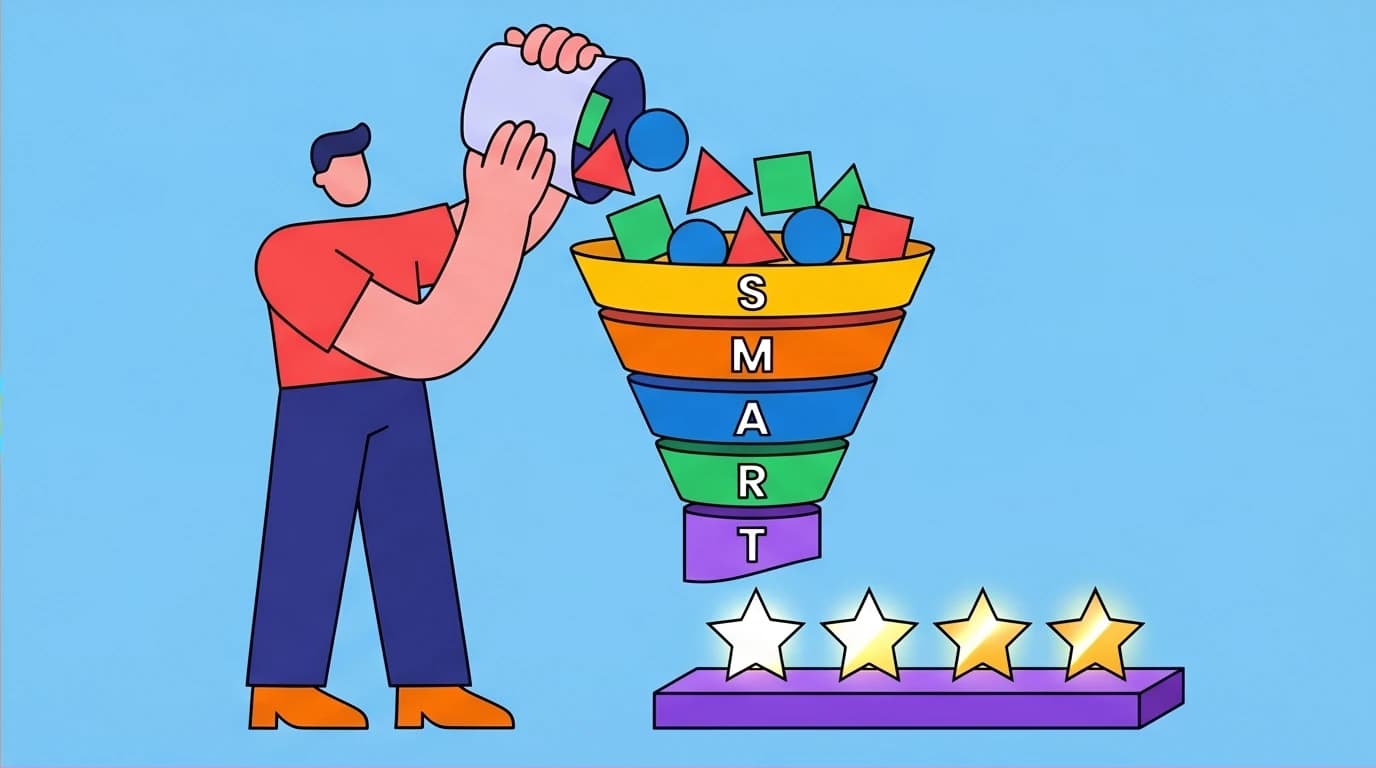
- Specific: Detail exactly what you want. Instead of "I want to run," use "I want to run a 5K race."
- Measurable: You need a number to track. "Lose weight" is a concept. "Lose 10 pounds" is measurable.
- Achievable: The goal must stretch you but remain within the realm of physics and your current resources. Don't plan to become an Amazon bestseller in one week if you haven't written page one.
- Relevant: Does this align with your long-term vision? If your primary focus is saving money for a house, buying a $3,000 espresso machine to "learn barista skills" is a distraction.
- Time-bound: A deadline creates urgency. Set a hard date.
Example in action:
Bad goal: I want to grow my freelance business.
SMART goal: I will acquire three new monthly retainer clients by the end of Q2 by sending 20 personalized cold emails per week.
Bad goal: I want to grow my freelance business.
SMART goal: I will acquire three new monthly retainer clients by the end of Q2 by sending 20 personalized cold emails per week.
The Growth Engine: Objectives and Key Results (OKRs)
While SMART is perfect for predictable outcomes, OKRs are built for exponential growth. Originally developed at Intel and popularized in Silicon Valley, this framework separates the inspirational direction from the hard data.
- Objective: What do you want to achieve? This is a short, memorable, and qualitative statement. It should feel slightly uncomfortable and highly ambitious.
- Key Results: How will you measure progress toward that objective? These are 3 to 5 quantitative targets. If you hit the Key Results, you achieve the Objective.
Example in action:
Objective: Launch a top-tier personal finance podcast.
Key Result 1: Secure 5 interviews with recognized industry experts by March 1st.
Key Result 2: Achieve 10,000 total downloads in the first 30 days.
Key Result 3: Maintain a 4.8-star average rating on Apple Podcasts from at least 100 reviews.
Objective: Launch a top-tier personal finance podcast.
Key Result 1: Secure 5 interviews with recognized industry experts by March 1st.
Key Result 2: Achieve 10,000 total downloads in the first 30 days.
Key Result 3: Maintain a 4.8-star average rating on Apple Podcasts from at least 100 reviews.

If you are intrigued by how OKRs can propel exponential growth, there is no better guide than the venture capitalist who brought the system to Google. Measure What Matters dives deep into how the biggest tech companies in the United States use Objectives and Key Results to align teams and crush ambitious targets. It is packed with real-world case studies that show you exactly how to apply this framework to your own professional or personal milestones.

Measure What Matters
John Doerr
 47 Duration
 9 Key Points
 4.5 Rate
OKR vs SMART Goals: Which Fits Your Mission?
Understanding OKR vs SMART goals saves you from using the wrong tool for the job.
Use the SMART goals framework when the path to success is clear and you need 100% completion. It works best for habit building, personal finance milestones, and strict operational tasks. If you need to save $5,000 for a down payment, you want a SMART goal.
Use OKRs when you are pushing into unknown territory. OKRs are designed to stretch your capabilities. In the OKR philosophy, achieving 70% of your Key Results is considered a massive success because the initial target was set so high. Use OKRs for launching a new product, scaling a business, or completely overhauling a major life area.
The Reality Check: The WOOP Method
Optimism often kills goals. You visualize the finish line but ignore the hurdles. The WOOP method, developed by psychologist Gabriele Oettingen, uses "mental contrasting" to anchor your goals in reality.
- Wish: What is your meaningful target?
- Outcome: What is the best possible result of achieving it?
- Obstacle: What is the specific internal or external roadblock that will try to stop you?
- Plan: If [Obstacle] happens, then I will do [Action].
If your goal is to read more books, the obstacle might be mindlessly scrolling on your phone after work. Your plan: "If I sit on the couch after 7 PM, I will place my phone in another room and open my Kindle."
How to Set Achievable Goals: A 4-Step Execution Plan
Knowing the frameworks is useless if you don't integrate them into your daily life. Here is how to set achievable goals without getting overwhelmed.
Step 1: The Brainstorm and Purge
Write down everything you want to accomplish. Then, apply Warren Buffett’s 5/25 rule. Circle your top five priorities. Cross out the other 20. Those 20 are now your "avoid at all costs" list until the top five are complete. Focus is defined by what you say no to.
Purging your list of distractions is incredibly difficult, especially in an American work culture that constantly glorifies hustle and multitasking. If you struggle with narrowing down your focus, The ONE Thing is a game-changing read. The authors break down the psychology of why doing less is truly more, offering a clear strategy to identify the single most important task in any given moment. It is an essential guide for ensuring your narrowed-down priorities actually lead to massive results.

The ONE Thing
Gary Keller, Jay Papasan
22 Duration10 Key Points4.5 RateThis article, and the books it recommends, are packed with valuable frameworks. If finding the time to read them all feels like another overwhelming goal, you can absorb their core lessons more efficiently.

Grasp key ideas from goal-setting books like The ONE Thing in 15-minute audio or text summaries, turning your commute or workout into a powerful learning session.

Download LeapAhead App now
Step 2: Assign the Right Framework
Look at your surviving targets. Assign them to the proper structure. Is it a massive, ambitious project? Map it out with OKRs. Is it a specific, linear task like passing a certification exam? Use the SMART goals framework.
Step 3: Map the Leading Indicators
Most people track the wrong metrics. If you want to lose 15 pounds, the scale is a lagging indicator. It tells you what already happened. You cannot control the scale directly. You can only control the leading indicators—the daily inputs. Track the calories consumed and the miles run. Focus purely on hitting your daily inputs, and the lagging indicator will take care of itself.
Step 4: Institute a Weekly Review
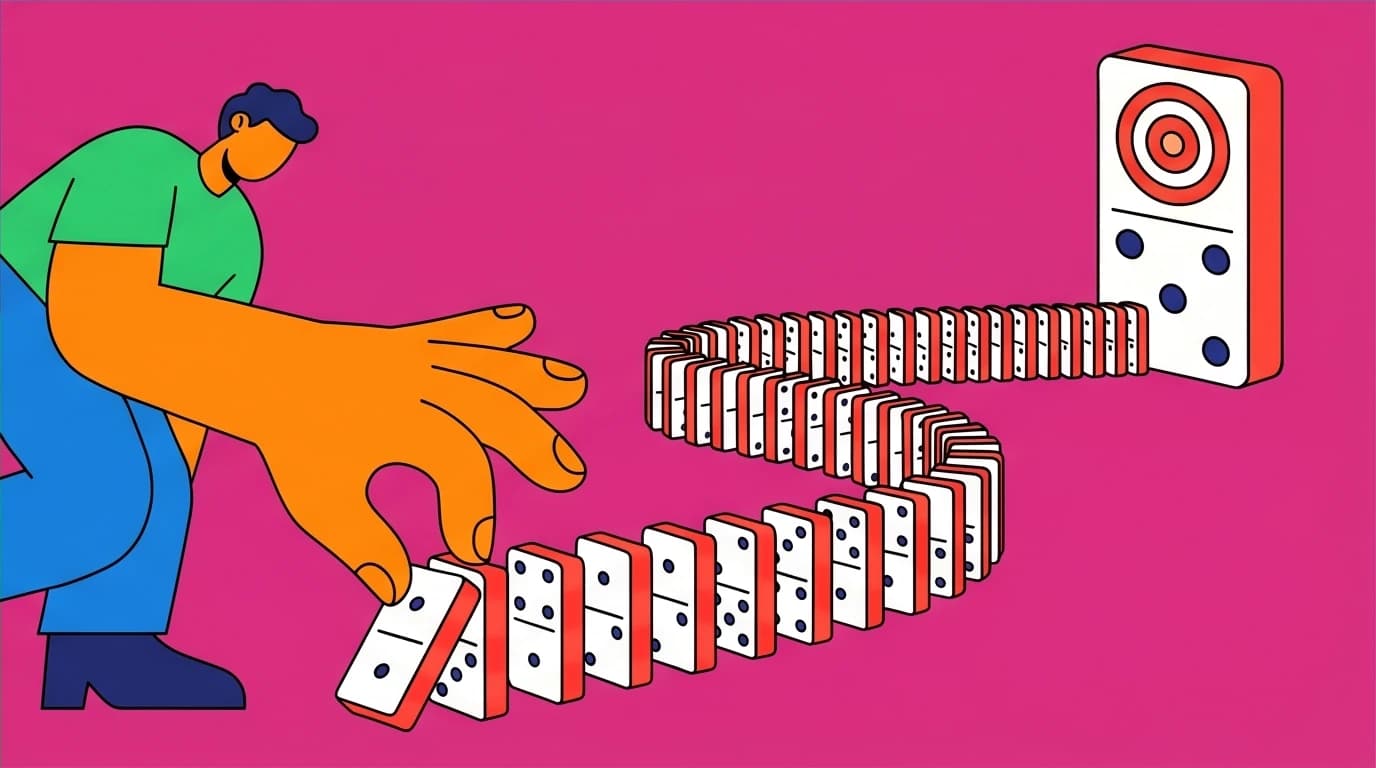
Goals die in silence. You must review your progress at least once a week. Pick a specific time—Sunday evening at 6 PM—to look at your numbers. Did you hit your weekly milestones? If not, where did the friction occur? Adjust your plan for the upcoming week immediately.
Advanced Goal Setting Techniques to Prevent Failure
To bulletproof your execution, pair your frameworks with these psychological goal setting techniques.
1. Environment Design
Willpower is a finite resource. Do not rely on it. Design your environment to make good behaviors easy and bad behaviors hard. If you want to eat healthier, do not buy junk food at the grocery store. If you want to study for an hour every morning, leave your textbook open on your desk the night before.
Willpower is a finite resource. Do not rely on it. Design your environment to make good behaviors easy and bad behaviors hard. If you want to eat healthier, do not buy junk food at the grocery store. If you want to study for an hour every morning, leave your textbook open on your desk the night before.
2. The 12-Week Year Concept
Annual goals create a false sense of security. If your deadline is December 31st, you will procrastinate until November. Shrink your timeline. Treat every 12 weeks as a full year. This compresses your deadlines, forces immediate action, and accelerates your learning curve.
Annual goals create a false sense of security. If your deadline is December 31st, you will procrastinate until November. Shrink your timeline. Treat every 12 weeks as a full year. This compresses your deadlines, forces immediate action, and accelerates your learning curve.
Ready to completely overhaul your relationship with time and deadlines? The 12 Week Year is the definitive playbook for compressing your execution cycles and ditching the sluggish pace of annual planning. The authors provide a structured, step-by-step methodology to help you achieve more in just a few months than most people do in an entire calendar year. It is a fantastic resource if you want to implement this exact advanced technique and maintain sky-high momentum.

The 12 Week Year
Brian P. Moran, Michael Lennington
39 Duration7 Key Points4.6 Rate3. Habit Stacking
Tie a new habit required for your goal to an existing daily habit. If you want to practice a new language for 10 minutes a day, stack it onto your morning coffee routine. "After I start the coffee maker, I will complete one lesson on my language app."
Tie a new habit required for your goal to an existing daily habit. If you want to practice a new language for 10 minutes a day, stack it onto your morning coffee routine. "After I start the coffee maker, I will complete one lesson on my language app."
Common Traps That Destroy Progress
Even with the best effective goal setting frameworks, certain behaviors will sabotage your results. Avoid these at all costs:
- The "All or Nothing" Mentality: You miss one workout, decide the week is ruined, and quit until Monday. Success requires consistency, not perfection. If you stumble, immediately get back on track the very next day.
- Focusing on Outcomes Over Systems: A goal sets the direction; a system makes the progress. If you are a writer, the goal is publishing a book. The system is writing 500 words before breakfast. Obsess over the system.
- Setting Conflicting Targets: You cannot simultaneously train for a 50-mile ultramarathon and attempt a massive powerlifting record. Respect the limits of your physical energy and time. Sequence your goals instead of stacking them.
As you start prioritizing systems over outcomes and designing an environment that limits friction, you might be looking for a comprehensive guide on behavior change. Atomic Habits is widely considered the ultimate manual for building resilient systems that last. It masterfully explains how microscopic daily changes compound into monumental life transformations. From habit stacking to identity shifts, this book will teach you how to fall in love with the process of execution so that you never rely on fleeting motivation again.

Atomic Habits
James Clear
26 Duration8 Key Points4.7 RateMastering these frameworks is an ongoing process of learning and refinement. For those who want to consistently absorb the knowledge from top business and productivity books but struggle to find the hours, a microlearning approach can be a game-changer.
Build a powerful learning habit by listening to key insights from bestselling books on goal setting and execution in just 15 minutes a day, even when you're too tired for traditional reading.
Download LeapAhead App now
FAQ
Why do my SMART goals still fail?
SMART goals usually fail because the "Achievable" metric was miscalculated, or the goal lacked an underlying daily system. Setting a SMART goal creates the map, but you still have to drive the car. You must break the goal down into daily or weekly recurring tasks to see actual movement.
SMART goals usually fail because the "Achievable" metric was miscalculated, or the goal lacked an underlying daily system. Setting a SMART goal creates the map, but you still have to drive the car. You must break the goal down into daily or weekly recurring tasks to see actual movement.
How many goals should I focus on at once?
Keep it between one and three. Spreading your attention across seven different targets guarantees you will make microscopic progress on all of them. Achieve one or two significant milestones, solidify them into your routine, and then add new targets.
Keep it between one and three. Spreading your attention across seven different targets guarantees you will make microscopic progress on all of them. Achieve one or two significant milestones, solidify them into your routine, and then add new targets.
What is the actual difference between a goal and a system?
A goal is the specific result you want to achieve (e.g., land a promotion). A system is the continuous process you follow to get there (e.g., taking on one new leadership task per week and reading industry journals for 20 minutes daily). Goals provide direction; systems provide traction.
A goal is the specific result you want to achieve (e.g., land a promotion). A system is the continuous process you follow to get there (e.g., taking on one new leadership task per week and reading industry journals for 20 minutes daily). Goals provide direction; systems provide traction.
What happens if I fall behind on my OKR timeline?
Do not panic or abandon the framework. OKRs are designed to be highly ambitious. If you are falling behind, use your weekly review to diagnose the bottleneck. Are your Key Results actually measurable? Did you hit a resource constraint? Adjust your tactics for the next week, but keep pushing toward the Objective. Remember, a 70% completion rate on a massive OKR is often better than 100% on a safe, easy task.
Do not panic or abandon the framework. OKRs are designed to be highly ambitious. If you are falling behind, use your weekly review to diagnose the bottleneck. Are your Key Results actually measurable? Did you hit a resource constraint? Adjust your tactics for the next week, but keep pushing toward the Objective. Remember, a 70% completion rate on a massive OKR is often better than 100% on a safe, easy task.