

Your chest feels tight, your mind is racing through worst-case scenarios, and telling yourself to "just calm down" is completely useless. When anxiety takes over, you do not need generic advice; you need a hard reset for your brain. The methods below bypass vague affirmations. They are practical, evidence-based mechanics designed to interrupt the anxiety spiral and put you back in the driver's seat.

The Core Mechanism: How CBT Interrupts Anxiety
Anxiety thrives on a specific feedback loop known in psychology as the Cognitive Triangle. Your thoughts, feelings, and behaviors are entirely interconnected.
If you think, "I am going to fail this presentation" (Thought), your body releases adrenaline causing your heart to race (Feeling), which makes you stutter or avoid eye contact (Behavior). That awkward behavior then reinforces your initial fear, starting the cycle all over again.
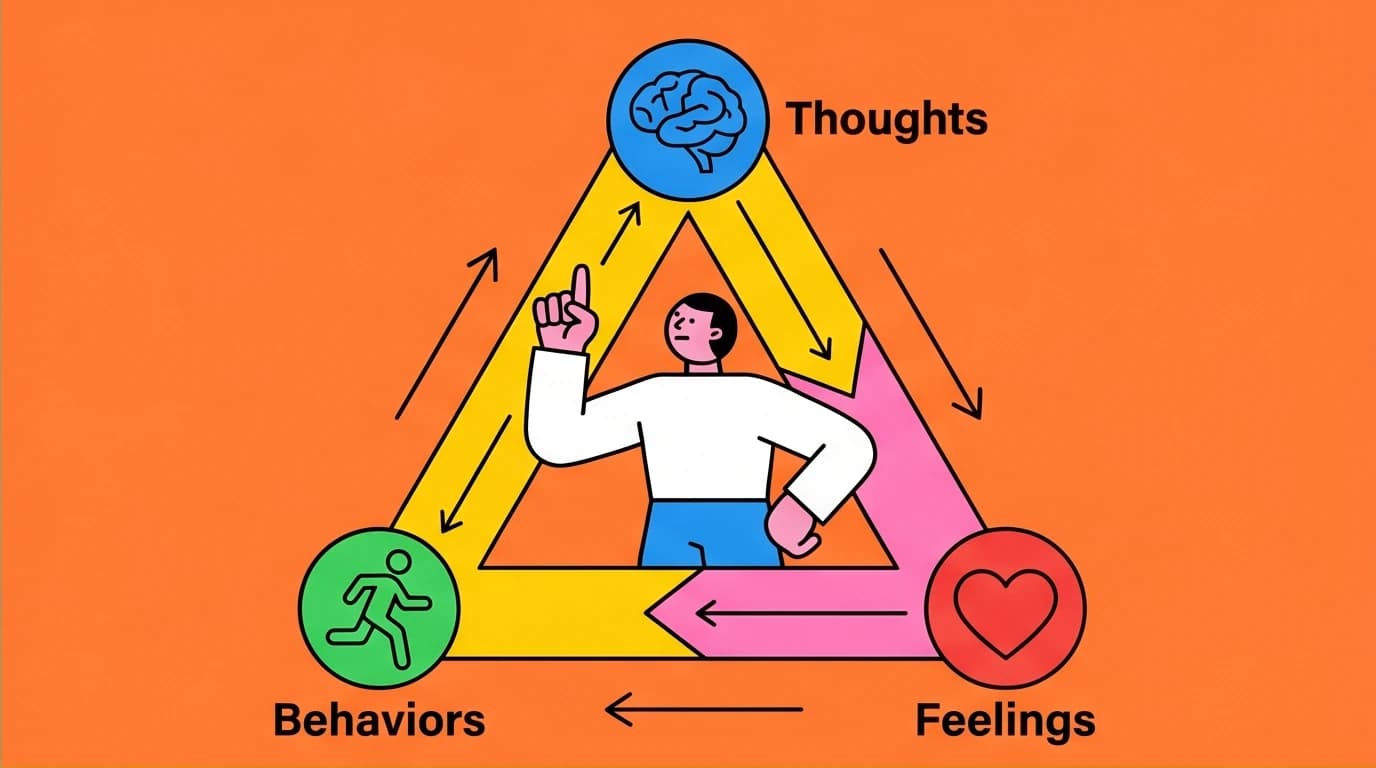
You cannot easily force your feelings to change. You can, however, forcefully change your thoughts and your behaviors. By targeting these two access points, CBT techniques for anxiety dismantle the panic loop from the inside out.
Understanding this core principle is the first step. Before diving into specific techniques, it can be helpful to get a complete overview of the therapy itself.
Immediate Relief: At Home CBT Techniques
When panic peaks, your logical brain (the prefrontal cortex) practically shuts down. You cannot analyze your thoughts when you feel like you are fighting a bear. You need behavioral at home CBT techniques to anchor your physical body first.
The 5-4-3-2-1 Grounding Method
This exercise forces your brain to process heavy sensory information, leaving no bandwidth for anxious loops. Look around your current environment and identify:
- 5 things you can see: Look for specific details. The grain of the wood on your desk, the color of a coffee mug, a crack in the pavement.
- 4 things you can physically feel: The fabric of your shirt, the weight of your shoes on the floor, the temperature of the air on your skin.
- 3 things you can hear: Traffic outside, the hum of the refrigerator, a distant dog barking.
- 2 things you can smell: Your own deodorant, coffee, or fresh air from a window.
- 1 thing you can taste: A mint, a sip of water, or just the lingering taste of your last meal.
Tactical Box Breathing
Navy SEALs use this exact behavioral technique to regulate their nervous systems in high-stress combat zones. It forces your heart rate to slow down, signaling to your brain that the immediate threat has passed.
- Inhale through your nose for a count of 4.
- Hold that breath in for a count of 4.
- Exhale completely through your mouth for a count of 4.
- Hold your lungs empty for a count of 4.
- Repeat this cycle four times.
These immediate grounding techniques are incredibly effective because they give you practical, bite-sized ways to regulate your nervous system on the fly. When you are building your personal mental health toolkit, having access to the exact strategies clinical psychologists teach their patients can be a total game-changer. If you are looking to expand your arsenal of at-home coping mechanisms, Dr. Julie Smith has compiled an incredible resource. She takes the most effective, evidence-based therapy techniques and breaks them down into easily digestible, everyday tools you can use the second anxiety strikes.

Why Has Nobody Told Me This Before?
Dr. Julie Smith
 23 Duration
 8 Key Points
 4.6 Rate
Breaking the Loop: Cognitive Behavioral Therapy Exercises
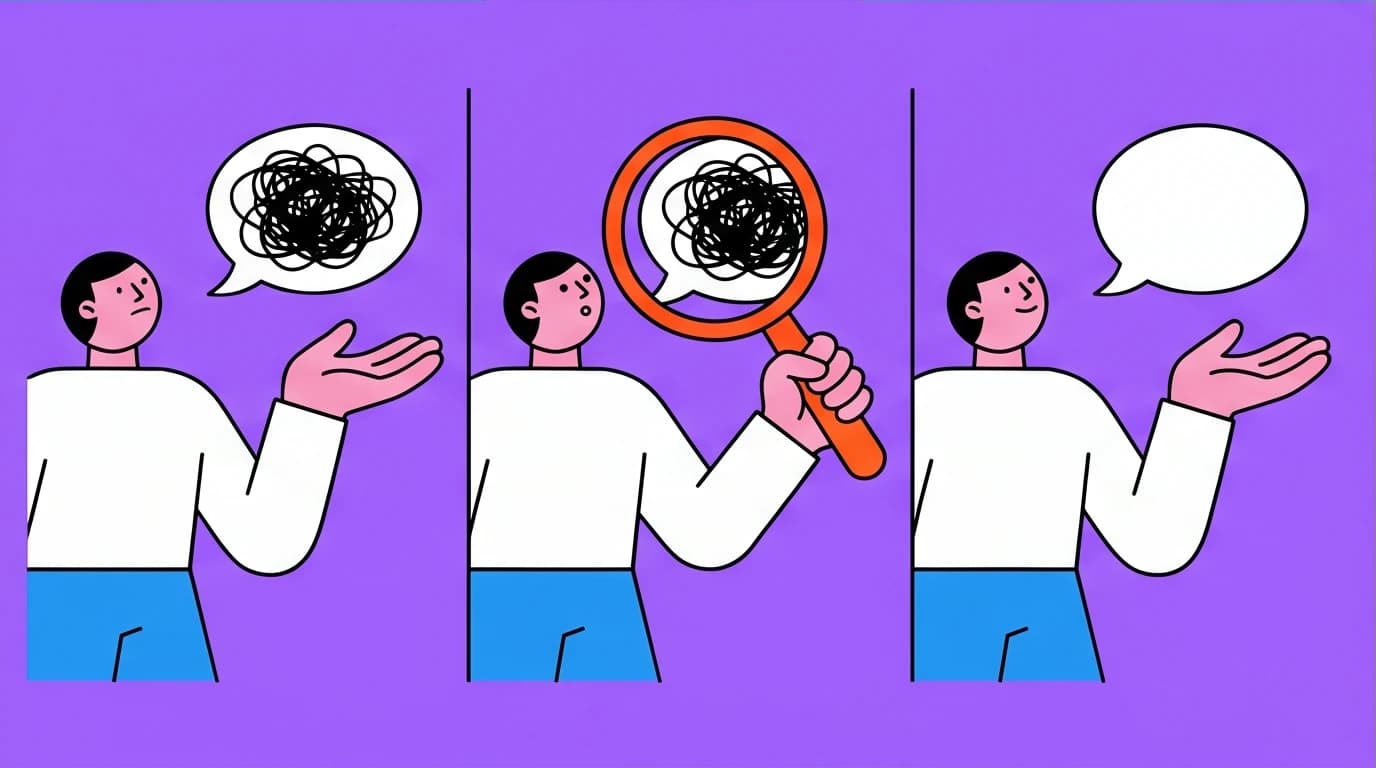
Once your physical body is grounded, you can target the mental loop. These cognitive behavioral therapy exercises train you to treat your thoughts as hypotheses rather than absolute facts.
The "Catch It, Check It, Change It" Framework
Anxious thoughts are automatic. They sneak in and take over before you even realize what happened. This framework slows the process down.
1. Catch It
Identify the exact thought driving the anxiety. Write it down on paper. Getting it out of your head and onto a physical page removes half its power.
Example: "My boss didn't say good morning. I am definitely getting fired."
Identify the exact thought driving the anxiety. Write it down on paper. Getting it out of your head and onto a physical page removes half its power.
Example: "My boss didn't say good morning. I am definitely getting fired."
2. Check It
Put the thought on trial. Act like a lawyer examining the evidence.
Put the thought on trial. Act like a lawyer examining the evidence.
- What is the factual evidence supporting this thought? (She didn't say hi).
- What is the factual evidence against this thought? (I just got a great performance review last month. She looked rushed and was carrying three folders).
- Is this a cognitive distortion? (Yes, this is "Mind Reading" and "Catastrophizing").
3. Change It
Draft a new, balanced thought based entirely on the evidence you just gathered. This is not about toxic positivity; it is about objective reality.
New thought: "My boss ignored me, which feels uncomfortable, but she was likely just distracted by her own busy morning. My job is secure based on my recent performance review."
Draft a new, balanced thought based entirely on the evidence you just gathered. This is not about toxic positivity; it is about objective reality.
New thought: "My boss ignored me, which feels uncomfortable, but she was likely just distracted by her own busy morning. My job is secure based on my recent performance review."
Cognitive Restructuring Examples
To successfully apply the framework above, you need to know what a restructured thought actually looks like. Here are common cognitive restructuring examples covering typical daily stressors.
Scenario 1: Social Anxiety at a Party
- Automatic Thought: "Everyone noticed I spilled a drop of water on my shirt. They all think I am an awkward mess." (Distortion: Spotlight Effect).
- Restructured Thought: "People are mostly focused on their own conversations. I barely notice when other people spill things, so they likely do not care about my shirt."
This type of cognitive restructuring is especially powerful for social phobias, where the fear of judgment often fuels a cycle of avoidance. For those situations, a targeted approach can make all the difference.
Scenario 2: Health Anxiety
- Automatic Thought: "My chest hurts slightly; I am definitely having a heart attack." (Distortion: Catastrophizing).
- Restructured Thought: "I just did a heavy chest workout yesterday, and I am highly stressed right now. A tight chest is a normal symptom of anxiety and muscle fatigue. I will monitor it calmly."
Scenario 3: Perfectionism in College/Work
- Automatic Thought: "If I don't get an A on this final, my entire GPA is ruined and I won't get into grad school." (Distortion: All-or-Nothing Thinking).
- Restructured Thought: "One test does not dictate my entire future. I have studied hard, and even a B is a solid grade that keeps me highly competitive."
Learning how to identify and restructure these cognitive distortions is the bedrock of overcoming anxiety, but it takes consistent repetition to rewire your brain's default settings. If you frequently find yourself falling into the traps of catastrophic thinking or the spotlight effect, reading up on how to dismantle these mental habits can accelerate your progress. Clinical psychologist Andrea Bonior offers a fantastic deep dive into recognizing and neutralizing the automatic thoughts that drag you down. Her practical approach helps you strip away the emotional weight of your thoughts so you can evaluate them with pure logic.
Detox Your Thoughts
Andrea Bonior, Ph.D.
18 Duration7 Key Points4.6 RateEssential CBT Tools for Anxiety
Building resilience requires daily practice. Use these specific CBT tools for anxiety to build a long-term defense system against worry.
The Daily Thought Record
A thought record is the most effective tool in the CBT arsenal. Grab a notebook or create a spreadsheet. Whenever you feel a sudden spike in anxiety, fill out these columns:
- Situation: What were you doing? (e.g., Opening an email).
- Emotion: What did you feel, and how intense was it? (e.g., Panic, 80%).
- Automatic Thought: What crossed your mind? (e.g., "This is a complaint from a client").
- Evidence For: Why might this be true?
- Evidence Against: Why is this likely false?
- Alternative Thought: A realistic view of the situation.
- New Emotion Intensity: How strong is the panic now? (Usually drops to 30% or lower).
Doing this repeatedly builds new neural pathways. Eventually, your brain will start auto-correcting negative thoughts without needing the physical paper.
The daily thought record is arguably the single most powerful exercise in modern psychology, but mastering it requires seeing plenty of real-world examples. If you want to get serious about dismantling your anxiety through written cognitive exercises, you should learn from the psychiatrist who helped popularize Cognitive Behavioral Therapy for the masses. Dr. David D. Burns provides an absolute masterclass in using thought records to instantly shift your mood. His updated methodologies offer step-by-step guidance on how to crush the cognitive distortions that fuel daily panic and depression.
Feeling Great
David D. Burns, MD
20 Duration9 Key Points4.6 RateScheduled "Worry Time"
When you tell yourself "Stop worrying," your brain rebels and worries harder. Instead, use a paradox intervention. Schedule a strict 15-minute appointment with your anxiety every single day.
- Pick a time: 4:30 PM.
- Pick a place: The dining table (never your bed).
- During the day, when an anxious thought pops up, write it on a sticky note and tell your brain, "We will worry about this at 4:30."
- At 4:30 PM, set a timer for 15 minutes. Worry as hard as you can. Look at your sticky notes.
- When the timer goes off, get up, physically walk away, and transition to a highly engaging task like cooking dinner or calling a friend.
You are teaching your brain that you control when and where anxiety is allowed to speak.
Paradoxical interventions like scheduling your worry time are brilliant because they directly address the exhausting nature of an overactive brain. When you try to fight your anxious thoughts, you inadvertently give them more power. If you constantly feel like your mind is swinging from one catastrophic scenario to the next, learning how to peacefully coexist with your thoughts without feeding them is essential. Psychotherapist Jennifer Shannon wrote a brilliant guide on exactly this topic. She explains how to stop fueling the "monkey mind" so you can finally break the cycle of chronic worry and avoidance.

Don't Feed the Monkey Mind
Jennifer Shannon
21 Duration8 Key Points4.4 Rate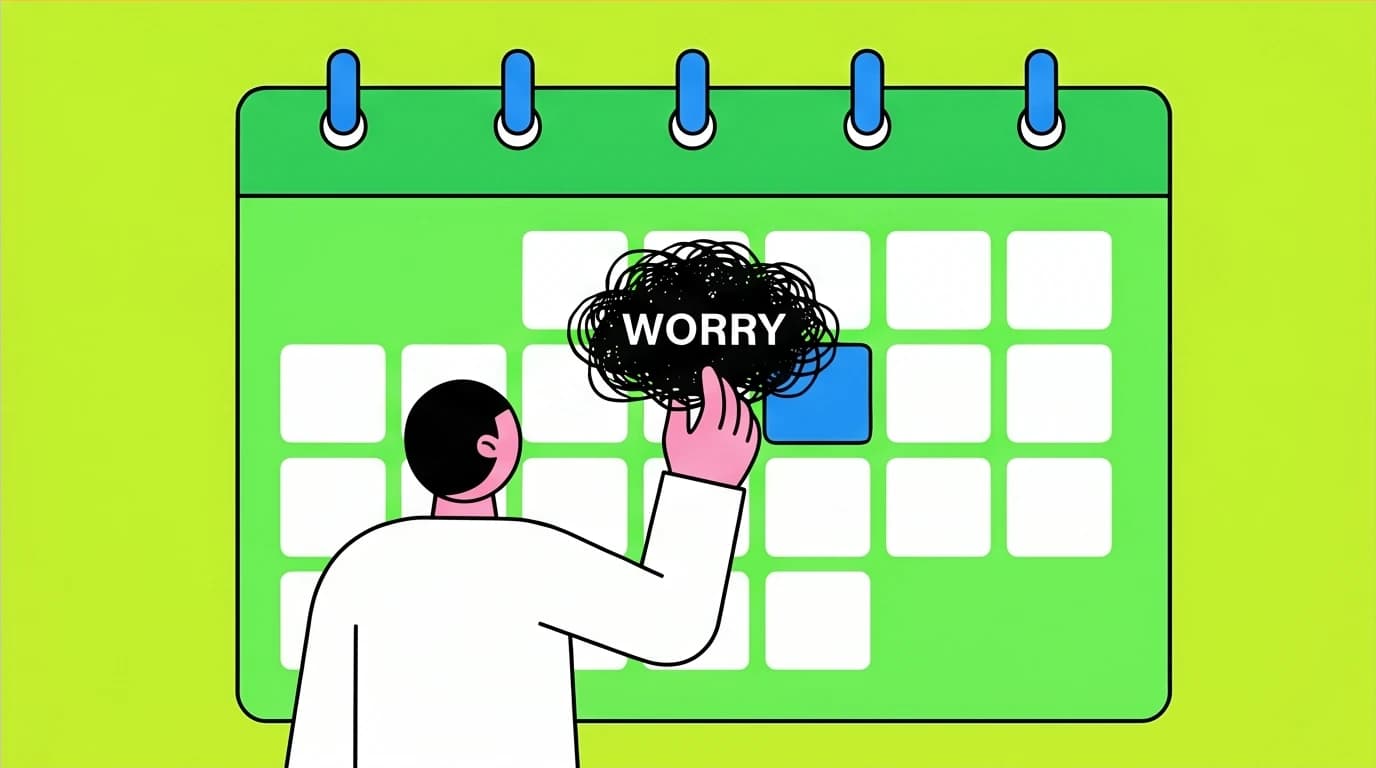
Behavioral Experiments
Anxiety tells you lies about what will happen if you face a fear. A behavioral experiment tests that lie.
If your anxiety says, "If I speak up in the Zoom meeting, everyone will laugh at me," design a small, safe experiment.
If your anxiety says, "If I speak up in the Zoom meeting, everyone will laugh at me," design a small, safe experiment.
- The Plan: Ask one simple, clarifying question in tomorrow's meeting.
- The Prediction: "People will scoff or roll their eyes."
- The Result: You ask the question. The manager answers it normally and moves on.
- The Takeaway: Your anxious prediction was completely inaccurate.
These tools are most effective when they become ingrained habits rather than one-off solutions. Integrating them into your routine is key to managing everyday stress.
Common Pitfalls and How to Avoid Them
Even highly effective techniques fail if applied incorrectly. Avoid these common mistakes when managing your anxiety at home.
Trying to logic your way out of a panic attack.
Never try to fill out a thought record when your heart rate is 120 beats per minute. Your prefrontal cortex is offline. You must use grounding techniques and breathing first to bring your physiological state back to baseline. Only attempt cognitive restructuring when you are physically calm.
Never try to fill out a thought record when your heart rate is 120 beats per minute. Your prefrontal cortex is offline. You must use grounding techniques and breathing first to bring your physiological state back to baseline. Only attempt cognitive restructuring when you are physically calm.
Confusing realistic thinking with positive thinking.
CBT is not about repeating phrases like "Everything is perfect and I am universally loved." If you make a mistake at work, telling yourself "I am a flawless employee" feels like a lie, and your anxiety will reject it. Aim for objective, boring reality: "I made a mistake, I will fix it, and it will be forgotten by next week."
CBT is not about repeating phrases like "Everything is perfect and I am universally loved." If you make a mistake at work, telling yourself "I am a flawless employee" feels like a lie, and your anxiety will reject it. Aim for objective, boring reality: "I made a mistake, I will fix it, and it will be forgotten by next week."
Giving up after the first try.
Your brain has spent years building the neural highways for anxiety. Practicing a new CBT technique for two days will not instantly pave a new road. Treat these exercises like going to the gym for your mind. Consistency is the only way to see permanent structural changes in how you process stress.
Your brain has spent years building the neural highways for anxiety. Practicing a new CBT technique for two days will not instantly pave a new road. Treat these exercises like going to the gym for your mind. Consistency is the only way to see permanent structural changes in how you process stress.
Building this consistency can feel daunting, especially when your mental energy is low. A great way to stay engaged with these concepts is to integrate learning into small, manageable moments, like your daily commute or a short walk.


Absorb key insights from bestselling psychology books in just 15-minute audio sessions, making it easier to build your mental health toolkit on busy or low-energy days.
 LeapAhead
FAQ
Can I do CBT on my own without a therapist?
Yes. Mild to moderate anxiety responds extremely well to self-guided CBT. The techniques are designed to be practical and self-administered. However, if your anxiety prevents you from completing basic daily tasks, sleeping, or working, you should partner with a licensed CBT therapist to guide your practice.
Yes. Mild to moderate anxiety responds extremely well to self-guided CBT. The techniques are designed to be practical and self-administered. However, if your anxiety prevents you from completing basic daily tasks, sleeping, or working, you should partner with a licensed CBT therapist to guide your practice.
How long does it take for CBT to work for anxiety?
Grounding and breathing exercises provide relief within minutes by directly altering your nervous system. Cognitive restructuring, however, takes time. Most people start noticing a significant, automatic decrease in background anxiety after 3 to 4 weeks of consistent, daily practice with thought records.
Grounding and breathing exercises provide relief within minutes by directly altering your nervous system. Cognitive restructuring, however, takes time. Most people start noticing a significant, automatic decrease in background anxiety after 3 to 4 weeks of consistent, daily practice with thought records.
What if I can't identify the specific thought making me anxious?
This is very common. Sometimes anxiety manifests purely as a physical dread before you register the thought. When this happens, work backward. Notice the physical sensation (e.g., tight chest). Ask yourself: "What was I looking at or doing exactly 10 seconds before my chest got tight?" Often, tracking the physical trigger will lead you right to the hidden automatic thought.
This is very common. Sometimes anxiety manifests purely as a physical dread before you register the thought. When this happens, work backward. Notice the physical sensation (e.g., tight chest). Ask yourself: "What was I looking at or doing exactly 10 seconds before my chest got tight?" Often, tracking the physical trigger will lead you right to the hidden automatic thought.
Is scheduled worry time actually safe? Won't it just make me more anxious?
It sounds counterintuitive, but it works precisely because it removes the constant, low-grade dread from your entire day. By confining the worry to a specific 15-minute window, you stop fighting the anxiety entirely. You acknowledge it, box it up, and open it only on your own terms. Most people find that when their "worry time" actually arrives, they no longer care about half the things they wrote down.
It sounds counterintuitive, but it works precisely because it removes the constant, low-grade dread from your entire day. By confining the worry to a specific 15-minute window, you stop fighting the anxiety entirely. You acknowledge it, box it up, and open it only on your own terms. Most people find that when their "worry time" actually arrives, they no longer care about half the things they wrote down.