

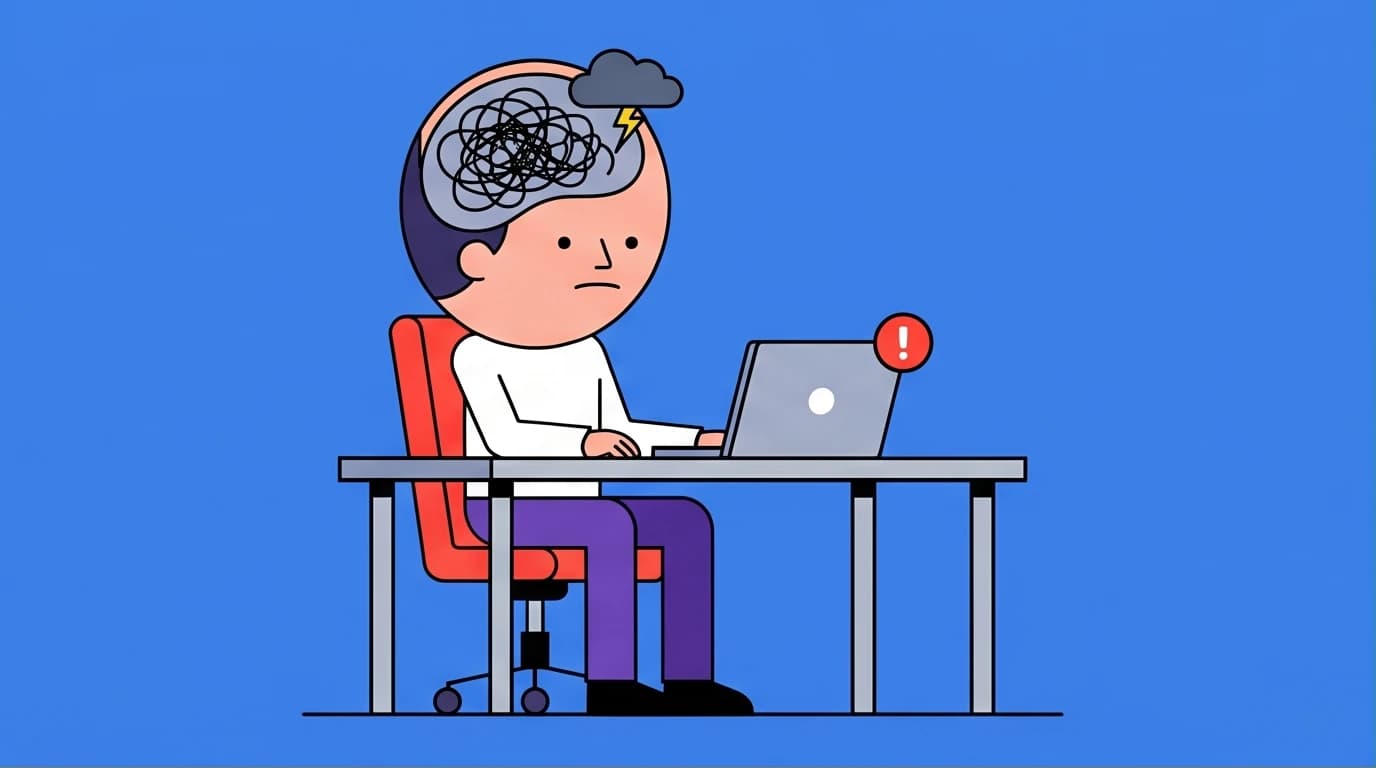
You see a random calendar invite from your manager titled "Quick Sync" pop up on your screen. Instantly, your heart rate spikes. Your mind bypasses logic and jumps straight to: I'm getting fired. Your stomach ties itself in knots, and your productivity for the next two hours drops to zero.
This is an automatic negative thought spiral. It drains your energy, kills your focus, and leaves you physically exhausted.
You do not need to schedule a 50-minute session on a therapist's couch every time this happens. While professional therapy is incredibly valuable, the true power of cognitive behavioral therapy lies in its daily application. If you want to build long-term mental resilience, you need to know how to practice CBT for anxiety daily. By turning psychological principles into bite-sized, actionable habits, you take control of your emotional regulation.
The Mechanics of DIY Cognitive Behavioral Therapy
Before you build a routine, you must understand the engine driving it. At cross, CBT operates on a very simple premise: Your thoughts, feelings, and behaviors are entirely connected.
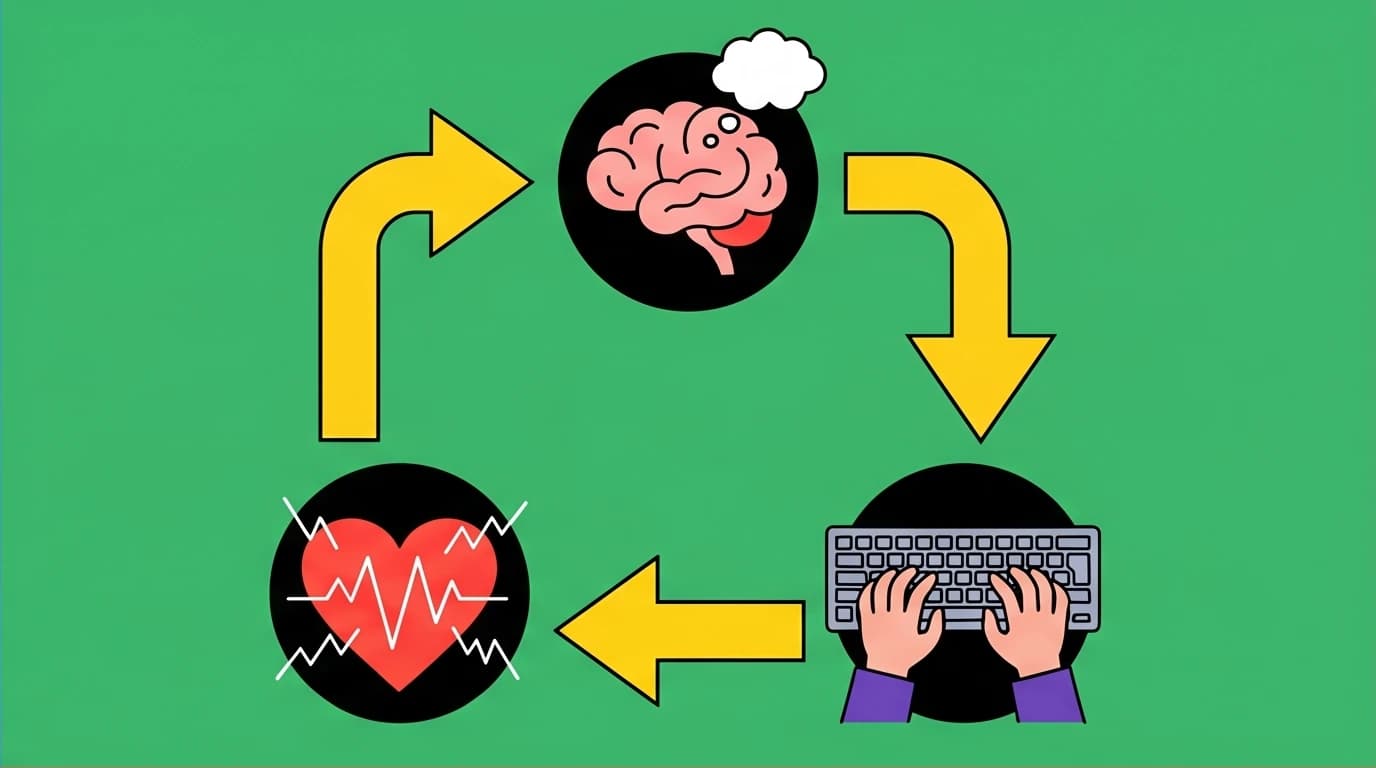
When you feel anxious, it is rarely the actual event causing the anxiety. It is the story you are telling yourself about the event. DIY cognitive behavioral therapy focuses on intercepting that story before it turns into a physical panic response.
Think of your brain as an overprotective bodyguard. Its job is to keep you safe, which means it constantly scans for threats. When it cannot find a physical threat—like a bear in the woods—it latches onto modern threats: a vague email, a missed deadline, or an awkward conversation.
The goal is not to stop thinking completely or to force toxic positivity. The goal is accurate thinking. If it is 30 degrees Fahrenheit outside, putting on a t-shirt and telling yourself "I feel warm" is delusional. CBT is about recognizing it is freezing and choosing to put on a coat.
This guide focuses on the practical "how-to," but understanding the science behind this approach can build your confidence in the process. For a deeper look at the core principles and proven benefits of this therapy:
If you are fascinated by the mechanics of how your thoughts directly dictate your physical anxiety, you might want to explore the foundational texts of this therapy approach. Cognitive behavioral therapy is not just a modern internet trend; it is backed by decades of clinical psychiatric research. For a deep dive into how to systematically untangle the distorted stories your brain tells you, Dr. David Burns's groundbreaking work is widely considered the gold standard for anyone looking to master their mental state without a prescription.

Feeling Good
David D. Burns, M.D.
 41 Duration
 9 Key Points
 4.6 Rate
Reading deep-dive books like this is an excellent way to master the principles of CBT, but finding the time for dense material can feel like a challenge on its own.


LeapAhead

Absorb the core ideas from bestselling psychology books in just 15 minutes, making it easier to learn and apply new mental models on a busy schedule.
Changing Negative Thought Patterns: The 3-Step Protocol
To change the way you feel, you must change the way you interpret data. Whenever you feel that sudden chest tightness or brain fog, execute this three-step protocol.
1. Catch It (Identify the Automatic Thought)
Anxious thoughts are fast. They happen in milliseconds. Your first job is to slow the process down and identify the exact thought making you panic. Write it down or state it out loud.
Example: "If I don't finish this project perfectly by 5 PM, my career is over."
2. Check It (Act Like a Lawyer)
Put your thought on trial. Divorce yourself from the emotion and look strictly at the evidence. Do not use feelings as facts. Ask yourself:
- What is the hard evidence supporting this thought?
- What is the hard evidence against it?
- If my best friend had this exact thought, what would I tell them?
3. Change It (Draft the Reframe)
Now, rewrite the thought to reflect reality. It does not need to be relentlessly optimistic; it just needs to be true.
Reframe: "I am stressed about this 5 PM deadline. If I miss it, my boss will be annoyed, but I have a strong track record and one late project will not end my career. I will do my best and communicate my progress."
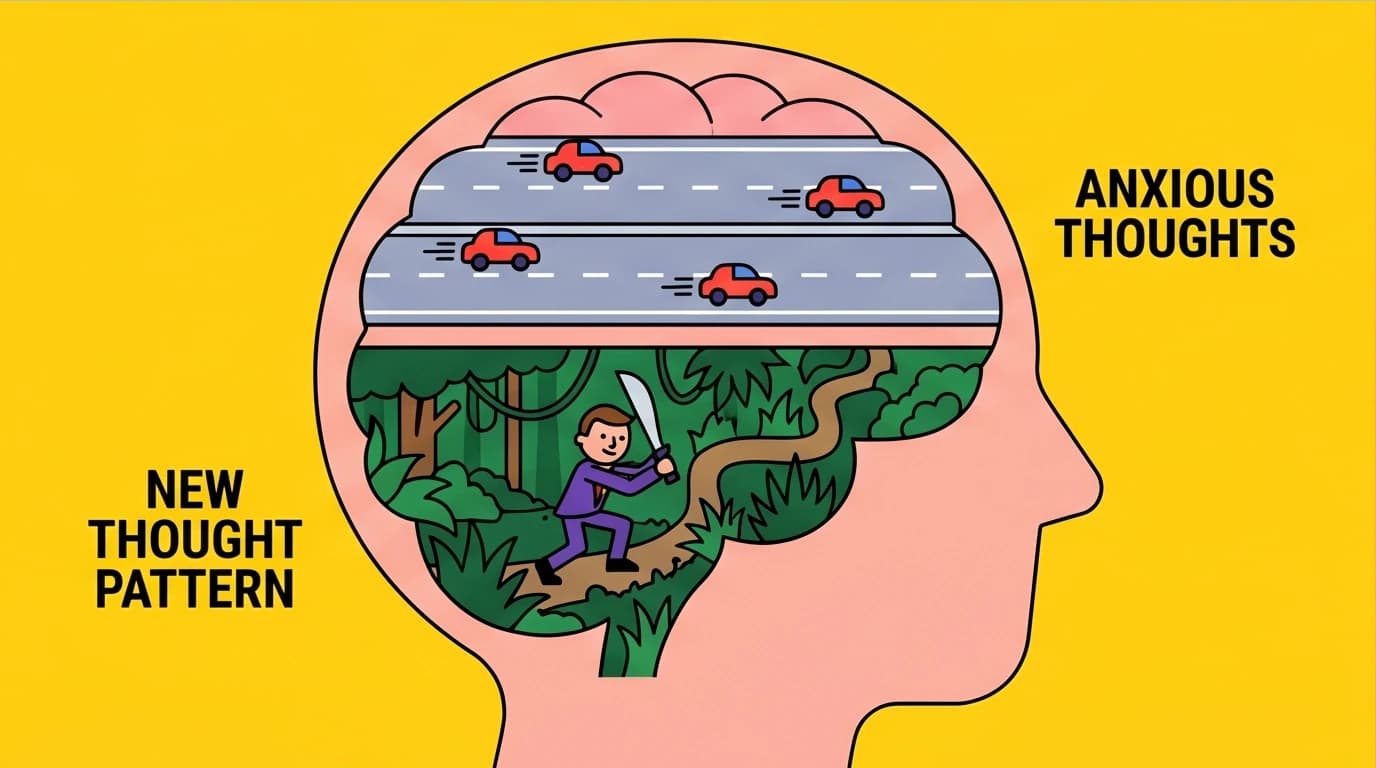
Changing negative thought patterns requires repetition. Your brain has spent years paving a fast, six-lane highway for anxiety. Reframing is like chopping a new path through the jungle with a machete. It takes effort at first, but with daily use, it becomes the default route.
Building Your Daily CBT Habits
You are busy. You do not have hours to spend analyzing your childhood. Integrating these tools requires habit stacking—attaching new behaviors to things you already do every day. Here is how to structure daily CBT habits from morning to night.
Relying on sheer willpower to implement these new mental routines is a losing battle. The secret to making your cognitive behavioral therapy stick is "habit stacking"—the process of linking a new behavior to an established daily routine, like brewing your morning coffee or driving down the interstate. If you struggle to maintain consistency with new self-care routines, mastering the psychology of habit formation is your next logical step. Learning how to make tiny, incremental changes can completely transform how your brain processes anxiety on autopilot.

Atomic Habits
James Clear
26 Duration8 Key Points4.7 RateUnderstanding the mechanics of habit formation is a game-changer, but it's another thing to find the time to read up on it.
LeapAhead
Turn your learning goals into an effortless daily habit by listening to key insights from books like 'Atomic Habits' during your commute or gym time.
Morning: The "Brain Drain" (5 Minutes)
Anxiety often peaks in the morning because your cortisol levels naturally spike to wake you up. Instead of immediately checking your phone and triggering an adrenaline rush, take five minutes for a preemptive strike.
- Action: Grab a notebook or open the Notes app on your phone. Write down the top three things making you anxious about the day ahead.
- The CBT Application: Next to each worry, categorize it as either "In My Control" or "Out of My Control." If you are anxious about sitting in traffic on the interstate for 10 miles, that is out of your control. Your only job is to pick an audiobook on Audible to pass the time. If you are anxious about an upcoming presentation, that is in your control. Your action item is to review your slides for ten minutes.
Midday: The "Pause and Fact-Check" (90 Seconds)
Managing everyday stress with CBT happens in the trenches. This is when the emails are flying, the meetings are running long, and the pressure is on.
- Action: Set a recurring alarm on your phone for 1:00 PM. When it goes off, do a quick physical and mental scan.
- The CBT Application: Are your shoulders up by your ears? Is your breathing shallow? Ask yourself: What is my current dominant thought? If it is a cognitive distortion—like "I have too much to do, I am going to fail"—pause. Take a breath. Reframe it: "I have a lot on my plate. I will prioritize the top two tasks and let the rest wait. Panicking does not finish the work faster."
Evening: The "Reality Audit" (5 Minutes)
Anxious brains love to ruminate on past mistakes when the head hits the pillow. You replay that one awkward sentence you said in a meeting on an endless loop.
- Action: Keep a notebook on your nightstand. Before you go to sleep, write down one negative thought you had today and fact-check it.
- The CBT Application: Write down the worst thing you imagined happening today. Did it happen? Almost certainly not. By forcing your brain to acknowledge that its disastrous predictions were wrong, you train it to be less reactive tomorrow.
Nighttime rumination is one of the most common hurdles for anyone battling an anxious mind. When the distractions of the workday fade, your brain suddenly has a quiet stage to perform its worst-case scenarios. If your mental spirals tend to hijack your sleep schedule despite your best efforts to fact-check them, you may need targeted strategies to hit the brakes on a racing mind. Gaining a few extra techniques to neutralize nighttime anxiety and stop the exhausting cycle of over-analysis can be an absolute game-changer for your sleep hygiene.
Stop Overthinking
Nick Trenton
50 Duration9 Key Points4.5 RateCommon Cognitive Distortions to Watch Out For
To defeat anxiety, you must know the enemy's playbook. Your brain uses specific "cognitive distortions"—mental filters that warp reality. Learn to spot these daily.
Catastrophizing
This is taking a minor inconvenience and instantly projecting the worst possible outcome.
- The Trap: You feel a headache coming on, and suddenly you are convinced you have a rare, incurable disease. You get a flat tire and assume you will lose your job because you are late.
- The Fix: Ask yourself, "What is the most realistic outcome?" Most situations are a 2 out of 10 on the disaster scale, not a 10.

All-or-Nothing Thinking
Seeing things strictly in black and white.
- The Trap: If you eat one donut while on a diet, you tell yourself you are a complete failure and might as well eat the whole box. If you get a B on an exam, you consider yourself a terrible student.
- The Fix: Look for the gray area. Remind yourself that progress is a spectrum, and one misstep does not erase all previous success.
Mind Reading
Assuming you know what other people are thinking about you, usually assuming the worst.
- The Trap: You wave to a coworker in the Starbucks line. They do not wave back. You immediately assume they hate you and are angry with you.
- The Fix: Demand evidence. The reality is they probably just didn't have their contacts in, or they were distracted thinking about their own stress. Unless someone tells you they are upset, do not do their talking for them.
Real-World Applications: Managing Everyday Stress with CBT
Theory is great, but application is what changes your life. Here is how to use these tactics in specific, high-stress scenarios.
Scenario 1: The Massive To-Do List
You sit at your desk, look at a list of 15 urgent tasks, and freeze. The anxiety is paralyzing.
You sit at your desk, look at a list of 15 urgent tasks, and freeze. The anxiety is paralyzing.
- The CBT Move: Recognize the distortion (Overgeneralization). Your brain is viewing 15 tasks as one giant, impossible boulder. Break it down. Tell yourself: "I cannot do 15 things at once. I can only do one thing." Pick the smallest task, complete it, and build momentum.
Scenario 2: Social Anxiety at a Networking Event
You walk into a crowded room to network. Your brain screams, "Everyone here is more successful than me. I look foolish."
You walk into a crowded room to network. Your brain screams, "Everyone here is more successful than me. I look foolish."
- The CBT Move: Catch the "Mind Reading" distortion. You have zero evidence that anyone in the room is judging you. In fact, most people are entirely focused on their own insecurities. Reframe: "Everyone here is just a person trying to make connections. I have valuable insights to share. I will focus on asking good questions."
Social settings are a major trigger for many people. If this scenario resonates with you, exploring targeted strategies for this specific challenge can be particularly helpful.
Scenario 3: Financial Anxiety
You get an alert from your bank or look at your Amazon order history and feel a wave of dread about your budget.
You get an alert from your bank or look at your Amazon order history and feel a wave of dread about your budget.
- The CBT Move: Stop catastrophizing about living on the streets. Ground yourself in numbers. Pull up your spreadsheet. Facing the actual math is always less terrifying than the vague, impending sense of doom your anxiety creates.
Crucial Pitfalls to Avoid
As you integrate these practices, watch out for these common stumbling blocks.
Do not aim for perfection. You will still have anxious days. You will still occasionally spiral. The goal of CBT is not to eliminate anxiety forever; the goal is to reduce the duration and intensity of the spiral. A fast recovery is a victory.
Avoid toxic positivity. Do not replace "My life is a disaster" with "Everything is perfectly awesome!" Your brain knows when you are lying to it, and it will reject the reframe. Replace negative lies with neutral truths. "This situation is difficult, but I have the resources to handle it" is a much stronger reframe.
Write it down. In the beginning, you cannot do this entirely in your head. An anxious brain is a chaotic place. Forcing your thoughts onto a piece of paper or a digital screen slows them down and strips them of their power. You can browse Barnes & Noble for fancy journals, but a 99-cent notebook works just as well. Just get the thoughts out of your head.
Once you master the daily habits in this guide, you might be ready to expand your mental toolkit. The 3-step protocol is just the beginning of what CBT has to offer.
Consistency is your ultimate weapon. Changing how your brain processes fear is exactly like building muscle in the gym. Doing one set of push-ups will not change your physique, and challenging one negative thought will not cure your anxiety. But by committing to daily CBT habits, you gradually rewire your neural pathways. You build a mental armor that protects your peace, focus, and energy, no matter what the day throws at you.
Rewiring your neural pathways through daily practice is not always glamorous, but it is the most effective way to build lasting emotional resilience. Taking radical responsibility for your mental health requires showing up for yourself every single day, even when the thought-check process feels tedious. If you are ready to take this DIY approach to the next level and truly commit to reparenting your anxious mind, there are incredible resources designed to guide you through the heavy lifting of self-healing and personal transformation.
How to Do the Work
Dr. Nicole LePera
47 Duration10 Key Points4.6 RateFAQ
How long does it take to see results from daily CBT habits?
Most people begin to notice a decrease in the intensity of their daily anxiety within two to four weeks of consistent practice. It takes time to physically rewire the neural pathways in your brain. Consistency is far more important than intensity; five minutes a day every day is better than one hour a week.
Most people begin to notice a decrease in the intensity of their daily anxiety within two to four weeks of consistent practice. It takes time to physically rewire the neural pathways in your brain. Consistency is far more important than intensity; five minutes a day every day is better than one hour a week.
Do I have to write my thoughts down, or can I do it in my head?
When you first start out, you must write them down. Anxiety thrives in the abstract, chaotic space of your mind. Writing forces you to articulate the fear, which instantly grounds it in logic. Once you have practiced the "Catch, Check, Change" method for a few months, you will naturally start doing it in your head automatically.
When you first start out, you must write them down. Anxiety thrives in the abstract, chaotic space of your mind. Writing forces you to articulate the fear, which instantly grounds it in logic. Once you have practiced the "Catch, Check, Change" method for a few months, you will naturally start doing it in your head automatically.
Can DIY CBT replace a real therapist?
DIY CBT is highly effective for managing everyday stress, mild to moderate anxiety, and general negative thought patterns. However, it is not a replacement for professional help if you are dealing with severe trauma, clinical depression, or crippling panic attacks. Think of daily CBT habits like brushing your teeth, while a therapist is the dentist you see for deeper work.
DIY CBT is highly effective for managing everyday stress, mild to moderate anxiety, and general negative thought patterns. However, it is not a replacement for professional help if you are dealing with severe trauma, clinical depression, or crippling panic attacks. Think of daily CBT habits like brushing your teeth, while a therapist is the dentist you see for deeper work.
What if my anxious thoughts are actually true?
Sometimes, the worst-case scenario does happen. If your anxiety is based on a verified fact (e.g., your company is doing layoffs, or you failed a class), CBT shifts from reframing the event to reframing your ability to cope. Instead of saying "I will never recover," the CBT reframe becomes: "This is a highly difficult situation, but I have overcome hard things before, and I will create a step-by-step plan to navigate this."
Sometimes, the worst-case scenario does happen. If your anxiety is based on a verified fact (e.g., your company is doing layoffs, or you failed a class), CBT shifts from reframing the event to reframing your ability to cope. Instead of saying "I will never recover," the CBT reframe becomes: "This is a highly difficult situation, but I have overcome hard things before, and I will create a step-by-step plan to navigate this."