

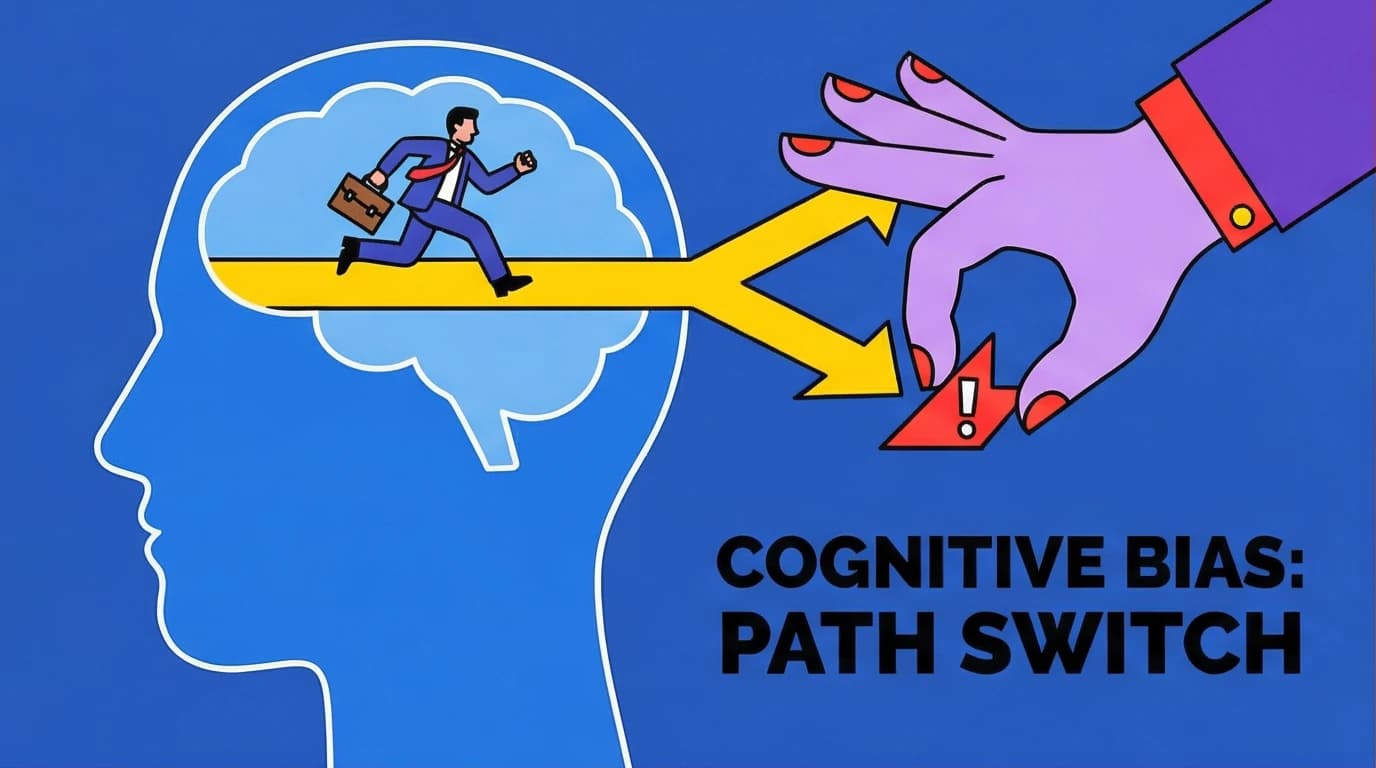
You review a project post-mortem and realize the team drastically underestimated the timeline—again. You make a hiring decision based on a stellar 15-minute chat, only to find yourself managing a poor performer six months later. You approve a marketing budget for a failing campaign just because you already spent $50,000 on it.
These are not strings of bad luck. They are predictable, systemic errors hardwired into human psychology.
Daniel Kahneman’s groundbreaking work exposes the hidden flaws in how we process information. To fix your decision-making process, you do not need to become a behavioral economist. You simply need to recognize the specific traps your brain sets for you and build guardrails to avoid them.
The Core Mechanism: Two Systems at War
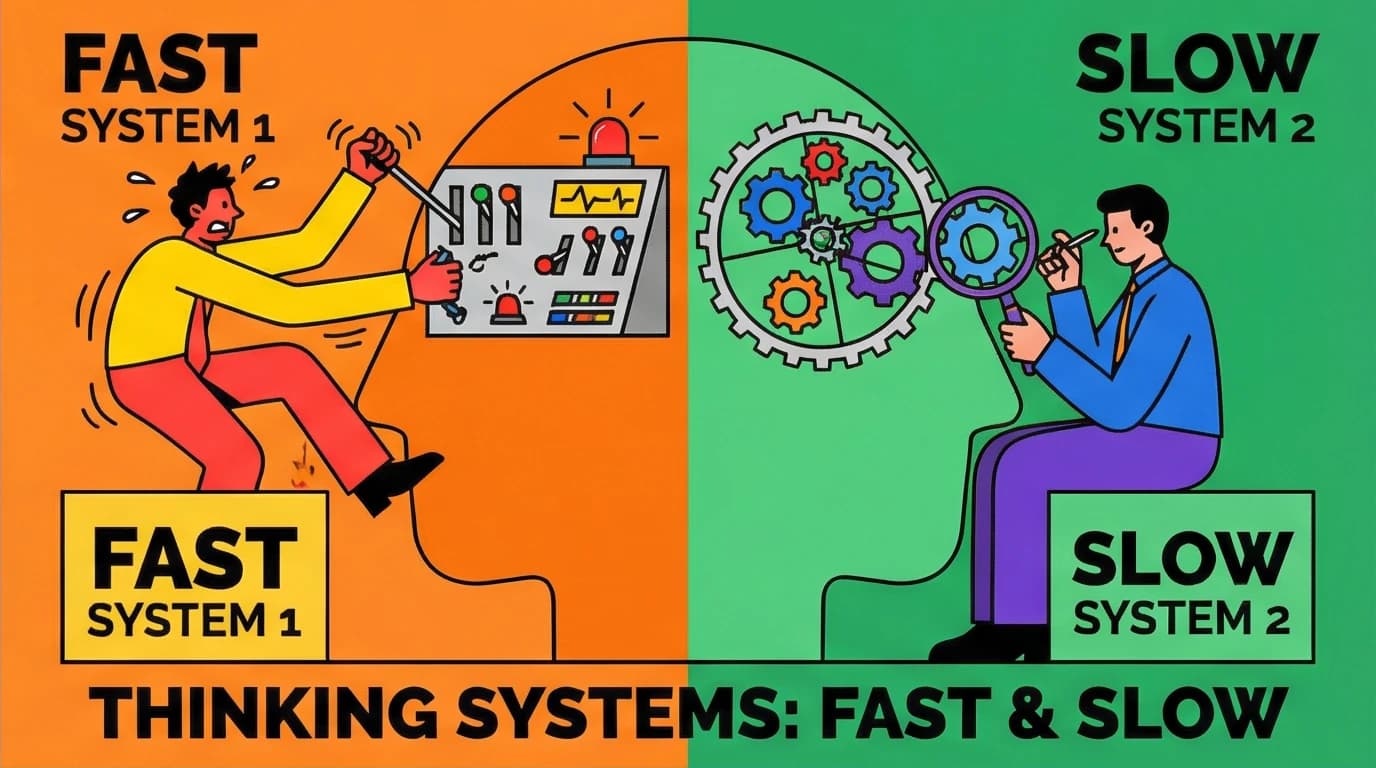
Before diving into specific flaws, you must understand the machinery of your mind. Kahneman divides the brain into two operating systems:
- System 1: Fast, automatic, emotional, and intuitive. It requires zero effort. It reads facial expressions, drives your car on an empty highway, and forms instant first impressions.
- System 2: Slow, deliberate, logical, and lazy. It requires intense focus. It calculates complex math, fills out tax forms, and evaluates data spreadsheets.
The problem? We think we are using System 2 to make business decisions, but we are actually letting System 1 run the show. System 1 relies on heuristics—mental shortcuts that save time but sacrifice accuracy.
While looking for a complete list of biases in Thinking Fast and Slow can feel overwhelming, professionals only need to master the few that cause the most damage in the workplace.
If you want to dive deeper into the exact mechanics behind System 1 and System 2, there is no better starting point than the foundational text itself. Daniel Kahneman's Nobel Prize-winning work explores these dual operating systems in incredible detail. By unpacking decades of fascinating psychological experiments, the book offers practical insights and real-world business applications that will permanently change how you view your own thoughts and everyday decisions.
Thinking, Fast and Slow
Daniel Kahneman
 53 Duration
 9 Key Points
 4.5 Rate
And if a deep dive into a 500-page book on psychology feels like too much of a commitment right now, you can still absorb the essential lessons from these influential thinkers.


Grasp the key insights from complex books like Thinking, Fast and Slow in just 15 minutes, making it easier to apply powerful concepts without the heavy reading.
 LeapAhead
High-Stakes Heuristics and Biases Examples
Here are the most destructive cognitive biases that hijack your logic, complete with everyday business examples and actionable fixes.
1. The Anchoring Effect
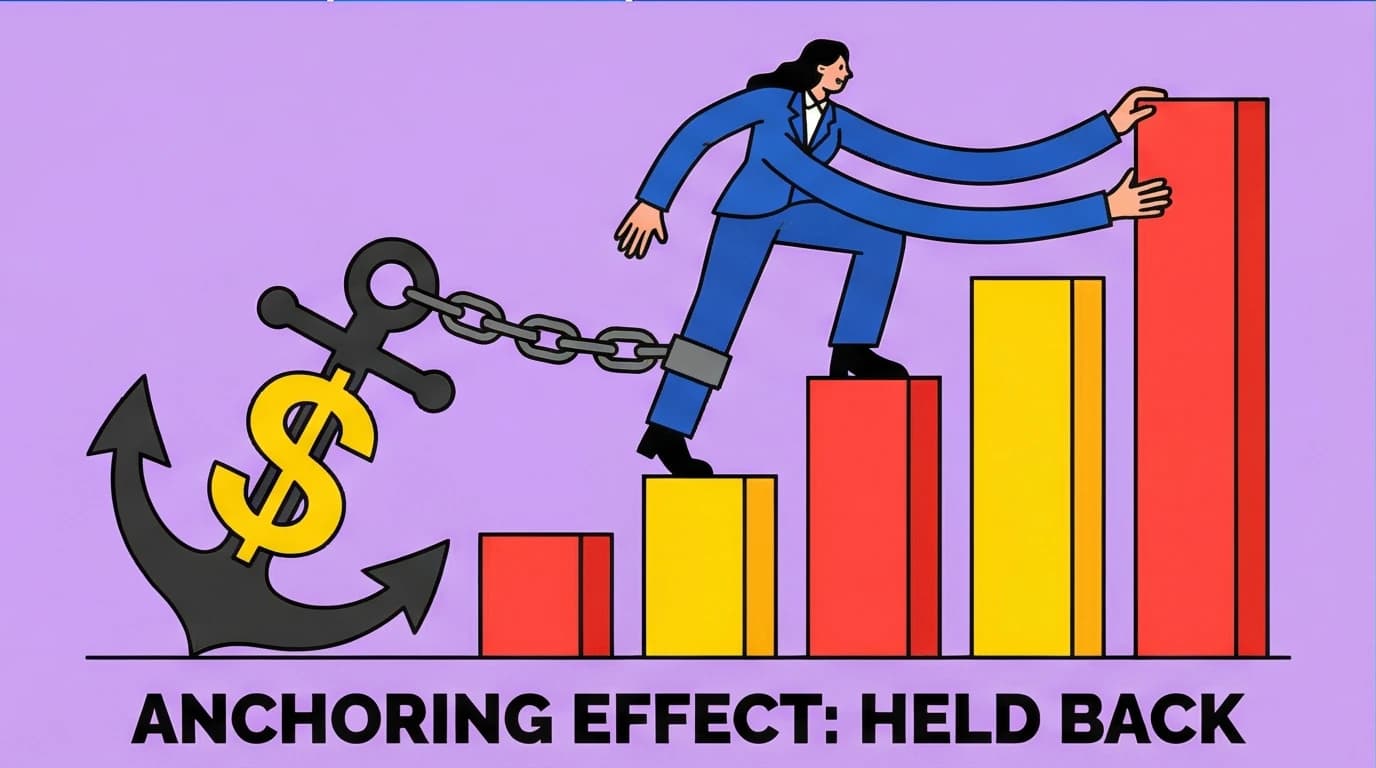
Your brain latches onto the very first piece of information it receives (the "anchor") and uses it as a reference point for all future judgments, even if that information is completely irrelevant.
The anchoring effect Kahneman describes is incredibly potent in negotiations and pricing. If you are buying a used car and the seller starts with a ridiculously high price, your brain is now anchored to that high number. Even if you negotiate them down, you end up paying more than the car's actual value because the starting point was skewed.
- Workplace Example: During salary negotiations, a candidate casually mentions they are hoping for $120,000. Even if your budget was strictly $90,000, that $120,000 anchor distorts your perception. Suddenly, offering $100,000 feels like a massive compromise, and you overpay.
- The Fix: Set the anchor yourself. If you are entering a negotiation, research objective market data beforehand. If the other party drops an extreme anchor, do not counter it immediately. Call it out, reject the premise entirely, and reset the conversation using your own verified data points.
To see exactly how these mental shortcuts—like the anchoring effect—influence pricing, consumer behavior, and our daily choices, it helps to look at behavioral economics as a whole. Dan Ariely’s fascinating exploration into the hidden forces that shape our decisions proves that our irrational mistakes aren't just random; they are entirely systematic and predictable. Understanding this concept can give you a massive edge in any salary negotiation, marketing campaign, or sales strategy.

Predictably Irrational
Dan Ariely
23 Duration10 Key Points4.6 Rate2. The Availability Heuristic
We judge the probability or importance of an event based on how easily an example comes to mind. If a memory is vivid, emotional, or recent, System 1 assumes it is a common occurrence.
- Workplace Example: It is time for annual performance reviews. An employee made a high-profile mistake last week. Because that mistake is fresh and easily available in the manager's memory, the manager gives the employee a poor rating, completely ignoring eleven months of outstanding, error-free work.
- The Fix: Stop relying on memory. Implement structured tracking. Keep a running log of both wins and losses for your team throughout the year. When making decisions, force System 2 to look at the aggregated data rather than relying on whatever pops into your head first.
3. Confirmation Bias & The Halo Effect
We actively seek out information that confirms our existing beliefs and aggressively ignore or dismiss data that contradicts them. Paired with the Halo Effect—where one positive trait of a person influences our overall judgment of them—this bias destroys objective evaluation.
- Workplace Example: You notice a job applicant graduated from your alma mater. System 1 immediately decides "this is a smart, capable person." During the interview, you unconsciously ask easy, softball questions to confirm your belief. You ignore red flags in their résumé because your brain has already decided they are a great fit.
- The Fix: Standardize your evaluations. Use structured interviews where every single candidate is asked the exact same questions in the exact same order. Score their answers on a standardized rubric before discussing them with your team.
4. The Planning Fallacy & Optimism Bias
We consistently underestimate the time, costs, and risks of future actions while overestimating the benefits. We assume our specific project will go perfectly, ignoring historical data of similar projects that faced delays.
- Workplace Example: Your IT team plans to migrate company data to a new server. They estimate it will take three weekends. Six months later, the project is still draining resources. They planned for the best-case scenario, failing to account for bugs, sick days, and inevitable vendor delays.
- The Fix: Use "Reference Class Forecasting." Look entirely outside your current project. How long did the last three similar migrations actually take? What did they cost? Base your baseline estimates on historical reality, not optimistic projections.
5. Sunk Cost Fallacy & Loss Aversion
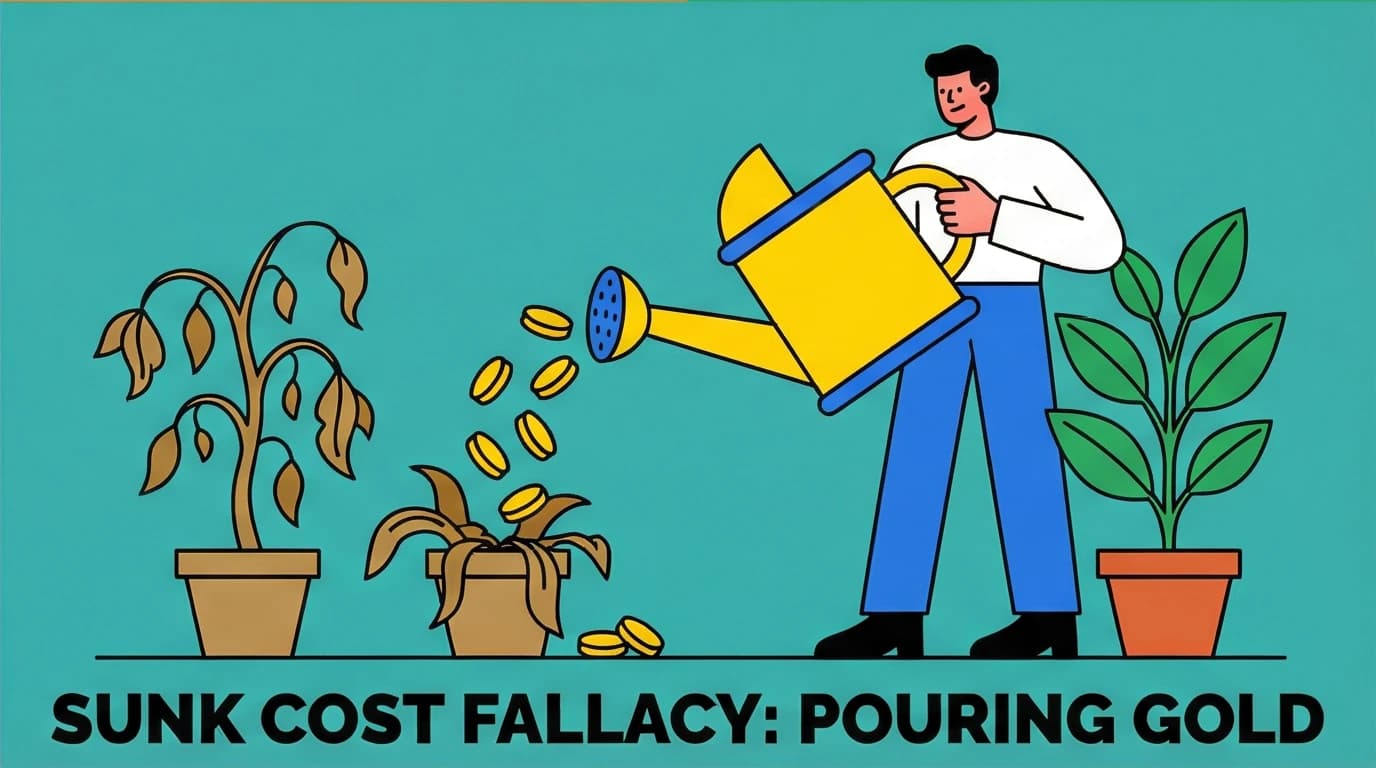
Kahneman’s research shows that human beings hate losing twice as much as they enjoy winning (Loss Aversion). Because of this, we often refuse to abandon a failing course of action simply because we have already invested time, money, or ego into it (Sunk Cost).
- Workplace Example: You launch a new product on Amazon. The reviews are terrible, and the return rate is massive. Instead of pulling the product, you pour another $20,000 into advertising, hoping to turn it around simply because you spent a year developing it.
- The Fix: Apply the "Clean Slate" test. Stop looking at what you have already spent—that money is gone. Ask yourself: "If I were starting from scratch today, with zero money invested, would I choose to fund this project based on its current performance?" If the answer is no, kill the project immediately.
Letting go of a sunk cost is emotionally painful because our brains are hardwired for loss aversion. If you struggle to cut your losses and make objective choices when the stakes are high, reframing your decisions as wagers can be a game-changer. Former professional poker champion Annie Duke provides a brilliant framework for embracing uncertainty. Her insights will teach you how to detach your ego from past outcomes and make smarter probabilistic bets in unpredictable business environments.
Thinking in Bets
Annie Duke
36 Duration8 Key Points4.6 RateHow to Overcome Cognitive Bias in Your Organization
Knowing these biases exist is not enough to stop them. System 1 operates faster than your conscious awareness. You cannot simply "think harder" to beat it.
If you want to know how to overcome cognitive bias, you must change your environment. You have to build systems that force System 2 to wake up and take the wheel.
1. Conduct a Pre-Mortem
Before launching a major initiative, gather your team and run a pre-mortem. Tell them: "Imagine it is one year from today. This project has failed spectacularly. Take 10 minutes and write down exactly why it failed."
This exercise completely bypasses optimism bias. It gives people psychological safety to voice doubts and forces System 2 to identify blind spots before a single dollar is spent.
Before launching a major initiative, gather your team and run a pre-mortem. Tell them: "Imagine it is one year from today. This project has failed spectacularly. Take 10 minutes and write down exactly why it failed."
This exercise completely bypasses optimism bias. It gives people psychological safety to voice doubts and forces System 2 to identify blind spots before a single dollar is spent.
2. Appoint a Devil’s Advocate
Confirmation bias turns meetings into echo chambers. To break this, assign one person the explicit role of the "Devil’s Advocate." Their only job during the meeting is to find flaws in the proposed plan, poke holes in the data, and argue the opposite side. When criticism is a designated role, it removes the personal friction from disagreeing with the boss.
Confirmation bias turns meetings into echo chambers. To break this, assign one person the explicit role of the "Devil’s Advocate." Their only job during the meeting is to find flaws in the proposed plan, poke holes in the data, and argue the opposite side. When criticism is a designated role, it removes the personal friction from disagreeing with the boss.
3. Use Checklists
Pilots use checklists before every flight, no matter how many hours they have logged. Doctors use checklists before surgery. Professionals should use them for high-stakes decisions. A simple checklist (e.g., Did we check historical data? Are we anchored to a random number? Are we ignoring negative feedback?) forces you to pause. That brief pause is all System 2 needs to step in and prevent a disaster.
Pilots use checklists before every flight, no matter how many hours they have logged. Doctors use checklists before surgery. Professionals should use them for high-stakes decisions. A simple checklist (e.g., Did we check historical data? Are we anchored to a random number? Are we ignoring negative feedback?) forces you to pause. That brief pause is all System 2 needs to step in and prevent a disaster.
4. Widen Your Options
A common trap is binary thinking: "Should we fire this vendor or keep them?" This limits your perspective. Force yourself to find a third option. "Could we keep them for minor tasks and hire a new vendor for the critical work?" Expanding your choices disrupts automatic decision-making and demands analytical thinking.
A common trap is binary thinking: "Should we fire this vendor or keep them?" This limits your perspective. Force yourself to find a third option. "Could we keep them for minor tasks and hire a new vendor for the critical work?" Expanding your choices disrupts automatic decision-making and demands analytical thinking.
We often assume that avoiding simple errors requires massive intelligence or expensive software, but sometimes the most effective tool is a simple piece of paper. As highlighted earlier, implementing checklists forces your brain's deliberate System 2 to pause and take charge. To truly understand how this humble tool can prevent catastrophic failures, streamline operations, and boost efficiency in highly complex, high-pressure environments, consider exploring Atul Gawande's renowned research on the subject.

The Checklist Manifesto
Atul Gawande
22 Duration10 Key Points4.6 RateBuilding a toolkit of mental models from books like these is the ultimate way to combat bias. But finding the time to read them all can be a challenge for any busy professional.
Stay sharp on behavioral economics and decision-making by listening to key takeaways from bestselling business books during your commute or lunch break.
LeapAheadFAQ
What is the difference between System 1 and System 2 thinking?
System 1 is your brain's autopilot—it is fast, automatic, emotional, and requires no effort. System 2 is your brain's manual override—it is slow, deliberate, logical, and requires intense focus. Biases occur when we rely on System 1 for complex decisions that actually require System 2.
System 1 is your brain's autopilot—it is fast, automatic, emotional, and requires no effort. System 2 is your brain's manual override—it is slow, deliberate, logical, and requires intense focus. Biases occur when we rely on System 1 for complex decisions that actually require System 2.
Can I completely eliminate my own cognitive biases?
No. System 1 is a permanent, hardwired part of human biology. You cannot shut it off. However, you can learn to recognize the situations where biases are most likely to occur (high stakes, tight deadlines, high stress) and rely on external processes—like checklists and structured data—to mitigate their impact.
No. System 1 is a permanent, hardwired part of human biology. You cannot shut it off. However, you can learn to recognize the situations where biases are most likely to occur (high stakes, tight deadlines, high stress) and rely on external processes—like checklists and structured data—to mitigate their impact.
Are heuristics always a bad thing?
Not at all. Heuristics are essential for survival. If you see a car speeding toward you, System 1 instantly tells you to jump out of the way. You don't need System 2 to calculate the vehicle's mass and speed in miles per hour. Heuristics only become dangerous when applied to complex financial, strategic, or interpersonal decisions.
Not at all. Heuristics are essential for survival. If you see a car speeding toward you, System 1 instantly tells you to jump out of the way. You don't need System 2 to calculate the vehicle's mass and speed in miles per hour. Heuristics only become dangerous when applied to complex financial, strategic, or interpersonal decisions.
What is the most common bias in daily management?
Confirmation bias is universally prevalent. Managers often make a gut decision about a strategy or a person within seconds, and then spend the next six months looking for data to prove they were right, ignoring all evidence to the contrary. Overcoming this requires actively seeking out dissenting opinions.
Confirmation bias is universally prevalent. Managers often make a gut decision about a strategy or a person within seconds, and then spend the next six months looking for data to prove they were right, ignoring all evidence to the contrary. Overcoming this requires actively seeking out dissenting opinions.